Reconsidering “Lincoln,” Lincoln…And Trump

I’ve been reading a lot about Abraham Lincoln of late. A book by William Hanchett called “The Lincoln Murder Conspiracies” reminded me that while President Jackson is the closest historical match for the populist, outsider aspect of Donald Trump’s rise, the startlingly close match for the antipathy and hatred Trump has faced from the moment of his election eerily traces the experience of Abraham Lincoln.

Like Trump a minority President, Abe won only 39.8% of the popular vote but was still comfortably elected by the Electoral College. As with Trump, his opposition refused to give him a chance to govern or unify the nation, although in his case, the Democrats divided the country literally, seceding from the union before Lincoln took the oath of office. Today’s Democrats are without that option (thanks to Lincoln!), but are doing everything else in their power to undermine the elected leader. (And California, the most Democratic state, is saber-rattling about seceding.) Also like Trump, Lincoln did not concede that his lack of a popular vote majority in any way robbed him of a mandate to govern.

From the moment the election results were known, many Democrats proclaimed the election of Lincoln itself to be an act of aggression, a “declaration of war.” Many in Lincoln’s own party—even his own Attorney General—accused him, with some justification, of engaging unconstitutional measures. The Governor of New York evoked the Revolutionary War generation, saying that they would not stand for such incursions on their rights. Constitutional expert George Ticknor Curtis of Massachusetts predicted that the Lincoln Presidency would “be an end to this experiment in self-government.”

Meanwhile, pundits and critics heaped personal abuse on Lincoln, calling him grotesque, a barbarian, ” gorilla.” Diarist George Templeton Strong, whose words are so often quoted by Ken Burns in his documentary about the Civil War, called him a “yahoo.” It was said that fashionable New Yorkers would be ashamed to be seen in the presence of someone as boorish and uncultured as Lincoln;  it was rumored that he rejected handkerchiefs and “blew his nose through his thumb and forefingers, frontier-style.” As late as 1864, a New York editor wrote,

“[The President] is an uneducated boor. He  is brutal in all his habits and in all his ways. He is filthy. He is obscene. He is vicious.”

Somehow, despite this cruel barrage of ad hominem rhetoric, arguably more successful then that it would be now since the public has more knowledge of the President and can make their own observations, Lincoln persevered to meet the greatest challenges any President ever faced.

While still pondering some of the parallels with today’s relentless attacks on our current President, I watched again the 2012 Stephen Spielberg-directed film “Lincoln,” which was almost unanimously praised when it was released, and which I enjoyed a great deal when I first saw it. This time, however, “Lincoln” revealed itself as an ethics corrupter. Continue reading

The Comey Testimony, Part II

[Part I is here]

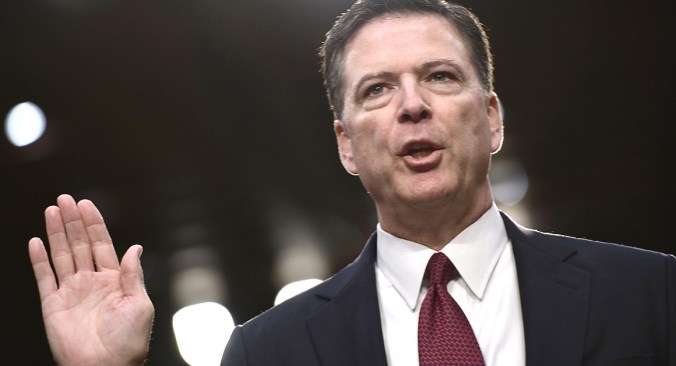
Now let’s look at some direct quotes from James Comey’s testimony: 

1. “Even though I was appointed to a ten-year term, which congress created in order to underscore the importance of the FBI being outside of politics and independent, I understood that I could be fired by a president for any reason or for no reason at all. And on May 9th, when I learned I had been fired for that reason, I immediately came home as a private citizen. But then the explanations, the shifting explanations, confused me and increasingly concerned me. They confused me because the president that I had had multiple conversations about my job, both before and after he took office, and he had repeatedly told me I was doing a great job and he hoped I would stay. And I had repeatedly assured him that I did intend to stay and serve out the remaining six years of my term. He told me repeatedly that he had talked to lots of people about me. Including our current attorney general. And had learned I was doing a great job. And that I was extremely well-liked by the FBI work force. So it confused me when I saw on television the president saying that he actually fired me because of the Russia investigation. And learned, again, from the media that he was telling privately other parties that my firing had relieved great pressure on the Russian investigation. I was also confused by the initial explanation that was offered publicly, that I was fired because of the decisions I had made during the election year. That didn’t make sense to me for a whole bunch of reasons, including the time and all the water that had gone under the bridge since those hard decisions had to be made. That didn’t make any sense to me. And although the law required no reason at all to fire an FBI director, the administration then chose to defame me and more importantly the FBI by saying that the organization was in disarray. That it was poorly led. That the workforce had lost confidence In its leader. Those were lies, plain and simple. And I am so sorry that the FBI workforce had to hear them and I’m so sorry the American people were told them. I worked every day at the FBI to help make that great organization better. As a help, because I did nothing alone at the FBI. There are no indispensable people at the FBI. The organization’s great strength is that its value and abilities run deep and wide. The FBI will be fine without me. The FBI’s mission will be relentlessly pursued by its people and that mission is to protect the American people and uphold the constitution of the United States. I will deeply miss being part of that mission, but this organization and its mission will go on long beyond me and long beyond any particular administration. I have a message before I close for the — for my former colleagues of the FBI. First I want the American people to know this truth. The FBI is honest. The FBI is strong. And the FBI is and always will be independent. And now to my former colleagues, If I may, I am so sorry I didn’t get the chance to say good bye to you properly. It was the honor of my life to serve beside you, to be part of the FBI family and I will miss it for the rest of my life. Thank you for standing watch, thank you for doing so much good for this country. Do that good as long as ever you can. And senators, I look forward to your questions.”

Observations: This entire statement is unworthy of the emphasis that has been placed on it by the wildly spinning news media, The key piece of information to frame the entire episode is  “I understood that I could be fired by a president for any reason or for no reason at all.” Comey also presumably understood that a sub-fact within that understanding is that he could be told some of the reasons he was fired, no reasons, or the reasons the President felt like talking about. He was told he was doing a great job and then fired? Welcome to the work force. Telling an employee that he is doing a great job when he isn’t may be good management, usually isn’t, but is still well within the range of management discretion, and certainly not illegal.

Comey said that he also concerned that the President was saying that firing “had relieved great pressure on the Russian investigation.” As we learn later, the President was not being targeted in that investigation, and we know that he regards it as a politically motivated effort to distract and derail his administration and its agenda. There was nothing sinister about the President’s desire that the investigation go away as quickly as possible. I would argue that he has an obligation to do whatever he can to speed it along. If he didn’t trust Comey’s judgment—and who would?—seeing his exit as a plus is reasonable. Naturally, Comey wouldn’t see it that way.

It is amazing to me that a fired employee saying that his superior’s assessment that his organization was in disarray, that he was a poor leader and that his staff had “lost confidence In its leader” is given any weight at all. What fired employee doesn’t think his firing is unjust and the criticism of him is unfair? Comey calls it a lie: how does he know what Trump had been told or heard? How does Comey know what his agents say behind his back?

Your opinion that someone’s negative opinion about you is wrong and based on erroneous information does not make that opinion a lie. As a lawyer, Comey should know that, and should not have thrown the word “lie” around to be misunderstood by people who don’t know what a lie is—that is, most of the public. Continue reading

Morning Ethics Warm-Up: 6/11/17

1.  Mainstream media bias has been such a frequent topic on Ethics Alarms that I hesitate to focus on it even when, against all odds, what passes for American journalism has another rotting chunk fall off.  The reaction of most of the media to the Comey testimony was a huge chunk, once again shocking me when I didn’t think my regard for this unprofessional profession could sink lower. Some commentators yesterday (they were conservative, but there is no reason a fair and objective liberal wouldn’t and shouldn’t come to the same conclusion) said that we are witnessing the birth of a mainstream media-progressive fusion political party. This is not a hysterical analysis. The New York Times coverage of the Comey hearing, for example, was so misleading and dishonest as to eliminate that paper from ever being regarded as a reliable political analyst again, at least until it cleans house and issues an abject apology to the nation. Ethics Alarms reader Greg did an excellent job detailing the Times’ disgraceful anti-Trump/pro-resistance spin in the thread on the Comey testimony post, as did journalist commenter Tippy Scales.

The Times knows its first take was untenable; you can tell by its editorial today, in which it already is changing the subject. If Comey had laid a glove on Trump (and he didn’t) regarding  impeachable conduct and a route to removing him—which was the Left’s fervent hope and the resistance’s confirmation bias-driven fantasy—the Times would have been  shaking its fist and demanding action in it Sunday pronouncement. Instead, it offered an extended whine about how Paul Ryan excused Trump’s clumsy handling of his communications with Comey by citing Trump’s inexperience, but that he had condemned President Obama for his inexperience, as if the two positions are inconsistent. First, they are not: Ryan did not support Trump’s nomination, though political inexperience was the least of his disqualifications. Second, the President’s cluelessness is directly relevant to the weaker than weak argument that he was obstructing justice by having the kinds of conversations with a subordinate that is commonplace in a business setting. The Times, as it has been doing a lot lately, simply assumes away an insuperable obstruction to its “resistance” position, , saying that “The president obviously knows that it’s wrong to interfere in an investigation.”

Like Hillary Clinton, apparent cyber-dolt,  “obviously” knew that using a private server for State Department business violated classified communications law?

The same logic that Comey himself used to give Clinton a Stay Out Of Jail pass applies to Trump’s statements to Comey, but far more reasonably. Not only was he not, as Ryan said, “steeped in the long-running protocols that establish the relationships between D.O.J., F.B.I. and White Houses,” the President  wasn’t interfering in the Flynn  investigation by telling Comey he hoped it would end, and he couldn’t interfere in the Russian investigation by firing the FBI director. The Times editorial reveals the real impetus behind the paper’s determination to bring down the President who dared to be elected by “deplorables” who don’t march to the Times’ ideological lock-step: Trump “[struts] about at the head of the party, insulting everyone and everything in sight: staff members, allies, laws, diplomatic decorum and common sense.”

Yes, for once the Times is reporting accurately, but that’s not grounds for removing an elected President, and it does not justify misrepresenting facts to create a public groundswell based on bias, hate, fear and ignorance.

2. And when it is clear that the news media and the Democrats are coordinating in an “Anti-Trump” party, what is a responsible stance for the Trump Administration regarding news organizations who wave the anti-Trump banner at the expense of fair reporting? Continue reading

Comment Of The Day (2): “Public Servant Ethics, Employment Ethics, Baseball Fan Ethics, And Senator John McCain”

The post about John McCain’s troubling performance during the Comey testimony inspired this thoughtful comment by dragin_dragon, a self-professed senior citizen (although I had no idea), on the related topic f officials knowing when age and/or infirmity create an ethical obligation to step down and retire in the interests of society. 

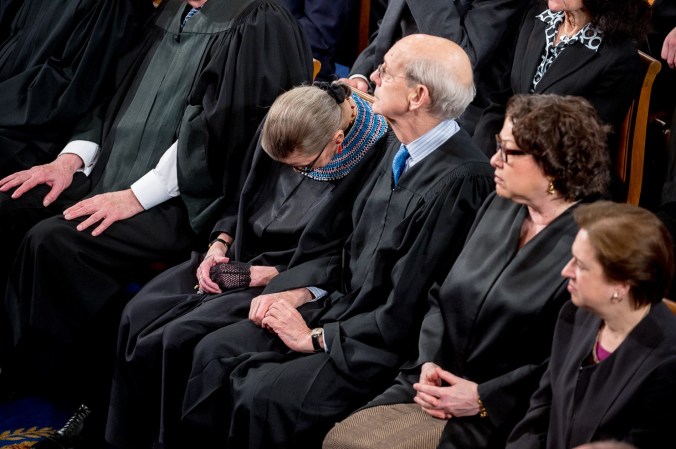
The confounding factor, and one that becomes a powerful rationalization for those who want to stay on in important positions long after their metaphorical pull-date, is that many of them can truthfully argue that their age-ravaged abilities are still better than most of the younger alternatives. Or, as my sister said during a discussion on this topic, “I’d rather have Justice Ginsberg with half her marbles than anyone Trump would nominate.”  I bet that’s how Justice Ginsberg is thinking too. Then there was that attorney with a drinking problem who everyone in the firm agreed was twice as good as any attorney in the firm when sober, and 50% better when drunk as a skunk.

Does that mean the firm should be satisfied if he’s drunk all the time? Isn’t this the same as the age diminished once-brilliant judge?

A topic for another time. Meanwhile, here is dragin_dragon’s Comment of the Day on the post, “Public Servant Ethics, Employment Ethics, Baseball Fan Ethics, And Senator John McCain”:

There comes a time in anyone’s life when it should be obvious that it is time to “Hang up the guns”. In my own life, I am but 71, and I am seeing numerous anomalies in my behavior (walking into a room and wondering why I am here) and in my rational thought (I suspect most who have read my comments sometimes have the same question). I am getting to where I lose debates to my wife on a regular basis (she’ll tell you I’ve always done that). More to the point, I am AWARE of the beginning deterioration. I am wondering if John McCain and Ruth Ginsberg are.

Another thought had occurred to me, however. After realizing that there was some slippage, I have refused an opportunity to run for Alderman and for Mayor of our little newly-incorporated city, because I honestly did not feel I would be able to do the job, either of them, justice, either mentally (what’d you say my name was again?) or physically. I’m winded some mornings after tying my shoe-laces. However, I am reasonably certain that narcissism plays little part in my personality. I suspect it is a BIG part of most elected officials (city, county, state, national) personalities. The idea being “Nobody but ME can do this job properly”, or in some cases, “Nobody but me can do this job, period, well or poorly.” Continue reading

From The “The Fish Rots From The Head Down” Files: The Uber CEO’s “Miami Letter”

You wonder why Uber has ethics problems?

This is why Uber has ethics problems.

Uber is being investigated by two law firms hired to make assessments regarding the corporate practices and culture at the ride-sharing giant, determine what created the toxic environment that led to sexism, sexual harassment, other unethical management conduct, and recommend remedial measures. Usually in such situations, the problem stems from unethical leadership. Guess what? Uber’s unethical conduct stems from not merely unethical leadership, but a leader with ethics alarms that have rotted into dust and rust.

The two law firms recently uncovered a 2013 e-mail sent to Uber’s staff by  CEO Travis Kalanick before a company outing in Miami.  Internally referred to as the “Miami letter,” this thing screams “What was he thinking?”, “Where were the lawyers?” and “This guy might get elected President of the United States!”

Here is the e-mail; I’m going to bold some important features: Continue reading

The Comey Testimony, Part I.

I have finally read the transcript, which you should do as well. By now I have also seen a lot of video clips. (James Comey really says, “Lordy!” Wow.)

First, some general observations, with more detailed comments to come in a subsequent post.

1. My earlier expressed opinion of James Comey when I defended him against conservative accusations that he was giving Hillary Clinton an undeserved break by not indicting her were revealed as too generous yesterday. I still believe he is honest and non-partisan. More than ever, I believe that he is untrustworthy. He was obviously in a difficult position—many, in fact—that he was not able to successfully manage, if anyone could have. However, his oft-repeated insistence that he (and his FBI) did not play politics was exposed as false, if not dishonest (a gracious interpretation of the sort that Comey denied the President in his bitter testimony.)

2. The fake Russia collusion narrative pushed by Hillary, Democrats and the news media to simultaneously excuse her loss and undermine the Trump Presidency was killed yesterday, but will wander around like a zombie for months if not years because Trump-haters will not have the integrity to admit they were wrong. Chris Matthews, a once astute and courageous liberal Democrat reporter who morphed into a partisan, knee-jerk progressive shill and anti-Republican scold as soon as he started getting paid by MSNBC, had a sudden flashback to his days of integrity when he pronounced yesterday,

“But the big story has always beenthe assumption of the critics of the president, of his pursuers, you might say, is that somewhere along the line in the last year, the president had something to do with colluding with the Russians. Something to do, a helping hand, encouraging them,feeding their desire, to affect the election in some way, some role they played, some conversation he had with Michael Flynn, or Paul Manafort, or somewhere. And yet what came apart this morning, was that theory, because in two regards the president said according to the written testimony of Mr. Comey, ‘go ahead and get anybody satellite to my operation and nail them, I’m with you on that,’ so that would mean Manafort, Carter Page, someone like that. And then he also came across today what was fascinating, Comey said that basically Flynn wasn’t central to the Russian investigation, that he was touching on it. That there was, of course, Flynn had an honest, we assume, wasn’t honest in his answer on the official forms that he had to fill out to become a national security head.”

But it only touched on that, it wasn’t really related to that. But he could be flipped for that, but in other words, they could flip him because they had him caught on something he dishonestly answered but he wasn’t central to the Russian thing, and I always assumed that Trump was afraid of was that he had said something to Flynn, and Flynn could be flipped on that. And Flynn would testify against the president that he had had some conversation with Flynn in terms of dealing with the Russians affirmatively. And if that’s the case, where’s the there there?”

There is no there there, and never has been. Thus the anti-Trump hysterics are left with what they have always believed was proof enough: Hillary lost, leaked hacks of e-mails that led the public to realize how sleazy the Democrats were should have never been seen by voters, Trump was the beneficiary of the leaks, he had said nice things about Putin, he’s an unethical creep, and a lot of his associates had business contacts with Russia, and besides, they just know Trump is guilty.

That’s not enough; in fact, it’s nothing at all. Matthews as both a lifetime Democrat and a romantic regarding the Presidency and democracy detests Trump to his Irish-American Boston liberal core, but he knows when to get off a bandwagon that will embarrass him if he stays on board, or make it impossible for Chris to look in the mirror.

3. For a lawyer, Comey’s loose use of the term “liar” and his stated belief that he assumed that Trump was a liar early on in their relationship shows a troubling inattentiveness to his own biases, as well as a classic misunderstanding of what it means to lie. Comey said Trump lied about why Comey was fired, for example. Comey has no way of knowing which of the many legitimate reasons for firing him played the biggest role in his firing. He does not know what Trump was thinking, so he cannot assert that Trump lied. He can say that he believes Trump lied, but that is only his opinion: it does not make Trump a liar, and it is not evidence. Last ditch bitter-enders among the Impeach Trump Lynch Mob will be arguing that Comey’s various opinions and reactions prove misconduct by Trump. But lying and obstruction of justice are not like sexual harassment, where a second party, by his or her reactions, determines whether misconduct has taken place. Comey stated that he took Trump’s words that he “hoped” that the FBI would drop the Flynn investigation as a “direction.” He also could have taken it as a marmoset, but that wouldn’t mean that the President meant it as one.

Any time a supervisor says “I hope you do this,” it is a statement of what will make that supervisor happy. (Did Obama ever say to his Treasury Secretary, “I hope the IRS is tough on those tea party groups: they are about as non-partisan as I am!”?) Nevertheless, it leaves the decision in the hands of the subordinate.

4. Comey came off like a classic disgruntled former employee, and I’ve interviewed many of them, angry that he was fired and determined to do as much damage to his former supervisor as possible on the way out the door.

I thought he was better than that.  Guess not. Continue reading

Ethics Quote Of The Month: Judge John Boccabella

“[These defendants are] good people who made a terrible mistake…Why no one made a phone call to police is beyond me.”

—-Dauphin County (Pennsylvania) Court of Common Pleas Judge John Boccabella,  as he sentenced three former Pennsylvania State University officials, including  former university president  Graham B. Spanier, to jail terms last week for doing nothing after they were informed that told in 2001 that a former assistant football coach, Jerry Sandusky, had been seen molesting a boy in a locker room shower. Sandusky was found guilty of subsequently molesting many other children.

Of course he’s good person—just look at the guy!

This is, of course, the last act of the Joe Paterno/Penn State/Jerry Sandusky tragedy, which burgeoned into an Ethics Train Wreck and occupied as much attention on Ethics Alarms as any other event in the blog’s history. You can review all of that here, if you have the interest or the time.

Right now I want to ponder the judge’s statement with a few questions and observations….

1. By what standard can the judge call this “a mistake’? This is like George Costanza in “Seinfeld” asking his boss if having sex on his desl with the office cleaning woman was wrong, as if the option posed a legitimate puzzle at the time he did it. Was it a mistake because Sandusky turned out to be a serial child predator rather than just trying it out that one time? Was it a mistake because for once the justice system held a university president and other administrators criminally responsible when they looked the other way to protect their precious institution while endangering innocent children? Did Spanier et al. make a “mistake” in calculating the odds? Was the  alleged “mistake” not understanding that “I saw Jerry a huge 50-year old man naked in a shower with a little boy” meant that something was amiss? Do you really believe that was how these men were thinking? Did the judge?

2. Why does the judge say these were good people? Because they had responsible, prestigious jobs? Because people trusted them? Because they are white, or wealthy, or have no criminal records? There are millions of prison inmats who have done less damage than Spanier, Peterno and the rest. Are the good too? Better than the Penn State enablers?

3. It your ethics alarm fails when it is most essential that it ring like crazy, what good is it?

_______________________

Sources: Washington Post, New York Times

The President’s London Terror Tweets

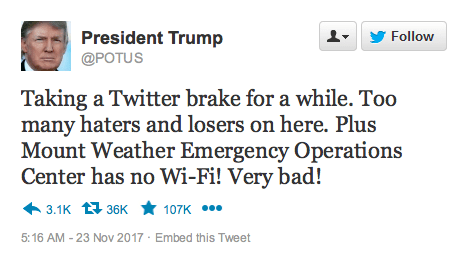
I’ve GOT it! Make Trump move to the Mount Weather Emergency Operations Center! Problem Solved!

Flat learning curve. That’s really the most alarming thing about President Trump’s tweet barrage over the weekend, as he responded stupidly, irresponsibly and offensively to the terror attack in London. It proved that he hasn’t learned a thing, despite repeated Twitter-assisted catastrophes that in the past have turned potential victories into embarrassments, mere mistakes into disasters, and whimsy into large clubs for his enemies to beat him bloody with. How could he not be wary when he considers a tweet? What happened to “Once burned, twice shy?” How about 6,348 times burned? How analytical do you have to be to think, after hitting yourself in the head squarely with a 2 X 4 and realizing that it is permanently dented (the head, not the board), “Wow! That hurt! I sure don’t want to do that again!”?

And yet here we are.

I can’t say I’m surprised, and that itself is depressing. But I’ve dealt with enough alcoholics in my life who I have asked, following particularly devastating relapses that placed everything they cared about (or should have cared about) in jeopardy, “Why would you do that, after all you have been through?”…and watched them shrug, shake their heads, and say, in various words, “I can’t explain it, and you’ll never understand.”

After the two attacks on Saturday, the President’s tweets weren’t all terrible. The second one read, “Whatever the United States can do to help out in London and the U. K., we will be there – WE ARE WITH YOU. GOD BLESS!” Then, like a binge drinker out of rehab who takes a small sip of chablis at a reception, POTUS was on a Twitter bender—a Twender. He began exploiting the tragedy to lobby for his stalled travel ban. He blamed the attacks on political correctness. He mocked the Mayor of London. He somehow saw the episode as revealing the hypocrisy of gun control advocates. Metaphorically, the President of the United States was reeling and staggering all over the street, singing “Barnacle Bill,” stopping traffic and vomiting on pedestrians. Continue reading

Ethics Dunce: Virginia Gubernatorial Candidate Ralph Northam

Current Lieutenant Governor Northam is the “establishment candidate” in the Democratic Party as it tries to hold on to the Governor’s mansion. He is being opposed in the primary by Tom Perriello, a populist, Bernie-backing candidate. Thus Northam is pandering to the leftist, “resistance,” “not my President” hard progressive base by indulging in ad hominem attacks while endorsing incivility and demonizing as the new standard Democratic modus operandi, which it is rapidly becoming.

“Donald Trump is a narcissistic maniac, and I will do all I can to keep his hate out of Virginia.”

I think we can all agree that Trump is a narcissist. So is Obama; so is Bill Clinton; so was  Lyndon Johnson, JFK and both Roosevelts. Many excellent leaders are narcissists. None are maniacs (synonyms: madman, lunatic, usually meaning “dangerous”), however, and neither is Donald Trump, except that anyone who doesn’t embrace political positions the left embraces is subject to being called and judged insane. This is why the Soviet Union locked up dissidents in mental hospitals, and increasingly U. S. progressives are looking to Stalin’s play-book: censorship, marginalization, slander.  Ironically, it is the anti-Trump obsessed who have shattered all rules and traditions of civilized political speech, advocacy and opposition in a democracy, and who are in the grip of mania.

Nothing the President has done or proposed justifies the maniac label, but current anti-Trump politics has nothing to do with justice, or fairness, or responsible rhetoric.  Northam says he wants to keep Trump’s “hate” out Virginia, whatever that’s supposed to mean, but he is branding his own hate, which I suppose is his party’s hate, by calling the President of the United States a foul name designed to wedge fear and alienation between the public and the man whom they chose to lead us.

Notham has disqualified himself for leadership by this alone.

If a maniac was running amuck, do you think Ralph Northam would favor beheading him? Do you really think people who denigrate our nation’s elected leader the way Virginia’s leading Democrat does were offended by Kathy Griffin’s art?

_________________________

Source: Slate

Ethics Verdict: Hillary Clinton Is The Worst Loser In US Presidential History (PART I)

Yes, having to write this post makes me feel like Michael Corleone in “Godfather III.”

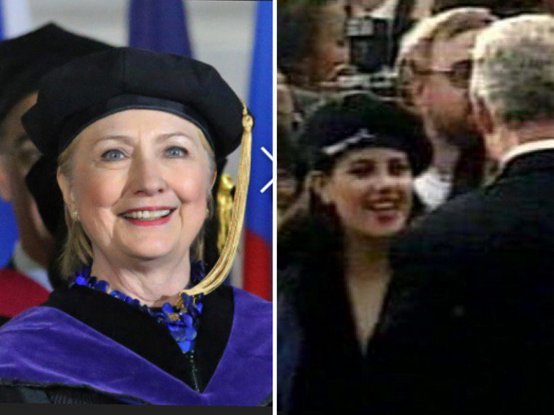
I considered giving Hillary her well-earned Worst Presidential Election Loser award after her embarrassing Commencement speech at Wellesley, but the wag who wrote “Why did Hillary dress up like Monica Lewinsky at Wellesley? to accompany this photo…

…made me laugh, and in my lightened state decided, “Nah! Why bother? Leave the poor woman alone.”

For I do feel sorry for Hillary Clinton. I feel sorry for anyone who loses the Presidency despite winning the popular vote. I would think it could drive someone crazy. In the play “Inherit the Wind,” there is a scene in which the wife of Matthew Harrison Brady (a thinly-disguised fictional avatar for three time Presidential loser William Jennings Bryan) begs for sympathy for her blow-hard husband, asking a critic to imagine what it must be like to have a Presidential election victory speech written and in his pocket three separate times and to never get to deliver it. Well, knowing you received the most votes and still can’t give the speech has to be much, much worse.

Then came yesterday’s orgy of excuses and recriminations as Clinton, looking and sounding angry and bitter, was interviewed at a tech conference hosted by Recode’s Kara Swisher and Walt Mossberg. And she puuuulled me back!

So now I have to review Hillary’s revolting and self-indicting Blame Everyone tour. Let’s begin by stating that no defeated Presidential candidate has ever done anything like this before, not even Richard Nixon. Nixon’s poor loser meltdown was after he lost the California Governor’s race in 1962. When he lost to Kennedy in 1960, his conduct was exemplary, refusing to demand a recount even when there was evidence, as there frequently was with the Kennedys, of shady operations. For a loser to engage in repeated recriminations and bitter pronouncements less than a year after losing is unprecedented. It is also —and forgive me for repeating myself from prior posts–disgusting, despicable and shameful for a defeated candidate to join a “resistance” against the lawfully elected winner. This is especially true in Clinton’s case, when she furiously condemned candidate Trump for suggesting that he might not accept his defeat. Continue reading