WSJ’s James Taranto Flunks His Ethics Test

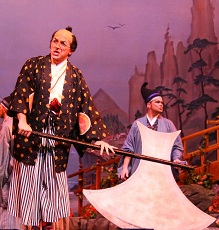
A longtime Taranto fan, I was waiting for his Monday installment of his “Best of the Web” blog on te Wall Street Journal site to see if he would retract his flat-out wrong and grossly unfair characterization of the Missoula “Mikado.” Alas, he chose to double down, apparently in thrall to a conservative, Gilbert and Sullivan deprived readership:

“On Friday we noted that a theater company in Montana had inserted into its production of Gilbert and Sullivan’s “The Mikado” a lyric calling for the beheading of Sarah Palin. By the close of business that same day, Michael McGill, executive director of MCT Inc., had announced remedial action…”

[The lyric, once again, is: “And that crazy Sarah Palin, needs a psychoanalyst!  She never would be missed.  No. She never would be missed.” Would any fair, sane, English comprehending person say that this “calls for the beheading of Sarah Palin”? Of course not.  Yet there it is.]

Thus Taranto follows a pattern I have noticed among many of the false critics of the production. They don’t seem to care what the facts are, or what is fair. They just want to rise to poor Sarah’s defense, and are willing to victimize an innocent small theater company of very nice, talented, dedicated people to do it.

Ah, James, I have misjudged you, I fear.

Ethics Train Wreck Report: Lessons, Ethical and Otherwise, of the Missoula “Mikado” Mess

Much of my weekend was occupied by reading, writing, thinking, and talking about the bizarre controversy over a community theater production of Gilbert and Sullivan’s “The Mikado,” which, by a series of misunderstandings, misdeeds, hypocrisies and journalistic malpractice, has created much anger and unhappiness for no legitimate reason at all. If you are late to the story and want to catch up, you can do so here, here, here, and here.

For the first and perhaps only time I can honestly say that Ethics Alarms is the most reliable source on a story. There may be plenty of ethicists who are more knowledgeable, scholarly, prudent and experienced than I am regarding ethics theory, but none of them knows this topic—Gilbert and Sullivan and “The Mikado”, like I do. I have 50 years experience performing, directing, studying, parodying and laughing at the works of these Victorian geniuses. The second I read the astoundingly wrong-headed interpretation being attached to the Missoula Community Theatre’s inclusion of Sarah Palin in Ko-Ko’s famous song “I’ve Got a Little List,” I surmised exactly what was going on, and my assessment has been confirmed by everything that has come to light since.

I will summarize what we now know in brief (well, briefer than reading all the posts) form:

Continue reading

Further Ethical Musings on Ko-Ko’s Little List’s “Eliminationist Rhetoric”: the Duty to Fight the Insanity

The more I think about the controversy over the Montana production of “The Mikado,” which I discussed in the previous post, the more it bothers me.

The fact that some conservative Missoulans were disturbed by Sarah Palin’s inclusion on the iconic “little list” carried by the fictional Ko-Ko, the Lord High Executioner in Gilbert and Sullivan’s classic musical comedy “The Mikado” is disturbing. The fact that the Missoula Community Theater actually caved-in to ignorance and hypersensitivity and removed the lyric is more so.  but the fact that some sensible commentators, like the Wall Street Journal’s usually perceptive and witty James Taranto, have had their brains addled by the current attempt at language, metaphor and humor purging by politically correct hysterics is genuinely terrifying. Continue reading

Next: A Version of “The Mikado” Without Execution References

For a text-book example of how political correctness, ideology, ignorance and a humor deficit can undermine speech, culture and entertainment, we need look no further than Montana, and its public critics of the Missoula Community Theater’s production of “The Mikado,” perhaps the best of all Gilbert and Sullivan operettas and one of the very best musical comedies ever written. Continue reading

Michael Palmer’s Ethics No-Brainer

Physician/novelist Michael Palmer is something of the new Michael Crichton, though unlike the eclectic late author of “Jurassic Park,” Palmer generally restricts himself to medical thrillers. He is promoting his latest novel, “A Heartbeat Away,” with a series of “ethics brainteasers,” as he called them in a recent Twitter post. Here is the latest, which he posted on his Facebook page and asked fans to discuss:

“What if a close friend confides to you that he/she has committed a heinous crime and you promise that you’ll never tell. However, you soon discover that an innocent person has been accused of the crime and is possibly facing significant jail time. You plead with your friend to give him/herself up, but he/she refuses and reminds you of the promise. What should you do? What if the if jail time was only a few months? What if the sentence was death?” Continue reading

“Finishing the Hat”: Sondheim, W.S. Gilbert, and Expert Malpractice

Stephen Sondheim’s “Finishing the Hat” is a fascinating reflection on a remarkable career and the craft of making musicals by the greatest living master of the form. In the course of recounting his formative years, triumphs, failures, and duels with producers, authors and composers, Sondheim also critiques the lyrics of his predecessors, contemporaries and role models—as long as they are dead. In a nod to gentility or cowardice, the only living lyricist he subjects to his expert critiques is himself.

Sondheim is a tough judge, as one might expect from a composer/lyricist who meticulously measures each vowel sound and stressed syllable for maximum effect. He is also, by virtue of both his reputation and technical expertise, an influential one. The lyricists he grades highly in the book, such as Frank Loesser, Cole Porter and Dorothy Fields, are likely to have their reputations burnished by his praise, and those he slams, like Lorenz Hart and Noel Coward, will suffer by comparison. Because of this, Sondheim had an obligation, as a respected expert in his field, to make each case carefully and fairly. To his credit, Sondheim seems to recognize this, and all of his critical discussions of an individual lyricist’s style and quirks include specific examples and careful analysis. We may disagree with Sondheim as a matter of personal taste, but it is difficult to argue with his specific points, because they are backed up by examples, technical theory, and the weight of his authority.

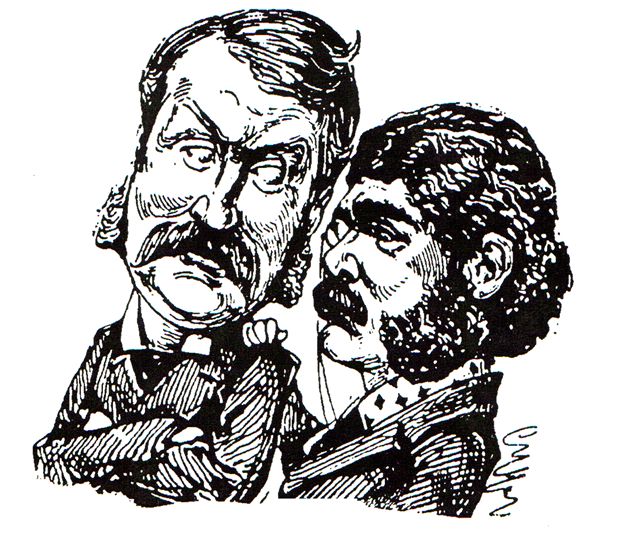
It is therefore surprising and disappointing to see Stephen Sondheim slide into expert malpractice when he undertakes, clearly half-heartedly, a critique of the lyrics of W.S. Gilbert, of Gilbert and Sullivan fame. Continue reading

Mr. Friedkin? Mr. Hawks? Meet Mr. Madison and Mr. Twain

It was Saturday Censorship at the Movies last night in Cable Land.

First, I got to watch that manly channel, Spike, blanch at showing a possessed 12-year-old girl use the work “fuck”, which, as you horror devotees know, is a word rather central to showing how she has been taken over, like Helen Thomas, by the demon Pazuzu. There was Linda Blair, as the suddenly possessed Regan O’Neill, bouncing rhythmically on her bed as her horrified mother and physician looked on, shouting “—Me!—Me!—Me!”, apparently horrifying them with a noisy outbreak of egocentricity. The later scene in which the Demon Child is found masturbating with a crucifix was also clumsily chopped up so it was impossible to figure out what was going on. Continue reading

Mr. Madison, Meet Mr. Twain

Whitewashing America’s past doesn’t honor it, burnish it, or repair it. All it accomplishes is making present-day Americans ignorant, naive, cocky and shallow. American society deserves respect for recognizing its ethical and moral errors and misconceptions, debating them, and remarkably often, fixing them. This is another reason why the new volume of Mark Twain masterpieces omitting his pointed use of the word “nigger” does damage to history and culture. It is also the reason why the Republican-led reading of the Constitution should have included all of the Constitution, including the document’s initial support of slavery.

It didn’t. Continue reading

The Ethics of “Improving” Mark Twain

From Publishers Weekly:

“Mark Twain …defined a “classic” as “a book which people praise and don’t read.” Rather than see Twain’s most important work succumb to that fate, Twain scholar Alan Gribben and NewSouth Books plan to release a version of Huckleberry Finn, in a single volume with The Adventures of Tom Sawyer, that does away with the “n” word (as well as the “in” word, “Injun”) by replacing it with the word “slave.”

“This is not an effort to render Tom Sawyer and Huckleberry Finn colorblind,” said Gribben, speaking from his office at Auburn University at Montgomery, where he’s spent most of the past 20 years heading the English department. “Race matters in these books. It’s a matter of how you express that in the 21st century.”

No law can stop Gribben and NewSouth from doing this vandalism to Twain’s classics. The two books are firmly ensconced in the realm of the public domain: no longer subject to copyright,  Huckleberry Finn and The Adventures of Tom Sawyer can be published in Pig Latin or with all the characters transformed into Martians. Still, it is wrong, obviously wrong and inexcusably wrong, and the most responsible thing any of us can do in the name of respect for literature, authors, American history, and education is to say so as vociferously as possible in as many ways and media as possible, so no misguided, politically correct fool will ever be tempted to do anything like this again. Continue reading

“True Grit” Ethics

I haven’t seen the remake of “True Grit,” but I know I will, and like many other fans of the original 1969 version, I’m trying to conquer my biases. The latest effort by the usually brilliant Coen brothers creates ethical conflicts for me, and I am hoping I can resolve them right now. Can I be fair to their work, while being loyal to a film that is important to me for many reasons?

The original, 1969 “True Grit” won John Wayne his only Oscar for his self-mocking portrayal of fat, seedy law man Rooster Cogburn, 

who is hired by a young girl to track down her father’s murderer. I love the film; I saw it on the big screen nine times, in fact. Remaking it with anyone else in the starring role feels like an insult, somehow, as if the Duke’s version was somehow inadequate.

Intellectually, I know that’s nonsense. Artists have a right to revisit classic stories and put their personal stamp on them, and they should be encouraged to do it. Every new version of a good story, if done well, will discover some unmined treasure in the material. Why discourage the exploration? Continue reading