Ethics Quote Of The Week: Blogger-Law Prof. Glenn Reynolds, The “Instapundit”

“ETHICISTS GENERALLY HAVE LITTLE TO OFFER, AND THAT INCLUDES ASTROPHYSICISTS ACTING AS ETHICISTS”

—Conservative blogger and pundit Professor Glenn Reynolds, reacting to the “Ars Technica” post, “Are we ethically ready to set up shop in space?”

I agree with Reynolds completely, and the article that prompted his dismissal of my field (except in rare cases, hence “generally”) deserved it.

It begins (the author is Diana Gittig, who “received her B.A. in Biochemistry from the University of Pennsylvania, and then a Ph.D. in Cell Biology and Genetics from Cornell,”and “is a freelance science writer and editor in New York’):

Off-Earth will amaze you: On nearly every page, it will have your jaw dropping in response to mind-blowing revelations and your head nodding vigorously in sudden recognition of some of your own half-realized thoughts (assuming you think about things like settling space). It will also have your head shaking sadly in resignation at the many immense challenges author Erika Nesvold describes. But the amazement will win out. Off-Earth: Ethical Questions and Quandaries for Living in Outer Space is really, really good…

The chapter headings, all of them questions, give a great indication of the issues she highlights in the book. Should we even settle space? Why? Who gets to go? How will property rights be distributed and finite resources be allocated? Do we need to protect the environment in space? How will we do that? What happens when someone breaks the rules or needs medical care? What if that person is the only one who can fix the water purifier? Underlying all of these questions, as yet unaddressed by any public or private institution currently shooting rockets into the air: who gets to decide?

Many of these issues have been dealt with, extensively, in fiction. But Nesvolt doesn’t really mention these works except to caution against the risk of taking them as prophecy.

Had it not triggered my bullshit alarm so thoroughly, I might have stopped reading there. Wait: this brilliant author supposedly explores the ethical hypotheticals that have been exhaustively examined by over a century of science fiction writers in literature, movies and TV without mentioning them? That’s unethical! It’s incompetent, irresponsible, unfair and disrespectful: the book is discredited as a trustworthy source of ethics analysis at the outset.

It is the final paragraph of the brilliant reviewer of the allegedly brilliant astrophyicist-ethicist’s revelations, however, that conclusively proves Reynold’s assessment is spot on. Ready?

Continue reading

Unethical Quote Of The Week: Jill Biden

“Ridiculous…“We would never even discuss something like that. How many 30-year-olds could travel to Poland, get on the train? Go nine more hours, go to Ukraine, meet with President  Zelensky? So, look at the man. Look what he’s doing. Look what he continues to do each and every day.”

First Lady Jill Bidenafter being asked during a CNN interview about Nikki Haley’s proposal that politicians over the age of 75 undergo mental competency testing.

In related news, Lance Armstrong declared that testing competitive cyclists for doping is “ridiculous,” and O.J. Simpson opined that DNA technology was “ridiculous.”

Fortunately, all we need to do to determine the competency of First Ladies is to analyze a cretinous answer like that one to a flamingly easy question. We are looking, Jill. And it’s not pretty. The words the First Lady was searching for were not “ridiculous,” but responsible, necessary, and “a matter of common sens

The United States has already courted disaster with Presidents continuing in office after their mental faculties have been damaged or declined. President Pierce was impaired by grief, crippling depression and alcoholism during his single term in office, which occurred at a crucial point in the deadly run-up to the Civil War. Woodrow Wilson infamously remained President after being crippled by a major stroke. There is evidence that President Reagan’s cognitive stability was declining during his presidency.

As for Jill’s human meal-ticket, no modern President has shown so many signs of mental decline and confusion, and this frightening development has come after a career in public office unmarked by intellectual acuity at its zenith. Every responsible Presidential candidate should be required to pledge to take such competency tests on a regular basis and agree to resign from office once a thorough, non-partisan diagnosis confirmed by multiple physicians concludes that there is significant cognitive decline.

Continue reading

On Judge Kollar-Kotelly’s Procrustean Attempt To Make Abortion A Constitutional Right

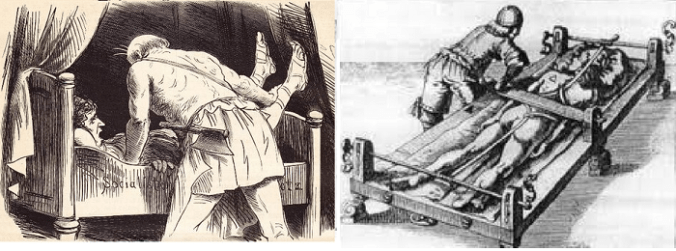
That’s Procrustes portrayed above, in both of his favored acts of mayhem. I checked: I’ve used the term “Procrustean” several times here, but never was kind enough to explain the term’s origins, which is what makes it cool.

Procrustes was the nastiest of the bad guys the mythological Greek hero Theseus encountered on his way to killing the Minotaur in Crete. Procrustes would invite a weary traveler to take refuge for the night, offering him sustenance and a bed—but the bed was a deadly trap. Procrustes guaranteed every guest would fit the bed neatly, but that was because it converted into a rack, stretching anyone who was too short. If a guest was too tall, Procrustes just hacked off enough inches from the feet up to ensure that the bed would fit him, too. Theseus killed the psycho, but the word procrustean eventually entered legal lexicon to describe an argument that illogically squeezed facts or omitted them to make a theory fit the law.

I thought of old Procrustes immediately when I read that Judge Colleen Kollar-Kotelly in the District Court for the District of Columbia suggested after a hearing that the Thirteenth Amendment might have created a right to abortions. Wait, you well might ask, “How could an amendment created specifically to make slavery illegal, passed right after the Civil War, be construed to enshrine abortion as a right?” The short answer is, “It can’t and doesn’t.” The stupid, intellectually dishonest answer, however, is the one that the previously responsible female judge has decided to promote.

When the amendment states, Continue reading

How Far Have Our Universities Traveled Into Thought Control Territory? This Far: Stanford Wants To Punish A Student For Reading A Politically Incorrect Historical Document

A while back, one of this blog’s self-exiled commenters told me that he left because I had become more hostile to the Left in recent years, in contrast to my position when Ethics Alarms started in 2010. He’s right, of course. In 2010, this story would have been unimaginable. My standards haven’t changed. But one whole side of the political spectrum has been abandoning ethics and core American principles with increasing arrogance, aggressiveness and ruthlessness.

I am in shock over this latest episode.

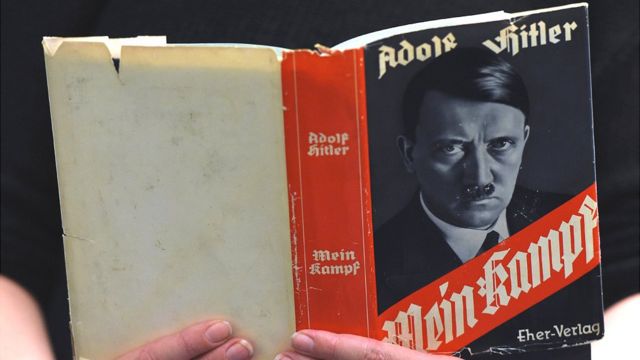
After a photo of a Stanford student reading Adolf Hitler’s autobiography “Mein Kampf” circulated on campus, The Stanford Daily revealed that administrators were working with the students involved to “address” the incident. Two campus rabbis emailed Jewish students saying administrators “are in ongoing conversation with the individuals involved, who are committed to and actively engaged in a process of reckoning and sincere repair.”

Reckoning—for reading something? “Repair”? Is that the strong stench of re-education I feel in my nostrils? Continue reading

NOOOOOO! “The Ethicist” Just Endorsed The Golden Rationalization As Justification For Deception.

It isn’t quite head-exploding, because the New York Times “The Ethicist” column has seen its columnist—there have been five of them, I think—promote unethical conduct all too frequently over the years. But the current ethics advice maven, Kwame Anthony Appiah, is a real ethicist, unlike the others, and I expect better of him. Because of his credentials and assumed authority, his unethical advice this week is particularly damaging. And to clarify my statement I quote one of many memorable exchanges during the testimony of Miss Mona Lisa Vitto (Marissa Tomei) in the climax of “My Cousin Vinny”:

D.A. Jim Trotter (Lane Smith): Objection, Your Honor! Can we clarify to the court whether the witness is stating opinion or fact?

Judge Chamberlain Haller (Fred Gwynne) : [to Lisa] This is your opinion?

Mona Lisa Vito: It’s a fact.

The inquirer asked whether it was unethical for him to list a fake publisher on the title page of his self-published book that he created on Amazon, apparently a common practice that Amazon permits. He also asked whether it would be unethical to tell a bookstore owner who agreed to sell the book on consignment that the book was published by his made-up book company.

“The Ethicst” answers the first query this way:

Continue reading

A Christmas Music Ethics Spectacular! [Third Stanza: The Good, The Bad, And The Creepy]

The New York Times has an article about the competition to create a new Christmas music standard, or at least a hit song for streaming.  The piece’s “Rules of the Game:

No. 1: The public prefers the old classics, and isn’t too interested in new songs.

No. 2: Singers shouldn’t wander too far from the melody.

No. 3: “You can’t be too corny at Christmas. You totally get a free pass.”

Corny is fine, but what about creepy?

D. Dark Christmas Songs

1. Traditional Carols

The problem with “The Carol of the Bells” isn’t the lyrics, it’s the music. The thing is affirmatively creepy; my mother hated it, and compared the tune to “The Hall of the Mountain King.” No other Christmas music has been so frequently used darkly. It came, then, as no surprise when the TV horror mini-series “Nos4A2,” based on a novel by Stephen King’s son, used the carol as its theme music. The show is the tale of a damned man who kidnaps children and takes them to “Christmasland” where they are kids forever, and also become little vampires. The music, which is by a Ukrainian composer, is unquestionably ominous. Why it has remained in the Christmas canon is a mystery to me.

Another carol in a minor key is “We Three Kings,” which contains this cheerful lyric in Verse 4, sung by Balthazar:

Myrrh is mine; its bitter perfume
Breathes a life of gathering gloom;—
Sorrowing, sighing,
Bleeding, dying,
Sealed in the stone-cold tomb

Merry Christmas!

And why would you give that stuff to a baby?

I’m going to call I Heard the Bells on Christmas Day” a traditional carol since its lyrics are more than a century old. It’s not creepy, but it is a sad song, and sadder still when one knows its origins. 

Henry Wadsworth Longfellow wrote a poem titled “Christmas Bells” on Christmas Day, December 25, 1863. He was in despair: his son had been wounded fighting for the Union the month before, and the poet feared he would die. The author of “Paul Revere’s Ride,” “Evangeline” and other famous poems also was still mourning his second wife, who had died horribly in a fire two years earlier. He was not in a good state of mind when he wrote,

Continue reading

Ethics Hero: Florida Catholic School Principal Tonya Peters, No Weenie She

In a seventh grade English class at St. Charles Borromeo Catholic School in Port Charlotte, Florida, the teacher was presenting Mark Twain’s “Tom Sawyer,” using an uncensored version, which is to say, “Tom Sawyer.” The classic novel, like its larger, more ambitious cousin “Huckleberry Finn,” uses the now taboo “n-word” in a society today that should be too sophisticated and wise by now not to know that declaring words taboo is ethically and intellectually indefensible. One African-American community website’s news report on the incident states, “Anyone who has read an unedited version of those books know how racially insensitive they were.” Well:

  • Any one who has only read an “unedited”, meaning bowldlerized, version of “Tom Sawyer” hasn’t read “Tom Sawyer,” and
  • Great literature isn’t supposed to be “racially sensitive”; it’s supposed to be enlightening.
  • The issue of watering down language that some may find offensive in literature is well-considered in this essay.

As described in the letter above, when members of the class read the book out loud and the word “nigger” was uttered, the students began “acting up,” laughing, making comments, and generally acting like undisciplined 7th graders, which they were. When the teacher could not calm them down, she improvised a creative but risky solution: having the children repeat the word over and over again. The idea, obviously (though not sufficiently obvious for any of the media reports to figure out) was to rob the “taboo” word of power by repetition. It’s an old linguistic trick that kids should be familiar with (i know I was): when any word is repeated enough, it becomes just a sound, which is all any word is. (This device becomes the climax of the excellent horror film “Pontypool,” in which something causes the English language to become deadly, destroying everyone’s brains.) Continue reading

Unethical (And Ominous) Quote Of The Month: 600 “Members Of The Writing, Publishing, And Broader Literary Community”[Link Fixed]

“As members of the writing, publishing, and broader literary community of the United States, we care deeply about freedom of speech. We also believe it is imperative that publishers uphold their dedication to freedom of speech with a duty of care. We recognize that harm is done to a democracy not only in the form of censorship, but also in the form of assault on inalienable human rights. As such, we are calling on Penguin Random House to recognize its own history and corporate responsibility commitments by reevaluating its decision to move forward with publishing Supreme Court Justice Amy Coney Barrett’s forthcoming book….”

—Signatories (600 and rising) from the world of publishing in an open letter titled “We Dissent,” demanding that Penguin Random House refuse to publish a book by Supreme Court Justice Amy Coney Barrett.

Here is the whole, head-exploding, censorious thing, an “it isn’t what it is” (Yoo’s Rationalization again!) classic that could have been composed by the lackeys of “1984’s” Big Brother: Continue reading

For Some Strange Reason, The Playwright Didn’t Think “N-Word” Carried The Same Dramatic Punch..

Yes, this is another Strange Tale of the Great Stupid.

A depressing one.

In the opening scene of Down in Mississippi by African American playwright Carlyle Brown, a white man calls a black character “nigger” multiple times and threatens him after learning that he’s in the area to help register black citizens to vote. Texas Wesleyan’s Black Student Association shared an Instagram post about how many students were “deeply disturbed” that such scenes would be shown on campus, because it might “hurt Black students and possibly students from other marginalized communities.”

So the university decided not to mount the production. Brown, the playwright, argued that the word’s use in the play was necessary to maintain historical accuracy and to provoke strong responses. Yes, and he might have also pointed out that this is live drama, and the objective of live drama is to arouse the audience’s emotions. Glenn O. Lewis, the first black board chairman the university has had, diplomatically said that he understood how the language could make some students uncomfortable, “But when have we ever … learned anything in our comfort zone?” Lewis asked. “You don’t learn anything new until you get out of your comfort zone, and I think that is what Mr. Brown intended for this play to do.” Lewis added that censorship of Brown’s work is not a real solution.

Continue reading

More Weird Tales Of The Great Stupid! “Death Of A Salesperson”?

Watch out! This one is really, really stupid.

Increasingly embarrassing New York Governor Kathy Hochul signed legislation last week officially eliminating the word “salesman” in official parlance and replacing it with “salesperson.” “Jobs have no gender, but unfortunately, many of our state’s laws still use gendered language when discussing professions that are practiced by people of all genders,” state Sen. Anna Kaplan (D-Nassau) said of the bill she sponsored with Assemblyman Danny O’Donnell (D-Manhattan).

No, unfortunately the legislators’ political party is now addicted to Orwellian GoodSpeak measures, as it tries to control thought by restricting language.

The new law also replaces “his” or “her” with “their” in relevant statutes affecting the real estate industry. Other new Big Brother laws in New York ban the official use of  “mentally retarded” and “inmate” in favor of “developmentally disabled” and “incarcerated person.”

Did you know that Donald Trump and Republicans pose an existential  threat to democracy? Continue reading