Its Post-Harvard President Firing Tantrum Shows That The Left Is Even More Corrupt Than We Thought! Part III: The News Media and the Race-Baiters [Expanded]

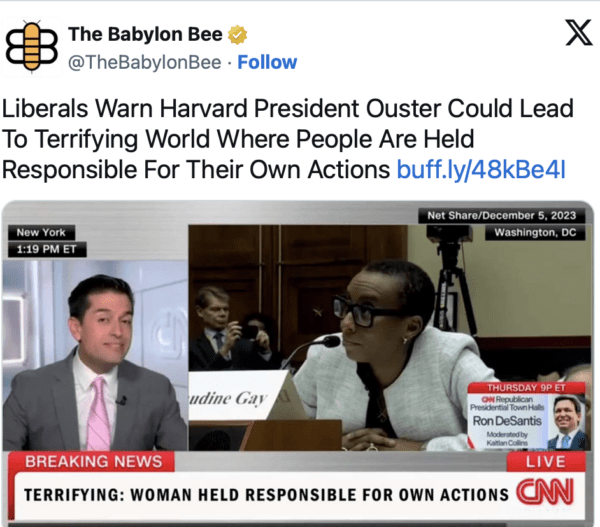
In a recent essay, Victor David Hanson concisely summarizes why the Left’s angry narrative that Claudine Gay was forced out as Harvard’s president because of racial discrimination is untenable and self-damning. He wrote in part,

…In the respective press releases from both Gay and the Harvard Corporation, racial animus was cited as a reason for her removal. Gay did not even refer to her failure to stop antisemitism on her campus or her own record of blatant plagiarism. Yet playing the race card reflects poorly on both and for a variety of reasons. One, Gay’s meager publication record — a mere eleven articles without a single published book of her own — had somehow earned her a prior Harvard full professorship and presidency. Such a thin resume leading to academic stardom is unprecedented.

Two, the University of Pennsylvania forced the resignation of its president, Liz Magill. She sat next to Gay during that now-infamous congressional hearing in which they both claimed they were unable to discipline blatant antisemitism on their campuses. Instead, both pleaded “free speech” and “context” considerations.

Such excuses were blatantly amoral and untrue. In truth, ivy-league campuses routinely sanction, punish, or remove staff, faculty, or students deemed culpable for speech or behavior deemed hurtful to protected minorities — except apparently white males and Jews. Yet Magill was immediately forced to resign, and Gay was not. Also noteworthy was Magill’s far more impressive and extensive administrative experience, along with a more prestigious scholarship that was free of even a suggestion of plagiarism.

Academia’s immediate firing of a white woman while trying desperately to save the career of a less qualified and ethically challenged Black woman will be seen not as a case of racial bias but more likely of racial preference.

And yet one after another of the prominent pundits, journalists and commentators immediately worked hard to spread the “Gay was a victim of systemic racism” narrative. In so doing, they discredited themselves and the ideology that warps their judgment and ethics.

Presidential candidate Cornel West, a former Harvard professor, wrote, “How sad but predictable that the same figures and forces enabling the ethnic cleansing and genocidal attacks on Palestinians in Gaza – Ackman, Blum, Summers and others – push out the first Black woman president of Harvard! This racism against both Palestinians and Black people is undeniable and despicable! I have experienced similar attacks from the same forces in academia with too many of my colleagues remaining silent! When big money dictates university policy and raw power dictates foreign policy, the moral bankruptcy of American education and democracy looms large! But we shall remain strong in our fight for Truth Justice Love!”

Al Sharpton told his MSNBC audience that the Harvard president’s resignation is an “attack” on “every Black woman” in US.

Mara Gay, one of several NYT’s race-baiters, told MSNBC that”This is really an attack on academic freedom … This is an attack on diversity. This is an attack on multiculturalism, & … I don’t have to say that they’re racist, because you can hear and see the racism in the attacks”

Continue reading

“Jeopardy!” Ethics,” 2023

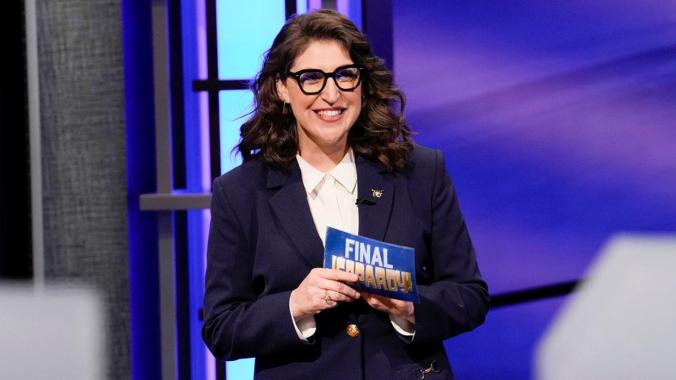
“Jeopardy!,” the apparently eternal TV game show that has persevered even as its once difficult questions have become increasingly pitched to the less-than-astute, ended its 2023 with a surprise. Mayim Bialik, the actress who is also (for an actress) unusually credentialed educationally, announced this month that she has been let go as a host of “Jeopardy!” Since 2021, Bialik, who had previously portrayed “Big Bang Theory” head nerd Sheldon’s girlfriend on the series, had shared the role of host with legendary “Jeopardy!” champ Ken Jennings. Bialik was the more reliable and professional of the two, perhaps because of her long performing background. Jennings was at the center of far more gaffes and controversies, though Bialik had her share. This season, for example, she disallowed all three contestants’ answers of ”Aleksandr Solzhenitsyn” because she found their pronunciations of the Russian writer and dissident’s name insufficiently accurate.

Continue reading

“A Christmas Carol”

-A-Christmas-Carol2

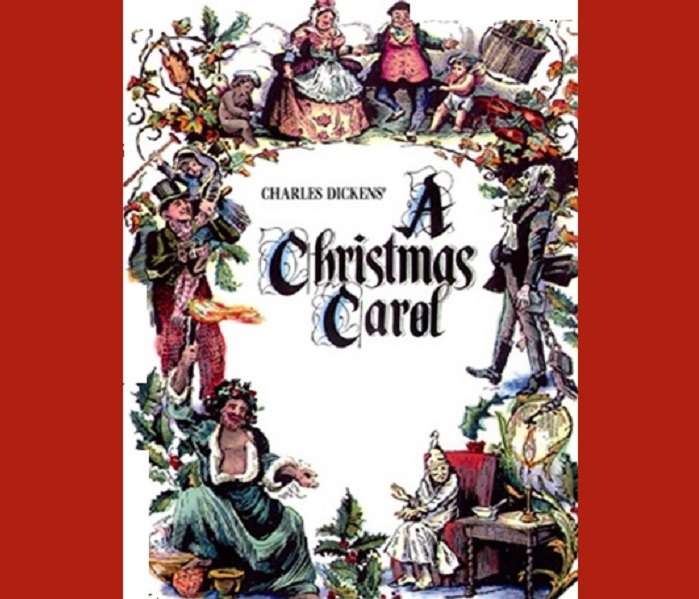
The entire text of “A Christmas Carol” is and has been for a long time listed under Inspirations on the Ethics Alarms homepage. If you haven’t read it (preferably out loud, to your family) recently, I urge you to do so. It is wonderful, and still, after all the movies and TV specials and songs and rival Christmas-themed stories, the best of the genre. It is also delightful literature, and, because I am an incurable romantic, a sap, and a Christmas addict, the story and Dickens’ telling of it gets to me every time.

I just realized that the last time I directed a production that wasn’t my own, it was a staged reading of “A Christmas Carol.” I miss directing greatly—no one has been clamoring for my comeback—so it that was my last hurrah, I can live with that. “A Christmas Carol” is, after all, one of the greatest ethics tales of all.

The first version of the film adaptations of “A Christmas Carol” I saw when I was knee-high to Robert Reich was the version starring Alistair Sim. Many aficionados of “A Christmas Carol” movies think it is still the best, and I won’t argue with them. Because the movie is in black and white and has been superseded by so many other versions, it is hard to find it on TV now except for the streaming services. Even the much inferior version starring Reginald Owen (with the entire Lockhart family, including young pre-“Lassie,” pre-“Lost in Space” June, as the Cratchits) is shown more than the classic Sim film. In these cynical times, the version of “A Christmas Carol” most likely to be available, sort of, is Bill Murray’s “Scooged.” It’s not the worst version—the musical starring Albert Finney wins that booby prize (“Thank you very much! Thank you very much!” Yecchh.)—but cynicism and dark humor really don’t belong in this story

My personal choice for the best adaptation goes to the 1984 George C. Scott version, if you don’t count “Mr. Magoo’s Christmas Carol,” and you probably shouldn’t, though I love it. The 1984 film has David Warner as Bob; Edward Woodward is the best (and tallest) Ghost of Christmas Present ever; and I think this is the scariest version of Marley.

Here it is…

The Res Ipsa Loquitur Files: Yeah, Thanks Lincoln Center, But I Think I’ll Skip “Jungle Book Reimagined”

Surely there are still some live theater production that are not arm-twusting agitprop and woke propaganda. Surely.

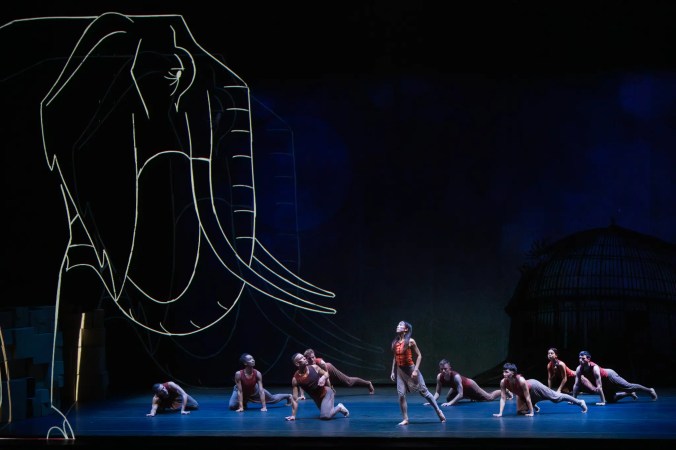
The production is described on the Lincoln Center website as a “rethinking of the Rudyard Kipling classic ‘The Jungle Book'” that “updates the original’s colonizer-centric perspective.” More specifically, the New York Times review tells us,

“Instead of a boy raised by wolves, Mowgli is a refugee girl separated from her family as sea levels surge. She is adopted by animals who have formed a peaceable kingdom in a city that humans have left behind. Many familiar characters appear, slightly altered. Baloo the bear is now a bear who was forced to dance by humans before escaping the humiliation. The Bandar-log monkeys are now former lab specimens, still traumatized by being experimented on but longing to replace their former masters. Kaa the python is dangerous and hypnotizing but also hung up on memories of captivity in a zoo.”

Gee-what-fun. Can a Disney version be far behind?

10 Ethics Takeaways From Wapo’s “Students Hated ‘To Kill A Mockingbird.’ Their teachers Tried To Dump It”

Subhead: “Four progressive teachers in Washington’s Mukilteo School District wanted to protect students from a book they saw as outdated and harmful. The blowback was fierce.”

To begin with, read it all, and to the extent you can stand it, the comments. I included some trenchant quotes below, however.

Now the takeaways:

1. If there is a more vivid and depressing illustration of how far public education, teacher competence and race relations have declined since, oh, let’s say 2008, I don’t know what it could be.

2. The episode was triggered, a black student told the Post, when a white teen read “nigger” while reading “Mockingbird” to the class. The student disobeyed the teacher’s instructions to skip the slur, and “the kid looked at every Black person — there’s three Black people in that class — and smiled.” Well: a) Asking a student to read a passage of any book to the class when she feels part of the text must be skipped is incompetent. b) Of all the passages to have a student read from “Mockingbird,” choosing one that includes “nigger” smacks of deliberate sabotage. c) Presumed facial expression racism? At this rate, we should be back to “separate but equal” in no time.

3. “Freeman-Miller wondered: Did the school really have to teach Harper Lee’s classic but polarizing novel, as was mandatory for all freshmen?” There is no reason for any novel to be regarded as “polarizing,” except to those who regard literature as indoctrination tools. The educational process is to read the novel, discuss its literary merit, its context, its cultural significance, the ideas it communicates, and it why it works (or not) for a particular reader.

Continue reading

My Favorite Poem: An Ethics Tale, A Romance, And A Ghost Story…

Happy Halloween, from Ethics Alarms!

***

The Highwayman

By Alfred Noyes

The wind was a torrent of darkness among the gusty trees.   

The moon was a ghostly galleon tossed upon cloudy seas.   

The road was a ribbon of moonlight over the purple moor,   

And the highwayman came riding—

         Riding—riding—

The highwayman came riding, up to the old inn-door.

Continue reading

Ethics Quiz, TV Talk Show Dept.: Unethical Or Well-Known Standard Practice? [Corrected]

Ann Althouse posted that video as genuine. Is it possible that Ann has never been on a TV talk show or news show? I sure have, and there is no chance, none, that Graham Norton sprung a surprise request on British theater and movie icon Judy Dench, who is 88, that she deliver a Shakespeare speech or sonnet on the spot.

Guests on talk shows are always prepped; they are told what the interview is going to cover, and no competent host, certainly not a veteran like Norton, would dare risk embarrassing a guest by putting them on the spot without notice and adequate preparation time.

Of course Dench knew she was going to be asked to recite some Shakespeare, and was ready. Being an actress, she also was ready to act as if the request was a surprise. And, of course, knowing little or nothing about how show business works, most of Norton’s viewers were impressed and fell for the stunt. Norton wins. Dench wins.

And someone who styles herself a truth-teller passes along the sham as genuine.

Your Ethics Alarms Ethics Quiz of the Day is…

Is Norton and Dench’s put-on ethical?

Continue reading

Eventually, We May Have To Call It “The Great Stupid Day”

It’s Columbus Day, and The New York Times’ way of celebrating it is to publish an op-ed  by a Hispanic anti-Columbus freelance audio journalist who complains about there being a gigantic statue to the explorer in Puerto Rico. After all, she reasons, the island is in “the part of the world that suffered Columbus’s brutality firsthand.”

Columbus’s “brutality,” of course, is not what’s being celebrated or honored by Columbus Day.   In 2019, before the Dawn of The Great Stupid, I re-posted both essays I have authored on Ethics Alarms about Columbus, the first, from 2011, explaining why it was an ethical holiday; the second, from two years later, taking the ethical position that Columbus is a problematical figure to honor. The comments the dual post inspired were diverse and excellent, and none of them endorsed contrarian post #2. 

2019 seems decades away now, with the annus horribilis of 2020 yawning between then and now like, well, the Atlantic Ocean. One bit of the Times op-ed perfectly crystalized why I cannot embrace the anti-Columbus Day movement—-even Massachusetts is considering making it “Indigenous Peoples Day,” meaning the Mayflower is next on the airbrushing list—and it was a CBS story linked to it about all the other Columbus statues that have been toppled lately (while the one on Puerto Rico, where Columbus is mentioned in the national anthem, still stands) “explains”:

After George Floyd, a 46-year-old Black man, was killed in police custody in Minneapolis on May 25, protests flooded the country and forced America to reckon with its past. Many protesters across the country flocked to local statues, demanding their removal and in some cases taking them down themselves. Almost 60 Confederate monuments have been removed, relocated and renamed since Floyd’s death, according to the Southern Poverty Law Center.

Yeah, THAT makes a lot of sense. A non-racial incident in Minnesota involving an over-dosing habitual criminal trying to resist arrest and ending up dying in the midst of negligent restraint by a bad cop makes people want to cancel an iconic 15th Century explorer. Brilliant. Yet it is also fitting, somehow: the same episode was permitted to launch the Great Stupid and its prevailing ethos that only the negative consequences created by something matter, the somethings including free speech, rules, laws, law enforcement, men, romance, white people, the Founders, literature, “Gone With The Wind,” gestating babies, industry, civilization, and the United States of America, among others. The one really bad line of my anti-Columbus (but not anti-Columbus Day) piece was this: “And who is to say that the world would be better today had pre-Columbian civilizations persisted without European interference?”

Ugh. NOBODY can say the world would be better today if those primitive cultures had not been overwhelmed by a superior one. Well, the can say it, but it would be incredibly stupid. A satirical article linked to a comment in 2019 made the point nicely with its facetious list of ways to “not be a bigot on Indigenous Peoples’ Day.” The list (with explanations; read the piece):

  1. Perform human sacrifice
  2. Massacre neighboring indigenous peoples
  3. Collect scalps of your enemies
  4. Enslave other humans
  5. Eat people
  6. Steal everything
  7. Torture your enemies
  8. Complain about Europeans doing the same thing you did

The article concludes, “If you don’t do these—at least one of them—you’re a bigot.”

Well played.

Here are the two Columbus articles again. I no longer endorse the second, but it’s worth including for the counterpoint. It’s also worth including this Comment of That Day, though it wasn’t recognized at the time (mea culpa), by Steve-O-in NJ:

I hate to break the news to you, but this isn’t about Christopher Columbus and what he did or didn’t do. This isn’t about the Indians and how they should or shouldn’t have been treated. This is about two things leading to a third thing. First this is about dividing society, not just between the Italian-Americans and the Indians, but between those who choose to celebrate, or even who choose to leave it alone, and those who oppose to appear “woke” or “forward-thinking” or just not to appear racist. Second, it’s about an attack on the West, its history, and its traditions by those who hate it and all it stands for, and can’t wait to try to make this place into the illusory utopia people like Bernie Sanders promise. It’s from both those things that a few folks hope to score political points and generate political capital.

It’s rich to call those who choose to celebrate Italian-American culture and contributions racist. We were treated pretty badly upon arrival, and not really even considered white initially. The biggest lynching ever in the US was of 11 Italian-Americans in New Orleans. It was also a year before we were allowed to join the fight in WW2 because we “passed the test” according to FDR. We might not boast a heavily decorated UNIT from that conflict like the 442nd, but we do boast several highly decorated INDIVIDUALS, like John Basilone, Vito Bertoldo, and Ralph Cheli.

It’s also rich to call the third most influential person (after Christ and Mohammed tied for first and Guttenberg second) in history a villain for making everything that is America possible. Don’t give me that Leif Erickson was first nonsense, he established no lasting link. But while we’re on the topic, if Leif truly was first, doesn’t the guilt transfer to him? Don’t bother answering, the question was rhetorical. And please don’t throw out that pseudohistory about the Welsh Indians and Chinese villages on the West Coast before Columbus. Here’s one you can answer, though: Do you really think that, once it was known there was a whole untouched hemisphere, the rulers of Europe would have written some kind of treaty banning any European from sailing west out of sight of the Pillars of Hercules? Do you think such a treaty would have lasted more than a generation? Do you really think that the world would be a better place had the United States never come to be? Yes or no, please, no equivocating. If the answer is no, then why the fuss? If the answer is yes, why are you still here?

Viva Italia! Viva America! Viva Colombo!

The two posts….

I. Celebrate Columbus Day, Honor Columbus

Continue reading

Comment Of The Day: “How Can It Be Responsible To Trust America’s Teachers When Their Leader Posts This…?”

Curmie is one of the teachers Ethics Alarms is fortunate to have ready with commentary. I suppose my post was in his wheelhouse, in more ways than one. His multi-faceted Comment of the Day in response to “How Can It Be Responsible To Trust America’s Teachers When Their Leader Posts This…?” has already sparked some good back and forth, but I don’t want anyone to miss it, so here it is:

***

There is a series of ethical questions here, going back decades.

We can start with the publication of the book to begin with. This was a diary, after all, something never intended to be made public. Is it ethical to take the explicitly confidential words and thoughts of someone else and broadcast them to the world? Yes, there’s an upside, even an enormous one, but there’s also a betrayal of trust. And does Anne’s death make it more appropriate to publish, or does it mean simply that she’s not able to exercise literally any control over her own thoughts and words?

And if you’re going to publish the diary, is it legitimate to censor parts of it rather than release the work in its entirety? It would be interesting to understand the rationale for that decision: salability? discretion? embarrassment? prudery?

We now move forward to the graphic version. It’s perfectly reasonable that it contains a translation of the entirety of the original text. I’ve never been a fan of “graphic” versions of anything, although I did enjoy some of the Classics Illustrated comic books when I was a kid. But different strokes for different folks. Assuming everything is/was above-board in terms of copyright, I see no objection to the publication.

Continue reading

“Curmie’s Conjectures”: Donald Trump Has No Convictions, But He Has No Convictions

by Curmie

[Notes from your host: 1) Curmie and I did not coordinate our posts, and 2) as usual, his erudition puts me to shame.]

***

I’m currently in the process of moving into a new office which is far too small to accommodate my collection of books, even after I gave away over 1000 of them.  One of the volumes I still haven’t figured out what to do with is my Penguin paperback copy of Thucydides’ “History of the Peloponnesian War,” purchased over 40 years ago for a course I took in grad school.

Coming across that volume triggered a memory of struggling with one of that book’s most famous sections, the Stasis in Corcyra.  It wasn’t that the passages in question were too confusing.  Rather, it was that word “stasis”; no one would describe the civil war on the island of Corcyra in 427 BCE as static. 

A little digging (well, actually more than a little, as these were the days before the internet) revealed that virtually all English translations of those passages of Thucydides had simply adopted a cognate of the Greek word στάσις (stásis), meaning roughly “that which is stood up.”  So something firmly placed and unchanging would be static, or in a state of stasis.  But the word also carried the meaning of “standing up against,” in the sense of resisting authority.  So the insurrection on Corcyra was, in fact, an act of stasis.

These linguistic constructions, known as contranyms, auto-antonyms, or “Janus words” (among other locutions) are not uncommon.  We all understand that a peer might be a member of the English nobility or an equal, or that “it’s all downhill from there” might mean that the system is in decline or that the hard part is over and we can coast to the finish line.

I’m not sure if there’s a word for the variation on the theme that forms the title of this essay: the two meanings of the term are not in direct contradiction, but they lead to pretty close to opposite conclusions.  What I find interesting is that both definitions can apply simultaneously. 

That is, “having no convictions” can mean lacking a system of guiding principles, especially one involving a moral compass or an ethical center. It can also mean that the subject has never been convicted of a crime.  I’d argue that Donald Trump fits both descriptions rather well. 

Continue reading