Pop Song Ethics, Part II (The Dark Side)

We are coming up on the anniversary of my post asking for nominations for the most ethical pop songs from past decades. Both here and in my office mail box, I received excellent suggestion—so many, that I have not been able to find the time to finish the project. However, I am determined to have the final list ready by the anniversary date, November 14, 2014.

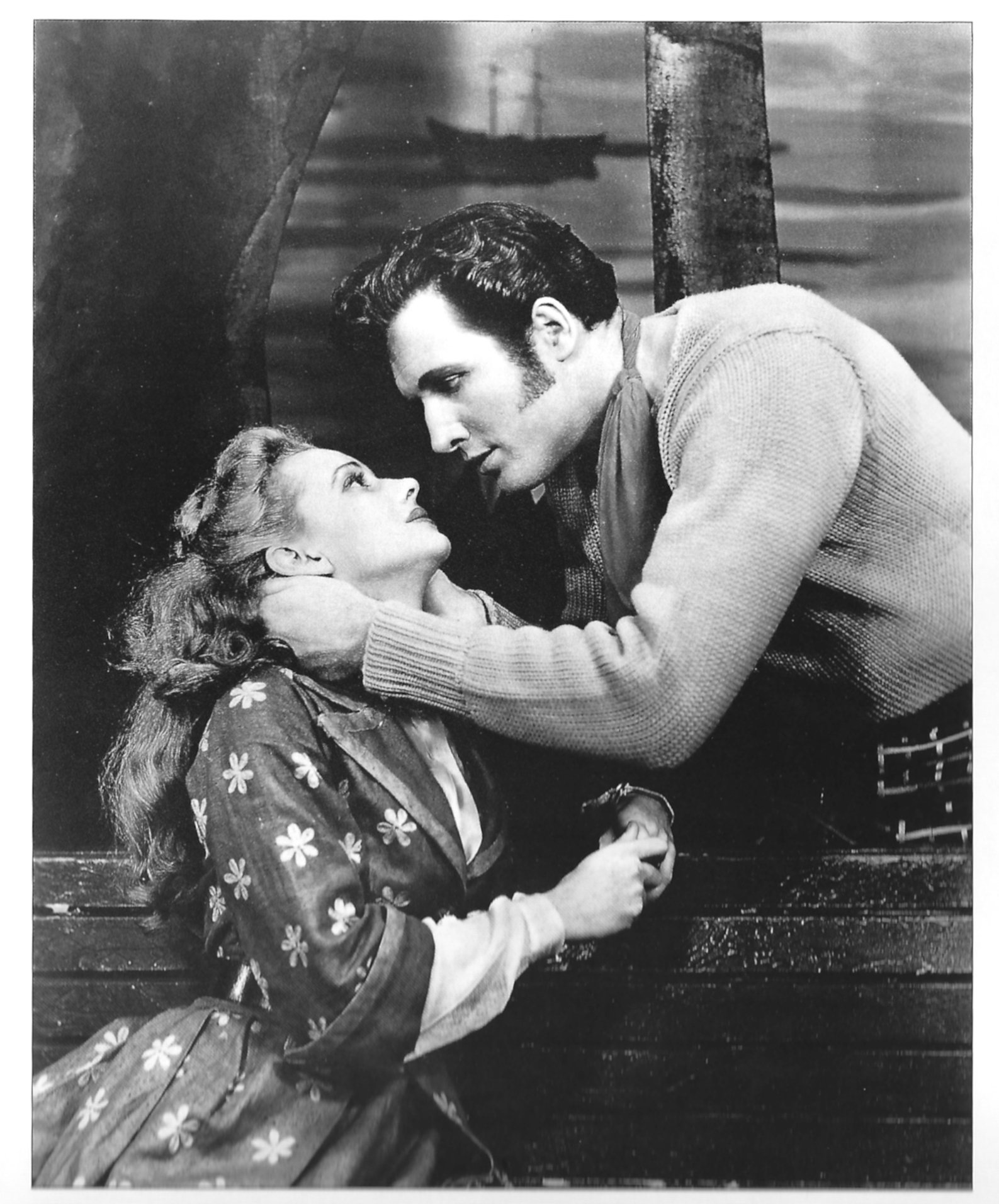
So there is still time to get your nominations in. Meanwhile, as I was driving home from a Virginia Beach ethics seminar and keeping myself occupied during the three hour drive with the Sirius-XM 50s-60’s-70’s and 80’s stations, I heard this song, by Leslie Gore, from 1964:

With the domestic abuser ethics issue still percolating in my fevered brain, it occurred to me, as it had not before, what a vile message the song sent to teenaged girls. “What else can” Leslie do about her abusive boyfriend? Dump him, that’s what. I wonder if Janay Rice knows this song.

Or sang it. Continue reading

Ethics Observations Regarding The “Little Thing” Letter

Mail call!

Mail call!

Let me begin by stating that I doubt that the now viral “Little Thing” letter is genuine. It may well be bait put on the web (it was first published on Reddit) to trap the worst unethical hypocrites of the pro-abortion movement. If so, it worked, for some pro-choice advocates have received it with deafening, nauseating, self-indicting applause. If, on the other hand, the letter is genuine, it is a chilling confirmation of the ethical gymnastics some abortion apologists put themselves through to rationalize what in their hearts they know to be wrong.

If abortion is ethically tolerable, it cannot involve the willful and unnecessary killing of a human life. Only then is “pro choice” a fair description of the legal and the ethical issues involved: the choice of a woman to end a her pregnancy without ending what she believes to be the life of an innocent child. There are many complex and logically dubious aspects to this. The magic moment, still moving, individually variable and often determined legislatively or judicially with the precision of a coin flip, when “undifferentiated cells” suddenly become a human life worthy of society’s respect and protection, is sometimes defined by the mother’s belief. If she believes she is with child, someone else killing that child may be charged with some form of murder. If she decides that it is no more human than a wart or a tumor, she is given leave by the law to kill it without regret or consequences. This means that it is in the interests of a woman who wishes an active sex life and wants to control the timing of motherhood to fit her life plan to tend toward the wart point of view.There is no integrity to defining a key factor in a life and death decision after we have already decided how we want that decision to come out. It is like the Bush administration, having decided that waterboarding is useful, creating legal arguments asserting that an act that had always been regarded as torture wasn’t torture after all. To  many women on the pro-abortion side, unwanted or inconvenient babies are as much enemies as terrorists were to Dick Cheney. Thus life is defined in such a way as to make their war winnable.

This self-delusion, legal fiction, essential myth or convenient belief—pick your favorite—has obviously been very successful, and many women appear to accept it without thinking very deeply about it. If the option of an abortion makes one’s life infinitely more manageable, why begin questioning the ethics of the procedure, especially since about half the public, most of the media, prestigious organizations, the law, a political party and political correctness tenets tell you not to, that the issues are settled? Nonetheless, some women do question it, and do reach the conclusion that it is not a wart or tumor or enemy within them, but rather an innocent, growing, human life.

If and when a woman reaches that conclusion, as inconvenient as it may, then to go ahead with an abortion is unethical, and is, in fact, the ethical equivalent of murder. It is not the legal equivalent of murder, but when a mother believes that she is, through abortion, taking the life of an unborn child that she regards as an individual, I don’t see how it can be termed anything else.

And that is clearly the state of mind of the anonymous author of this letter, if it is genuine: Continue reading

Advice Column Ethics: The Case Of The Anxious Godmother

"look, I'll take your 8 kids if anything happens to you, but I really think you should stop juggling chainsaws..."

“Look, I’ll take your 8 kids if anything happens to you, but I really think you should stop juggling chainsaws…”

The best of all advice columnists, Carolyn Hax, found herself confronted with a tough question this weekend, and uncharacteristically flailed at an answer.

I’m going to try to help her out.

The question came from husband who was trying to decide how to deal with the anxiety of his wife, godmother to two teenagers being raised alone by her brother. The brother, it seems, has decided to take up race car driving as a new hobby, and sister, the wife of Hax’s correspondent, is terrified that this risky pursuit might eventually place the teens in her care. “The kids have been raised in a way that neither of us agrees with, and if they were to come under our care, it would be very difficult for everyone involved,” he writes. What should he do?

Maybe Hax’s reply helps the potential adoptive parent, but I sure found it stuttering, overly equivocal and confusing. It’s not surprising: the issues are difficult, full of ethical conflicts.

Here is my analysis:

1. If one agrees to be the designated guardian of a child or children, one is ethically obligated to be ready to accept the duties of the job. “I’ll take care of your kids happily as long as it’s not your fault that you can’t” just isn’t good enough. Too many people, perhaps most, accept this crucial responsibility as an honor rather than as a very serious commitment, and first and foremost, it is a commitment to the children. If a godmother (or, in a non-religious setting, a guardian) is terrified of the reality of fulfilling the duties of the job, she should give them up, so they can be accepted by someone who is not so reluctant. It shouldn’t matter if the parent is an amateur snake handler or a couch potato.

2. It is reckless, selfish and irresponsible for the sole parent of children to not take this fact into consideration regarding his lifestyle and other choices. Two children depend on him: he is duty bound to do what he can to stay alive, healthy, and capable of supporting them. Taking on unquestionably risky hobby like race car driving, or storm chasing, or being a volunteer human subject for the ebola vaccine, is irrational and wrong. It is right for the potential successor guadians to make this point to him, for the children, for a family intervention, for his friends, for anyone. And they should. He is not free to act as if he has complete autonomy, not with two children who depend on him.

3. If his thinking is “it’s OK to risk my life, because I have two foster parents on the hook,” that is similarly unethical, and he needs to be told that, too. But he should be told it by  guardians/godparents who are still committed to being loving parents should the worst occur, not by a couple that accepted the responsibility assuming they would never actually have to deliver.

The bottom line:

  • The inquirer and his wife should withdraw as guardians.
  • The father should grow up.
  • The next guardian couple should be informed of the father’s irresponsible proclivities, and make his promise to take reasonable efforts to remains capable of raising the children as a condition of their accepting the role.

And, of course, if the worst happens and the father ends up a victim of Dead Man’s Curve without having found a suitable guardian, the sister and her husband may be obligated to raise the orphaned teens anyway.

Because that’s what families are for.

Is that what Carolyn says? I’m not sure. If it is, it wasn’t clear enough.

Dog Custody Ethics From The Vermont Supreme Court

It's a dog's life, whatever THAT means...

It’s a dog’s life, whatever THAT means…

Pet dogs are more than property and less than citizens. When they become surrogate children, as they often do, the legal battles over which member of splitting couples will have custody can become as furious and emotional as anything in “Kramer vs. Kramer.” Now the Vermont Supreme Court has approved a a new approach to these cases, deciding one on the basis of “the best interests of the dog.” Here is the relevant portion of the decision, in the case of Hamet v. Baker: Continue reading

Janay Palmer’s Ethics Fallacy Cornucopia

horn_of_plenty

I suffer pangs of conscience as I do this to Janay Palmer, who has plenty of other pressing problems, but it you are going to put out a public statement on social media that threatens to melt the ethics alarms of millions, you can’t reasonably expect me to stand by and take it.

Palmer produced this on Instagram in response to the NFL’s bizarre do-over on her husband’s punishment, which combined with his team, the Baltimore Ravens, releasing him as persona non grata, effectively makes Ray Rice an ex-star running back for the foreseeable future:

I woke up this morning feeling like I had a horrible nightmare, feeling like I’m mourning the death of my closest friend. But to have to accept the fact that it’s reality is a nightmare in itself. No one knows the pain that the media & unwanted options from the public has caused my family. To make us relive a moment in our lives that we regret every day is a horrible thing. To take something away from the man I love that he has worked his ass off for all his life just to gain ratings is a horrific [sic]. THIS IS OUR LIFE! What don’t you all get. If your intentions were to hurt us, embarrass us, make us feel alone, take all happiness away, you’ve succeeded on so many levels. Just know we will continue to grow & show the world what real love is! Ravensnation we love you!

Observations:

  • Who is her “closest friend?” Ray Rice, her husband and sparring partner? If your best friend is prone to punch you silly in elevators, I think your relationship either has trust issues, or should have. Does she mean his career, which is what actually “died”? That’s telling, if so, and crassly. Was her best friend really Ray’s 8 million dollar a year pay check? Did that justify standing up for the right of rich, famous celebrities to knock their arm-candy around when they think nobody’s looking?
  • Competence check: like it or not, Janay is in the public eye, and what she has to say right now is likely to be read far and wide. How about having someone literate check out your screed before reminding us again what a cheat the public school system is?
  • Janay’s husband beats her unconscious, she lets him get away with it and sends the message to women trapped in abusive relationships that security and a ring is worth the occasional black eye, and her position is that Rice’s demise is the fault of the media and the public? Let’s go to the videotape, shall we?

Continue reading

Presenting Rationalization #45: The Abuser’s License, or “It’s Complicated”

complexity

I owe Carol Costello for this one, which she unveiled today while explaining why it was unfair to criticize Janay Palmer for marrying Ray Rice, the pro football star who punched her lights out in a hotel elevator when they were engaged.  “It’s complicated,” Carol said, as her entire argument, as if this settled the issue.  My rationalization alarm immediately began clanging. Then I thought about all the other times I have heard that explanation used to avoid accountability or blame for wrongful action. Thus Ethics Alarms will add to its useful and always growing Rationalizations List…

45. The Abuser’s License:  “It’s Complicated”

 Costello later noted that the decision to stay with a potentially deadly partner was related to the emotion of love, as if love deserves an ethics pass that other emotions do not qualify for.  In this context, “It’s complicated” is a matched set with #23. Woody’s Excuse: “The heart wants what the heart wants.”

Love does not get a pass, or warrant one. Love is one of the most powerful of the non-ethical consideration magnets that stop ethics alarm clappers from moving when they should, and the sentimental, warm and fuzzy tradition of excusing harmful, irresponsible, clearly wrongful conduct because it might have been motivated by love is a rejection of ethics in favor of romance. Love is not the most benign of impediments to sound ethical reasoning, but rather one of the most insidious. Some of the worst crimes in human history have been rationalized by lovers. If the the coded meaning of “It’s complicated” is “it’s love, and we can never plumb the mysteries of the heart!”, the sentiment should be received with exactly the same contempt as “It’s greed,” It’s hate,” or “It’s revenge.”  Continue reading

Unethical Website Of The Month: OKCupid…The First Corporate Fick!

cupid5af

The ignominy of mere Ethics Dunce status is too good for OKCupid CEO Christian Rudder and his online dating service, and Unethical Website of the Month doesn’t do it justice either. The online dating website has revealed itself as an ethics outlaw, and a smug one. It is lying to its customers,  toying with the lives of vulnerable people who trust it, and doesn’t see anything wrong with its conduct.

That qualifies OKCupid as a Corporate Fick, the first ever so-identified here. As stated in the blog glossary of terms and concepts, a fick is someone who openly and blatantly violates social norms of responsibility, honesty or fairness without shame or remorse. That description fits OKCupid to a fare-thee-well.

In case you missed the story, the website revealed—proudly, in fact—that it intentionally set up users with bad dates, or mismatched by its own compatibility formulas, to see how people would behave. The uproar over Facebook’s undisclosed manipulation of users’ moods prompted the disclosure.Facebook’s experiment violated research ethics standards, and the company was misrepresenting both law and ethics when it claimed that they had Facebook user’s consent to use them as cyber lab rats. That was bad. This is infinitely worse. Continue reading

Comment of the Day: “The Ray Rice Affair: Defending Stephen Smith (and Blaming the Victims Of Domestic Abuse When They Behave Like Rice’s)”


"I'm going to slug you, and then you sing a lovely song about how you love me anyway, and it doesn't matter in the great scheme of things. OK?"

“I’m going to slug you, and then you sing a lovely song about how you love me anyway, and it doesn’t matter in the great scheme of things. OK?”

Steve-O-in-NJ sent in a thoughtful elaboration on the issue underlying my previous post regarding the obligation of abused women to end their relationship with abuser, and certainly not deepen it. He gets extra credit for quoting a lyric from “Carousel” in response to my post’s use of a similar themed lyric from “Show Boat.” (I wonder how many Broadway and popular songs are laments by abused women? The Rodgers and Hammerstein classic “Carousel’s” protagonist is an abuser: one woman he strikes says that the blow “felt like a kiss.” Gee, if he threw her down the stairs, would it feel like a hug?)

Here is Steve’s Comment of the Day on the post, The Ray Rice Affair: Defending Stephen Smith (and Blaming the Victims Of Domestic Abuse When They Behave Like Rice’s)

There’s an Italian proverb to the effect that no one else should enter into the discussions between husband and wife. I’m personally acquainted with one couple where things went bad after the wedding because the husband decided his wife was no longer so good-looking after she didn’t quite lose all the weight she gained during her first pregnancy. I’m also acquainted with another couple, mostly with the wife, in which the husband both verbally and physically abused the wife for months before the wedding, but she married him anyway, and now with the birth of their first child it appears that life is perfect.

For a long time prior to the second couple’s wedding I listened to the now-wife’s constant complaining and gave her exactly the advice set forth above. It fell on deaf ears, and I paid a draining emotional price. Because of that, when the wife in the first couple came to me in tears because the husband’s attention had turned to some hot number with tattoos and piercings, I turned her away and told her to work it out, I didn’t have the time or the inclination to listen to this nonsense again, when all it would probably result in was her going back with him after burdening me with her problems, leaving me the loser. I should also mention that the wife in the second relationship had been in relationships with at least two other men who beat her prior to the one she actually married.

It’s hard to say that there’s a war on women when some of the women actively walk into the line of fire and toss logic to the wind (“What’s the Use of Wondrin’?”) and burden society’s resources by welcoming their 911 rescue only to drop all charges once they see their men in cuffs, leaving the cops and prosecutors wondering why they even bothered.

It’s generally an accepted practice that if you call for the paramedics because you feel ill or are injured, but decline to go to the hospital, you have to sign a form generally called an AMA (against medical advice) form, absolving them from liability. I would suggest that a similar form be adopted for domestic violence situations, where, if the woman declines to press charges, she has to sign a form saying she is doing so, and perhaps a second form where she has to sign off if she declines to leave the relationship. Then the police keep these forms on file, and when they get another call from the same address about the same stuff, they can give it a lower priority or ignore it altogether in favor of pursuing the shots fired or burglary in progress calls. It isn’t society’s job to help those who refuse to help themselves, nor to be a maid or valet service cleaning up after messy relationships but never able to get at the source. Society has an obligation to properly husband its limited resources, and members of society have an obligation not to become a drain on those resources.

Continue reading

Ethics Hero, Mother’s Day Division: NBA MVP Kevin Durant

kevin-durant-nba-kevin-durant-mvp-press-conference2

Just in time to temporarily relieve the National Basketball Association from public exposure of its expediency, hypocrisy and criminalization of thought, and also just in time for Mother’s Day, Oklahoma Thunder forward Kevin Durant delivered an ethics slam-dunk of an acceptance speech when he was honored with the league’s Most Valuable Player Award.

‘Tis not always thus. Another NBA great, Michael Jordan, revealed the bleakness of his character in his nauseating speech upon being admitted to pro basketball’s Hall of Fame, settling old grudges and celebrating himself. Durant, in glorious contrast, was graceful, humble, sincere, gracious, and filled with gratitude, particularly toward his mother, who was in the audience. It takes a sense of fairness, respect and perspective, as well as confidence,  to use the spotlight at an event that honors you to shift attention to others, and that is what Durant did. His speech itself is proof that his mother raised him well, and his words drove the message home:

“One my best memories I have is when we moved into our first apartment. No bed, no furniture, we all just sat in the living room and just hugged each other. We thought we made it. … You wake me up in the middle of the night in the summertime, making me run up a hill, making me do push-ups. Screaming at me from the sidelines of my games at eight or nine years old … When you didn’t eat, you made sure we ate. You went to sleep hungry. You sacrificed for us. You’re the real MVP.”

Here is his entire speech, displaying an ethical character that can’t be faked.

Ethics Hero: Pasco High School (Dade City, Fla.)

Graduate

I need this story to get the previous post out of my head.

In Mark Harris’s novel “Bang The Drum Slowly,” best known as the inspiration for the film that introduced Robert DeNiro to the movie-going public, a major league baseball team exhibits uncharacteristic kindness toward a third-string catcher who is dying of Hodgkin’s Disease. The book, like the film and the stage adaptation, is about kindness and the Golden Rule, an ethical value that seldom inspires literature or art. Kindness is not particularly exciting, but it may be the most ethical of all ethical virtues. The serious illness and impending death of someone in our life often brings the importance of kindness into sharp focus. “Everybody’d be nice to you if they knew you were dying,” says the doomed catcher, Bruce Pearson, to his room mate and champion, star pitcher Henry Wiggen.  “Everybody knows everybody is dying,” Wiggen replies. “That’s why people are as good as they are.”

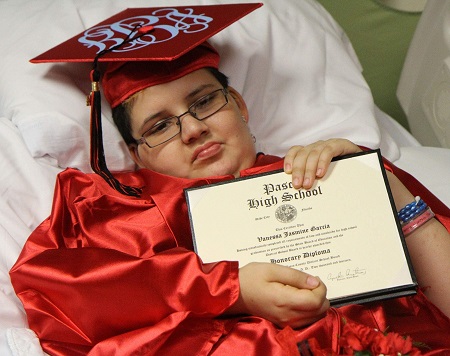
Pasco High School student Vanessa Garcia  learned that she had an inoperable brain tumor when she was in elementary school. Until two years ago, treatment had kept the tumor  in remission, but the mass began growing again when she was 15. Undaunted, Garcia continued to go to school, work diligently, and keep a positive and uncomplaining outlook, earning the admiration of her classmates, teachers and school officials. Continue reading