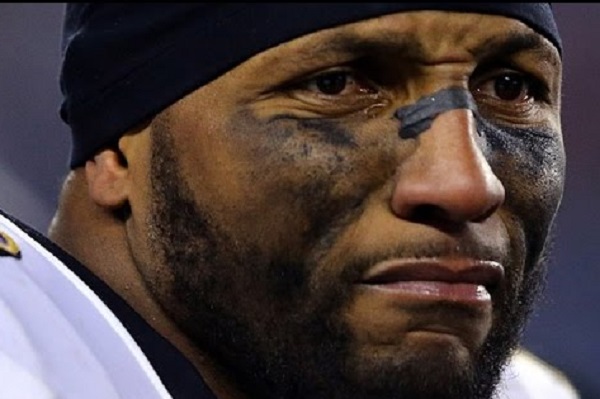
This past Saturday night in Green Bay, Wisconsin, Isiah Bolden, a cornerback for the Ne England Patriots, collided with a teammate, lay motionless on the ground, and was put on a cart to be rolled off the field. Though there was little more than 10 minutes to play, the NFL canceled the rest of the game. Patriots coach Bill Belichick praised the NFL for acting quickly. Patriots players then praised Belichick. Bolden was released from the hospital the next morning and appeared to be in good health, but the Patriots canceled a pair scheduled of joint practices anyway.
Conservative political pundit and sports commentator Jason Whitlock wrote of the episode, “The enemies of football and masculinity have won. They killed football. They won the long war of convincing men that the key to happiness is choosing safety over freedom, safety over everything.” Whitlock is saying, in essence, that the incident has greater significance beyond football, that it demonstrates that the progressive weenification of the culture has reached a critical and dangerous level that has ominous implications for American society at large.
There is only one ethical way to cast a play, musical or movie: pick the actor whose portrayal will most entertain the audience and realize the full potential of the script. Casting is not the place (if anywhere is) for political correctness, quotas, “diversity,” or affirmative action.
Ethics Alarms is full of discussions of this issue, most recently here, in the post just last week about how Disney decided it was offensive to cast seven little people as the Seven Dwarfs in “Snow White and the Seven Dwarfs.” Hollywood and Broadway are completely confused and hypocritical in this area, because the people who run both places are 1) desperate to be seen as progressive and to signal their virtue at every opportunity, 2) terrified of being branded as non-woke, giving extreme activist groups representing various tribes and interests groups the upper hand in their bullying efforts, and 3) not very bright, frankly.
This is why a Samoan-African American actor was found insufficiently black to play folk legend John Henry, but a black woman was cast as red-headed fish-girl Ariel in “The Little Mermaid,” and the Founding Fathers ended up being portrayed by black, Asian, and Hispanic women and “non-binary” performers in the revival of “1776.” Tom Hanks now says only gay actors should play gay characters, but a director who refused to cast a gay actor as a non-gay character would be run out of the business. It is, as I have written here before, Calvinball.
Back in March, Ethics Alarms discussed the ethical issues implicated when marketing departments begin using Artificial Intelligence to “increase the number and diversity of our models for our products in a sustainable way,” as one retailer phrased it. The scenario echoed the plot of “Looker,” a 1981 Michael Crichton science fiction thriller in which a high-tech research firm convinces companies that real, live models, even after cosmetic surgery, can’t approach the physical perfection that will optimally influence consumers. In its diabolical scheme, models are offered a contracts to have their faces and figures scanned to create 3D computer-generated avatars, indistinguishable from the live versions, which would be animated by A.I. programs for use in TV commercials. Once their bodies are duplicated digitally, the human beings get lifetime paychecks and can retire, since their more perfect CGI dopplegangers will be doing their work for them. As he did so often during his brilliant, too-sort life, Crichton anticipated a serious ethical crisis arising out of developing technology. “Looker” is almost here.
Last week,the 160,000-member union SAG-AFTRA announced that it would join the the screenwriters union in its industry strike after failing to secure a new contract with movie studios and streaming services. The Screen ActorsGuild and American Federation of Television and Radio Artists President Fran Drescher—yes, “The Nanny” herself—- condemned the AMPTP’s “shameful” and “disgusting” treatment of the union’s members. Among the major points of dispute is how to preserve acting and writing jobs that could soon be imperiled by the rapid development of computer technology and artificial intelligence.
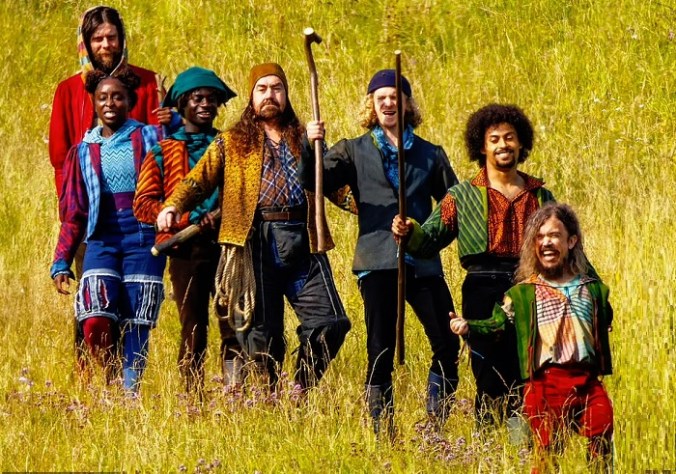
Yes, those are “the Seven Dwarfs” of “Snow White and” fame, according to our national steward of childhood fantasy and iconic fables, the Disney Corporation. That photo is smoking gun evidence of insanity, a production shot from the upcoming live action version of the 1937 movie that made Walt Disney’s artistic vision a cultural force, now retitled “Snow White.” Of course Snow White is going to be Snow Of Color, as the actress playing the German fairy tale princess is Latina Rachel Zegler, who has already embraced the company’s current “screw tradition, common sense and legacy” attitude by tweeting, “Yes I am Snow White; no, I am not bleaching my skin for the role.”
You do recall why Snow White was called Snow White, right?
Disney has a man in a dress working in the dress store for little girls at Disneyland. This is who Disney wants girls to see when they first walk in to pick out a dress. pic.twitter.com/Ta2dwyAaSa
For a couple of weeks now, I’ve been planning a long post examining what Disney’s mission and methodology need to be in 21st Century America. Walt’s creation faces an important challenge and a difficult one, and I would hope that the people responsible for guiding a company whose role in shaping U.S. culture has been both successful and beneficent as well as profitable are up to the task. They had better be, for the sake of the culture, not merely stockholders.
I was well on the way to devising a post I felt would be perceptive and provocative when I saw the video above. That stopped me cold. I wasn’t exactly optimistic about Disney, which has been a major positive influence in my own life, being able to safely navigate around the cultural icebergs in the roiling societal seas ahead before I watched the thing, but now I am as confused as I am depressed.
The classic starting point for ethical analysis is “What’s going on here?” In this case, it is more appropriate to ask, “What THE HELL is going on here?”
If you watch TV even half as much as I do, the image of the Federal Bureau of Investigation hammered into your skull weekly is that of the most dedicated, well-trained, well-run and honorable law enforcement organization on Earth. There are three hour-long dramas focusing on the FBI’s heroism; its work is also central to “Blacklist.” On the streaming platforms and on cable, special series and older FBI-centered shows are abundant: “Criminal Minds,” “Without a Trace,” “White Collar,” “Night Agent,” “The X-Files,” “Blindspot,” “Quantico,” “The Rookie,” “Shooter”…too many to list, so I won’t list them all. Movies in which FBI agents are the heroes are legion There is no agency or organization that has a more suffocating and relentless indoctrination presence in the popular culture than the FBI.
It is no wonder the that public and the media are inclined to pooh-pooh or ignore entirely the massive evidence of sinister and illegal FBI activities devoted to bringing down the Trump administration, the machinations of James Comey, and the other scandals. Periodically some glimmers of the corruption and abuse of power that has infected the FBI’s culture since the long reign of its shadowy creator J. Edgar Hoover sneak into various programs: the lying FBI forensic expert whose work is exposed in the documentary “Staircase;” and the two excellent docudramas exploring the horrors of Waco and its cover-up are examples.
Clearly, the time has come to discard the presumption of virtue that has protected the FBI for generations. It is at least as inept, corrupt, politicized and incompetent as the rest of federal government, and perhaps even more so.
An episode in Boston earlier this month—barely reported by the mainstream media, of course—strongly hints at an “Emperor’s New Clothes” situation. The FBI was holding a special training exercise at the Revere Hotel in downtown Boston in coordination with the U.S. Army. Role players—that is, actors—were supposed to help create a realistic simulation for the agents who had to react to unexpected developments. Around 10 p.m. on the evening of April 6, FBI agents banged loudly on the door of the room where a Delta Air Lines pilot was staying. The surprised guest was handcuffed when he opened the door, detained and interrogated, and thrown into the shower.
Netflix is telling its subscribers that Cleopatra was black, but both Cleopatra and I come from Greek stock, so if she was black, I must be too. This is just the break I have been waiting for after seeing my legal ethics training business torn to pieces by the stupid Wuhan virus lockdown, and income reduced to trickle that cannot be restored to its previous whoosh! Now that I can market my services as one of the very few blacks in the field, whole new vistas are open to me. Thanks, Netflix!
But I’m getting ahead of myself. Sorry, I’m just giddy.
A new Netflix new docu-series, “African Queens: Queen Cleopatra,” stars black British actress Adele James as the fabled Egyptian ruler. Producer Jada Pinkett Smith (yes, she’s the one her husband slapped Chis Rock over) has said that “she wanted to tell the story because ‘”we don’t often get to see or hear stories about black queens.” Somebody should tell Jada that one reason for that is that they prefer to tell the stories of white queens and pretend they are black, as when the very white second wife of King Henry the VIII was cast as being black in 2021 British mini-series. As I pointed out in the linked post, this kind of fantasy revisionism is considered benign—DEI, man!—-while casting a white women to play a black one would be “whitewashing” and racist. Similarly, casting a black actress to play the red-haired, fishy-white Little Mermaid in Disney’s life action version of the animated classic is hunky-dory, but using computer magic to make the black version of whitefish Ariel white again is racist. Clear?
Some misguided fool at the conservative polling operation Rasmussen Reports convinced the gang to ask 1,000 randomly chosen Americans two questions:
1. Do you agree or disagree with this statement: “It’s OK to be white”?
2. Do you agree or disagree with this statement: “Black people can be racist, too”?
Question #1 is unforgivable—incompetent, irresponsible, unethical. “It’s OK to be white” was designed as parallel “gotcha!” linguistic retort to “Black lives matter,” an equivalent to “When did you stop beating your wife?” What does it mean? Agreeing with “It’s OK to be white” might mean, “I reject the premise behind Black Lives Matter and Critical Race Theory!” It also could mean, “Of course it’s okay to be white; any other position is racist.”
Disagreeing with the statement might mean, “I see what you’re doing there: trying to weasel out of white society’s obligation to recognize the intrinsic injustices it inflicts on black citizens!” Or it might mean, “I hate those honky bastards! They’re all the same: evil.” Without defining terms, no poll is legitimate.
I have a confession to make. I know that the ethical and moral deterioration of the Disney corporation is a major ethics catastrophe with dire consequences for our society and culture, and Ethics Alarms should have been covering it more thoroughly. It hasn’t, and that’s because this topic is particularly painful for me.
I owe so much to Disney’s creations and philosophy. I learned a lot of ethics from the shows and movies growing up, and many of my most enduring and important interests and hobbies were inspired by Walt’s vision. My fascination with dinosaurs began with the terrifying T-Rex sequence in “The Rite of Spring” segment of “Fantasia,” for example. My reverence for the Alamo was inspired by Disney’s “Davy Crockett” series. The first dramatic production of any kind that genuinely move me was “Bambi.” I never got to visit a Disney theme park until college, but finally going to Disneyland after dreaming about it as a kid was one of the epiphanal experiences of my entire life:it was perhaps the only time something I had looked forward to was even better than I expected it to be. Disney’s perfectionism—at the parks, which were immaculate and overlooked no detail to immerse visitors in the fantasy, and in the TV shows and movies—influenced my own view of professionalism and my approach to directing for the stage. His courage and certitude in pursuing risky creative projects that everyone was telling him were doomed to fail—a full length animated film?—bolstered my own resolve when I have had project ideas that seemed nuts to everyone but me.
(And some were nuts, as it turned out. But the times I was right more than made up for those.)
I could go on, but I won’t. The point is that attacking Disney for me is like savaging a childhood hero, or even a parent. But the country, its culture and mental health is being harmed by the current distortion of Walt’s creation’s destructive alliance with the radical Left. It deserves to be attacked, and it’s time I got down to it.
This Comment of the Day (actually two comments, in sequence) by jmv0405 on the depressing post yesterday on a Disney Critical Race Theory video, makes up for some of that lost time by getting the discussion jump-started. It is also a perceptive and illuminating perspective that I wouldn’t have seen without the comment’s guidance.Continue reading →
I don’t like being shouted at by cartoon characters. Even if they had a valid point, my response to this kind of assaultive advocacy is, has ever been, and always will be…