I started really being annoyed at this when “The Gilmore Girls,” an annoying chick TV series to begin with, began featuring the single mom’s boyfriend who wore his cap like the guy in the photo. The graphic is a screen shot from a Tik-Tok video in which the guy is railing against wearing caps like that because you look like an idiot when you do. Verdict: True. In fact, I assume anyone who wears a baseball cap that way IS an idiot. It looks stupid, it defeats the purpose of the brim—there is no excuse for it whatsoever, except, in the opinion of the guy in the video, it is an attempt to look “like a ‘bad boy.'”
I decided to skip this issue a month ago when comic Amy Schumer was being called a hypocrite for suddenly showing off her newly svelte, Ozempic-drowned body all over social media after spending years defending being”plus size.” Then she posted bikini photos yesterday and social media was freaking out again.
“I think there’s nothing wrong with being plus size,” Schumer argued in a tiff with Glamour Magazine a decade ago. “Beautiful healthy women.” Amy got progressively more plus-size as the years went by and was more militantly anti-fatshaming as a “body-positivity” advocate while the pounds piled on.
Today I woke up to a new year and made the mistake of allowing my screen to land on Fox News. The gang was seriously interviewing an astrologer. On a news show. She was enthusing about what a wonderful month January is, because the moon is in all kinds of “houses,” or something.
I refuse to watch the movie “Network” again because I know it would send me to the bridge. So many of the seemingly absurd programs screenwriter Paddy Cheyefsky concocted for his dark 1976 satire about a fictional TV network that abandons all integrity and only aims to entertain and inflame the public have come to pass—reality shows, sick competitions, ranting pundits and worse—that the famous film can no longer be amusing. It’s horrifying that the decline of the medium and its journalism particularly has come to pass when this seemed so impossible 50 years ago.
One of the shows on “Network” featured a mystic who predicted the news. Of course Fox News would go down that metaphorical sewer. A real psychic would have seen it coming…
I was looking for an appropriate “Night Before Christmas” post and found this instead, a parody I wrote on Christmas Eve in 2009, the very first year of Ethics Alarms, in reaction to the ethically-tainted passage of the “Affordable Care Act,” which didn’t make health care affordable. I knew the bill was smoke and mirrors and that it would not accomplish what it was supposed to do. I knew that we would be in one mess or another as a result of the ugly thing, supposedly the signature legislation of the Obama Administration…and sad thing is that it probably was. What does that tell you?
I was struck, as you will be, how much of my mordant satire seems relevant today, and how little has changed.
So let’s travel back to that halcyon year, and the day before Christmas…
It’s the day before Christmas, and all though my house, there’s no sign of Christmas, but I’ve no right to grouse…
…because it’s my choice to be solitary and miserable this season. Two days ago my adult heir gratuitously sent me a hate bomb that was the most hurtful communication I have ever received from anyone. Given that this individual lives rent free in an apartment in my house and is over 30, I expected just a teeny-weeny bit of, if not gratitude, respect. Uh, no. This was only the latest joy-extracting event this holiday season: I also just wounded my leg (the same one that put me in the hospital in July and hasn’t healed completely yet), I was fired from my oldest ethics gig (as with the unexpected attack from downstairs, the reason is obscure) and the number of administrative Swords of Damocles hanging over my head since Grace died last year have increased rather than diminished, as was my grand plan for 2025. So I’m taking pleasure in other people’s Christmas, including yours. So you better have a great one. Tonight I expect to be playing bridge with three ghosts.
Or heading to the bridge, like George Bailey.
Below is an updated and rewritten version of my earlier post about my favorite modern Christmas song, “Do You Hear What I Hear?” When I still had a professional theater company to oversee, I wrote and directed a musical revue called “An American Century Christmas.” It was staged like one of those old-fashioned TV Christmas specials, with the set decorated like a Christmas living room, and celebrity guests arriving with gifts.
I stuffed everything I loved about the seasonal entertainment into the thing: the scene in “The Homecoming” when John-Boy gets his tablets from his father; the scene in “It’s a Wonderful Life” when George gets emotional realizing that he’s in love with Mary while talking to Sam (Hee-haw!) Wainwright on the telephone; Danny and Bing standing in for the Haines Sisters and singing “Sisters:” a reading of “The Littlest Angel;” the Peanuts kids and Snoopy decorating Charlie Brown’s sickly tree. I don’t think anyone liked that show as much as I did, but so what. It made me happy. Even remembering it now makes me happy.
The first act finale was a rousing rendition of “Do You Hear What I Hear?” The song means a lot to me, and I’ll be blasting the original version tonight.
Before you make a public statement that will guarantee that you will become a poster-mayor for the usual “War on Christmas” battles, it might be wise to check legal history regardless of which position you take.
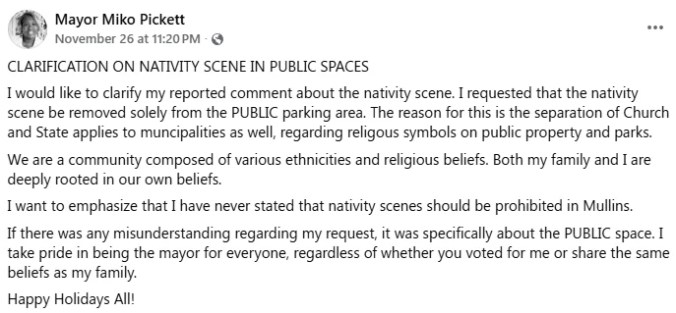
Mayor Miko Pickett, the “historic” first black mayor of Mullins, South Carolina, ordered this season’s Nativity scene removed from a public parking lot due to “separation of church and state.” The town happily ignored her. Not surprisingly, she had based her decision on “diversity” and “inclusion” principles and the “separation of Church and State.”
Naturally, she opted for the politically correct “Happy Holidays.” But the mayor may have had a point.
Madison Wisconsin Ann Althouse, who tries admirably hard to suppress her natural left-leaning biases and I admire her for that, wrote a statement over the weekend that perfectly encapsulates what is so seductive and destructive about the progressive mindset.
I didn’t know what to do with it. I was temped to make it an Unethical Quote of the Month, but it’s not really unethical; it’s just dumb. (Also Trump’s outrageous attack on Rob Reiner locked up that distinction. I’m pretty sure it is also the most unethical quote of 2025.) It is so dumb, however, that I am tempted to say Althouse failed her duty of influence and expertise. Smart people who are expected to provide intellectual and emotional guidance have to take care that they don’t mislead the people who trust them.
Her statement was…“It shouldn’t be possible to become famous through murder, but it very clearly is.”
What a silly, utopian, “Imagine”-esque thing to say, out loud or on a blog (the internet is forever). It is, however, a near perfect example of the how the progressive delusion gene makes people believe in, advocate, and administer terrible policies that can’t possibly do anything but backfire horribly, and can’t possibly work.
It is one thing for someone to think along those lines in a moment of panic or stress. That’s excusable, though my late wife, “E2” in the EA comments, was always annoyed when characters in movies or TV shows would scream, “This can’t be happening!” The political Left is constantly gulled into thinking the realities of life can somehow be banished by a well-meaning program, law or policy. That’ where communism and socialism ooze from: surely there’s a way for everyone in a successful society to be happy, healthy, safe and having the benefit of sufficient food, living space and employment!
[Johnny Mathisfinally announced his retirement this year—he’s only 90. His has been one of the most recognizable, enjoyable, seductive voices in American popular music for almost 70 years. My college room mate always had his records on hand to create the proper mood for his dates. An old time crooner’s chances of being remembered rests now on whether there is a Christmas standard he can be associated with. Johnny’s best shots are “It’s Beginning to Lot Like Christmas,” and “We Need a Little Christmas” from “Mame.” He sings all the others beautifully too, but they are taken.]
I was informed by a fellow Christmas movie fan that it is almost impossible to watch the original “Miracle on 34th Street” film on streaming services or the networks. They prefer to show the various remakes, all inferior in every way. What made director-writer George Seaton‘s movie (it won him an Oscar) so superb in addition to the casting, his straight-forward style and his obvious love of Christmas is that it instantly felt perfect despite its many suspension of disbelief challenges. Why do they feel this film has to be remade? Is it the lack of color? (“Miracle on 34th Street” was one of the first movies Ted Turner colorizes, and that version is unwatchable.)
As I’ve stated here before I believed in Santa Claus until I was 12. I didn’t want to give the fantasy up: I loved magic, and my parents always tried to make the season magical. My late wife Grace and I tried to do the same with Grant, now “Samantha,” but he was a non-believer by the third grade. Is there anything more joyful to see than the look on a child’s face as he or she wakes up to find what Santa has delivered? Will anything feel that wonderful again?
“Miracle on 34th Street” is an ethics movie in many ways. The movie is about the importance of believing in good things, hopeful things, even impossible things. The movie reminds us that wonderful things can happen even when they seem impossible, and that life is better when we believe that every day of our lives. I’m engaged in that right now: all of 2025 has required it. I’ve had serious injuries, successes, new projects and setbacks. My father taught me to be ready for the worst but to never to give up on the best.
One thing this film does well is to concentrate on the secular holiday without any allusions to the religious holy day, but not being obnoxious about it. “It’s a Wonderful Life” also straddles the line very cleverly: it begins in heaven, after all. All the “A Christmas Carol” films include Bob Cratchit telling his wife that Tiny Tim mused about how his disability reminded people of Jesus’s miracles at Christmastime, and that’s Dickens’ only reference to Jesus in his story.
On the offensive side is the Rankin-Bass animated “Rudolph the Red-Nosed Reindeer”—I can’t believe they still show that thing—when the “stormy Christmas Eve” causes Santa to decide to “cancel Christmas.” I’d say that’s above Santa’s pay grade, wouldn’t you agree? It also suggests that Christmas is only about gifts and children. (Do parents today explain that the singing snowman who narrates the story is based on, and looks like) the real person who also sings the most memorable songs? They should. Burl Ives had a fascinating life and a varied career, and those kids will probably be hearing him sing “Have a Holly Jolly Christmas” for the rest of theirs.
Interestingly, all of the perennial Christmas movies have been made into stage musicals of varying success—“White Christmas,” “It’s a Wonderful Life,” “A Christmas Story,” “Elf”—- but “Miracle on 34th Street” flopped so badly when Meredith Willson [“The Music Man”] adapted it as “Here’s Love” on Broadway that nobody has tried again. The show included the song, “It’s Beginning to Look a Lot Like Christmas,” which Willson wrote long before the show was assembled. But as with all the movie remakes, the show missed Edmund Gwynn, the best Kris Kringle of them all. He was a distinguished classical actor until that movie: he complained that after the film he wasn’t allowed to get rid of his bushy white beard and was type-cast as jolly old men.
I decided to post the Companion earlier this year; I also was moved by the fact that a number of EA readers had sought out the 2024 version today. When I’ve posted it on Christmas Eve, it has lacked views for the obvious reasons.
The 2025 companion reflects some additional thoughts upon my re-watching “Miracle on 34th Street” last week—I even took notes. Mostly, I though about how important the holiday, the stories, the music, the movies and what they signify taken as a whole is to our nation, our society and our culture. Thus it was that I decided that here was a good place to re-post “Christmas, the Ethical Holiday” Besides, I need to read it myself.
Christmas: the Ethical Holiday
Benjamin Franklin recognized the importance of regularly focusing one’s attention on ethical conduct rather than the usual non-ethical goals, needs, desires and impulses that usually occupy the thoughts of even the most virtuous among us. He suggested that every morning an individual should challenge himself to do good during the day. In the 21st century psychologists call this “priming,” a form of beneficial self-brain-washing that plants the seeds of future choices.
The Christmas season operates as an effective form of mass population priming, using tradition, lore, music, poetry, ritual, literature, art and entertainment to celebrate basic ethical virtues and exemplary conduct toward other human beings. Kindness, love, forgiveness, empathy, generosity, charity, sacrifice, selflessness, respect, caring, peacefulness…all of these are part of the message of Christmas, which has become more universal and influential in its societal and behavioral importance than its religious origins could have ever accomplished alone. Secular and cultural contributions have greatly strengthened the ethical lessons of Christmas. “It’s A Wonderful Life” urges us to value our ability to enrich the lives of others, and to appreciate the way they enrich ours. “A Christmas Story” reminds us to make childhood a magical time when wishes can come true. O. Henry’s story “The Gift of the Magi” proves that it is not the value of gifts, but the love that motivates them that truly matters. Most powerful of all, Charles Dickens’ “A Christmas Carol” teaches that the admirable conduct the spirit of the season can inspire need not be short-lived, and that if we use Christmas properly, as Ben Franklin used his morning exhortation to good conduct, it can make all of us better, happier, more virtuous human beings.
At this point in civilization, the religious context of Christmas almost does more harm than good. Though the day chosen to celebrate Jesus of Nazareth’s birthday has been spectacularly successful in promoting the ethical and moral ideals he taught, the idea that Christmas is indistinguishable from the religion he founded has made it the object of yearly controversy, as if celebrating Christmas is an affront to other faiths.
This is a tragedy, because every human being, regardless of religious belief, can benefit from a culture-wide exhortation to be good and to do good. “Happy Holidays!”—the bland, generic, careful greeting of those afraid to offend those who should not be offended—does nothing to spur us toward love, kindness, peace and empathy. “Merry Christmas!” does.
This is not just a religious holiday; it is the culture-wide ethical holiday, the time when everything should be aligned to remind us to take stock of our lives, think about everyone else who lives on earth with us, and to try to live for others as well as ourselves. Christians should be proud that their religion gave such a valuable gift to humanity, and non-Christians should be eager to accept that gift, with thanks.
It is foolish and self-destructive for there to be a “war on Christmas.” Charles Dickens understood. There is hardly a word about religion anywhere in his story. There doesn’t need to be. Christmas is the ethical holiday. Christians and non-Christians can celebrate it or not as they choose, but whether they do or not, the Christmas season is more important than any one religion, even the one that gives the holiday its name.
Christmas is important because it primes us to be good, be better, be more ethical, for the rest of the year. There should be nothing controversial about that.
Well this is all I needed on a busy day that just included me re-injuring my leg after being pulled off my feet by Spuds. The post below is based on a hoax, and damn the hoaxers to hell. Spreading false stories on the web is unethical, and satire sites are obligated to signal when a post is intended as parody. A few notes:
1. Thanks to the crack EA commentariate for flagging this.
2. The fake story is still up on the usually reliable conservative commentary site Victory Girls, which linked to the fake story I used.
3. I was fooled because first, none of the quotes sounded unlikely given what we have heard and witnessed in Portland in the recent past, and
4. I had never seen a “butt plug” before.I apologize to Ethics Alarms readers and the City of Portland. I try to be careful, but this time I was fooled.
5. Apparently the hoax was inspired by Portland’s city officials this year referring to their annual tree lighting event as just “the tree” or “winter tree,” deliberately omitting the word “Christmas.” Typical dumb Portland wokeness at work: if the hoaxers had only made it clear what they were spoofing, I’d call it a successful and well-deserved satire.
6. I apologize to all, including the City of Portland, for my error.
***
I missed this, which happened about a week ago, in part because I view Portland as a lost cause. You know those zombie apocalypse movies where the survivors will say, sadly, “Boston’s gone, San Diego’s gone”? Portland’s gone, and has been for a long time. I would say it’s Patient Zero for Trump Derangement, woke insanity, anti-Americanism and The Great Stupid, except there are so many other candidates: New York City, California, Minnesota. None of them, however, have descended so far into incompetent cultural madness as Portland, as exemplified by the Christmas, sorry, Holiday Thing the city unveiled this month.
Portland officially replaced its traditional Christmas tree—to be fair, it’s so hard to find evergreen trees in Oregon these days—with that whatever it is above. Officials described the holiday display as “bold,” “inclusive,” and “a meaningful departure from tree-based expectations.”
How far gone do you have to be to utter the words “tree-based expectations” without feeling ridiculous?
City leaders, presumably the same ones who let Black Lives Matter take over parts of the city five year sago, explained the traditional Christmas tree ultimately failed to reflect Portland’s “evolving” relationship with holidays. Thus the “inclusive” replacement, officials said, is intentionally ambiguous, streamlined, and designed to invite interpretation.
I, for example, interpret it as “meaningless, joyless crap.”
I’m rewriting a post from last Christmas that I liked, in part because the ethics news is ticking me off, in part because I am once again having a non-Christmas because I miss my late wife Grace too much to celebrate anything, and in part because the song means a lot to me. I foolishly posted the first version of this last year on Christmas day, guaranteeing that few would read it. I’ll try a bit earlier this time.
I co-wrote two Christmas revues for my late, lamented (by me, anyway) professional theater company in Arlington, Virginia, The American Century Theater. The most popular of the two (though not my personal favorite) was called “If Only In My Dreams,” a title taken from the lyrics of another wistful Christmas song, “I’ll Be Home For Christmas,” by lyricist Kim Gannon and composer Walter Kent. It was introduced by Bing Crosby in 1943—it’s amazing how many of our secular Christmas songs were first recorded by Bing. Well, maybe not so amazing: what was amazing was the range and warmth of his voice.
“If Only In My Dreams” was constructed around the letters written by GIs overseas during World War II to their families or girlfriends as Christmas loomed. They were published in an issue of American Heritage, a wonderful magazine now, sadly, in the company of Life, Look, and the Saturday Evening Post, gone and nearly forgotten. I alternated those letters with narration and the popular Christmas songs of the period. The brilliant Jacqueline Manger directed the show, which was being written as she rehearsed it.
The most famous and important of these songs was, of course, “White Christmas.” Bing Crosby’s version is still the best selling single of all time, and deserves the title. When Irving Berlin handed the song over to the musician who transcribed his melodies (Irv could not read music and composed by ear, just like another brilliant and prolific tune-smith, Paul McCartney), he famously announced that he had written, not just the best song he had ever created, but the best song that anyone had ever written. Continue reading →





 Ethics Alarms