“Rogue One” Ethics: Peter Cushing Returns From The Grave

He's baaaaack!

He’s baaaaack!

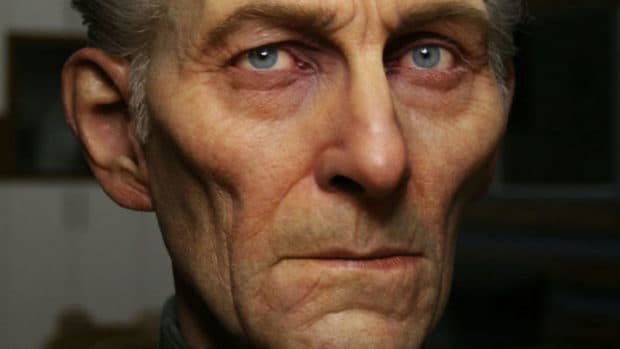
Hammer Films horror icon and Christopher Lee foil Peter Cushing died in 1994 from prostate cancer. That couldn’t stop the makers of the latest “Star Wars” movie from bringing his image back from the grave.  The gaunt-faced British actor—an early “Doctor Who”!—played Grand Moff Tarkin in the original “Star Wars,” a bad guy, Cushing’s specialty. Since “Rogue One,” the current addition to the series, is a prequel, Tarkin is alive again (he went down with the Death Star in Episode IV). Instead of recasting the part, the producers decided to recreate Tarkin/Cushing using CGI technology. Lucasfilm-owned digital effects house Industrial Light & Magic reanimated Cushing’s likeness so that a recognizable Tarkin could make a convincing  appearance in “Rogue One.” The results are not perfect, but it is still one step closer to allowing future movies to cast avatars of long dead stars to interact seamlessly with live performers.

We have recently seen actors like Arnold Schwarzenegger, Jeff Bridges and Anthony Hopkins digitally youthened, but forcing a dead actor’s image to perform is a different matter entirely. The use of computer animated images of dead performers to do the bidding of their director masters evokes memories of “Looker,” a science fiction film directed and written by the late Michael Crichton of “Jurassic Park” and “Westworld” fame. In that 1981 movie, a corporation transferred the images of living models to a computer program that could use the new cyber-models to do and say anything more effectively and attractively than the models themselves in television ads. Then the company had the models killed—less residuals that way.

The emerging technology raises many ethical issues that didn’t have to be considered before, but when it comes to using a dead actor in a new role, the ethics verdict should be easy. It’s unethical, unless a performer  gives informed consent for his image to be used post mortem in this fashion. Presumably, the consent or the lack of it will be part of future negotiations and standard contracts. Actors who agree to have their images used as cyberslaves will also probably want to limit the uses of their names and images. No porn films, for example. No uses of an actor in a role he would have never agreed to playing while alive. Don’t make John Wayne shoot someone in the back. Don’t show Fred Astaire as clumsy on his feet; don’t make Jimmy Cagney a weenie.

Allowing another actor to use a dead one’s face and body, like Andy Serkis wore his cyber King King suit, is a closer call. If it is clear that the dead actor isn’t the one doing the acting, and that digital technology is being used as the equivalent of make-up, maybe that practice is just icky rather than unethical, provided the credits are clear.To make Cushing’s Tarkin live again on screen, “Rogue One’s “film-makers hired Guy Henry, a 56-year-old British actor who resembles Cushing. Henry played the part of Tarkin on the set, then the tech wizards transformed him into a Cushing clone. Continue reading

Late Nominations For 2016 Jerk Of The Year: Lena Dunham And Daniel Goldstein, Ivanka’s Jet Blue Harasser

jet-blue-tweet

I’m pretty sure the Ethics Alarms 2016 Jerk of the Year Award was locked up a while ago, but two new challengers for the title at least strengthen the field:

1. Daniel Goldstein, attorney

Goldstein, in the cabin of a JetBlue flight on which Donald Trump’s daughter, Ivanka, was also a passenger, verbally accosted the soon-to-be First Daughter before take-off. Holding a child in his arms, the New York lawyer started shouting, “Your father is ruining the country!” Then he asked, “Why is she on our flight? She should be flying private!”

Ivanka, who had her own kids in tow, tried to ignore him and attend to her family until he was removed from the flight by JetBlue personnel. “You’re kicking me off for expressing my opinion?” he yelled as he was led off the plane.

What a rude and obnoxious jerk.

Other observations: Continue reading

Yes, Poker Champ Phil Ivey Cheated, Even If He Didn’t Think He Did

baccarat2

Phil Ivey is known as one of the best all-around professional card players in the world, in part because he notices things that other players, even great ones, may not. While playing baccarat at the Borgata Casino in Atlantic City in 2012, Ivey and a friend noticed  inconsistencies on the back of the cards that allowed him to read some of them as if they were marked. He even asked the dealer to position the cards so he could see them better, as in “see what nobody else noticed, giving him an unfair advantage.” Some advantage: he and his associate, Cheng Yin Sun, won $9.6 million at baccarat over four visits to the casino, then won an additional $504,000 betting their winning at the  craps table.

A federal judge has now ruled that the two must repay the $10 million. What they did is called “edge-sorting,” and it is considered cheating, though technically the ruling was that Ivey and Sun breached their contract with the casino.

In baccarat, players bet on the relative value of two hands of two cards each before the hands are dealt or the cards are revealed. The game is  played with six or eight decks of cards placed into a dealing “shoe,” and the object is to bet on the hand that will have a total value closest to nine. If a player knows the value of the first card in the shoe before it’s dealt, the player has a significant advantage over the house. Borgata accused Ivey and Sun of exploiting defects in playing cards manufactured by Gemaco Inc. that were not cut symmetrically during the manufacturing process, so Ivey and Sun were able to spot the manufacturing defects and  read the “marked”  cards without actually touching or defacing them themselves. The New Jersey Casino Controls Act requires that all casino games offer “fair odds to both sides.”  Without intending to or knowing, the casino was creating unfair odds against itself, and these two players made out like bandits as a result.

Ivey’s lawyer argued in a court filing that since his client never touched the cards, his advantage was like the casino trying to distract players with “free alcohol served by only the most curvaceous and voluptuous females in the industry.” Continue reading

President Barack Obama Has Appointed A Zealous And Competent Civil Rights Lawyer To the U.S. Commission On Civil Rights, And There Isn’t A Thing Wrong With That.

Perry Mason would have defended Mumia Abu-Jamal...

Perry Mason would have defended Mumia Abu-Jamal…

President Barack Obama has appointed Debo Adegbile,  who had served as an former attorney for convicted controversial police-killer Mumia Abu-Jamal, to a six-year post on the U.S. Commission on Civil Rights. The eight-member commission consists of four members appointed by the president and four appointed by Congress.

Adegbile worked at the NAACP Legal Defense and Educational Fund when he represented Abu-Jamal in the appeal of his conviction and death sentence for the  1981 shooting death of Philadelphia police officer Daniel Faulkner. Abu-Jamal’s sentence was reduced to life in prison. Predictably, rightish-commentators and of course police groups are highly critical of the appointment, just as they were in 2014 when they and others convinced the Senate to reject Obama’s nomination of  Adegbile to lead the Justice Department’s Office on Civil Rights. Ethics Alarms noted then, in the post, The Right’s Unethical, Ignorant, Un-American And Dangerous Attack On Debo Adegbile,

“It says nothing of Debo Adegbile’s fitness as a public servant that he represented a convicted cop killer, a cannibal, Son of Sam, Spiro Agnew or Willie Sutton. It simply says that he is a lawyer, and one who embraces the traditional ethics and aspirations of the profession. Abraham Lincoln won fame getting an acquittal for a friend whom Lincoln knew was guilty of murder, but the prosecution didn’t have the evidence to prove it. Good. Does this mean he was pro-murder? Clarence Darrow used his extraordinary persuasive power to stop over a hundred men accused of murder—most of them guilty, some of them certifiable monsters— from being executed. Good. They were citizens, they had as much a right to use the laws that offered them protection as the government had to use other laws to threaten their lives and freedom. Was Darrow a fan of killers? No, he was fan of making sure ordinary people weren’t crushed by laws and systems they could never understand, use or survive without the help of a lawyer, in his case, the greatest lawyer of them all…. The principle [critics of Adegbile’s defense of Abu-Jamal] are advocating… is a sinister one, where lawyers rather than judges or juries pass premature judgment on the claims and needs of citizens, and withhold competent access to legal remedies according the their personal assessments regarding the validity of a citizen’s motives. This, of course, gives unacceptable power to lawyers, making it their choice who gets the protections of our justice system and who does not. The danger of this contention cannot be understated….let’s remind all the conservatives using this irresponsible tactic where it leads. It leads directly to citizens being slaves to their own nations’ laws, because they can’t possibly access them on their own, with lawyers deciding who is worthy of being able to take advantage of our “inalienable” rights, and who has the “privilege” of legal representation.”

Continue reading

“White Christmas” Ethics Addendum: Battlefield Incompetence, Insubordination And More In The Holiday Classic


A Special Guest Post by Texagg04

Ethics Alarms commenters who are honored with the annual “Commenter of the Year” title in the yearly Ethics Alarms awards have the option of joining the elite ranks of guest bloggers here. Texagg04 got the honor a couple years ago but never exercised his option. His recently posted, meticulously-researched and fascinating  multi-comment  addition to my 2012 post about the holiday film “White Christmas” seemed too extensive for a mere Comment of the Day, and I asked tex to edit it into a single post. He agreed, and what follows is the result. I recommend seeing the film (it’s on Netflix) either before of after reading his analysis. The 2015 update to the 2012 Ethics alarms “White Christmas” post is here.

—Jack

***

As the kids were watching “White Christmas” and I walked by, in passing, I noticed something amiss about the “military” feel of the opening scenes that seemed off ethically. So I copied and pasted the first website that claimed to be a script of White Christmas. I’m not sure what it was…if it was a working copy or a first draft, but it has significant differences from the actual filmed scenes. So, I’m forced to modify some of my assessment from the original three posts.

All the dialogue is transcribed *directly* from the listening to the movie, so I think I’m pretty close to word for word. The scene descriptions and action statements are modified versions of the script I got from the original website (which can be found here).

Before I go into commentary, I’ll insert the entire dialogue for perusal and familiarity. There are numbers to reference particular dialogue in my analysis at the end. Here are the opening scenes—General Waverly is played by Dean Jagger; Captain Bob Wallace is Bing Crosby, and Private Phil Davis is Danny Kaye:
Continue reading

Ethics Quiz: The Ethical Duties Of Santa Claus Imposters

11 photos for movie review running Thanksgiving Eve. Billy Bob Thornton in Terry ZwigoffÕs BAD SANTA. Photo Courtesy of Tracy Bennett.

A post yesterday described the outrageous conduct of the management at the Six Flags Over Texas theme park, which declared a local man named Jerry Henderson person non grata and kicked him out of the park because he “looked too much like Santa Claus” (they want him to shave his white beard to resume his park privileges). He also gave candy canes to children after their mom asked him to pose with her kids for a photo.

A regular Ethics Alarms commenter related this 180 degree variation on the story:

My kids take swimming classes at our local park authority pool, and last week, while we were signing in, one of the managers came out of the back office dressed as Santa. However, he was doing it as a gag for the other employees, not for the kids. (About 80%+ of the people there were children.) My kids went running up to him shouting, “Santa, Santa!” He did not acknowledge them or the other kids, didn’t even say hi, and just walked into one of the workout rooms.

I thought my kids were going to cry. I had to tell them that Santa was busy right now, but not to worry, we would go see him tomorrow when he had time to talk to them.

Your “Bad Santa”-themed Ethics Alarms Ethics Quiz of the Day:

If you look like Santa Claus, are you ethically obligated to act like Santa Claus?

Continue reading

A Christmas KABOOM! Six Flags’ Sick Parody Of “Miracle On 34th Street”

HO HO KABOOM!

HO HO KABOOM!

Call it “Miraculous Stupidity On Six Flags’ Street.” I’m sure I could come up with something more clever if my brains weren’t splattered on the walls and ceiling.

Get this:

Jerry Henderson and his wife visit Six Flags Over Texas almost every weekend to walk the park for exercise. Jerry has white hair,a long white beard, and a little round belly that shakes when he laughs like a bowl full of jelly. Around this time of year, he wears a red vest and a Santa hat.

“This ain’t a costume,” says Henderson. “I go to Walmart like this. This is me,” he said. “I enjoy making kids smile.” He’s looked like Santa Claus for  almost 20 years . On this visit to the theme park, a woman asked him to pose for a picture with her children. “Knelt down, put my arms around them, and afterward I reached in my wife’s walker, pulled out two candy canes, handed it to them,” recalled Henderson. The kids were thrilled.

The Horror.

Jerry was then confronted by park security, who ordered him to leave the park.  “For what reason?  Jerry asked. The stupid answer was, “You look too much like Santa Claus.” Continue reading

Unethical Quote Of The Week: Harry Belafonte

“In a few weeks from now, if there is a platform on which I will be privileged to stand and speak, my opening remarks will probably be something like “Welcome to the Fourth Reich.”

—Legendary singer and long-time civil rights activist Harry Belafonte, now 90, speaking at a “Democracy Now!” event with an audience of 2000.

Harry Belafonte radiated sunniness and spirituality when he sang in his unique, whispery voice, but his political activism was always angry, radical, and with the passing years, increasingly bitter and paranoid. It was predictable that, health allowing, “The Banana Boat Song” artist would be in his element in the 2016 Post-Election Freak-Out and Ethics Train Wreck, and, sadly, he did not disappoint.

In his remarks, Harry mentioned with affection Paul Robeson, the late actor and singer who left the U.S. for the worker’s paradise of  Stalinist Russia, and America-hater Noam Chomsky. He might have mentioned Fidel Castro, for whom Harry frequently expressed his admiration in the past. Back in 2012, Belafonte told another one of his pals, Al Sharpton, that since the evil, racist Republicans wouldn’t do Barack Obama’s bidding, “The only thing left for Barack Obama to do is to work like a third-world dictator and put all these guys in jail!”

But Donald Trump is a Nazi. Continue reading

Comment Of The Day: “Christmas Music Blues”

christmas-hero-h

In addition to honoring his Comment of the Day, I also have to thank texagg04 for his timely comment to last year’s lament here, “Christmas Blues,” about the state of Christmas music as presented by the media. Christmas and holiday music is a useful, if depressing, window into the state of U.S. culture, and if he hasn’t written this commentary, I would have had to. Unfortunately, the tex’s list is res ipsa loquitur, and what it speaks of isn’t good. Christmas, the most ethical of holidays, has been substantially stripped of its ethical foundations by pop culture.

Here is texaggo4’s Comment of the Day on the post “Christmas Music Blues.” For added perspective, you may also want to revue last year’s post, On the Importance Of Christmas To The Culture And Our Nation : An Ethics Alarms Guide.

As of noon today (Monday, 28 Nov), I ran a quick survey of songs played on our local “Christmas” station since the start of last Monday.

95 songs played (though 161 if you separate them by Artist and Version of the song) for a total of 1,893 times.

Here’s the list and how many times they were played (Down on the list are some weird outliers involving the Magnum P.I. and Miami Vice soundtrack. I have no clue how those landed on the station’s playlist archive…but they were there, so I’ve included them): Continue reading

Holiday Ethics Assigment: Quick! Watch These 25 Great Old Ethics Movies Again Before You Go Bonkers Too!

movie-theater

I am compiling a new list of great ethics movies to help those troubled by the recently completed Presidential campaign, the election and its aftermath. I haven’t decided whether to reveal it piecemeal, or collectively as I have before, but I do need to begin by presenting the previous list of 25, actually the combination of several previous posts. Ethics films I have covered individually since those lists debuted, like Spotlight and Bridge of Spies, will eventually be added.

For now, here’s the top 25. Don’t pay attention to the order.

1Spartacus (196o)

The raw history is inspiring enough: an escaped gladiator led an army of slaves to multiple victories over the Roman legions in one of the greatest underdog triumphs ever recorded. Stanley Kubrick’s sword-and-sandal classic has many inspiring sequences, none more so than the moment when Spartacus’s defeated army chooses death rather than to allow him to identify himself to their Roman captors (“I am Spartacus!”)

Ethical issues highlighted: Liberty, slavery, sacrifice, trust, politics, courage, determination, the duty to resist abusive power, revolution, love, loyalty.

Favorite quote: “When a free man dies, he loses the pleasure of life. A slave loses his pain. Death is the only freedom a slave knows. That’s why he’s not afraid of it. That’s why we’ll win.” [Spartacus (Kirk Douglas)]

2.  Hoosiers (1986)

“Hoosiers” is loosely based on true story, but its strength is the way it combines classic sports movie clichés—the win-at-all-costs coach down on his luck, the remote superstar, over-achieving team—into a powerful lesson: it isn’t the final victory that matters most, but the journey to achieving it.

Ethical issues highlighted: Forgiveness, generosity, leadership, kindness, courage, loyalty, diligence, redemption.

Favorite quote: “If you put your effort and concentration into playing to your potential, to be the best that you can be, I don’t care what the scoreboard says at the end of the game, in my book we’re gonna be winners.” [ Coach Norman Dale (Gene Hackman)]

3. Babe (1995)

A wonderful movie about the virtues of being nice, the greatest civility film of all time. Second place: “Harvey.”

Ethical issues highlighted: Civility, kindness, reciprocity, loyalty, courage, love, friendship, bigotry, bias.

Favorite quote: “Fly decided to speak very slowly, for it was a cold fact of nature that sheep were stupid, and there was nothing that could convince her otherwise…The sheep decided to speak very slowly, for it was a cold fact of nature that wolves were ignorant, and there was nothing that could convince them otherwise”  The Narrator (Roscoe Lee Browne) Continue reading