Friday Open Forum: Waiting to See If I’m Right…

Judge Scott McAfee confirmed yesterday that he will announce the fate of Fulton County’s designated “Stop Trump!” agent Fani Willis some time today. From the moment your friendly neighborhood ethicist heard the basic facts in this annoying story I was convinced that one way or the other she would have to leave the Trump case. One of my legal ethics colleagues emphatically disagrees, arguing that whatever conflicts of interest she created by hiring her illicit boyfriend to help prosecute Trump were matters of legal ethics discipline but irrelevant to the defendants. He also pooh-poohed the “appearance of impropriety” issue, echoing the American Bar Association’s logic when it took that category out of the ethics rules: actual impropriety matters, the mere appearance doesn’t.

Yet Willis is a government attorney, and employees of the state are required to avoid the appearance of impropriety because it erodes the public trust. If there was ever a prosecution that mandated a squeaky clean leader beyond suspicion or reproach, this is it. Instead, Willis has left an odoriferous trail of conflicts, arrogance, hypocrisy, dubious explanations and likely lies, all supported by her obnoxious reliance on race-baiting. I have been certain that she would eventually go down for all of this, and that my learned friend–who is apolitical— as well as the my myriad partisan-biased colleagues in the legal ethics association I belong to are wrong.

Well, we shall see . If you see Fredo (“I’m smart! I’m not dumb like everybody says!”) leading off a post today, you’ll know I was right.

Meanwhile, talk about whatever interests you in the Wonderful World of Ethics.

Oh-Oh. Another Ethically Obtuse Question for “The Ethicist”

Maybe it’s just a coincidence, but it sure seems to me that the questions being asked of the New York Times “The Ethicist” column (or the ones he’s choosing to answer) are increasingly obtuse. This suggests a dangerous trend. Are most Americans really that ethically incompetent? Or are the increasingly frequent (it seems to me) instances of blatantly unethical conduct modeled by our elected leaders and shrugged off by our news media causing galloping ethics rot?

The latest query for “The Ethicist” was, in my estimation, steeped in grade school-level ethics ignorance. A female designer who used to work for a sexually harassing boss when she was just getting started eventually told the bastard off and was fired in retaliation. Now she asks,

Continue reading

At Least They Weren’t Flying A Boeing 737 Max…

Now these were unethical pilots:

Evoking a memorable scene in “National Lampoon’sVacation” but in a passenger jet instead of a station wagon, the pilot and co-pilot of Batik Air flight en-route to Jakarta fell asleep in the cockpit of their Airbus A320 for 28 minutes. The 153 passengers and four flight attendants on board did not know that no one was flying the plane. A preliminary report by Indonesia’s National Transportation Safety Committee explained why the plane drifted off its designated flight path during the January 25 incident, and it sounds like a version of “Airplane!”

Continue reading

For the EA “Do As I Say, Not As I Do” Files: Iowa Lawyer David L. Leitner

My chosen profession of legal ethics has not been covering itself with glory lately.

The Iowa Supreme Court suspended 68-year-old lawyer David L. Leitner as explained in a discouraging story in the Iowa Capital Dispatch. He’s out of the practice of law for two years: I would have disbarred him. First, Leitner represented an Iowa seed dealer who was convicted of bankruptcy fraud in 2007 after the lawyer helped him hide assets. Leitner created a company for the seed dealer with himself the company’s manager , allowing the seed dealer to send part of his income to the company while hiding it from the government, which the dealer owed about $71,000. (Can’t help clients try to defraud the government. Can’t go into fake businesses with clients designed to cheat on taxes. Pretty basic legal ethics.)

Continue reading

Now THIS Is an Unethical Lawyer!

The Tennessee Supreme Court this month disbarred a Nashville lawyer, Brian Philip Manookian, for habitual unethical conduct that I have a hard time believing that any lawyer would dare to engage in even once. Manookian, wrote the Court, “engaged in this long pattern of intimidating and degrading conduct” to succeed in a medical liability case, the Tennessee Supreme Court said. His goal was to coerce opposing lawyers “into standing down to avoid personal humiliation and emotional distress for them or their families. A business model of sorts, based on fear….To say that Mr. Manookian engaged in multiple offenses is to understate,” the state supreme court continued. “Despite lectures, fines, sanctions and suspensions from judge after judge, Mr. Manookian did not choose merely to continue engaging in misconduct—each time he received the expected negative reaction to his behavior, he responded by escalating it.”

Continue reading

Alan Page, Esq.: Role Model

After being so critical of the NFL’s ethics and business practices, I feel obligated to highlight the impressive example of Alan Page, a Pro Football Hall of Fame inductee (in 1988) who does not suffer from CTE and who exemplifies the kind of role model American youth should know about and emulate. I’m embarrassed to admit that I had no idea that Page had gone on from his NFL exploits with the Minnesota Vikings to, among other things,

  • Establish and oversee the Page Education Foundation, which award Page Scholarships to black students who are then obligated  to mentor younger children. The foundation has awarded nearly 9,000 scholarships and taken in approximately $16 million in grants.
  • Earn a law degree from the University of Minnesota in 1978, while he was still playing football.
  • Practice employment law in a law firm,  join the Attorney General’s office, and eventually became assistant attorney general.
  • Get elected to the Minnesota Supreme Court four times,  sitting for 22 years on the court before  hitting the mandatory retirement age of 70.
  • Write inspirational children’s books with his daughter, Kamie Page.

Continue reading

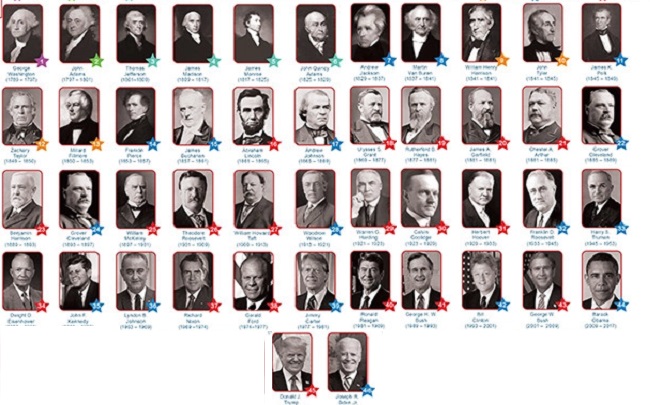
In Which I Comment on That Absurd Presidential Ranking Poll Without Reading It, Because My Head Doesn’t Need Any More Explosions, Thanks…

Several readers and friends sent me this new poll, described as the product of historians in some sources and a the opinion of political science organization in others. It looks to me like the latter is more correct: the thing was the brainchild (I’m being generous here) of Brandon Rottinghaus and Justin Vaughn, both professors of political science, and that’s what their degrees and credentials are in as well. Calling them “historians” is misleading, but that’s what the Times and others sources are doing. Political science is not the same academic field as history, though of course it involves the study of history. I would never call myself a professional historian. My degrees are in American Government ( the College That Must Not Be Named’s version of political science) and law.

I was tempted to dissect the poll, which famously ranks the spectacularly incompetent Joe Biden as the 14th best President and Donald Trump dead last as the worst, in order to add to previous posts in which I described how ruinously political and untrustworthy the field of history has become. I decided that this would be unfair, since these biased history dummies are not a group of historians. I also decided that such an obviously partisan and politically motivated poll was not worth dignifying by treating it as anything but.

Continue reading

Clearly, #MeToo Never Quite Got Its Message Across

Baltimore judge Kevin M. Wilson is facing an ethics hearing in May after a female lawyer accused him of inappropriate and unwelcome touching at a bar association event at the Maryland Club in May of last year. Thecomplaining victim says that when she stopped at a table where Wilson and another judge were seated, she felt Wilson’s hand rub her leg up and down. Two lawyers witnessed this, as well as hearing the complainant tell Wilson that his behavior was inappropriate. The judge moved his hand away, but then, also allegedly, put his hand back on the attorney’s leg, moved his hand up under her skirt, and touched her buttocks.

The event was called “Join Our District Court Judges for Practice Tips on Tap,” so I guess maybe Wilson was just…tapping. 

Continue reading

“Indictment: The McMartin Trial,” An Ethics Movie That Seems Disturbingly Relevant Today

How I missed the 1995 HBO film “Indictment: the McMartin Trial” for almost 30 years, I don’t know, but I did. The Oliver Stone produced legal drama about the insane events surrounding what turned out to be the start of a nation-wide freak-out over supposed Satan worship and widespread child abuse at day-care centers is unusually accurate for a docudrama. For this reason it is also infuriating. How could this have happened even once?

In August of 1983, the mother of a 2-year-old boy phoned the Manhattan Beach (California) Police Dept. claiming that her son had been sexually abused at the family-run McMartin Pre-School. That accusation prompted a series of sensational and inflammatory reports from an unscrupulous broadcast journalist (or “journalist,” for short) at WABC-TV. It also prompted the police to contact other parents with children at the school to ask if their children had been molested. Those children were, in turn, interviewed by a crusading social worker named Kee MacFarlane, who used controversial techniques to persuade the young children that they had seen and experienced terrible things, escalating from sexual abuse to having to witness ritual rapes and human sacrifices. (This was one of the seminal cases in the psychiatry profession’s “implanted memories” scandal.)

Continue reading

Florida Becomes the First Bar to Issue Ethics Guidance on the Use of Artificial Intelligence in the Practice of Law

After seeking comments last fall on a proposed advisory opinion to its members on the ethical use of artificial intelligence by lawyers in the practice of law, the Florida Bar’s review committee has voted unanimously to issue Florida Bar ethics opinion 24-1, the first such opinion by any U.S. jurisdiction about the assuredly revolutionary changes in legal practice and the concomitant perils that lie ahead as a result of AI technology. The advisory opinion’s summary:

“Lawyers may use generative artificial intelligence (“AI”) in the practice of law but must protect the confidentiality of client information, provide accurate and competent services, avoid improper billing practices, and comply with applicable restrictions on lawyer advertising. Lawyers must ensure that the confidentiality of client information is protected when using generative AI by researching the program’s policies on data retention, data sharing, and self- learning. Lawyers remain responsible for their work product and professional judgment and must develop policies and practices to verify that the use of generative AI is consistent with the lawyer’s ethical obligations. Use of generative AI does not permit a lawyer to engage in improper billing practices such as double-billing. Generative AI chatbots that communicate with clients or third parties must comply with restrictions on lawyer advertising and must include a disclaimer indicating that the chatbot is an AI program and not a lawyer or employee of the law firm. Lawyers should be mindful of the duty to maintain technological competence and educate themselves regarding the risks and benefits of new technology.”

Continue reading