Is There A “Naked Beauty Pageant Queen” Principle?

Beauty queen above, secret twin below?

Beauty queen above, secret twin below?

We know that teachers who have performed in porn movies are toast, once their performances surface online, and that teachers whose images, showing them in their birthday suits, are easily accessible by post-pubescent students are not going to stay secondary school faculty members for long. But do similar rules apply for beauty pageant winners, whose physical assets are not only barely hidden anyway, but the primary, if not sole reasons for their “titles”? Should they?

Let’s look at the dilemma facing Melissa King, the newly crowned Miss Delaware Teen USA. A porn site featured a video with a, er, key performer that both looked and sounded exactly like her, apparently showing Miss Delaware Teen USA doing all sorts of fascinating things on, over, and around an unclothed male actor. King denied that she was the performer (who references her participation in beauty pageants on the video), but gave up her crown anyway. Looking at the photos, either she has also triggered the Lying Beauty Queen Principle, or has a twin sister in the porn trade.

One website covering the story polled its readers regarding whether it should matter if a beauty queen has done porn. Stated in that way, it is a reasonable question. If  beauty pageants were like dog shows, and all that was being awarded was a prize for the most perfect physical specimen, it shouldn’t matter if the winner is a Nazi, a terrorist, a serial killer or a werewolf. The problem arises because these pageants include titles. Continue reading

Some content on this page was disabled on July 29, 2022 as a result of a DMCA takedown notice from Brian Mayer. You can learn more about the DMCA here:

https://wordpress.com/support/copyright-and-the-dmca/

And One More…UPDATE: “Cheated Out Of Their Final Bows: Hollywood Snubs Its Own At The Oscars…”

Yesterday I attempted in a small way to make up for the injustice perpetrated on their own by the Academy of Motion Picture sciences, by noting the passing of ten talented and worthy film actors who were unfairly and inexplicably left off the Oscar’s “In Memoriam” feature. I was afraid that I missed someone important, and sure enough, I did. And it was…

Susan Tyrell (1945-2012)

susan-tyrrell

Leaving out Tyrell was especially callous by the Academy (not that dissing the others was not), because, first of all, she was a previous nominee for Best Supporting Actress (for John Huston’s “Fat City,” made in 1972), and second, because Tyrell had battled courageously against multiple health issues while doggedly trying to pursue her craft.  In 2000, she lost both legs as a result of a rare blood disease, but stayed active, performing in seated roles and voice parts to the end. Susan Tyrell was an electric performer, a veteran of Broadway and Off-Broadway, fearless, quirky, and unforgettable.

Except, apparently, by her colleagues in Hollywood.

I’m sorry I missed you first time around, Susan.

Classroom Indoctrination Again: Enough! I Propose No-Tolerance

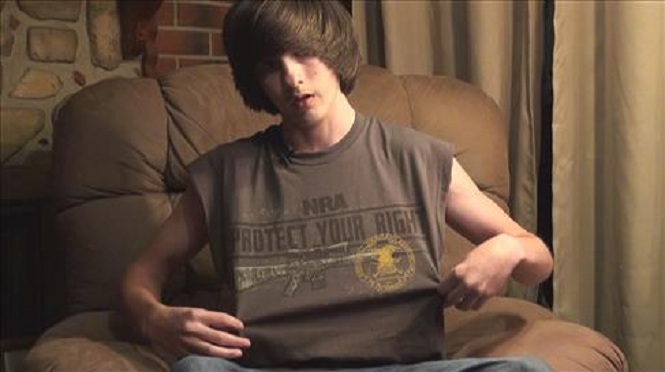
"Now class, I'm not going to say this again---no essays about evil guns, or you'll be sorry."

“Now class, I’m not going to say this again—no essays about evil guns, or you’ll be sorry.”

Dewey Christian is an English teacher at Denton High School in the Dallas-Fort Worth area, and on the evidence of this incident, one more example of how our children are being warped by arrogant bullies and fools under the pretense of public education. The teacher told students to write a few sentences about whatever topic they chose—“a fun experience,” one student said.  However, when two seniors turned in papers that referenced guns—the Horror!— Christian scolded and humiliated them in front of the class, and told them that they would receive zeros unless they chose a different topic.

Fired, that’s all—that’s what this teacher should and must be. Continue reading

The “Do You Know Who I Am?” Prosecutor and the Strip Club

"My mistake--that's a POLE, not the Florida BAR! Silly me. I just made a mistake..."

“My mistake–that’s a POLE, not the Florida BAR! Silly me. I just made a mistake. Wrong address…”

Personally, I find few varieties of unethical conduct more nauseating than individuals of fame, position, power or influence who use that status to squeeze special privileges and considerations from ordinary citizens. From the cop who assumes that he won’t be charged for street grocer’s apple, to the judge who talks his way out of a speeding ticket, to the famous actress  who tries “Do you  know who I am?” when she’s stopped while driving drunk, this behavior warps justice, broadcasts unfairness, and saturates the culture with the toxic assumption of class and privilege, the idea that not only are the rich, powerful and famous subject to different and more lenient standards than the rest of us mere mortals, but that they deserve such treatment.

Ari Pregren, a Miami-Dade County prosecutor, was just fired from his job for embracing this tactic, and appropriately so. The fascinating aspect of the incident for me is that I am certain that his miserable conduct does not rise to level that the legal profession would deem professional misconduct. In Pregren’s case, this means that a state prosecutor who uses his position to get special consideration at a strip club is an unethical jerk, but not necessarily an unethical lawyer, at least in the eyes of the legal profession.

Hmmmmm…. Continue reading

Ethics Dunce: Any South Carolinian Who Votes For Disgraced Ex-Governor Mark Sanford

You'll never know if this movie is still playing in the Mark Sanford Head Multiplex...

You’ll never know if this movie is still playing in the Mark Sanford Head Multiplex…

When Mark Sanford was last entrusted with high elected office in South Carolina, he…

  • Carried on a clandestine adulterous affair with a South American “soul mate” when he was supposed to be serving as the governor of the state,
  • Went AWOL from the state and his duties, telling aides that he was “hiking” in South America when he was really doing something very different in Argentina,
  • Used official funds to pay for his personal affair,
  • Lied about it,
  • Humiliated his wife and family while embarrassing South Carolina and his party, and
  • Was censored by the state legislature.

Now, displaying a level of gall only politicians and Hollywood actors can achieve, Sanford is back seeking office in South Carolina, running for the open seat in its 1st Congressional District. His strategy appears to be that old stand-by of the habitual miscreant, evoking the virtue of forgiveness and redemption, as well as suggesting that God wouldn’t rule out voting for him. In his first TV ad, Sanford says that he has learned about a “God of second chances.” Continue reading

Judge Ken Anderson: A Judge With An Ethical Obligation To Resign

Ken Anderson

Regret isn’t enough.

Ken Anderson has been a Williamson County (Texas) district judge since 2002, but in 1987  he was the district attorney who prosecuted Michael Morton for fatally beating his wife to death. Morton was convicted and served 25 years in prison before DNA tests proved he was innocent. (This is yet another triumph of The Innocence Project.) Another man has been arrested for the murder of Morton’s wife Christine, as well as a second woman he allegedly killed in similar fashion while Morton was behind bars.

Last week, a five day hearing examined Judge Anderson regarding his conduct in the case, in a special court of inquiry to determine whether he engaged in criminal wrongdoing as well as unethical prosecution. Among the questions raised was why Anderson never divulged to Morton’s defense team a police report that Morton’s neighbors had said that they saw a suspicious man walking into the woods behind the Morton home shortly before the murder, and why Morton’s three-year-old son’s statement that “a monster,” not his father, beat the child’s mother to death was similarly withheld. On the stand enduring five hours of questioning, a tearful Anderson could only say that he didn’t remember not turning over the evidence to the defense, while defense attorneys adamantly insisted that they never received it. The hearing also revealed that Anderson kept his lead investigator from testifying at trial, when his testimony would have ensured that the child’s statement and the report about the stranger were raised in court, as well as allowing defense attorneys to cross-examine the investigator regarding his peculiar theory of the case.The theory, which was subsequently endorsed by DA Anderson, was that Morton become homicidal after his wife fell asleep when he sought to have sex with her, and donned his scuba wet suit so his son wouldn’t know it was him beating her to death. Continue reading

Easiest Ethics Question Of The Month

" Dear Ellie: The firm seems a little shady to me, but I need the experience. Should I take the offer?"

” Dear Ellie: The firm seems a little shady to me, but I need the experience. Should I take the offer?”

Over at Above the Law, Ellie Mystal posts a request for advice from a desperate job-seeking lawyer, and polls readers for their response. The lawyer has an offer from a local attorney she says has a reputation for being unethical and untrustworthy. He has filed for bankruptcy once; he is being investigated by the local bar and the government, and former employees say he’s atrocious to work for. The inexperienced lawyer asks,

“Is this really bad for an entry-level lawyer to work for an (arguably) bad lawyer? Is it an absolute NO? Which one is more important: get some experience or working at a right/good firm? To put it another way, which one is worse: having no experience or working at a bad firm? I keep searching job postings and there is no opening for entry-level. Everyone looks for experienced lawyers. So I get the impression that no experience is the worst.

“I don’t know what to do with this offer. Feels not right to accept this offer but cannot just forgo. So give me some advice — should I accept his offer?”

Well, let me th—NOOOOOOOO!!!! Absolutely NOT! Never in a million years! NEVER!

And yet, almost 20% of Above the Law’s mostly lawyer readers voted for the choice reading, “Yes. Beggars can’t be choosers.”

That is disturbing. Continue reading

Jonah Lehrer Shows Us A Level One Apology: Remorse, Regret, Contrition. Sincerity? Who Knows…

The-Remorse-Of-OrestesWhen we last looked in on writer Jonah Lehrer last summer, he had detonated his career and credibility with a series of incidents of serious professional misconduct that led to his ignominious firing from The New Yorker, where he once was regarded as a rising star. First he was caught plagiarizing himself, recycling a previously published work as an original  essay for the magazine. That led to an investigation showing that this was not the first time he had taken such an unethical short-cut. Finally, it was discovered that he had fabricated Bob Dylan quotes in his best-selling book about, ironically enough, creativity. When confronted about this, Lehrer lied. Soon he was out of a job and condemned to the limbo reserved for writers who deceive their readers: Jason Blair, Stephen Glass, James Frey, Janet Cooke, and others. It is not a pleasant or profitable place to be.

Lehrer was recently invited to speak to a gathering at the Knight Foundation, and chose the forum to deliver an apology for his conduct. It would be difficult, I think, to deliver a better one. On the Ethics Alarms Apology Scale, the most ethical apology, at the top of the scale, is this one:

1. An apology motivated by the realization that one’s past conduct was unjust, unfair, and wrong, constituting an unequivocal admission of wrongdoing as well as regret, remorse and contrition, as part of a sincere effort to make amends and seek forgiveness.

That is exactly what Lehrer delivered to the Knight Foundation, and through his blog, the rest of us. He said…

“..I am the author of a book on creativity that contained several fabricated Bob Dylan quotes. I committed plagiarism on my blog, taking, without credit or citation, an entire paragraph from the blog of Christian Jarrett. I also plagiarized from myself. I lied to a journalist named Michael Moynihan to cover up the Dylan fabrications.

“My mistakes have caused deep pain to those I care about. I am constantly remembering all those people I’ve hurt and let down – friends, family, colleagues. My wife, my parents, my editors. I think about all the readers I’ve disappointed, people who paid good money for my book and now don’t want it on their shelves.I have broken their trust. For that, I am profoundly sorry. It is my hope that, someday, my transgressions might be forgiven.

“I could stop here. But I am convinced that unless I talk openly about what I’ve learned so far – unless I hold myself accountable in public – then the lessons will not last. I will lose the only consolation of my failure, which is the promise that I will not fail like this again. That I might, one day, find a way to fail better.

“The lessons have arrived in phases. The first phase involved a literal reconstruction of my mistakes. I wanted to have an accounting, in my head, of how I fabricated those Dylan quotes. I wanted to understand the mechanics of every lapse, to relive all those errors that led to my disgrace. I wanted to understand so that I could explain it to people, so that I could explain it in a talk like this. So that I could say that I found the broken part and that part has a name. My arrogance. My desire for attention. My willingness to take shortcuts, provided I don’t think anyone else will notice. My carelessness, matched with an ability to excuse my carelessness away. My tendency to believe my own excuses.

“But then, once I came up with this list of flaws, and once I began to understand how these flaws led to each of my mistakes, I realized that all of my explanations changed nothing. They cannot undo what I’ve done, not even a little. A confession is not a solution. It does not restore trust. Not the trust of others and not the trust of myself. What’s more, I came to see that my explanations were distracting me from the more important reality I need to deal with.

“Because my flaws – these flaws that led to my failure – they are a basic part of me. They are as fundamental to my self as those other parts I’m not ashamed of. This is the phase that comes next, the phase I’m in now. It is the slow realization that all the apologies and regrets are just the beginning. That my harshest words will not fix me, that I cannot quickly become the person I need to be. It is finally understanding how hard it is to change.

“Character, Joan Didion wrote, is the willingness to accept responsibility for one’s own life. For too long, I did not accept responsibility. And by not accepting responsibility – by pretending that all of my errors were accidents, that my carelessness was not a choice – I kept myself from getting better. I postponed the reckoning that was needed.

“There is no secret to good decision-making. There is only the obvious truth: We either confront our mistakes and gain a little wisdom, or we don’t and remain a fool.”

You can read the whole speech here. Continue reading

My Spidey Sense Is Tingling: When Skipping The Tip IS Theft

Things are stranger than ever, it seems, in Times Square.

Chelsea? Is that really you?

Chelsea? Is that really you?

Philip Williams, 35, is one of many individuals who makes a living of sorts in Manhattan’s famed pop-culture and commerce jungle by dressing up as a colorful character to amuse tourists. In Williams’ case, it’s Spiderman. He is currently charged with assault and harassment for punching a woman who asked him to pose for a photo with her kids, then after getting her picture, refused to pay him the customary tip when he asked for some money.

“Sorry, I don’t have any,” said she. “You’re crap!” said Spidey, and socked her. Williams claimed in court that his punch was in self-defense, because, he claims, the woman threw a snowball at him. This is disputed. 

Williams’ arrest came when police intervened to stop the assaulted woman’s husband from squishing Spiderman, which he was endeavoring to do with a packpack. Initially, the woman had fingered another Times Square Spiderman as her assailant, but the husband was paying better attention, and knew which one to pound on.

I love this city! Continue reading

Unethical Trio: An Ambush, An Incompetent Diagnosis, and Partisan Journalist Hackery

Doctors and Kurtz

There were three notable unethical performances last week from professionals who should know better:

I. Dr. Benjamin Carson, neurosurgeon. Carson was invited to give the keynote speech at the National Prayer Breakfast (don’t get me started about why there even is a National Prayer Breakfast, and why the President should feel obligated to attend it) last week and turned what is traditionally understood to be a non-partisan, non-political speech into a direct attack, without explicitly designating it as such, on President Obama’s policies. Yes, it was a well-written, well-reasoned and well-delivered speech, but it was an ambush. Many conservatives were pleased to have President Obama  subjected to an articulate complaint that “spoke truth to power,” yet the objectives and specific content of the speech doesn’t matter: that wasn’t what Carson was invited to do, and it wasn’t what he should have done. Dr. Carson has subsequently justified his actions in self-congratulatory terms as an act of courage, but in reality it was an instance of a citizen seizing an opportunity to grab national attention and a prominent soapbox that weren’t his to grab. His actions made the President of the United States a captive audience to his amateur analysis of national affairs. It was disrespectful, and because it was given under false pretenses, dishonest. Continue reading