Ethics Quiz: The Return Of Sacheen Littlefeather

Apparently the Oscars are looking hard for virtue-signaling opportunities.

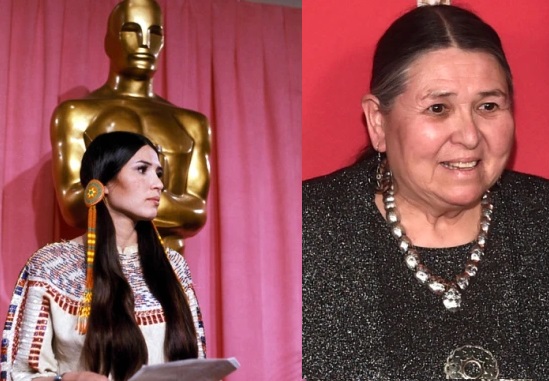
In this instance, they had to travel back in time 50 years and decide to make amends for one of the more ludicrous examples of celebrity grandstanding in pop culture lore. Marlon Brando, a cinch to win the Best Actor statuette for “The Godfather” in 1973, decided to snub the Academy of Motion Picture Sciences, his Hollywood colleagues and the Oscars’ TV audience by sending an obscure, Native American actress named Sacheen Littlefeather to go to the podium when Marlon’s name was read and make a statement about the abuse of Indians at Hollywood’s hands while announcing that Brando was rejecting his honor in protest. You know, because “The Godfather” was all about Native American mobs, or something.

It was a complete non sequitur, and many suspected that the whole stunt had little to do with Native American portrayals in film (about which Brando had previously said nothing) and more to do with the famously weird actor’s desire to stick his thumb in the eye of the industry that had made him rich and famous. He might have just as well had his statuette rejected by Bozo the Clown; maybe it came down to a coin flip: heads, Sasheen (it was an Indian Head nickel), tails, Bozo.

The young woman’s appearance did not go over well. “Mr. Brando very regretfully cannot accept this very generous award,” Littlefeather said. “And the reasons for this being are the treatment of American Indians today by the film industry and on television in movie reruns, and also with recent happenings at Wounded Knee.”  That was a reference to a protest a month earlier,when the American Indian Movement had occupied the South Dakota town of Wounded Knee, site of the infamous massacre, to protest Hollywood’s killing and..no wait, it was the U.S. government’s treatment of Native Americans that protest was about. What did it have to do with movies, Brando, and the Oscars?

Oh, nothing. Continue reading

Ethics Quiz: Hitler’s Watch

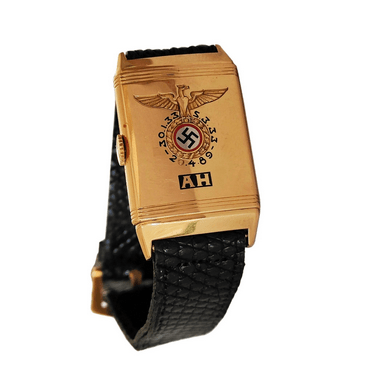
Adolf Hitler’s watch, shown above, recently sold at auction for over a million dollars. (The auction house had been expecting more, between 2 and 4 million.) The sale provoke some angry rhetoric online: many believe that it is unethical, indeed immoral, to acquire, keep or sell artifacts from Nazi Germany. In several countries, putting such things up for sale is illegal.

Your Ethics Alarms Ethics Quiz of the Day is this:

Is it unethical to sell or buy Hitler’s watch?

Continue reading

Ethics Quiz: Travails Of A Transgender Sex Offender

As Samuel L. Jackson would say if he were preparing to delve into this ethics quiz:

“Ella” is transgender woman now, whatever that means, but back when Ella was a 15-year-old boy, and stood 6-foot, 5-inches while weighing in at more than 300 pounds, she, though then a he, joined another teen in sexually assaulting a 110 pound autistic 14-year-old boy who was blind in one eye and autistic. The Pre-Ella then taunted the kid on Facebook. The male predecessor of Ella pleaded no contest to one count of sexual assault of a child under 16 years of age and spent time in two juvenile detention and treatment centers. Somewhere along the way Ella decided she needed to transition to female-hood, so when, in her new female-identifying edition, she was ordered to register as a sex offender, she objected. Under Wisconsin law, sex offenders must register a legal name and any aliases they use, and they may not legally change their name. That seems reasonable, since there is no point to legally registering as a sex offender to alert the community of sex offending proclivities if one can just foil the measure by using a different name.

Ella has been “Ella” since her teens and is now 22. She argued that requiring her to register as a sex offender under her male name given at birth violates her First Amendment right to express her true female identity. She also contended the registry requirement, as applied to her, amounted to cruel and unusual punishment under the Eighth Amendment, in essence making her out herself as a former him, or a former him trapped in a female body, or something.

The Wisconsin Court of Appeals rejected Ella’s claims,  and last week, four mean old conservatives outvoted the court’s liberal members on the Wisconsin Supreme Court also denied Ella’s attempt to change her name after hearing arguments in the case in February. Continue reading

Comment Of The Day: “Ethics Quiz: Grandstanding Or Justice?”

I didn’t provide my answer to the ethics quiz about the propriety of charging and trying the woman whose accusation against 14-year-old Emmett Till resulted in his infamous lynching in 1955. Jim Hodgson’s Comment of the Day nicely explains what it would be, though.

I also heard an interesting angle from my lawyer sister that is probably worth a full post. What Carolyn Bryant Donham said in 1955 would be literally nothing today. It was only in the warped Jim Crow culture of 1950s Mississippi that a woman false claiming a black teen touched and flirted with her could lead to violence, or could be considered provocation for a violent crime. How do you justify prosecuting someone 67 years later for an act that would no longer be considered a crime?

Here is Jim’s post, in response to “Ethics Quiz: Grandstanding Or Justice?”

***

My answer to the ethics quiz is that no, she should not be prosecuted. It just isn’t feasible to achieve any fair degree of justice at this point.

As a retired deputy sheriff, the first thing that struck me as odd in the news reports that I read concerning this “discovery” was the clear implication that the “lost” warrant itself was somehow a bar to her being arrested and prosecuted at some time during the past 67 years. It may be news to many people, but paper warrants get lost (or at least temporarily “misplaced”) with some regularity. In my state, any officer of the court with knowledge of the original warrant could have asked for the warrant to be re-issued by the same court that issued the original. In my state this is referred to as issuing an “alias warrant” or an “alias writ.” Continue reading

Ethics Quiz: The Secret Service Defies Orders!

As soon as I saw the headline to Prof. Turley’s latest post on his blog, “Res Ipsa Loquitur” I knew we had an ethics quiz: “Presidential Protection or Abduction: Why Secret Service Wrong for all the Right Reasons on Jan. 6.”

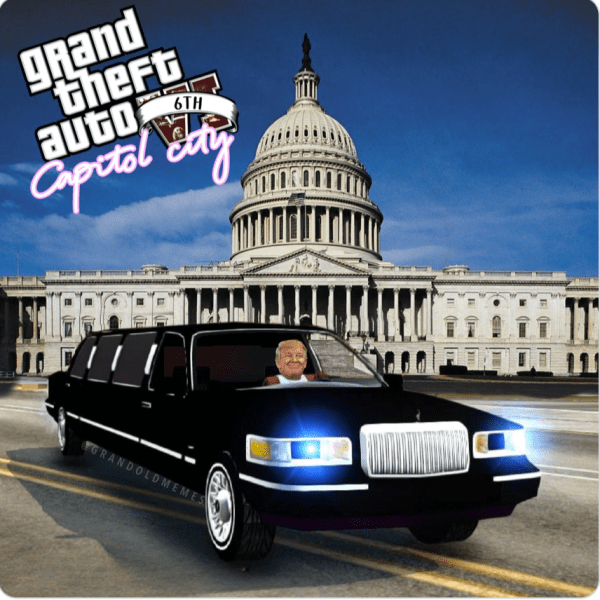
Turley’s article was prompted by one aspect of the Jan. 6 Commission testimony of Cassidy Hutchinson that President Trump ordered his official SUV to take him to the U.S. Capitol to be on hand with his supporters as they rallied (it turned out to be a “mostly peaceful” rally) against what Trump had told them was the stolen 2020 election. According to the witness, that she was told that T his Secret Service security team refused, causing the President to become furious.

Turley’s take, in brief:

…the Secret Service is trained to take immediate action to protect a president. On the other hand, it cannot effectively control the presidency by controlling a president like a modern Praetorian Guard. In the end, if this account is true, the security team was likely wrong in refusing the order of the President to be taken to Capitol Hill….Trump intended to do exactly what he promised and ordered the Secret Service to take him to the Capitol. But Tony Ornato, White House deputy chief of staff for operations, and Bobby Engel, who headed Trump’s security detail, reportedly refused.

…If true, the security team’s motivation certainly was commendable. It probably prevented Jan. 6 from getting much, much worse…what was the authority of the security team to refuse a direct order from a sitting president to go to Congress?

…The Secret Service has always assumed discretion in seizing a president to protect him from immediate harm [but there was no immediate harm threatened]…Trump reportedly decided he wanted to lead the protests to the Capitol and didn’t care about the security uncertainties — and he actually had a right to do so. Presidents can elect to put themselves in harm’s way… The Secret Service has no authority to put a president into effective custody against his will… In Trump’s case, he reportedly said he did not want to go back to the White House but was taken there anyway.

…This act of disobedience may have saved the country from an even greater crisis…

In the end, the security team was correct on the merits but probably wrong on the law. This was not an unlawful order, and a president must be able to control his own travel. In other words, the agents were wrong for all the right reasons.

Your Ethics Alarms Ethics Quiz of the Day is: Continue reading

Ethics Quiz: VP Harris And The Julie Principle

Father’s Day naturally got me thinking about Jack Marshall, Sr., and it was he who explained The Julie Principle to me. The context was one of his best friends from childhood, an obvious sociopath. It puzzled me that my father, who was literally dedicated to all of the virtues in the Boy Scout Creed and whom I witnessed placing his values over his self-interest repeatedly throughout his life, would remain friends 60 years with someone who so clearly was the opposite of my father, a deceptive, self-centered, even cruel individual who never showed any hint of remorse or contrition.

As I have related here more than once, Dad, tone-deaf as always, responded to my puzzlement by singing the opening lines from the famous “Show Boat” ballad, “Can’t Help Lovin’ That Man of Mine,”sung by the tragic mulatto, Julie : “Fish gotta swim, birds gotta fly.” He then explained, “I decided long ago that it was a waste of time and emotion to keep complaining or criticizing someone for conduct they will never change. You have too choices: either accept that a person will do what he does, like a bird or a fish, or decide that you can’t stand the way he or she is and cut them out of your life. But to keep getting angry or upset when someone simply acts as you know they will is pointless.”

I wrote the first post here designating my father’s philosophy as the Jule Principle in 2013. Looking back, I officially applied the JP to the late Washington, D.C. Mayor Marion Barry, and Donald Trump (both before and after his election), writing shortly after his surprise victory,

Donald Trump, more than any national figure in my lifetime,  requires a careful, measured application of The Julie Principle to serve everyone’s best interest. Screaming “TRUMP IS TRUMP! ARRGHHHHH!” for four years will do no good at all. Find a way to co-exist with him so his negative proclivities do as little damage as possible and his positive ones have a chance to thrive, and save the explosions of indignation for substantive matters where opposition is essential.

Note that nobody heeded my advice, but I was right. But I digress: Joe Biden got Julied here both before and after his election, also “The View,” Hillary Clinton, and most recently, poor, addled Larry Tribe. Looking back, there are many other individuals who have earned Julie’s pass, and I’ll take nominations. I also see that following the lesson of Julie is hard. I have frequently forgotten the fishiness of several Julie designees.

The subject of this Ethics Quiz, however, is Kamala Harris. I gave her a sort of half-Julie Principle nod regarding her general sliminess and lack of integrity, writing,

If, as many seem to assume, Harris is making stuff up to pander to the crowd, why fixate on this episode? We all know, or should, that the woman is shallow, has no core, and that saying whatever she thinks will endear herself to the most people at the moment is her defining characteristic. As Julie sang, “Fish gotta swim, birds gotta fly”: Kamala’s gotta make stuff up to pretend she’s something she’s not for the gullible, the naive, the hopeful and the blind.

That, however, evoked Julie in the context of Harris’s deplorable ethics, and before she took office as the woman a “heartbeat from the Presidency.” Over the 18 months since then, we have also learned that Harris is a babbling, incoherent fool, and I have frequently expressed horror at such gibberish coming from someone who was chosen by Biden to fill her critical role in the Administration.

She did it again today: speaking to a group of about two dozen elementary school-aged children at the National Museum of African American History & Culture in Washington, Harris said,

“I think that we all know today is a day to celebrate the principle of freedom. And think about it in terms of the context of history, knowing that black people in America were not free for 400 years of slavery. Let this be a day that is a day to celebrate the principle of freedom, but to speak about it honestly and accurately, both in the context of history and current application. With the Emancipation Proclamation and Civil War, it required America to really ask itself, who is free? How do we define freedom? Freedom in terms of the autonomy one should have? Is freedom given to us or are we born with freedom? Right? I would argue it is our God-given right to have freedom. It is your birthright to have freedom. And then during slavery, freedom was taken. And so we’re not going to celebrate being given back what God gave us anyway, right? We should think about it also in terms of current application, asking is everyone we know free? Do we know anyone who is not free? Around the world do all people have freedom? Are there those who are without freedom? When we talk about freedom, are we talking about freedom from — or are we talking about the freedom to?”

What the hell?

Your Ethics Alarms Ethics Quiz of the Day:

Does Harris deserve a Julie Principle pass for her evident inability to think and speak in addition to one for her appalling lack of integrity?

Continue reading

Ethics Quiz: The Uncivil Gravestone

Having begun today with a convoluted ethics quiz, I feel I owe you a straightforward one. The topic: gravestone etiquette!

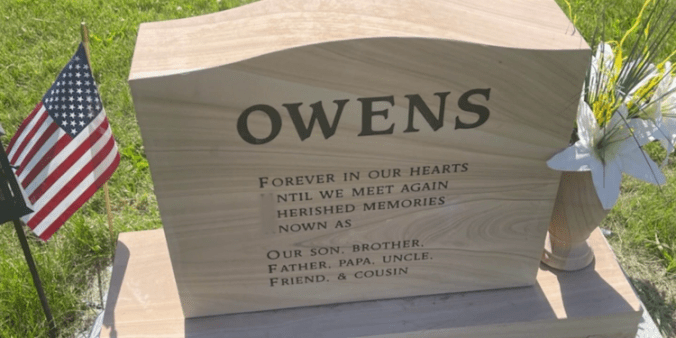
The family of “Owens”—didn’t he have a first name?—coded his favorite retort “Fuck off” onto his gravestone. “It was a term he used a lot,” his daughter told a local radio station. “He was very direct: if he didn’t like you, he wouldn’t talk to you.” Wow, what a great guy! I don’t know how long it took for someone outside of the family to discover the clever <cough!> arrangement of initial letters that spelled out his cheery slogan, but the cemetery management says that it was always was against the placement of the vulgar marker. “There is no place for swearing in the place where people’s loved ones lie,” a spokesperson said. “Imagine lying next to this tombstone forever.”

Yeah, I’m lying dead in a coffin forever, but what really bothers me is “fuck off” being engraved on the headstone next door. What is this, stupid statement week? While we’re tallying up stupid, why are the letters crucial to the story blurred on that photo? If the story is about the use of “fuck,” why censor the same word in the photo?

Your SECOND Ethics Alarms Ethics Quiz of the Day is…

Is the “Fuck off” gravestone unethical?

Revisiting The Celebrity Post-Retirement Photos Ethics Quiz…

Way back in January…at least it seems way back…Ethics Alarms used a shocking photograph of retired actress Bridget Fonda to raise the question of whether it was ethical “to take unflattering photos of former performers and celebrities and publicize them expressly to invite cruel comments and ridicule.” The fact that it was offered as a quiz indicates that I was torn on the matter.

On one hand, such photos could be legitimately called newsworthy, although their main attraction is prurient and mean. There is also a fair argument that if one profits by fame and celebrity on the way up, taking the hit during one’s decline in career, popularity and allure is part of the price.

Never mind all that, though. I’ve made up my mind. The practice is unethical, and a blatant Golden Rule breach. I shouldn’t have made the question a quiz.

Why the change of heart? Yesterday I saw photos circulating in social media, and in various memes, showing Sylvester Stallone in his back yard looking every inch of his nearly 76 years and carrying an enormous gut that made him resemble Don Corleone if he had just swallowed Luca Brasi. This caused much hilarity on the web (“Look! I can finally say I have a body like Rambo!”) but it is just cruelty.

Continue reading

Ethics Quiz: The Interrupted Marriage Proposal

Disney clearly “can’t win for losing,” as a saying I’ve never understood goes. At Disneyland Paris, a couple invaded a stage in the park reserved for performances so the guy could propose to his love with a castle in the background. A Disney cast member then interrupted the romantic moment, snatched the engagement ring, and motioned the couple and guests to leave the forbidden area.

There is some controversy over whether the couple had received permission for the stunt (from someone not authorized to grant it)—an Ethics Alarms principle holds that all public wedding proposals are stunts, and unethical ones—but the intervening Disney employee was undoubtedly correct that the couple and the witnesses were breaking park rules.

So your Ethics Alarms Ethics Quiz of the Day is…

Was it unethical to break up the proposal?

Continue reading

Ethics Quiz: The Uber Driver’s Sign

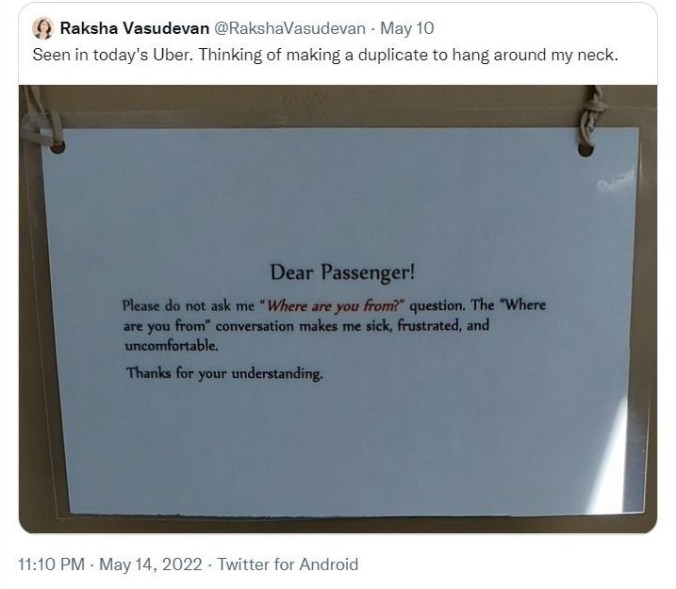
This is one of those ethics quizzes where I am seeking reactions that might make me question my own. My response to Mr. Vasudevan’s tweet was reflexive: Please do wear that sign around your neck, so everyone is warned that you’re an offense-seeking, paranoid jerk to be avoided at all costs.

Back before the CDC wrecked by business and crippled my livelihood, I was often in taxicabs, and my employing some version of the “Where are you from?” question led to many of the most enlightening and fascinating conversations I have ever had. I never encountered a driver who seemed to resent the question in any way; usually they were pleased by my interest, and they always had amazing stories to tell.

I get asked the question myself in our neighborhood when I am walking Spuds in my Red Sox hat or Boston jacket. I don’t see those markers as different from an accent or a turban. The question shows that the inquirer is interested in me: thanks! When I hear a Greek or Russian accent, I’m interested because those origins relate to my family. If my question that the accent prompts causes discomfort, well, that’s not my problem.

Nevertheless, the Ethics Alarms Ethics Quiz of the Day is…

Is it unethical to ask a stranger “Where are you from?”