Ethics Quiz: The Symbolic Pardon

I should have come up with this quiz without a nudge from Ben Shapiro and Elon Musk, but I didn’t. I am ashamed.

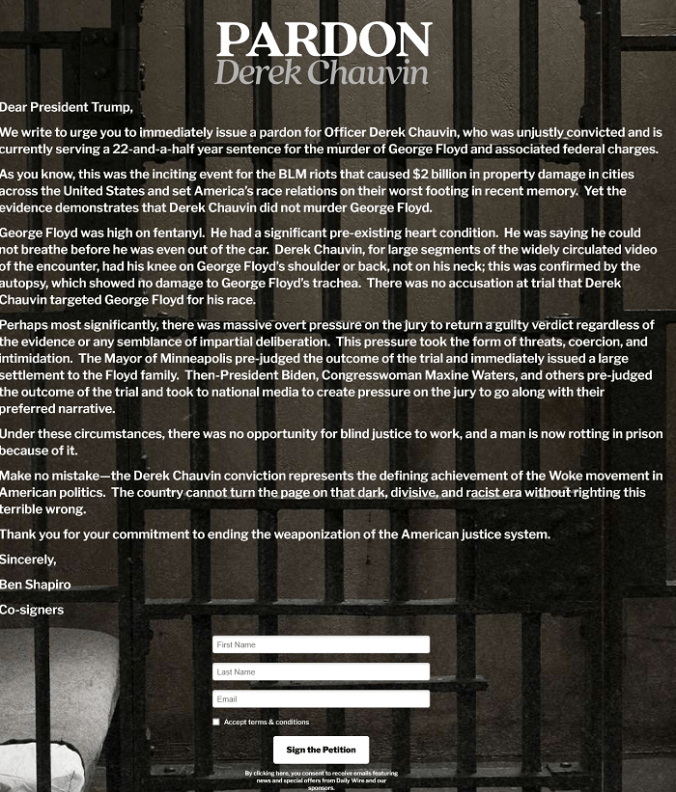
Conservative gadfly and Daily Wire founder Ben Shapiro called on President Trump to pardon Derek Chauvin, the white, former Minneapolis police officer who was convicted of murder in the 2020 death of George Floyd in a petition published on Shapiro’s website. (I don’t think it was murder, and I don’t think murder was ever proven, much less “beyond a reasonable doubt”.)

In his entreaty to the President, Shapiro declares, “We write to urge you to immediately issue a pardon for Officer Derek Chauvin, who was unjustly convicted and is currently serving a 22-and-a-half year sentence for the murder of George Floyd and associated federal charges.”

Shapiro accurately describes the incident as “the inciting event for the BLM riots,” which he says “set America’s race relations on their worst footing in recent memory.”

Most importantly, Shapiro says that the guilty verdict was tainted by the “massive overt pressure on the jury to return a guilty verdict regardless of the evidence or any semblance of impartial deliberation,” and that elected officials “pre-judged the outcome of the trial and took to national media to create pressure on the jury to go along with their preferred narrative.”

This, in my view, should be beyond dispute. I last posted on the way Chauvin was sacrificed in December of 2023, here. “Under these circumstances, there was no opportunity for blind justice to work, and a man is now rotting in prison because of it,” Shapiro concludes.

I concluded in part,

“The contrast between how Chauvin has been treated and the wall of protection erected around the black Capitol Hill cop who shot and killed an unarmed (white) January 7 rioter in 2021 is striking. From the beginning, the case against Chauvin lacked convincing intent, causation, or proof of guilt beyond a reasonable doubt. I keep seeing in various documentaries regarding other “true crime” stories rote statements by lawyers, prosecutors and judges about how in the United States, all citizens are presumed innocent and treated equally. If this equal treatment can be withheld from Derek Chauvin, and it has been, then it can and will be withheld by others who are deemed sufficiently unpopular. As [Professor Glenn] Loury writes, the result tells us that “the deep epistemic corruption at the heart of the affair will become, if it goes unchallenged, imperceptible to future generations, simply more evidence that the world is as the poetic truth has determined it to be.” Who will challenge it now? Who has the integrity and courage today to stand up for justice a “racist” who was profitably used as the excuse to advance such marvelous revolutionary movements as critical race theory and “diversity, equity and inclusion”?

Chauvin was convicted in two separate trials, state and federal, and is simultaneously serving a 21-year federal sentence for violating Floyd’s civil rights along with a 22.5-year state sentence for second-degree murder. He has tried to appeal his conviction numerous times, including to the Supreme Court. He has no plausible avenues to pursue now except a pardon.

Shapiro argues in a video that although Trump cannot pardon Chauvin in the state murder case, it is important for Chauvin be pardoned on federal charges anyway.

“Make no mistake—the Derek Chauvin conviction represents the defining achievement of the Woke movement in American politics. The country cannot turn the page on that dark, divisive, and racist era without righting this terrible wrong,” Shapiro said in the letter. Elon Musk, not knowing when he should “tend to his own knitting,” posted about Shapiro’s petition on Twitter/X yesterday saying, “Something to think about.”

OK, I’m thinking.

Your first Ethics Alarms Ethics Quiz of March, 2025, is…

Should President Trump pardon Derek Chauvin?

Continue reading

Ethics Quiz: Honoring Roland Bragg

The North Carolina military base long called Fort Bragg was stripped of its familiar name in 2023 and changed to Fort Liberty by the Biden administration. With this Democrats joined forces with and essentially endorsed the statue-topping and historical airbrushing that removed statues, street and school names and other memorials to Americans judged insufficiently dedicated to the woke values that hadn’t surfaced until long after their deaths.

Particularly targeted were Confederate generals and other major figures in the Confederacy. Fort Bragg was named after Confederate General Braxton Bragg. Of all the Confederates stripped of honors in 2020 as The Great Stupid spread over the land, Bragg’s might have deserved that fate most. Bragg is generally considered among the worst generals of the Civil War, with most of the battles he engaged in, Shiloh, for example, ending in his army’s defeat. He was also unpopular with both the officers and soldiers under his command. Why he had a fort named after him is something of a mystery. Well, maybe not so mysterious: the North Carolina fort was named during the Wilson administration while that President was undoing civil rights advances for blacks.

Continue reading

Ethics Quiz: Mouse in the House

I have caught over 40 mice over the past three years in the humane mouse trap my late wife insisted upon. We used to carry them over to the woods near our home in the trap, and release them as I sang “Born Free.”

But today, for the first time, I woke up to find a terrified baby mouse in the trap on a day when it is freezing (and snowing) outside. I do not want to care for a pet mouse; I have enough to worry about already. I do not want to put the little thing in a position where it is doomed to freeze—the spirit of my wife will start haunting me. I do not want to let it free into the house. It won’t warm up for at least a few more days. Now what?

Your Ethics Alarms Ethics Quiz of the Day:

Is there any practical and ethical solution to this dilemma?

Ethics Quiz: The Hegseth Hearing, Part I

Your Ethics Alarms Ethics Quiz of the Day:
Was Sen. Tim Kaine’s questioning of Pete Hegseth, Trump’s nominee to be Secretary of Defense, competent, fair, respectful and professional?

Ethics Quiz: Discrimination As a IA Right

Seriously? Will this ruling stand? Can it? Should it?

The Superior Court of New Jersey’s Appellate Division ruled Dec. 20 against Rajeh A. Saadeh in his lawsuit alleging that the New Jersey State Bar Association had violated the New Jersey Law Against Discrimination. The NJSB has a diversity policy that reserves 13 out of 94 leadership positions for members of specified underrepresented groups. Saadeh is a Palestinian Muslim American attorney, and his group didn’t make the cut. He argued that this was discriminatory, while the bar association argued that it had a First Amendment right to select leaders “consistent with its values regarding diversity in the legal profession.”

The Appellate Court overruled a trial judge who had held that the diversity program was an illegal quota system under New Jersey law. “[T]he undisputed facts in this record establishes beyond peradventure that the bar association qualifies as an expressive association, and that compelling it to end its practice of ensuring the presence of designated underrepresented groups in its leadership would unconstitutionally infringe its ability to advocate the value of diversity and inclusivity in the association and more broadly in the legal profession,” the appeals court said. Since the ruling was that the discriminatory policy was protected speech, it did not even address the question of discrimination.

[Two side points: 1) I have an automatic prejudice against any judge, or anyone, who uses the term “peradventure” and 2) I will not forgive the NJSBA for firing me after years of providing it with (acclaimed, profitable and discounted!) musical ethics CLE programs because I exclaimed “Fuck!” a single time to no one in particular in a moment of frustation during a tech check on Zoom when the bar association’s technical staff proved that it had no idea what it was doing.]

Your Ethics Alarms Ethics Quiz of the Day

Is that an ethically defensible decision?

Continue reading

Ethics Quiz: The Wrong Snack

This is an ethics quiz in which I am curious whether my certainty regarding the answer might be mistaken. It’s also a pretty silly tale.

A Calhoun City (Mississippi)High School teacher, whose name was not released by the Calhoun County School District, thought she was giving her students beef jerky as part of a class birthday celebration, but in fact the snacks were “Beggin’ Strips” or some similar form of dog treat. At least eight children took at least one bite of the stuff, according to Dr. Lisa Langford, the district superintendent. One child reported an upset stomach; the district alerted the affected children’s parents and had the school nurse check with the Poison Center.

The teacher was summarily dismissed.

Your Ethics Alarms Ethics Quiz of the Day:

Was that a fair response by the school?

Continue reading

Ethics Quiz: Smoking Daddy

In the YouTube video posted by “web influencer” Rosanna Pansino (over 14 million YouTube subscribers—I’m all the way up to around 230 followers in my recent return to Twitter/X!—the 39-year-old baking star smokes her dead father’s ashes in accordance with his dying wish. She says her father, dying of leukemia, wanted her to grow a marijuana plant with his ashes and then smoke him. So five years after he died, with his pot plant flourishing, Pansino lit a joint that had particles of her father in it and smoked it for the entertainment of her YouTube audience.

Classy. So tasteful.

Your Ethics Alarms Ethics Quiz of the Day…

“Is this unethical, or just icky?”

Continue reading

Ethics Quiz: The Maori MP Protest

Wow. Now THAT’s a protest!

New Zealand’s Parliament was temporarily suspended yesterday when Māori lawmakers suddenly launched into a haka, a traditional group dance. It was intended to demonstrated the nation’s Indigenous people’s community’s passionate objections to a bill that would reinterpret the country’s founding treaty with the Maoris.

When the proposal was read, and Māori lawmaker Hana-Rawhiti Maipi-Clarke was asked how her party, Te Pāti Māori, would vote on the Principles of the Treaty of Waitangi Bill. The response was what you see above.

So, you’re not in favor of it, then?

Other opposition members joined the performance on the floor, and onlooker is the gallery also started dancing. The chamber’s speaker, Gerry Brownlee, temporarily stopped the session. Maipi-Clarke was suspended over the protest.

I’m not going to get in the high weeds of the bill, but will only present…

Your Ethics Alarms Ethics Quiz of the Day, which is…

Was this an unethical demonstration—disrespectful, disruptive, and a breach of proper decorum—or an ethical one?

I am decidedly undecided on this one. I sure don’t want to give AOC any ideas. The routine was cool, though, and effective.

Ethics Quiz: President Trump’s Gift

According to Bob Woodward’s latest “rumors and gossip as history” soon-to-be best seller, Donald Trump, as President in in 2020, sent Wuhan Virus testing equipment to Vladimir Putin for his personal use. In Kamala Harris’s predictably revolting interview with past-his-pull-date sleaze merchant Howard Stern yesterday, we had this exchange:

Continue reading

Here’s Your Ethics Challenge: Argue Convincingly That It Would Have Been More Ethical For This Horrible Couple To Abort The Baby…

Early favorites for “Parents of the Year”!

Darien Urban, 21, and Shalene Ehlers, 20, decided to sell their baby to a stranger while they were at a camp ground. (No, they weren’t married: why would you even ask?) As Mom explained later, having to deal with a baby while taking care of three dogs was just too much. All they asked for was a six-pack of beer and a thousand bucks. What a deal!

“I, Darien Urban and Shalene Ehlers, are signing our rights over to [Cody Martin] of our baby for $1,000 on 9/21/24,” their contract read. Good: these things should be legal. “After signing this there will be no changing y’all two’s minds and to never contact again,” it concluded.

Continue reading