Ethics Quiz: Looters

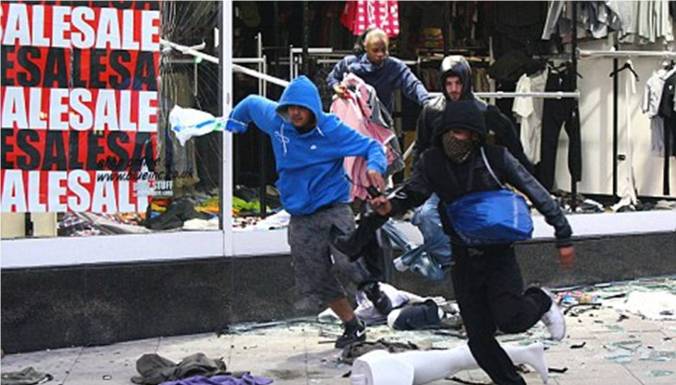
Looting has been reported in Houston. There are not too many species of human detritus lower than those who take advantage of natural disasters to prey on their neighbors, so the question arises, is it ethical for a city government to order police to shoot them?

This question usually arises in the context of martial law. A curfew has in fact been declared in Houston to minimize the looting; presumably an announcement that looters will be shot on sight will be even more effective deterrence. There are good reasons to discourage looting with strong measures. The conduct threatens civilized society itself, because it is not civilized conduct. If looting becomes widespread, the rule of law is suspended, and worse crimes may follow. In a situation like Houston’s, looting also forces law enforcement to choose between rescuing property and rescuing people. If police openly make the choice to let looters loot while they devote their attention elsewhere, then Looting Season has been declared officially open.

Over the years we have occasionally heard that orders were given to shoot looters on sight, but few looters have been shot. Usually the order is enough, which suggests that the order to shoot is a bluff, but usually an effective one.

Police shoot unarmed citizens alarmingly frequently already, however: that’s one order that shouldn’t be given in jest. Presumably most looters are unarmed; I’m not going to concern myself with the question of whether armed looters can be ethically shot. The answer to that is yes, especially when they shoot at rescuers, as apparently some have in Houston. No, your Ethics Alarms Ethics Quiz of the Day is this:

In a natural disaster, is the order to shoot looters on sight ethical?

Continue reading

Ethics Quiz: “13 Reasons Why”

“13 Reasons Why” is a Netflix  television series based on the 2007 novel “Thirteen Reasons Why” by Jay Asher. A high school student receives a box containing 13 cassette tapes recorded by his friend Hannah Baker, before she committed  suicide. The show has been a critical and popular success (although the Times didn’t like it much) , and a second season is planned.

But Researcher John Ayers of San Diego State University has studied the results of the show on the culture by monitoring discussions of suicide on the internet following the debut of “13 Reasons Why.” The phrases “how to commit suicide” and “commit suicide”  have experienced a 26% and 18% increase in searches. Ayers sees no other explanation for this other than the show.  Searches for the phrase “suicide hotline number” also jumped, by 21%

Ayers now says, “Our worst fears were confirmed That is, thousands of people, thousands more, are searching online about ways to kill themselves.”

Ayers wants the first season to be re-edited to discourage suicidal behavior, and argues that the second season should be postponed. “Psychiatrists have expressed grave concerns because the show ignores the World Health Organization’s validated media guidelines for preventing suicide. The show’s staff instead continue to prefer their gut instincts,” Ayers says.

Your Ethics Alarms Ethics Quiz of the Day is this head-scratcher…

Is it ethical for Netflix to continue running the series in light of Ayers’ research and recommendations?

Continue reading

From The “Law vs Ethics” Files: PETA Chooses To Harm An Artist On Behalf Of A Monkey Who Couldn’t Care Less, And Judges Think It’s An Amusing Legal Condundrum

“I’m baaaaack!”

When we last heard from  photographer David Slater, the U.S. Copyright Office had rejected his claim that he owned the  copyright for the famous series of selfies presumably taken unintentionally by a Celebes crested macaque.  In 2011,  Slater spent several days following and photographing a troop of macaques in Sulawesi, Indonesia, and the selfies were a lucky bi-product that quickly became a web sensation. Slater had asserted ownership over the photos, and had demanded that various on-line users, such as Wikipedia, either take them down or pay him as the copyright holder. The ruling of the Copyright Office was based on the theory that Slater had not taken the photo, so he was not the creator, and animals couldn’t own copyrights, so the photos were in the public domain.

Pop Ethics Quiz: Would it have been unethical had Slater simply released the photos without revealing that the selfies had been the lucky result of an  accident, snapped by the monkey while it was messing around with his equipment?

About the Copyright Office’s ruling: I’m dubious. Slater owned the equipment, and had the sense to preserve the photos. A decision that if a photo is taken accidentally by a non-human or an act of God, the photographer who owns the equipment gets the copyright would have been fair.  Zapruder owned the film that inadvertently caught President Kennedy having his forehead shot off, and it made him rich. Slater’s claim just goes a step further: Zapruder left the street  to buy a hotdog, put his camera on on a trash can and asked a friend to “watch it,” and a dog turned the camera on, catching the grisly scene. So Zapruder doesn’t own the film anymore? Does that make sense to you?

Well, that was the ruling anyway. Then things got really ridiculous. Slater included the monkey selfies in a book, and People for the Ethical Treatment of Animals (PETA)  brought a law suit against Slater on behalf of the monkey,which PETA claims is named Naruto, and asked that PETA be appointed to administer proceeds from the photos for the benefit of Naruto and other crested macaques in the reserve on Sulawesi. So PETA would suddenly be the de facto copyright holder. Continue reading

Ethics Quiz: The Neglectful Mom

An upstate New York mother allowed her 10-year-old child to shop alone at the LEGO store as she shopped at a different store in the same mall. It appears that the LEGO store’s personnel called the mall’s security, and the child’s mother was arrested and charged with endangering the welfare of a child. The store does have a sign that states that children under the age of 12 must be accompanied by an adult.

Arresting the mother is obviously absurd over-kill. Obviously also, the LEGO store has a right to have whatever policy it chooses regarding unaccompanied children. However the question remains, and is the Ethics Alarms Ethics Quiz of the Day

Is it irresponsible for a mother to allow her 10-year-old to shop alone if the mother is shopping in the same mall?

Related questions as you ponder: Continue reading

Ethics Quiz: The Ferguson Settlement

News Item:

The parents of black teenager Michael Brown and the city of Ferguson, Missouri, have settled a lawsuit over his fatal shooting by a white city police officer in 2014, according to a court document filed on Monday. …Terms of the wrongful death settlement between Ferguson and Brown’s parents, Michael Brown Sr. and Lesley McSpadden, were not disclosed. U.S. District Judge E. Richard Webber approved the settlement and ordered it sealed.

“The gross settlement amount is fair and reasonable compensation for this wrongful death claim and is in the best interests of each plaintiff,” Webber wrote. Both James Knowles, the mayor of the blue-collar, largely black St. Louis suburb, and Anthony Gray, the lead attorney for Brown’s parents, declined to comment.

Wait, what?

A thorough investigation found Officer Wilson guilty of no crime, nor did the shooting appear to be the result of officer malfeasance or negligence. Brown’s parents, Michael Brown Sr. and Lesley McSpadden, meanwhile, took extraordinary measures to stir up racial hatred and anti-police sentiment, not just locally but nationally, sparking deadly riots in Ferguson and elsewhere, and leading to attacks on police. They even made a human rights complaint to the United Nations, based substantially on a lie (“Hands up! Don’t shoot!”) concocted by their son’s friend and credulously reported as fact by the news media. By what theory are Brown’s parents deserving of damages from Ferguson? By agreeing to this settlement, is not Ferguson setting the precedent that any time a black suspect is shot by a white police officer, it is a wrongful death mandating damages?

Your Ethics Alarms Ethics Quiz of the Day:

Was this settlement, whatever the amount, ethical?

I’ll launch the debate by saying that the city probably had no choice but to settle, as the sooner this whole catastrophe can get in the rear view mirror the better off the city will be. In the narrow sense, then, the settlement was in the city’s best interest and the responsible course.

Long term, however, I see nothing but bad results flowing from this result. If Wilson was not wrong, then Brown was at fault. If Brown was at fault, his family should not benefit. If Ferguson paid out a significant amount when its police officer behaved reasonably, then Ferguson just set a precedent that Black Lives Matter could have authored in its dreams.

If a black victim is shot by the police, it is  racism and a wrongful death per se, whatever the facts are.

Ethics Quiz: Harvard’s Anti-Meme Vendetta

…or not

Harvard College rescinded admissions offers to at least ten anointed members of the Class of 2021 after it discovered that the prospective students traded sexually explicit memes and messages in a private Facebook group chat. Some of the memes apparently mocked and denigrated minority groups.

The admitted students had formed the messaging group, “Harvard memes for horny bourgeois teens,”on Facebook in late December, 2016.

The members of the group sent each other memes and other images mocking sexual assault, the Holocaust, and the deaths of children, among other topis.  Screenshots captured and obtained by the Harvard Crimson, the student newspaper, revealed that  some messages joked that abusing children was sexually arousing, while others had punchlines targeting ethnic or racial groups, like one that called hanging a Mexican child “piñata time.”

Harvard administrators were alerted  to the existence and contents of the chat and sent the students an e-mail that read,

“The Admissions Committee was disappointed to learn that several students in a private group chat for the Class of 2021 were sending messages that contained offensive messages and graphics As we understand you were among the members contributing such material to this chat, we are asking that you submit a statement by tomorrow at noon to explain your contributions and actions for discussion with the Admissions Committee. It is unfortunate that I have to reach out about this situation.”

A week later, at least ten members of the meme chat group were sent letters from Harvard announcing that their admission offers were no longer valid, and that the decision was final.

“As a reminder, Harvard College reserves the right to withdraw an offer of admission under various conditions including if an admitted student engages in behavior that brings into question his or her honesty, maturity, or moral character.”

Your Ethics Alarms Ethics Quiz Of The Day

Was Harvard’s action fair, reasonable and proportionate?

Continue reading

Ethics Quiz: Martina Navratilova’s “Open Letter”

Court the tennis icon (right); Court the anti-gay rights advocate (left)

Martina Navratilova, the 18-time tennis Grand Slam champion, wrote an “open letter”  to the Margaret Court Arena at Melbourne Park (Do arenas read letters? I did not know that!) as the Australian Open, always played there, looms in January. Navratilova, a feminist and gay rights activists, argued for removing Court’s name from the venue, despite her undeniable status as a ground-breaking female tennis star, because of Court’s recent statements  hostile to gay marriage, lesbians, and the transgendered.

In the letter, which is as diplomatic and mild as such a letter could possibly be (and Martina has always been an excellent writer), Navratilova says that her position is not based on Court’s “headline-grabbing comments in 1990 when she said I was a bad role model because I was a lesbian.” However, Navratilova focused on Court’s “statements she made in the ’70s about apartheid in South Africa,” in which she opined that ” South Africa dealt with the “situation” (meaning people of colour) much better than anywhere else in the world, particularly the US,”  and, more recently, her anti-gay, anti-trans positions. The 74-year-old  Court had said she would boycott Qantas airline “where possible” in response to its support of same-sex marriage, saying, “I believe in marriage as a union between a man and a woman as stated in the Bible.” This week, interviewed on  a Christian radio station, Court said “tennis is full of lesbians” and that older players lure younger ones into gay sex. Court also said that transgender children are the work of “the devil.”

Concludes Martina’s open letter to the arena:

It is now clear exactly who Court is: an amazing tennis player, and a racist and a homophobe. Her vitriol is not just an opinion. She is actively trying to keep LGBT people from getting equal rights (note to Court: we are human beings, too). She is demonising trans kids and trans adults everywhere….How much blood will be on Margaret’s hands because kids will continue to get beaten for being different? This is not OK. Too many will die by suicide because of this kind of intolerance, this kind of bashing and yes, this kind of bullying. This is not OK.

We celebrate free speech, but that doesn’t mean it is free of consequences – not punishment, but consequences. We should not be celebrating this kind of behaviour, this kind of philosophy. The platform people like Margaret Court use needs to be made smaller, not bigger.

Which is why I think it’s time to change your name.

This is as well-argued a case for one side of the issue as anyone could make.

Here’s the other side: Margaret Court’s name was placed on the arena because she was a great tennis player and a pioneer in her sport, not to honor her political and social views. She still was a great tennis player. That hasn’t changed.

Your Ethics Alarms Ethics Quiz of the Day:

Do Margaret Court’s political views and anti-LGTBQ statements create an ethical obligation to remove her name from Margaret Court Arena?

Continue reading

Ethics Quiz: A Police Hypothetical From, Of All Places, “Diagnosis Murder”

Hallmark has launched an all-mystery channel, moving into the territory NBC’s Cloo cable channel abandoned when it went belly-up in February. (The name should have doomed it anyway.) The mainstays of the new channel are a fleet of “Murder She Wrote” rip-offs starring a string of female C-list stars TV and has-beens: Allison Sweeney, Candace Cameron Bure, Kelly Martin and Courtney Thorne-Smith so far. The flagship show is the real McCoy, Jessica Fletcher herself. Take it from me: there is no current scripted drama as trite, predictable or badly acted or written than “Murder, She Wrote”—the closest in years would be Debra Messing’s  idiotic “The Mysteries of Laura,” but that was officially a “comedy.”

Another mainstay on the channel is “Diagnosis, Murder,” which is marginally less terrible than watching in Angela Lansbury collect a check for doing the same thing over and over, in part because I am entertained by Dick Van Dyke doing anything.  ( “Diagnosis, Murder” was a drama, yet still about ten times funnier than “The Mysteries of Laura.” ) Still, I don’t expect thought-provoking episodes on the Mystery channel.

Two nights ago, I was surprised. The episode showed Dr. Dick’s police detective son (played by Van Dyke’s real son Barry, who sounds just like Dad) chasing a perp he had stopped while the man was roughing up a woman in  the park. Barry was chasing him on foot, gun drawn, and in the shadows (it was evening), the suspect quickly turned, stopped and pulled something metallic from his pocket. The officer fired, killing him. Barry’s troubled partner shows up (he had been backing up Barry) and checks the scene as police sirens are heard. He finds a flashlight, not a gun, right by the unarmed deceased man, and Barry says, mournfully, “I though the had a gun” His partner (played by Joe Penny) pulls a revolver out of his  own pocket, wipes it, and places it in the dead man’s hand as he pockets the flashlight. “Don’t worry,” he tells distraught Barry, contemplating his career going down the drain, “It’s clean,” meaning “It can’t be traced.”

The police arrive, and Joe quickly tells them that it was a good shooting, that the victim was armed. Barry knows that his partner has strikes against him already for substance abuse, and to rat him out about the flashlight would end his career for certain, and maybe Barry’s as well. He doesn’t say anything, thus becoming complicit in the cover-up.

Tough one! Continue reading

Ethics Quiz: The Boston Red Sox And “Hate Speech”

SHHHHHHHH!

I don’t know why it is that the Boston Red Sox are leading all of baseball in ethics controversies, but here’s the story:

The Red Sox have been playing the Orioles the last four days, in a series marked by rancor arising from an incident last week that has metastasized into an exchange of words, accusations and attempted beanballs.  After the first game in this series,  Orioles’ outfielder Adam Jones claimed that he had heard racial epithets from the stands, and a bag of peanuts had been thrown at him.  Boston  and the Red Sox in particular have a dubious racial history (the team was the last in baseball ito have a black player), so this immediately became a big story, with the Sox, MLB, the city, and even the governor expressing horror, regret, and outrage. No fan or Orioles player has stepped  forward to substantiate Jones’ accusations. I don’t doubt him, but that is relevant, because in the entire episode as it unfolded, conclusive evidence has been deemed unnecessary. Accusations alone confer guilt. In the next game, Fenway gave Jones a long standing ovation on his first trip to the plate, saying, in essence, “We’re sorry you were treated this way, and we reject that disgusting conduct.” Good. That is the Fenway Park I know.

Then it was reported that another fan who was in the crowd at Fenway  the next night has been banned for life by the Red Sox. Team president Sam Kennedy said that the fan received the lifetime ban for using a racial slur to to describe a Kenyan woman who sang the National Anthem before the game, in a conversation with another fan.

Calvin Hennick, a Boston resident bringing his son to his first Red Sox game as a present for his sixth birthday, wrote on Facebook and confirmed to the Associated Press  that a  fan sitting near him used “nigger” when referring to the National  Anthem singer that night. Hennick asked the man to repeat what he had said, and when he did,Hennick summoned security. The Fenway security ejected the offending fan, who denied using a racial slur….you know, like Giles Corey denied being a witch.

Kennedy thanked Hennick, who is white, for coming forward. Says NBC baseball writer Craig Calcaterra, who once was a lawyer and presumably understood basic principles of justice, process, and fairness, “Kudos to the Red Sox for acting so swiftly.”

The Red Sox acted swiftly, all right.

Your Ethics Alarms Ethics Quiz of the Day is this...

Is it fair, proportionate, reasonable and just to ban a baseball spectator for life under these circumstances?

Continue reading

Ethics Quiz: Never Mind Breastfeeding In Church, What About Gus the Asparagus Man?

If churchgoers’ sensibilities regarding mothers breastfeeding during a religious service are worthy of respect and deference, what about their sensibilities regarding people dressed like vegetables?

This past Sunday, England’s Worcester Cathedral  kicked off the region’s annual Asparagus Festival with a unique ceremonial blessing. A man in a suit and tie carried a bundle of the vegetable to the front of the church, followed by a man costumed as a spear of asparagus (Gus the Asparagus Man) and someone costumed as St. George, shield and all. The cathedral’s Precentor then blessed the crop.

Many churchgoers were offended. “This is an absurd pantomime-type scene that makes a mockery of Christian worship,” said one.  A popular religious blogger asked, “Where’s the sprout liturgy, or equality for mushrooms? Would the Dean really permit a walking fungus to participate in an act of divine worship?”

Your Ethics Alarms Ethics Quiz of the Day is..

Was it unethical for the Church of England to present such a whimsical service to its unsuspecting members?

The values to consider here are trust, fairness, respect, and responsibility.

What do you think?

________________________

Pointer: Fred