It’s Time To Play The Exciting New Broadcast Media Ethics Game, “Biased, Lazy, or Incompetent!”

Time to play

Ready to play, contestants?

All right! For your first test, consider President Obama’s recent statement in response to signs that Russia is preparing to invade Crimea in the Ukraine as an opportunistic territory grab made possible by the collapse of the Ukrainian government. He said in part…

” …we are now deeply concerned by reports of military movements taken by the Russian Federation inside of the Ukraine. Any violation of Ukraine’s sovereignty and territorial integrity would be deeply destabilizing, which is not in the interests of Ukraine, Russia, or Europe… The United States will stand with the international community in affirming that there will be costs for any military intervention in Ukraine.”

For background in answering this question, President Obama has often made sweeping threats regarding foreign oppression and military adventurism, but has established a pattern of doing little or nothing when the actions he warned other governments against taking occurred anyway. His “red line” warning about Syria was the most egregious example, but there have been others. Reporting on the most recent “warning” by the President, CBS stated that his credibility in such situations was “somewhat shaken” by the Syria debacle. [LAUGH SIGN FLASHES] I know, that’s a good one, isn’t it? “Somewhat” shaken! Elsewhere, conservative columnist Charles Krauthammer pronounced Obama’s statement as flagrantly weak: Continue reading

Ethics Quiz: “12 Years A Slave” Plays The Racial Guilt Card On Oscar Voters

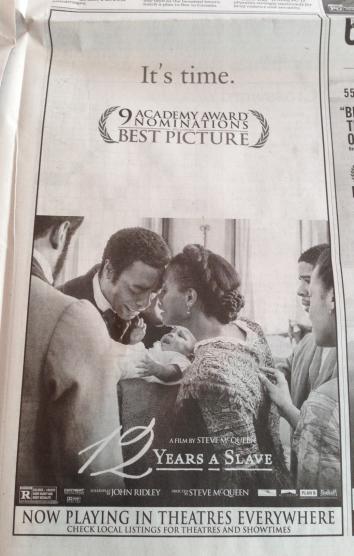
12_years_ad_2.jpeg

“It’s time.”

This is the  tag line in the post-Oscar nomination ads being prominently run in New York and California for  “12 Years A Slave,” a strong Academy Award contender (nine nominations, including best film).

Although there is room for disagreement, and the ad has the virtue of all clever advertising that it conveys different messages to different markets—Haven’t seen the film yet? “It’s time!”  Desperate to see the best movie you saw in 2013 finally get its due? “It’s time!”  When will the question of whether the most honored film of the last 12 months will win the biggest honor of them all be answered? “It’s time!”…or almost time, as the Oscar ceremonies are coming up on March 2—the consensus is that “It’s time” is mainly aimed at Oscar voters, and the message it conveys is, as Slate puts it, “it’s time for a movie about slavery, and with a significantly black cast and crew, to be recognized by the Academy of Motion Picture Arts and Sciences.” Film critic Phil Hammond puts it slightly differently:

“The ad not only can be interpreted as shining a light on a very dark period in American history, it also shines a light on the Academy’s fairly dismal record of awarding its top honor to any movie about the black experience. In fact there has been only one Best Picture winner in the 85 years the Academy of Motion Picture Arts and Sciences has been handing out Oscars that even remotely qualifies in this regard. In 1968, In The Heat Of The Night, a murder mystery set against the racial divide in a small Southern town, won Best Picture and four other Oscars just a few days after the assassination of Martin Luther King (the ceremony was even postponed two days out of respect). The votes were in before the King assassination, but it seemed then that “It’s Time” would have been an appropriate way to describe that victory. However, outside of lead actor Sidney Poitier — who also co-starred in another racially themed Best Pic nominee that year, Guess Who’s Coming To Dinner —  this movie  featured a largely white cast, white producer, screenwriter and director (Norman Jewison).”

If so many in the industry are interpreting the ad this way, it is fair to assume that this was at least one of the ad’s objectives, and on the assumption that it was an objective, your Ethics Alarms Ethics Quiz today is this:

“Is appealing to Oscar voters on this basis fair and ethical?”

I can see strong arguments for each position. Continue reading

Ethics Quiz: Alex or Alexis?

Actually, his friends called him "Alex"...

Actually, his friends called him “Alex”…

The Daily Caller believes it has caught the White House in an attempt to erase a Presidential gaffe from history:

“White House officials have quietly changed an official transcript to hide President Barack Obama’s embarrassing historical error during his international press conference with French President Francois Hollande. Obama’s error came when he misnamed Alexis de Tocqueville, a clear-eyed Frenchman who explained the subtle miracle of American culture and democracy in the 1830s. His book is a classic, partly because his insights about Americans’ social equality and civic society have become commonplace among centrists and conservatives. But Obama called him “Alex” in front of the French and U.S. press, and while facing banks of TV cameras. The White House’s official transcript, however, hides the presidential error by using the correct name. It now says that Obama declared: “Alexis de Tocqueville — that great son of France who chronicled our American democracy.

“Obama’s error was slight, but badly timed, partly because Obama is holding a state dinner for Hollande tonight.”

Your Ethics Alarms Ethics Quiz:

Is the White House transcript alteration of the President’s shortened version of de Tocqueville’s first name a mere edit of a trivial and immaterial miscue by President Obama (ethical) or an attempted cover-up, as the Daily Caller argues, of “an embarrassment for a President who claims to have been a constitutional scholar, and a judicious student of American history” (unethical)?

My answer: Continue reading

Ethics Quiz: The Marriage Mark-Up

Wedding reception

The New York Times published a feature in December exposing how hotels and wedding service vendors typically charge more to couples planning wedding festivities than they do to corporations seeking the same facilities and the same services. Is the result of  gauging, market forces, negotiation inexperience by the happy couple, or something else? Is it unethical?

The article seems to conclude that the vendors are simply taking advantage of purchasers who have no sensitivity to price, especially so-called “Bridezillas.” They want what they want for their perfect day, and will pay whatever it will cost to get it. Are the venders being unethical to take advantage of what is an emotional rather than a rational mindset? After considering whether more price transparency in the wedding industry would help (the author thinks not), the piece concludes,

“Strong consumer preferences — about the flower type, bridesmaid dress, cake decorations, music style, whatever — mean less price sensitivity (what economists refer to as greater demand inelasticity). If the cocktail napkins must be blue, the happy couple will be willing to pay more for blue. So if there are enough brides out there with strong and specific preferences, who want their weddings to be the special day they always dreamed of, that’s going to push equilibrium prices higher, no matter how transparently they are displayed. In other words, the Bridezillas keep prices high for the rest of us.” Continue reading

Ethics Quiz: Rank The Unethical Politicians!

Three pols

For your first Ethics Alarms Ethics Quiz of the New Year:

Consider these unethical politicians from Florida, Texas and California…

Unethical Politician A:

California State Sen. Kevin de Leon (D-Los Angeles)

Ethics Failures:

Competence, Responsibility, Diligence

Explaining his proposed legislation SB808, dealing with “ghost guns” (that is, home-made weapons) at the California Capitol in Sacramento last week, de Leon held up such a firearm and said, “This right here has the ability with a .30-caliber clip to disperse with 30 bullets within half a second. Thirty magazine clip in half a second.”

This is genuine anti-gun gibberish that could not possibly be uttered with a straight face by anyone even slightly familiar with guns. There is no such thing as a “30-caliber clip;” he is referring to a 30-round magazine. (There is also no such thing as a “30 magazine clip.) “Caliber” refers the measurement of the width of a bullet or the internal diameter of a gun barrel, not what the magazine will hold. And the average rate of fire for a semi-automatic rifle, which is what he was holding, is about 120 rounds per minute, not 3,600 rounds per minute.

Why are legislators who don’t care enough about guns to educate themselves about what they are, how they work and what they are capable of doing, submitting legislation about guns? Because they just know guns are dangerous, and in their infantile, knee-jerk reasoning, that’s all they have to know. The rest is fakery: the legislator is pretending that he has sufficient expertise to be credible on the issue, when he is too lazy and arrogant to do the minimum study necessary to render him qualified to vote on gun regulations, much less author them.  This is the equivalent of a legislator who thinks babies are delivered by storks proposing abortion laws. Continue reading

Ethics Quiz: “The Penniless Girl” And The Yechhh! Competition

"Hey...I'm cute, without shame, ambitious, mean...I could be a reality TV star!"

“Hey…I’m cute, without shame, ambitious, mean…I could be a reality TV star!”

Actress Erin Wotherspoon, 24, lives in Toronto and has an unusual avocation. As she describes it on “A Penniless Girl, Bad Dates and Plenty of Oysters”,

“I’ve got a pretty face & a pretty extensive urban spoon wish list…We all know that getting what you want in life can be tough. Which is why I’ve decided to let someone else finance my dreams. My dream? To eat in pretty restaurants without costing me a penny. You had me at Elk Tartare, lost me at chin strap. Follow me to learn who I screw over, bang and love as I navigate Toronto’s diners, drive-ins & dives.”

Yes, as breezily chronicled on the Tumblr blog, Erin entices unenticing, lonely and hopeful men to feed her at Toronto’s best eateries, then dumps them unceremoniously once the bill has been paid. As her mission statement above demonstrates, she doesn’t see anything wrong with this, despite the fact that it is dishonest, cruel, manipulative and a straight-up violation of both Kantian ethics (don’t use people) and the Golden Rule, as well as a pure as crap example of an ends justifies the means life philosophy. Are some of Erin’s escorts using her as well, essentially buying faux affectionate companionship for the cost of some elk tartare? Oh, surely. Such individuals use their affluence to sully the dignity and integrity of others for a price. The fact that one is being unethical in his dealings with another who is also unethical—mutual users, mutual corrupters—is no justification.

Now, as someone—maybe even Erin—could have predicted, a U.S. reality show producer wants to make a star out of her, and it appears that we may soon be able to watch Ellen dupe wannabe sugar daddies into delicious and free meals weekly.Then she can give an interview to GQ and explain why gays are sinners.

Your Ethics Alarms Ethics Quiz as 2013 winds down to an ethically depressing finale:

Who is more unethical: “the Penniless Girl” or the TV executives who want to make her rich and famous?

For me, it’s an easy call: the reality show purveyors are much worse than Erin. Selfish, deceptive, exploitive conduct is wrong and more harmful to society the more of it we get. Reality shows and the other ways the United States and its media reward terrible conduct—CNN giving Eliot Spitzer his own show, MSNBC doing the same with Al Sharpton, Fox employing sleazy (but famously sleazy!) Dick Morris, and the radio shows for the likes of Ollie North and G. Gordon Liddy come to mind, and now I’m nauseous again—make being unethical (or drunk, or stupid, or pathetic) a ticket to stardom, and even a desirable career path. It isn’t only reality shows, of course. It’s Republicans cheering Phil Robertson as if what he said wasn’t offensive; it’s Joe Wilson getting boat-loads of contributions off of shouting “You Lie!” at the President of the United States; it’s Tom Delay and Kim Kardashian getting gigs on “Dancing With The Stars” for being indicted and making a sex tape, respectively; it’s Kanye West, Miley Cyrus and other pop “sensations” receiving dawn to dusk publicity and inflated recording sales by behaving badly. We stifle liberty and expression by organizing boycotts against those whose conduct is objectively or subjectively offensive, but to reward them for it is courting cultural suicide, and turning the usual process of establishing healthy societal standards upside-down and inside out.

________________________________

Pointer: Fark

Facts: Toronto Sun, Tumblr

Graphic: Toronto Sun

Ethics Quiz: Awarding An Accused Rapist The Heisman Trophy

jameis2Heisman Trophy winner Jameis Winston was cool, collected and funny delivering the “Top Ten” on David Letterman last night, but to me, the hijinks seemed out of sync with reality, fairness and justice somehow.

The 19 year-old-Florida State University star quarterback became the youngest Heisman Trophy winner ever when he was named college football’s most outstanding player Saturday night in New York. He is also the youngest accused rapist to be awarded the Heisman.

That award  symbolizes football’s ongoing ethics problem. The pro game’s brutal, uber-macho and “the ends justify the means” culture that has players maiming each other as the crowd cheers and multiple felons on the field in most games has reached into the lower reaches of football, with both colleges and high schools breeding arrogant, entitled jerks who get special treatment through their pampered academic careers and too often emerge from from the football machine as polished sociopaths. The Penn State horror story was a symptom of this. Is Winston’s award another?

It hasn’t been featured in many of the exultant stories about the Heisman winner, but a year ago, on December 7, he was accused of rape by an FSU co-ed. Last week the prosecutors—just in time for the Heisman!—declared that they had not found enough evidence to convict him, which means that they did not have enough evidence to ethically prosecute him. The accuser’s attorney, Patricia Carroll, immediately condemned the decision and the  investigation that led to it, detailing multiple irregularities in the the handling of evidence and testimony. Writes Slate’s legal reporter Emily Bazelon: Continue reading

Ethics Quiz: PolitiFact’s Ethical, Unethical Lie Of The Year

Lie of the Year

I’m so confused!

PolitiFact, the Tampa Bay Times’ “fact check” web page, has long been flagged on Ethics Alarms (and elsewhere, notably by the WSJ’s James Taranto) for its lack of integrity and flagrant bias towards the Left, Democrats, and President Obama. It was in June of 2012 that Ethics Alarms produced the “smoking gun” of PolitiFact’s perfidy, when the site  pulled off a “when did you stop beating your wife” stunt to cast unfair suspicion on House Speaker John Boehner, “fact-checking” a groundless accusation and despite finding no evidence that it was true, labeling the accusation unsettled, because Boehner might do what he was accused of, eventually. In May of this year, as it slowly dawned on fair, English-comprehending Americans that then-U.N. Ambassador Susan Rice was misleading the American people about what the CIA knew about the September Benghazi attack, and Jay Carney, as his job description requires, lied through his teeth about her performance, PolitiFact could only muster a “mostly false” rating. The site is a partisan spin-machine, using the dishonest guise of a neutral “fact-checker” to undermine trust in Republicans and bolster Democrats when they need cover, particularly the President, who needs cover a lot. Continue reading

Ethics Poll: The Amityville Kidney

"Wait---you're going to put THAT  inside me???"

“Wait—you’re going to put THAT inside me???”

In the comments to the post The Kidneys of Orlac, Texagg04 raises a fascinating angle that I had not considered. I have previously written, regarding state regulations that do not require realtors or sellers to disclose that a grisly murder or six occurred on a property, that a purchaser has the right to know about such conditions that may bother him personally, and that regardless of the laws involved, there is an ethical duty inform  a potential purchaser know that he is buying the site of the Amityville Horror (for example). Texagg04 suggests..

“Much like real estate agents ought to reveal that a house had a grisly murder in it, I’d submit that recipients of organ donations of this kind should get to be informed of the donor’s convictions.”

Hmmm. I’m not so sure. One of the reasons for my views about the death houses is that they may be difficult for the uninformed buyer to sell later if the home’s history is known or becomes well known. Also, there are always alternatives to buying a particular house—given a choice between the site of a murder and a similar house with no such history, I might opt for the latter—I’ve seen too many of the “Paranormal Experiences”  and “The Grudge” movies, I guess. But with donated organs, the options are more limited. Maybe not telling the recipient that he has the heart of the Green River Killer is the fair and kind thing to do.

Let’s vote!

Ethics Quiz: Michael Wilbon’s Politically Incorrect Confession

mike_wilbon

Sportswriter Michael Wilbon, Tony Kornheiser’s African-American foil on the fluffy ESPN show “Pardon the Interruption” and hardly a rabble-rouser, shocked his audience this week when he announced that he is an aficionado of the word “nigger” (but not in public), and objects to being told that there is something wrong with that, especially by white folks. The issue came up regarding an uproar over a tweet, since deleted, from an NBA player using the word to criticize his team mates. [ Aside: It is funny how frequently a single post on Ethics Alarms  about a topic—say political correctness, word censorship, civility and the morass of related ethical issues—seems to trigger an explosion of news stories in the same area. Undoubtedly it is because the proximity of the post itself influences my judgment regarding which events deserve comment, but it sure doesn’t feel that way. This is similar to the phenomenon where you think you have heard a word or phrase for the first time, and suddenly you’re aware of it everywhere.] Wilbon said, unapologetically,

“People can be upset with me if they want, I, like a whole lot of people, use the N-word all day, every day, my whole life … I have a problem with white people framing the discussion for the use of the N-word.”

Your Ethics Alarms Ethics Quiz this weekend is this:

Is Wilbon’s defense of using the word “nigger”ethical? Continue reading