Unethical (and Cynical) Donation Of The Year: The St. Louis Rams’ Forgiveness Bribe To The Backstoppers

"Agreed, then: you can call us racist murderers, as long as you keep the donations coming...."

“Agreed, then: you can call us racist murderers, as long as you keep the donations coming….”

Let us be undiplomaticly clear about what the five St. Louis Rams players did when they came onto the field at the start of a Monday Night Football games with their hands in the air like the fictional, idealized, sanitized, imaginary and politically useful version of Michael Brown—you know: the angelic young college-bound African-American male who did nothing whatsoever to cause the circumstances of his own death.

The players were saying, on national television, with millions of people watching, that Officer Darren Wilson executed Mike Brown in cold blood; that the St. Louis police do such things, want to do such things, and will do such things, because they routinely target young black men for harm; and that police generally, around the nation, are virulent racists. That’s what the gesture meant, and that is what it was devised to convey. Continue reading →

On Peter Pan, Pippi Longstocking, And Ethics Of Applying Political Correctness To Art And Literature

Cultural events earlier this month brought to light, on two continents, the problem of maintaining the integrity of art and literature under the onslaught of political correctness.

In Sweden, a controversy has erupted over the re-broadcast of a 1969 television adaptation of the Pippi Longstocking books, the children’s classics authored by Astrid Lindgren. The Swedish national TV station, SVT, announced that it is revising a scene from the 1969 television series about Pippi  which she says her father is “king of the Negroes,”a direct quote from one of the stories. Believe it or not, this has set off a contentious national debate.

The family has approved the station’s  desire to change the TV version, but is keeping the term in future editions of the books. In 2006, the family added a preface explaining that today, the word is considered “offensive,” but that when the books first appeared, “Negro was a common expression for people with black skin who lived in other parts of the world than ours.” That’s a sensible solution. Period and context is important in art and literature: the urge by some to constantly purge the world of any reference, word or attitude in past creations that seem out of place now leads to a form of cultural self-lobotomy. Erik Helmerson, a columnist at Dagens Nyheter, an influential Stockholm newspaper, called the changes a form of censorship. “I’m very sensitive to the fact that people are offended by the N word,” he said in an interview. “I’d never use it myself.” He even called revising the TV series  “a huge interference into freedom of speech.”  “Where do we draw the line? What do we cut and what do we keep? Who should decide? Who needs to be offended before we cut a word?” Continue reading →

Smith College President Kathleen McCartney’s Apologizes For Saying “All Lives Matter”: Is There A Problem?

Damned if you do, damned if you don't.

Damned if she does, damned if she doesn’t.

There is a problem, all right, but not the one you might think—at least not this time.

Smith College President Kathleen McCartney attempted to  show support for her students  protesting racism and police brutality by sending a campus-wide email titled, “All Lives Matter.” But the official slogan of such protests is “black lives matter.” McCartney immediately came under fire from black students and others, accusing her of minimizing the specific nature of her concerns. “No, Kathy. Please do not send out an email saying ‘All lives matter.’ This isn’t about everyone, this is about black lives,” Sophia Buchanan, a Smith student, in a typical critique.

The college President apologized several hours later, saying that she hadn’t thought about the fact that “all lives matter” was being used by some as a rebuttal to “black lives matter”:

“I regret that I was unaware the phrase/hashtag ‘all lives matter’ has been used by some to draw attention away from the focus on institutional violence against Black people…. “It minimizes the anti-blackness of this the current situation; yes, all lives matter, but not all lives are being targeted for police brutality. The black students at this school deserve to have their specific struggles and pain recognized, not dissolved into the larger student body.”

That statement put her in the cross-hairs of the “conservative media” and others, who treated it as a full-fledged “gotcha!” What??? Saying that all lives matter is offensive now? What next Orwellian proposition will political correctness bullies demand from spineless college administrators? Continue reading →

Comment of the Day on “The Perils Of Over-Regulating The Police: A Case Study”

militarization

ABC News Political Analyst and former Bush advisor Matthew Dowd said on ABC’s This Week  that the recent cases of police violence involving unarmed African Americans were as much due to the militarization of police forces as race.

“We basically dress up officers as if they’re machines,” Dowd said. “And then we expect them to act like human beings. So what happens is, they confuse power with force. Most of the officers in this country do a great job. But when we militarize our police force and dress them up like machines, they act like machines.”

Technically, he was right: there is no evidence that those tragedies were caused by race or militarization. He had exactly no evidence or documentation that the “militarization of police” caused these deaths, or that alleged militarization has caused any deaths. This appears to be emerging conventional wisdom, just one of those things someone says and everyone nods in agreement with no real thought. Why is the so-called “militarization” of police forces such a threat or cause to distrust police? If police are not trustworthy, that’s a reason not to give them fire-power, but having more fire-power doesn’t make them less trustworthy. It simply makes it more important than ever that police be well trained and responsible.

I was preparing a post about this emerging theme as an example of bias, in this case, pre-existing anti-police bias, being translated into false and discourse-warping assumptions by activists and the police when stalwart commenter dragin_dragon delivered this, the Comment of the Day, on the post The Perils of Over-Regulating the Police: A Case Study:

Police departments have been quasi-military for many years, and it has not seemed to hurt their ability to enforce the law. As early as 1974, Austin, Texas P.D. referred to it’s officers on patrol as “the troops”. S.W.A.T. units have traditionally used what they thought of as “Military” weapons, tactics and mode of dress; never mind that a properly trained infantry squad could and would wipe them out in minutes. Note, also, that most states and/or cities ban the mounting of weapons on the surplus (obsolete) armored and tracked vehicles or helicopters. They do NOT ban a man carrying a weapon being mounted on those vehicles. I also point out that many police officers are ex-military so are bringing to the job an environment with which they are already familiar. Rank structures are similar, and the police in the United States, at least, carry weapons, perhaps as a holdover from the Old West, perhaps not.

Given the rise in crime rates (see Chicago, Detroit), many of these escalations of Police equipment and training are needed. This became evident a number of years ago when a Los Angeles bank robbery went south and the robbers began shooting at the converging police with automatic (not the semi-automatic versions described as automatic, but rock-and-roll full automatic) assault weapons. The out-gunned police (9 MM pistols and shotguns) did the best they could and, like Israel, vowed “Never again”. Strangely enough, many in the National Media agreed, at the time. So, what we are referring to as the “Militarization” of the Police is being undertaken for 2 reasons: 1) to provide a higher likelihood that the officers will get to, at the end of the day, go home to family, and 2) so that the public, which they are sworn to protect and defend, will also, at the end of the day, get to go home and family.

Does this increase the likelihood that a perpetrator may not make it to trial? Quite likely. Do I care? Not so much. As I am sure will be pointed out repeatedly, death tends to be relatively final, with no appeal. And, after all, the most dangerous criminal has the right to due process. Unfortunately, crime, violent crime, is not something one does accidentally. It requires a conscious decision, often along with a misplaced almost arrogant sense of invincibility. Getting shot, and probably killed is the most natural consequence in the world of that attitude. Ask Michael Brown. Like it or not he jeopardized the well-being of an armed police officer, apparently arrogantly disregarding the consequences of his behavior and, quite probably putting the officer’s life at risk. I am assuming that Wilson, like many police officers these days, was wearing a very militaristic bullet-proof vest under his shirt, but, since Ferguson is a fairly poor community (and rapidly becoming poorer) possibly not, so he might have been better off if Brown had shot him, first. At least he would still have a job.

All this is by way of saying that militarization of departments is not necessarily a bad thing. The use to which the training and equipment is put may be a bad thing, but I have not seen, in any report, any attempt to oppress or exert Nazi-like control over the citizenry. So, am I in favor of the “Militarization”? You bet. I am in favor of anything that makes it more likely that they will be able to survive the work day. And make no mistake, that is always a question for a police officer, just like it is for the combat soldier. Am I also in favor of more and better training? Also, you bet. Need I repeat? And the management, or “command” element of the police need to be taught How and When to use the equipment and training.

Continue reading →

Transparency, Causation, Eggshells, Trust : Seven More Ethics Issues In The Eric Garner Case

jigsaw-puzzle-record

1. There is near unanimity in the response to the non-indictment by the Staten Island jury in the Eric Garner case. In light of the graphic video, it is hard to see how there wasn’t probable cause to indict. The coroner verdict of “homicide” would see to provide sufficient evidence all by itself. However, in the absence of the complete record of what the grand jury heard and saw, nobody can be certain that this was a miscarriage of justice. However, given the context of the case and its deleterious impact on faith in the justice system, that is no solace and scant mitigation. As in Ferguson, it is prudent and essential that the public see what the decision was based upon. It is true that those who are determined to see injustice, bias and racism will do so regardless of what the evidence shows–again, as in Ferguson—but the only evidence that has been made public, the various videos and the officer’s testimony–only makes the non-prosecution more suspicious.

2. Can the non-prosecution be justified? If so, the only reason I can see would be lack of proof of causation. Causation is tricky, and  juries get confused about how to analyze it. Since it is fair to assume Daniel Pantaleo did not intend to kill Eric Garner, the issues are a) whether his actions during the arrest were negligent, and b) whether they were the proximate cause of Garner’s death. That his conduct was negligent is not enough to sustain and indictment—that negligence had to be the reason Garner died. Remember, he was not choked to death. The medical examiner ruled that Garner died from a collection of factors: compression on his chest and throat, the position he was forced into, his obesity, weak heart, and asthma, all causing asphyxia.

  • If Pantaleo’s actions alone would not have caused Garner’s death, then it could be legitimately argued that he was not guilty of a crime. The other officers were given immunity for their testimony, which seems like either a bad decision by the district attorney, or intentional sabotage of the case against Pantaleo’s. If it was the collective action of the police that caused Garner’s death, it would be unjust to make Pantaleo the sole officer punished. If some of the testimony from the unchargeable cops made the case that it was another officer, or several, who really caused Garner’s death, that would explain the no indictment result.

In the widely seen video of the arrest, Pantaleo can be seen with his arm around Garner’s neck as Garner is taken to the ground and for some time thereafter, but in watching the video it’s difficult to determine whether Garner was in fact choked. And if he was, it did not appear it was long enough even to render him unconscious, much less kill him…I saw nothing excessive in the manner in which the officers subdued Garner. He was neither beaten with batons nor even punched. To me, it appeared to be a fairly typical scuffle with a large man who had clearly demonstrated his unwillingness to be arrested peacefully.

He misses the point. The question is whether the take-down was excessive for Garner, not some theoretical average arrestee. It is true that with a normal, healthy subject, what the officers did would not typically cause death….but Garner was obviously not normal, nor healthy. He was morbidly obese, and 350 pound middle-aged people tend to have the kinds of heath issues Garner in fact had. Nobody would argue that an elderly woman or a ten-year old girl or someone in a wheelchair should be manhandled like that. Such treatment was negligent for Eric Garner, and the deadly result could and should have been anticipated.

It is true that the officers couldn’t know that Garner had a weak heart and suffered from asthma, but it doesn’t matter: the rule in negligence is that “you take your victim as you find him.” If your negligence is the proximate cause of someone’s death, the fact that it wouldn’t have caused anyone else’s death is no defense. This is the so-called “Egg-shell Skull” rule.

Garner was an egg-shell perp. Continue reading →

Ethically Incoherent Statement Of The Month: Van Jones

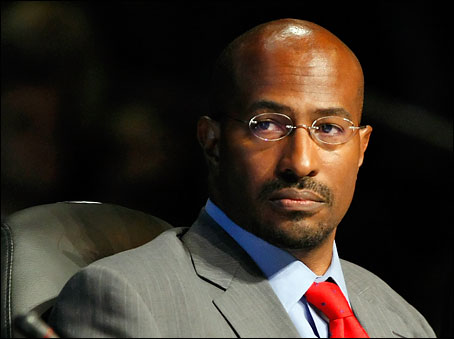
Van Jones: Reasonable or biased?

Van Jones: Reasonable or biased?

Van Jones, the former White House “czar” of something or other turned smooth-talking racialist warrior on CNN’s “Cross-Fire” and various TV panels, was arguing for frank racial dialogue on ABC’s “This Week With George Stephanopoulos,” in the context of the protests over the Ferguson and Staten Island police grand jury decisions. Sounding reasonable as he often does, Jones then said that what should be an area of agreement is the need for a special prosecutor whenever police misconduct is before a grand jury, noting that it was an “obvious conflict of interest”for prosecutors who work with police as a core element of their job.

I have addressed this argument before, but let me be clearer. This is a conflict of interest that a competent and ethical prosecutor should acknowledge and be able to deal with as the legal ethics rule require. The prosecutor should get a waiver from his or her client—not the victim’s family, but the government the prosecutor represents—and honestly assess whether the fact that the police serve the same client will prevent the prosecutor from being fair and objective. If the answer is yes, then the prosecutor must recuse, but I see no reason why the answer should be yes, if the prosecutor is ethical and worthy of the position.(Jones and other advocates for this “solution” have a bias against prosecutors, whom they view as presumptively unethical.)

Theoretically, every case in which an officer’s credibility determines whether a citizen should be charged poses the same conflict: it is endemic to the prosecutor’s job. Indeed, prosecutors have a very good reason to want bad cops punished and removed from the police force; I’m not at all certain that there is a necessary bias on the part of prosecutors in favor of letting such cops escape legal consequences of their actions. That assumption is based on the assumption that prosecutors don’t care about  justice. Nobody who doesn’t care about justice becomes a prosecutor. Why would they? It is a hard, frustrating job and the pay isn’t anything special.

The strongest argument for a special prosecutor is a different ethical problem, the appearance of impropriety. If the decision to prosecute or not is tainted with suspicion of bias, then the justice system is compromised and breaks down. This is why, for example, it is terrible that the Justice Department, a super-politicized one at that, is supposedly investigating the I.R.S. scandal.

As George moved to another topic, Jones blurted out a final statement that caused me to spit-take a mouthful of coffee. It undermined all of his finely tuned rhetoric about fairness and non-partisan dialogue about race, and exposed, ironically, his own biases. He said;

“If there had been a special prosecutor in Ferguson, we would have had a different result.”

AHA! Continue reading →

Journalism Ethics Reality Check: What The Entire News Media Did To Darren Wilson With Dorian Johnson’s “Hands Up” Story Is EXACTLY Like What Rolling Stone Did To UVA With “Jackie’s” Rape Account, Just Worse.

Am I the only one who sees this?

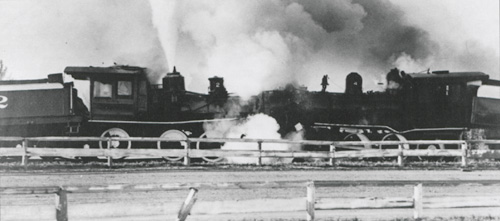
Two train wrecks, same track...

Two train wrecks, same track…

I discern that I was too subtle—imagine that!— when I wrote,

In light of all this, it seems that women really have done a relatively poor job at intimidating the left-biased media as well as its progressive pundits and elected officials. If they had sufficiently pressured journalists into believing that to challenge their accounts of rape, substantiated or not, was proof positive of malicious animus, like the civil rights machine has regarding narratives of police racism, they could depend on much of the media continuing to repeat the Rolling Stone account as truth even if it is completely discredited. This is, after all, what we are witnessing right now, as the recent grand jury decision in the Eric Garner death has allowed columnists, reporters, and broadcasters—and thus protesters and politicians—to continue to represent what happened to Michael Brown as if Dorian Johnson’s discredited description of his friend’s death was fair, accurate and unbiased.

So let me be clear….

We are told the the news media is furious with Rolling Stone over its discredited and anonymously sourced gang rape accusation against the University of Virginia’s chapter of the Phi Kappa Psi fraternity. Why is it not similarly critical of itself for publicly and far more widely accusing a single, named Ferguson police officer, Darren Wilson, of a race-motivated, cold-blooded execution of an unarmed man based on the allegations of Dorian Johnson? They are, from a journalism ethics perspective, equally irresponsible and unprofessional, and predictably more harmful. It is, we can stipulate, worse for a police officer to be accused of first degree murder than for unnamed members of a fraternity to be accused of rape.

Note:

1. Both Rolling Stone and the mainstream media were eager to accept the stories being told as fact because of their own ideological biases.

Rolling Stone is committed to the current campaign of the left to portray college campuses as perpetuating a “rape culture.” The mainstream media, as it had already proved in its slanted and incompetent coverage of Trayvon Martin’s death and the trial of George Zimmerman, is a shameless ally of the cynical Democratic Party’s tactic of representing the nation as racist. Continue reading →

The Rams’ “Hands Up!” Gesture: Of Course The Players Deserved be Disciplined

rams protest 1201

The five St. Louis Rams who entered their NFL game last week with their hands up aren’t going to be disciplined by the league, for reasons that have nothing to do with the appropriateness of their conduct. The NFL is up to its faceguards in bad public relations already, and understandably wants to avoid wading into the Ferguson quagmire and being perceived to be taking sides, a move with no up-sides at all. Sportswriter Sally Jenkins also took issue with the St. Louis police demanding that the players be punished, in an emotional statement that seemed to threaten vague consequences if they were not. She was right to point out that government entities may not use threats of non-performance of their duties to members of the public in order to control their speech, like, say, the Federal government is doing now to try to force Dan Snyder to change the name of his Washington, D.C. NFL team.

Jenkins’ conclusion, however, was an ethics mess:

“Five members of the St. Louis Rams made an edgy gesture on Sunday, and you may not agree with them. But they merely joined a long tradition of athletes using their celebrity for symbolic public protest, and the NFL was right to reject the call to punish them. Punish them for what, after all? For showing an alertness and sensitivity to current events in their community, and holding an opinion on them?”

1. The “long tradition” argument is “everybody does it,” and nothing better. Professional athletes are paid to play games and entertain. Few of them have any qualifications or expertise that elevate the value of their opinions on public policy and politics above that of the regulate citizens watching them, and it is an abuse of their position and an exploitation of the venue for any athlete to exploit both to make a personal statement. Earlier, Jenkins says that to punish the Rams players “would also smack of 1968, when Tommie Smith and John Carlos were expelled from the Olympic Games for their black-gloved salutes,” as if that’s an argument. Smith and Carlos should have been expelled. The Olympics wasn’t theirs to co-opt for national political statements, no matter how valid or worthy. The Rmas players can hold opinions, and nobody is saying otherwise. Once they are in uniform and on the field, however, their opinions are not for display. They don’t own the forum. Continue reading →

Observations on the Eric Garner Non-Indictment

The New York Times, among others, reports that the Staten Island grand jury has brought no indictment in the Eric Garner case, in which a large African American man resisted arrest and was brought down by multiple cops, as one, Daniel Pantaleo, used a choke hold to restrain him. After saying that he couldn’t breathe, Garner, who was asthmatic, stopped breathing and died

Observations:

1. I haven’t seen all the evidence, and stipulate that there may be some good reason for the non-indictement that I am not aware of. That aside, however, it certainly seems like this case embodies many of the features that were not present in the death of Michael Brown but that the media and activist narrative attributed to it nonetheless. Garner’s case, in contrast, appears to demonstrate an unwillingness of the law enforcement and justice system to hold police officers accountable for the results of excessive force, even when the result is death.

2. Again, absent some significant evidence that has not been made public, I believe that the video of the fatal arrest, the fact that the choke hold tactic is prohibited by police department policy [ Note: I originally wrote that it was illegal; that was in error, and I apologize for the mistake], and the coroner’s verdict that Garner’s death was a homicide should have been sufficient to mandate the grand jury finding probable cause for at least a charge of negligent homicide.

3. This seems like a result worthy of protest. It is one more reason why activists continuing to use Brown’s death as a rallying point is foolish and wrong. For their purposes, it is a weak case. Garner’s is not. Continue reading →

How Should We Judge Second Apologies?

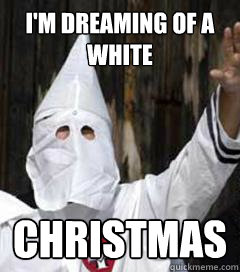
Sure, who wouldn't think this was funny coming from a member of your school board?

Sure, who wouldn’t think this was funny coming from a member of your school board?

The most important feature of apologies is that they express sincere and honest regret for the real harm done. If the first apology for misconduct fails that test, how much credence should a second attempt have? Does it negate the first apology completely? Ought it to be read and understood in light of the initial, unsatisfactory apology? Or should it be ignored completely as a public relations document crafted to achieve a result, rather than to express genuine contrition?

The case of Chris Harris, a board member for the Hooks Independent School District in the town of Hooks, Texas, provides a fascinating test.

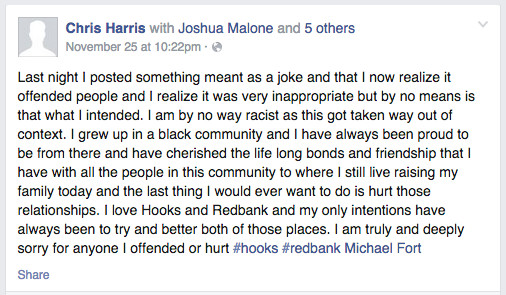
Lat week, Harris posted an image of a Klu Klux Klan member with the caption, “I’m dreaming of a white Christmas”  to his Facebook page. The reaction to this was what almost anyone with a fully functioning cerebrum would expect, a category that Harris does not belong to, or at least did not when he posted it. Perhaps after shouting, “Doh!” or perhaps not, Harris rushed to repair the damage, publishing this apology:

Harris apology 1

Terrible apology! Continue reading →