The Democratic Party Has Announced That Discrimination Against Asian-Americans Can Be Justified

It can’t.

This was a significant and revealing vote in the Senate last week in many ways.

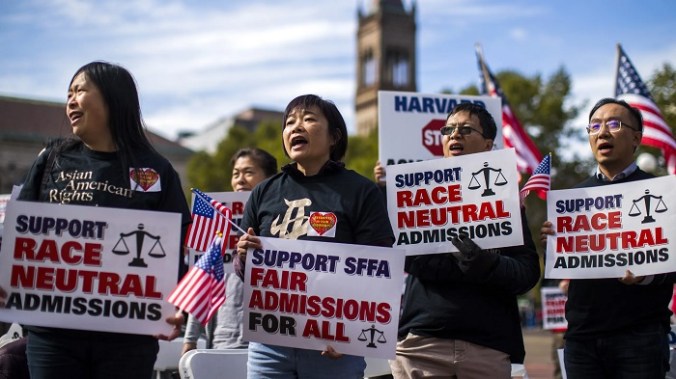
Senate Democrats united to vote down an amendment from Senate Republicans designed to bar “Federal funding for any institution of higher education that discriminates against Asian Americans in recruitment, applicant review, or admissions.” The addition was proposed for the grandstanding Senate legislation called the “COVID-19 Hate Crimes Act” that would require “expedited review of hate crimes” by the Department of Justice with “online reporting of hate crimes or incidents” and “expand public education campaigns aimed at raising awareness of hate crimes and reaching victims.”

This unnecessary legislation, sponsored by Hawaii Senator Mazie Hirono, passed the Senate 94-1, because nobody is against “hate crimes.” Yet oddly, the Democratic Party, at least in the Senate, appears to be in favor of discrimination against Asian Americans. Why is that? The Yea-Nay vote was 49 – 48, with no Republican voting against the amendment, and not a single Democrat voting for it.

“We have major universities in this country that are discriminating in admissions against Asian-Americans,” Louisiana Republican Senator John Kennedy (R-La) said. “Discrimination is discrimination…This is wrong, it is contemptible, it is odious.” Yes, yes it is. But the current ideology of the political Left now holds that discrimination against whites is good discrimination (they have it coming, after all, the racist bastards!) and discrimination against Asian-Americans is necessary discrimination. The argument is vile, and indefensible in law or ethics, which is why, so far at least, the mainstream news media is burying the story and the vote. The passage of the pandemic hate crimes act is being trumpeted everywhere, perhaps because the news media is complicit in the wildly inflated public belief in the extent of the problem it addresses, but the Democratic rejection of S.Amdt. 1456 is barely mentioned at all. Regarding this, I will repeat the same rhetorical question I asked once already here: “Why is that?”

Continue reading

Assorted Ethics Items, 4/23/2021: I Can’t Talk Or Eat, But I Can Still Write. And Think, Sort Of…[Finally Corrected!]

Well, THAT was certainly unpleasant…made a root canal seem like the warm embrace of a succubus by comparison…

1. An alternate juror in the Chauvin trial gave an interview. She seems like a pretty rational sort, but two comments support the contention that the trial was not a fair one:

  • “I did tell them that I saw the settlement run across the bottom of the screen one day…I was not surprised there was a settlement, but I was surprised they announced it beforehand.” She also said she understood that civil trial and criminal trial standards were different, but the fact that the city essentially announced that its police were liable for Floyd’s death cut the legs out from under Chauvin’s defense.
  • “I did not want to go through rioting and destruction again and I was concerned about people coming to my house if they were not happy with the verdict.” If any jurors feel that way, it’s not a fair trial.

Continue reading

Comment Of The Day: “Ethics Observations On The Shooting Death Of Peyton Ham”

Steve-O-in NJ has stepped into a temporary (I hope) vacuum of ambitious comments to monopolize the COTD field. Steve is a lot more pessimistic than I am, and prone to Jeremiads (THE END IS NEAR!) but he also is willing to make observations that most are reticent to put into print. A few of you out there hang out on my Facebook page, where my alleged friends had a meltdown over a repeat of my musings here about whether Juror 8 in “12 Angry Men” would have bothered fighting for reasonable doubt in the trial of a defendant whom he thought was probably guilty if he knew that a not guilty verdict would trigger violent riots. How dare anyone suggest that there was reasonable doubt in the Chauvin trial? How dare anyone imply that the trial wasn’t fair!

Steve-O’s point about police being in an impossible position still applies to Derek Chauvin, cruel and untrustworthy cop that he undoubtedly was. Usually that impossible position girds police from conviction in all but the most egregious examples of police misconduct, as in the case of Michael Slager. I think the public’s acknowledgement of the dilemma is appropriate and generally ethical, but it is ready-made for accusations of racism when the victim is black.

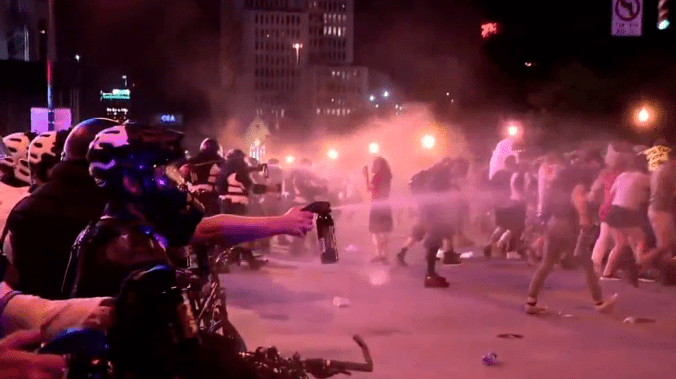
Back to the post that sparked Steve’s COTD, “Ethics Observations On The Shooting Death Of Peyton Ham”, there has been no news coverage of Ham’s death for a week. He was 16, just like the girl shot in the act of trying to stab another teen in Columbus, Ohio, but nobody in Congress or anywhere else is arguing that his youth demanded restraint by police. The reason is that Peyton Ham was a white male, and Ma’Khia Bryant was a black female. The police were supposed to understand that different standards applied. (The photo above is of the Columbus riots in response to the girl’s shooting. Somehow I can’t locate any similar photos of the protests of Ham’s death.)

Here is Steve-O-in-NJ’s Comment of the Day:

Policing in the United States is fast becoming a lose-lose proposition and a job fewer and fewer people are going to want. If you take action, you are considered a thug, a bully, and automatically a racist. If you take no action, you are either lazy or dead from the neck up and need to be fired. We’ve been over this half a dozen times since the death of George Floyd. Policing is by nature a dangerous and demanding job. Policing by nature sometimes requires split-second decisions which have a tiny margin for error and possibly grievous consequences if gotten wrong. Policing is not just about crossing schoolkids, directing traffic, getting lost children home, making reports of fender benders, and once in a while giving out a ticket to someone driving a little too fast or parked in a place clearly marked “no parking.”

Even in the safest small towns in America there are always going to be domestic violence calls, holdups, drunk and disorderly conduct, kids getting into drugs, or the mentally ill who do crazy things that endanger themselves or others. Like it or not, a big part of policing involves making unwilling individuals comply with lawful orders necessary to keep order. Sometimes there is no way to make that happen but to use force. Using force isn’t pretty. It’s not pretty to slam a violent husband or boyfriend down on the kitchen table and cuff him before he hits the woman in his life again. It’s not pretty to cuff a drug-addled, emaciated streetwalker who you’ve told to move along for the umpteenth time and been met with a torrent of profanity each time. It’s not pretty to throw a reeking homeless person who’s been harassing shoppers into the back of a police cruiser to take him somewhere where he can (hopefully) get the help he needs. And no, it’s not pretty to arrest some dreadlocked thug who’s spent his whole life doing nothing but commit crimes when he commits yet another one. It’s also not pretty when a hapless wife or girlfriend gets a broken jaw or a spiral fracture of the arm from a partner who she “just wouldn’t listen to.”

It’s not pretty when a family can’t walk down the street without seeing some skeletal prostitute shooting up. It’s not pretty when everyone has to avoid the block that “Crazy Joe” has claimed as his own. It’s not pretty when DeShawn, out of prison barely a week, sticks up a bodega with a gun or hits somebody over the head because he has no money and few prospects.

Continue reading

Who Is Surprised To Hear That “Propaganda Causes People To Grossly Overstate Police Killings of Blacks”?

Who? Well, probably your friends on social media who think you’re a racist because you point out that Black Lives Matter is spreading lies and hate.

I read with interest this feature yesterday in my New York Times: “Few Charges, Fewer Convictions: The Chauvin Trial and the History of Police Violence.”

It covered two full pages—you know, it was important—and was pure propaganda: deliberately misleading, contoured to make a political argument under the guise of news analysis. I classify the reporters, Aidan Gardiner and Rebecca Halleck, as ethics villains, along with whatever editor gave a green light to publish this deliberate deceit.

It begins,

For many observers, the trial of Derek Chauvin, the former Minneapolis police officer charged in George Floyd’s death, has felt like the culmination of years of outrage and grief over police killings of Black people in America. Video of the arrest that led to Mr. Floyd’s death inspired demonstrations that touched every corner of the country last summer, with protesters demanding justice for Mr. Floyd.

The Times reviewed dozens of similar cases in which encounters between Black people and police ended fatally. Though many cases prompted public outrage, that did not always translate to criminal indictments. In some cases, police officers were shown to have responded lawfully. In others, charges were dropped or plea agreements were reached. Some have resulted in civil settlements. But very few have resulted in convictions at trial.

These cases offer valuable points of comparison about what issues — video evidence, drug use, whether the person who died was armed — proved decisive in each outcome and what consequences, if any, officers faced. Even as the trial has unfolded, several events, including the killing of Daunte Wright just a few miles from Minneapolis, have provided a grim reminder that Mr. Floyd’s death is one in a decades-long history of fatal encounters.

Then we get a list of cases where blacks died as a result of police action. The facts of the cases are summarized briefly, often leaving out important facts. We are told, for example, the Eric Garner was “confronted” by police but not that he resisted arrest, nor that he weighed over 300 pounds. The Times reporters don’t deem it significant that Mike Brown tried to take away the officer’s gun, or that he was shot while charging the cop. In the case of Tamir Rice, the Cleveland 12-year-old shot while playing with a realistic toy gun that had its red tip removed, the article says that “a 911 caller reported seeing a person with a gun but said that it was ‘probably fake’ and that the person was ‘probably a juvenile,'” but does not add the crucial detail that these statements were not relayed to the officer.

I know most of the cases mentioned in the piece; for those I do not, I assume that I am being similarly misled. The Times isn’t reporting or doing legitimate analysis; this is advocacy, and unethical advocacy. Facts that would undermine the political agenda of the reporters, and by extension, the Times, are omitted. That is lying by omission.

Continue reading

Wednesday Wrap-Up For A Post-Chauvin Trial America, 2/21/21 [Corrected]

I guess I have to come clean: I thought I had posted this before noon. Guess not. So a Morning Warm-Up became a late night wrap up…

1. The trial was a sporting event? I did not know that! ESPN included the Chauvin guilty verdict in its list of important sports news today. Apparently, it’s sports news because a lot of athletes are going to shoot off their mouths about it, spreading ignorance far and wide.

2. Deranged Quote of the Day: “Where are the disabled, queer, poor, gender diverse, dogs of colour and single-parent dog families in Bluey’s Brisbane?” That comes from ABC Everyday’s Beverley Wang. The Disney+ program, we are told :

….is the award-winning, mega-hit animated series about the Heelers, a family of dog-shaped humans — parents Bandit and Chilli, four-year-old Bingo, and six-year-old Bluey — who live in a gorgeous Queenslander with city views, perched on a lush hilltop in sunny Brisbane.

The only way to handle people who poison minds and the the culture with ideas like this is to be merciless, and slap them down with the classic reaction of “Sidney Wang”:

Being nice just enables them.

3. From the False Narrative files: Yahoo! News correspondent Jon Ward authored a piece of counter-factual propaganda headlined, “Chauvin’s guilty verdict is a major milestone in America’s reckoning with racial justice.”  As I have tried to point out repeatedly, there is no evidence that George Floyd’s fate would have been any different if he had been white, Asian-American or a Smurf. None. NONE. There is no evidence that Chauvin was a racist, or that race played any part in his brutal treatment of Floyd. The fact that activists, politicians and the journalists seized on the symbolic imagery of a white cop’s knee on a black man’s neck and exploited it shamelessly doesn’t change the facts. This was not a racial incident. If the jury convicted Chauvin thinking that it was, then they were misled.

Ward’s essay is a good starting place for anyone who wants to understand  how far journalism has sunk.

Continue reading

Unethical And Intolerable: Waters, Babbitt, Sicknick, Part 1.

intolerable

The United States is now being consumed by a wave of audacious double standards and hypocrisy, rooted in racial bias and oppressive partisanship. Exposing it, condemning it and opposing it is to invite “cancellation” and being tarred as an ally of white supremacy. In the words of George H.W. Bush to Saddam Hussein, “This will not stand.”

I. Rep. Maxine Waters.

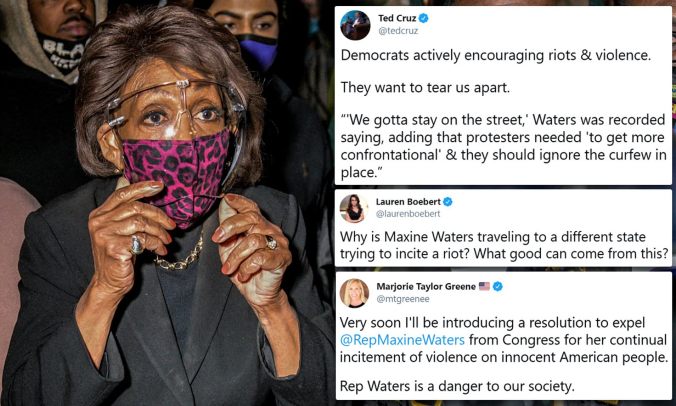
By any fair and reasonable standard, Waters’deliberate attempt to incite violence and law-breaking among already agitated and agitated protesters in Brooklyn Center, the Minneapolis suburb where Daunte Wright was killed, should earn her serious sanctions from Congress, her own party, and by the standards previously asserted by her party, the justice system. She exhorted the potential “mostly peaceful” mob to “get more confrontational” when the city had already seen burning, looting, and attacks on police. She directly threatened the jury in the Chauvin trial just a few miles away. In response, the judge in that trial, Peter Cahill, castigated Waters by name as the trial went to the jury, saying that her words were “disrespectful to the rule of law,” and adding,

“I’m aware that Congresswoman Waters was talking specifically about this trial, and about the unacceptability of anything less than a murder conviction, and talk about being ‘confrontational.’ [I wish] elected officials would stop talking about this case…I think if they want to give their opinions, they should do so in a respectful and in a manner that is consistent with their oath to the Constitution, to respect a coequal branch of government.Their failure to do so, I think, is abhorrent.”

Then, whistling in the dark, he tried to deny the obvious, saying that her comments wouldn’t affect the jury because he had instructed them not to pay attention to them. Right. Everyone knows that the old “pretend you didn’t hear what you heard’ command is a perfect remedy. (See: “The Verdict.”) Pathetically, Cahill said that one congresswoman’s opinion “really doesn’t matter a whole lot anyway.” Then why did the judge take the extraordinary course of mentioning it during the trial?

Cahill’s refusal to sequester the jury after Wright’s death was a terrible error, and it is coming back to haunt him quicker than anyone could have predicted, thanks to Waters. Later, the truth battled its way out of his mouth and he blurted out that Waters “may have given” the defense grounds “on appeal that may result in this whole trial being overturned.”

And yet Nancy Pelosi, who led a contrived impeachment of Donald Trump for urging demonstrators to peacefully protest because she claimed it sparked an “insurrection,” claimed nothing was amiss with Waters’ speech. “Maxine talked about confrontation in the manner of the Civil Rights movement. I myself think we should take our lead from the George Floyd family. They’ve handled this with great dignity and no ambiguity or lack of misinterpretation by the other side…No, I don’t think she should apologize.”

The rule, then, appears to be that a Democratic Congresswoman can cross state lines to urge an already inflamed crowd to get “more confrontational” while threatening a demonstration showing that it “means business’ if a jury does not provide the verdict she demands, while a Republican President should be impeached and charged with a crime for urging demonstrators to peacefully protest what they and he believe to be an undemocratic election.

Is it material that the Congresswoman inciting a riot is black, and the President who called for a peaceful protest is white? Are we allowed to wonder? Is it permissible to consider reality?

Continue reading

Ethics Villain: Rep. Maxine Waters (D-Cal.)

I seriously considered not posting this, because Waters’ ethical villlainy should be obvious to everyone, and Ethics Alarms generally doesn’t post on the obvious.

It has certainly been obvious to Ethics Alarms from the beginning: in 2009, in one of the very first posts here, I noted that CREW (Citizens for Responsible Ethics and Responsibility in Washington), the Democratic Party-bolstering fake “non-partisan” ethics watchdog, had labeled Waters one of the “Most Corrupt” members of Congress. This served their masquerade at the time, because it is so obvious that Waters is corrupt that she was “low hanging fruit”: by listing her on their unethical Congress members docket, CREW could claim that they really were bipartisan. (If CREW didn’t list Waters, it would make the group look like the sham it is.) Democrats know Waters is unethical; they simply lack the guts and integrity to say so and do something about her.

As I wrote in another post about Waters, “Never mind though: Waters is black, so by the infinitely adjustable weaponizing definition of racism used by progressives, black activists and Democrats for the previous eight years, to criticize her at all is to be a racist.” There is no member of Congress—maybe no one in government—so brazenly reliant on this principle as Waters. She also girds herself in gender, so pointing out the obvious about her—that she’s a demagogue, a racist, an embarrassment to her her party, a disgrace to Congress and not very bright in the bargain—gets a critic tagged as a bigot AND a misogynist. The fear of this is so great that even Bill O’Reilly, himself an ethics villain who seldom crumpled in the face of race-baiting, groveled an apology for mocking Waters’ helmet-hair in 2017, saying, “As I have said many times, I respect Congresswoman Maxine Waters for being sincere in her beliefs. I said that again today on ‘Fox and Friends,’ calling her ‘old school.’ Unfortunately, I also made a jest about her hair, which was dumb. I apologize.”

Defenders of slavery were sincere in their beliefs. Flat-earthers are sincere in their beliefs. Charles Manson was sincere in his beliefs. Stalin was sincere in his beliefs. The old guy with empty look in his eyes who stood with his old Weimaraner day and night near our street where I grew up, thinking he was still an air raid warden in World War II was sincere in his beliefs, and he was harmless, unlike Maxine Waters.

It’s kind of fun, in fact, to read the Waters dossier at Ethics Alarms, and I was selective. I almost literally could have posted about her ethics vacuum every time she opened her mouth. I had forgotten for example, that she posted this on Twitter:

But history teaches that eventually those who think they are immune from accountability go too far, and if the latest from Maxine isn’t an example of that, it should be. Continue reading

Ethics Observations On The Shooting Death Of Peyton Ham [UPDATED]

There were no mostly peaceful protests in Leonardtown, Maryland this week, despite the similarities between the 16-year-old high school student’s shooting death at the hands of a Maryland state trooper and the sensational death of 12-year-old Tamir Rice in Cleveland six years ago. Why is that?

Ham was fatally shot by a state trooper who had responded to two 911 calls about someone “acting suspiciously” and armed with a pistol. A witness to the event told police that troopers encounter Ham in a driveway “in a shooting stance” using an Airsoft gun. A trooper opened fire on the teen and wounded him. A second witness said the wounded boy then took out a knife and tried to get up, whereupon he was shot dead.

Airsoft guns are realistic replicas of real weapons. They shoot plastic BBs. My son collected them; once we had our parked car surrounded by police because he left some of them in the back seat. Pointing an Airsoft at a police officer is an excellent way to get shot, and justifiably so. But the reason there were no protests, demonstrations or riots after his death is that Peyton Ham was white. There is no other reason. (Well, it also wasn’t Portland. More about that later…)

Because the victim was white, there was no immediate presumption of racism and police brutality. Nobody argued that police should have tried to “wing” him. Nobody argued that a social worker rather than police officers should have responded to the 911 call. Ben Crump didn’t immediately make a statement that this was yet another “execution” of an innocent, promising young black man due to cop brutality and racism, and a racist system. The story wasn’t even national news.

Yet the family played by the script that has become so familiar. It quickly put out a statement that made Ham sound like the perfect son. It described him as “an incredibly smart, gifted sweet young man” with a “Alex P. Keaton” type personality, referring Michael J. Fox’s character on the 1980s sitcom “Family Ties.”

“Our family is absolutely heart broken and shattered over this sudden, unexpected loss of life of a talented young man, filled with promise,” the statement says. “Words cannot express the gratitude our family is feeling with the overwhelming love and support being extended by our friends and family in our amazing community.”

Speaking to the AP, Ham’s mother described her son as “an awesome young man.” You know, like Michael Brown and Trayvon Martin. This kind of statement, which made no sense whatsoever in the context of the facts of Ham’s death, was calculated to spark anger and suspicion against the police, and to shift responsibility from the shooting victim to those trying to protect the community. If Ham had been white, there would have been the assumption of a cover-up, and the presumption of a deliberate racist killing of an innocent boy.

Continue reading

Unethical Quote Of The Month (But Funny!): BLM Co-Founder Patrisse Khan-Cullors

“I see my money as not my own. I see it as my family’s money as well.”

—-Black Lives Matter co-founder Patrice Kahn-Cullors, explaining why amassing millions of dollars and spending them on luxery homes isn’t inconsistent with her professed belief in Marxism

I know, I know: using that movie clip was too obvious. Still, it could not be more appropriate. When I started to type this, Black Lives Matter was having a “mostly peaceful protest” a few miles away in D.C. This was entirely predictable, as every death of a black man in an altercation with police is automatically scored as racist and police brutality by BLM, and the cue for riots, chants of “No justice, no peace,” virtue-signalling by elected officials, and fund-raising. Facts don’t matter. Due process is irrelevant.

Black Lives Matter was launched on a lie (that Trayvon Martin was murdered by a racist “white Hispanic), gained steam based on another lie (“Hands Up! Don’t Shoot!”) and really became profitable (about 90 million dollars raised) when George Floyd died under knee of a career bully cop who would have treated a white man just as brutally. Ethics Alarms pronounced BLM a Marxist, racist racket from the beginning: BLM skipped the initial stages of Eric Hoffer’s famous observation that every cause becomes a business, and eventually deteriorates into a racket, and went straight to racket. To give the group credit, it saves time.

Khan-Cullors is proof of how brazen the group has become; apparently it is convinced that the public will never have the guts to reject these cynical and divisive race-baiters for fear of their terrifying “Racist!” accusations. Senator Joe McCarthy made a similar miscalculation. though in his case the go-to cry was “Communist!”

Thus BLM co-founder Patrisse Khan-Cullors, an avowed Marxist, spent the BLM riots-filled summer months buying expensive real estate:

Continue reading

No, “Chop Suey Fonts” Are Not Racist

This dispatch from The Great Stupid raises the question, “How stupid can the Great Stupid get before a critical mass of the public says, “Hey! This stuff is stupid!“? But we will leave that one for another day.

It also raises the question, “How does one correctly regard what CNN says and publishes?” We know now that the network cares not a whit about journalism, nor facts, nor objective analysis, not integrity. So when it comes out with something like this idiocy, complaining about “racist fonts,” what is the ethical response? It’s click-bait, so there is no way to determine whether anyone, even the author, believes what the article says. If the author does believe it, he or she (it’s a she this time) is obviously a victim of the dreaded “political correctness ate my brain” pandemic, so why pay any more attention to what she writes about fonts than if she had ranted on about Republican beetle larvae burrowing into her brain?

Musing about this article, Matt Margolies says, “The question of whether fonts can actually be racist is obviously a sign that true, legitimate racism is so hard to find that we actually have to make everything inherently racist just to have something to complain about.” Well, yes, except that the Left is in the process of re-defining racism to mean “anything said or done in America or by Americans, unless it is said or done by an African American or another Perpetual Victim of Color (PVC).”

Ann Quito, the author, argues that type fonts that attempt to evoke or reference another culture or locale like this…

and, though she doesn’t mention it, this (African)…

..and surely this (Hebrew)…

and if anybody cared about what they thought, this…

Then there’s this one, of course,

and the “Mexican” font:

…smack of racism. To be fair, the article never exactly says the fonts are racist or objectively offensive, though it does have this classic junk: Continue reading