Fairness, Justice, And Baseball No-Hitters

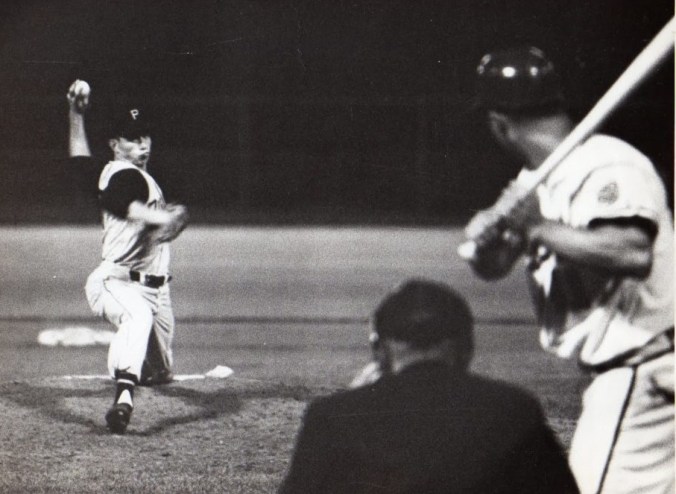
That’s Harvey Haddix about to throw a pitch above. The photo is from one of the most famous baseball games ever played: on May 26, 1959, Haddix, then a starting pitcher for the Pittsburgh Pirates pitched a perfect game—that’s no runs, hits, walks or errors, with nobody on the other team reaching base) for 12 innings against the Milwaukee Braves. It was the greatest pitching performance of all time, but because the Pirates didn’t score a run either, Haddix had to keep pitching into the 13th inning, where he lost the perfect game, the shutout and the game itself. As a result, he wasn’t even given credit for a no-hitter, which is normally when a pitcher throws nine-innings of hitless ball. That really bothered me as a kid; it made no sense.

In baseball, a no-hitter, with a perfect game being the ultimate no-hitter, has always been considered one of pinnacles of single game performance by a baseball player. A pitcher who throws one gets his name in the Hall of Fame; it’s a distinction that accents an entire career. Only the greatest pitchers throw more than one in a career; some of the very greatest, like Lefty Grove, Grover Cleveland Alexander, and Roger Clemens, never get one. (Cy Young, Nolan Ryan and Sandy Koufax, however, tossed three or more each. Johnny Vander Meer tossed two no-hitter in consecutive starts!) So being credited with a no-hitter is important; it matters.

Imagine then what it would feel like to be credited with pitching a major league no-hitter (or have your father or grandfather credited with one) and have it taken away. That’s what happened in 1991. Up until then, there had been no specific definition of no-hitter except the obvious, common sense one used by sportswriters, players, fans and baseball historians: a no-hitter was a baseball game that ended with one team having failed to get a hit. One of my favorite Commissioners of Baseball, however, Fay Vincent, the last one who wasn’t a toady for the baseball team owners (Vincent was fired for being independent, which up until then was the definition of his job), decided that the definition of no-hitter was too loose, among some other statistical anomalies. He put together a commission, and, with his influence, they redefined a no -hitter as a game that ended with one team getting no hits in at least nine innings.

Continue reading

Comment Of The Day: “Let’s Play “What’s Wrong With This Guy?”!”

There I was, thinking dark thoughts and moping about the horrible traffic here over the weekend, and along comes A.M. Golden to remind me that this blog has always sought to inspire quality rather than quantity, with this superb Comment of the Day on the post about the enterprising Mr. Clifford, who feels that IBM isn’t him paying him enough not to work for 30 years, Let’s Play “What’s Wrong With This Guy?”! Here it is; it even has a “Facts of Life” reference!

* * *

Stipulated: The plaintiff’s disability could be a legitimate one. We don’t know. That doesn’t really change my answer.

How did we get here?

The Deep Pockets Rationalization aka The Jo Polniaczek Excuse: Named for Nancy McKeon’s character on the ’80s show “The Facts of Life.” In one episode, Jo borrows a watch belonging to her frenemy, wealthy Blair Warner, without asking so she can time herself while taking an exam. On her way back, the watch is damaged when she jumps into a quick basketball game. She blows it off because Blair is wealthy and has a lot of watches.

The Deep Pockets Rationalization states that the person with the most money should pay even if not at fault. A guy driving a Hyundai hits a guy driving a BMW. The Hyundai driver tries to argue that the BMW driver should pay for everything because he has more money. A person trips in a store and tries to compel the business to pay even though she tripped because she wasn’t paying attention to what she was doing. Or a restaurant is pressured to pay for a disfigured child’s surgery after the family failed to extort money with false allegations against employees (Remember the KFC incident from a few years’ back?).

Continue reading

Unethical Quote Of The Month: San Francisco Homeless Resident Joseph Peterson

“I just stole to eat.”

 —Joseph Peterson, a homeless man in San Francisco, lamenting the demise of the Whole Foods in his neighborhood and attempting to draw a material distinction between the rampant theft from the store by those seeking to sell what they stole, and his own shoplifting.

And there it is! In such carefully crafted rationalizations lie the seeds of societal rot. Peterson thinks his personal shoplifting—he cops to stealing macaroni and cheese and chicken from the hot food bar at the now closed grocery store a number of times, but believes that his theft is justifiable, unlike those who wanted to sell their heist for cash. Also believing his thefts were justifiable are many of San Francisco’s elected officials. They also believe that the “bad” shoplifters in Peterson’s view are equally justified, and in fact they are. What’s the ethical difference between stealing food to eat it, and stealing food to sell and use the money for other needs? There is none. In both cases, the expense of the food stolen is borne by other city residents, who will have to pay higher prices for their food, unless the prices become so high that they resort to theft as well.

Continue reading

Wait, WHAT? The White House Is Caught Rigging Biden’s Press Conference To Make Him Appear More Competent Than He Is, And The Washington Post’s Analysis is “Everybody Does It” And “Republicans Pounce”?

Nah, there’s no mainstream media bias!

How do these people look at themselves in the mirror without retching?

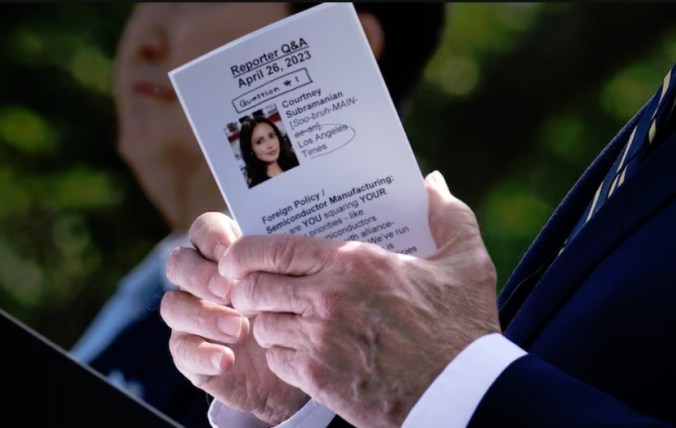
Paul Farhi was the veteran Democratic operative (aka a MSM reporter) the Post assigned to spin this scandal. “President Biden was photographed holding a notecard Wednesday, revealing the stage managing behind many political media events,” he began. Oh, the euphemism is “stagemanaging,” is it? What the “notecard” was is called a cheat sheet, and what it signifies is cheating, and lying to the public.

The card in Biden’s hand—he’s so diminished mentally that he can’t even cheat competently–read “Question # 1,” and directed the President to call on Los Angeles Times reporter, Courtney Subramanian. The card included Subramanian’s name, a pronunciation guide, her affiliation and a headshot. The card also included Subramanian’s question: under the heading “Foreign Policy/Semiconductor Manufacturing,” the card read, “How are YOU squaring YOUR domestic priorities — like reshoring semiconductors manufacturing — with alliance-based foreign policy?”

Biden called on her for the first question, she asked what she was supposed to, and Biden offered an uncharacteristically detailed and coherent response. Farhi’s spin: “White House press office employees have routinely polled reporters about their priorities and interests in advance of news meetings to anticipate what their boss might be asked while on the podium. The practice is also common in news conferences with Cabinet secretaries, such as the secretary of defense and secretary of state.” Fine, that’s their job. And it is an ethical reporter’s job to say, “Sorry, you’re just going to have to find out when I’m called on.” Sure Presidential aides want to brief POTUS on what the likely topics are. Rigging the questions in advance, however, is something completely different. It’s called cheating. This is particularly true in this case, when much of the pubic is concerned about the President’s cognitive abilities. Presenting him as able to whip off a detailed answer to a reporter’s question when in fact he was tipped off and the reporter was in cahoots with the White House is pure deception.

Continue reading

The Tucker Carlson Firing Aftermath

Tucker Carlson behaved in a manner that would get any employee fired from any organization with two atoms of integrity and professionalism to rub together unless the organization was completely in thrall to The King’s Pass. It is really as simple as that; this isn’t hard. Nevertheless, pundits, politicians and hack journalists on both sides of the ideological divide set out to misrepresent the event in order to promote their own world views, confusing the American public when they should be illuminating a basic ethics and life competence issue.

Let’s see...why not start with one of the biggest hacks out there, CNN’s former fake journalism ethics watchdog and veteran Fox News-a-phobe, Brian Stelter? “Why Tucker Carlson’s Exit From Fox News Looks Like an Execution” is the title of his analysis in “Vanity Fair,” itself now a nest of progressive propaganda merchants (but Stelter lowers the net ethics quotient anyway).  The answer to Stelter’s question is, he offers, this: “He’s not being given a chance to say goodbye. It is technically possible, I suppose, that Carlson turned down a chance to sign off on his own terms. But my 20 years of experience covering cable news suggests otherwise.”

Wow. This guy is really something. Completely inept and intellectually dishonest, Stelter has to begin an article by reminding readers how special he is. Of course Carlson wasn’t given a chance to give a last broadcast. He was fired for cause. When you are fired for cause, security ushers you out of the building. Your bosses don’t give you anything but a severance package—maybe—and ten minutes to put your stuff in a cardboard box. Allowing a likely bitter and angry demagogue like Carlson to “say good bye” is like the Charles Addams cartoon where a guy arrested for making obscene phone calls is allowed to make his one call and he makes another obscene one. What Fox did with Carlson wasn’t “an execution.” It was a standard firing.

Over at the New Republic, long-time leftist hysteric Michael Tomasky (whose biased news analysis helped drive me away from The Daily Beast) writes in “Why Fox News Is Going to Get Worse—a Lot Worse” that Carlson is certain to be replaced by someone who is “more trolly, more racist, more pro-Putin, and just all-around more outrageous than Carlson.” Tomasky is just using Carlson’s demise as an excuse to attack Fox News when it has done the right and responsible thing for once, and at significant cost: its value dipped a billion dollars on the news of the firing. In the process, he repeats the Big Lies that the Left wielded against Carlson in its efforts to silence him, because censoring opposition is how Big Blue rolls these days; it’s so much more effective than trying to win a debate with facts and logic.

Carlson’s not “racist,” but the playbook demands that anyone who questions color-based, George Floyd Freakout policies must be a racist. Tucker’s not “pro-Putin,” he’s anti-US involvement in the Russia-Ukraine war, a defensible position. Carlson, moreover, was far less outrageous than the jerk he replaced, Bill O’Reilly, so why does Tomasky assume Carlson’s replacement will be worse than he was?

Continue reading

On Waco, “Waco,” And Cults

Another horrible occurrence that I did not mention yesterday while review the ethics-related events of April 19 through the centuries was the tragic conclusion of the FBI’s seige against Mount Carmel in Waco, Texas, in 1993. After a 51-day stand-off between the federal government and an armed religious cult, the compound burned to the ground, with about 80 members of Branch Davidians, including 22 children, dying in the blaze.

This was an ethics train wreck to be sure, and an unusually deadly one. There are so many documentaries and online accounts of the incident (of various quality and accuracy) that I’m not going to add to them here. I do recommend the 2018 Showtime docudrama series “Waco,” which is now streaming with a fascinating new sequel, “Waco: Aftermath,” currently being presented on Showtime.

There is a natural bias in “Waco”: its main sources were a book by one of the survivors and cult members whose wife perished in the fire, and another by an FBI negotiator who was extremely critical of how the agency handled the situation. Both authors come off as heroes of the disaster to the extent that such a botch can have heroes. When the docudrama premiered in 2018, many reviewers complained that the writers treated the FBI as the villains of the story, with cult leader David Koresh portrayed too sympathetically.

My impression, seeing “Waco” now, is that the series’ creators were on to something that has come into sharper focus in recent years. The FBI abuses its power, is badly managed, has too much autonomy, and can’t be trusted. That should have sunk in in 1993, but the news media was determined to let the hallowed law enforcement agency, Attorney General Janet Reno, and especially President Bill Clinton off the hook. I remember the coverage well: Koresh’s cult was lumped into the paramilitary and survivalist anti-government movement of the period. The Waco siege followed on the heels of the Ruby Ridge fiasco the year before, involving the same federal agencies, the FBI and the ATF. Even though that fatal showdown was ultimately shown to be exacerbated by the Feds (and a lawsuit found the agencies liable for damages), the public and media still were conditioned to regard the FBI as the “good guys.” Sure, it was tragic that people died, but the consensus was that they brought it on themselves, sad as the outcome was. At the time, I found it astounding that Reno wasn’t forced to resign, and that President Clinton escaped any accountability at all.

Much of that result was because of the subsequent Oklahoma City Bombing by Timothy McVeigh in 1995. Public opinion was turning against the trend of over-aggressive government following Waco: Rush Limbaugh in particular was leading a daily attack on what he saw as as Big Government restrictions on personal liberties (like the right to live out in the desert with fellow followers of a deranged but charismatic religious fanatic who claimed to be chosen by God). Once McVeigh’s truck brought down the Alfred P. Murrah Federal Building, destroyed or damaged 324 other buildings within a 16-block radius, killed 168 people and injured 680, however, public opinion turned decisively the government’s way. McVeigh cited Waco as a major reason for his terrorism, and the Cognitive Dissonance Scale worked its predictable magic: now the Branch Davidians were linked to pure evil. The FBI, and thus the U.S. government, propelled to the other side of the scale, the “good guys” at Waco, at Ruby Ridge, and always.

They aren’t, and weren’t. “Waco,” for all its flaws, makes that contrary conclusion unavoidable.

Continue reading

From Chicago: Today’s “It Isn’t What It Is!” Moment Of Delusion…

The impetus for this indignant and ignorant rant is Walmart’s announcement that it is closing 4 of their 8 stores in Chicago, including the one at issue. In announcing the move, Walmart explained,

The simplest explanation is that collectively our Chicago stores have not been profitable since we opened the first one nearly 17 years ago – these stores lose tens of millions of dollars a year, and their annual losses nearly doubled in just the last five years. The remaining four Chicago stores continue to face the same business difficulties, but we think this decision gives us the best chance to help keep them open and serving the community.

Continue reading

“Good Censorship”: Regarding Ethics Villain Puffin Books And Its Defender, Seth Abramson

Yes, that’s a dead and rotting puffin above. It should be the new logo for Puffin Books, a division of Penguin. According to Wikipedia, “it has been among the largest publishers of children’s books in the UK and much of the English-speaking world” since the 1960s. According to the Penguin website, Puffin Books is “prestigious.”

According to Ethics Alarms, the children’s book publisher has no regard for authors’ rights, integrity, fairness, literature or language, all rather crucial to its trade, wouldn’t you say? What’s happened at Puffin? Well, what’s happened to Disney, elementary schools and toy makers? ( Clue: Mattel has a gender-fluid line of Barbies).

Puffin has decided that the demands of wokism, political correctness and child indoctrination justify rewriting the works of iconic British author Roald Dahl. Since Dahl’s death, Puffin has made hundreds of changes to his childen’s classics, removing words and passages that The Wonderfully Woke might consider offensive or harmful, even to the extent of adding passages that Dahl never wrote.

What?? I’m assuming that Puffin owns the rights to the books somehow and can do this legally. You want to know why authors like Samuel Beckett made sure his estate had iron-clad control over his works? THIS is why. Please note: it doesn’t matter one whit that Puffin can allow some anonymous censor to rewrite “Charlie and the Choaolate Factory,” it is throbbingly unethical for it to do so.

In the original edition of “Charlie and the Chocolate Factory” Grandma Josephine speaks of a “crazy Indian prince.” The 2022 edition describes the character as a “ridiculously rich Indian prince.” Augustus Gloop, one of the horrible children in the novel, is no longer described as “enormously fat” as Dahl wrote; he is now   described as “enormous”(whatever that means). Puffin apparently has a fetish about “fat.” Aunt Sponge, in the 2022 edition of “James and the Giant Peach,” is now “quite large” instead of “enormously fat,” leaving the possibility that she could be the size of  The Rock or even a T-Rex. Other passages where Aunt Sponge is described as “fat” have been excised.

Meanwhile, “two ghastly hags” has been changed to “two ghastly aunts.” “Queer” is apparently no longer acceptable to describe a house—just in case its a gay house, I suppose—and was replaced with  “strange.” In “The Witches,”  edits by Puffin made character descriptors gender-neutral, so “chambermaid” became “cleaner.” Though Dahl wrote that a character said, “You must be mad, woman!,” the line is now, “You must be out of your mind!” The line describing a, “Great flock of ladies” was changed to a “Great group of ladies.”

And so on. Continue reading

Saturday In The Great Stupid Continues: The “Waiting For Godot” Catch-22

I love this dispatch from The Great Stupid! It has everything…

  • It involves a theater production…
  • It’s woke academia at its worst…
  • Copyright and artistic integrity principles are at issue..
  • Diversity, Equity and Inclusion mania is at its core…
  • It’s another “It isn’t what it is” (Yoo’s Rationalization) classic….
  • It didn’t happen here, but I could easily see it happening here, and…
  • It’s really, really, really stupid.

A bit of background: Samuel Beckett, the late Irish novelist and playwright of Theater of the Absurd fame ,best known for his minimalist drama and “Waiting For Godot” in particular, was a cantankerous old coot who didn’t trust directors (with good cause, say I), and directed them in his texts to change neither lines nor character, or risk legal action. Edward Albee was similarly strict on this point, having seen what happens to plays in the public domain (like Shakespeare’s works) when far less talented “artists” decide to make them “relevant.” So if you are going to produce a Beckett play, it’s Beckett’s way or the metaphorical highway.

Oisín Moyne, a fellow countryman of Beckett, was directing “Waiting for Godot” in the Netherlands and auditioned only men for the all-male cast of characters, as he was legally and artistically obligated to do. the college production been in rehearsals since November and was due to be presented at the University of Groningen’s Usva student cultural center in March. (Don’t ask me how or why it would take more than three months to rehearse this play, which primarily involves two guys sitting around talking, but never mind.) Continue reading

Gee, Could Massachusetts Democrats Come Up With A MORE Unethical Bill?

[You know,  writing this blog of late has made me feel like I’m Uma Thurman in “Kill Bill I,” fighting O-Ren Ishii’s (Lucy Liu) personal army, The Crazy 88’s. The ethics stories just get worse and worse, especially from the world of government and politics, and they keep on coming. The mission of this blog is to, in some small way, try to encourage ethical analysis and sensitivity in the culture of a nation uniquely dependent on it, and all I see is the ethics in our culture, especially in the professions (which exist to be trusted) and our institutions (all of them) deteriorating rapidly and seemingly deliberately. The effort feels hopeless. Maybe a better analogy than The Bride’s mass battle in “Kill Bill I” is Viking king Ragnar (Ernest Borgnine) fighting gleefully and futilely in a pit full of hungry wolves in “The Vikings.” After all, Uma wins her fight. But Ethics Alarms is not directed by Quentin Tarantino.

What prompts these musings? This item from the State of my birth: Massachusetts Democrats have offered a bill giving prison inmates reduced sentences when they donate their kidneys and bone marrow. State Reps. Carlos Gonzalez and Judith Garcia came up with this monstrosity, which aims to create “The Bone Marrow and Organ Donation Program” within the Massachusetts Department of Corrections. Prisoners would be able to shave between 60 days to a year off their sentences. 

Talk about killing bills—I’d love that bill as a hypothetical in an ethics class, though I would think it might be too easy for anyone old enough to vote. In The Guardian’s story, we read that the bill “has raised ethical concerns.” YA THINK??? Continue reading