Ethics Verdict: Stanford Law Prof. Mark Lemley and Law Firm Lex Lumina Are Unethical

…and their conduct in the Facebook matter is damaging to the profession of the law.

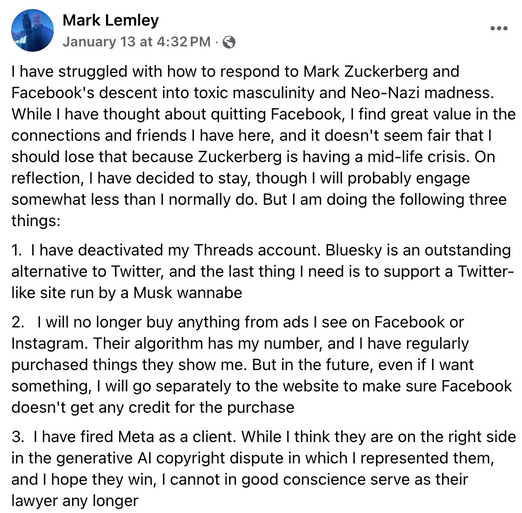
Intellectual property expert Mark Lemley, a professor at Stanford Law School and a partner at law firm Lex Lumina, represented Facebook in the copyright case brought on behalf of creators claiming the platform infringed their intellectual property. Yesterday he “fired” his client, despite believing that Meta’s case was strong. His stated reason was that he is outraged at Mark Zuckerberg and Meta’s “descent into toxic masculinity and Neo-Nazi madness.” His law firm then proceeded to back him up.

Here is Lemley’s Facebook post announcing his decision:
Meanwhile, the managing partner of his woke law firm followed with the statement that “Money can’t buy everyone. We’re proud to be a firm that doesn’t sell out our values. Sadly, it seems this is becoming a rarer and rarer quality in America today.” Another partner said, “When we started Lex Lumina, one of the things we committed to was only taking cases we felt good about, on the law and in terms of who we represented. Proud to be working with my friend and partner, Mark Lemley, who lived out our commitment today.”

This is labeling unethical lawyer conduct as ethical.

Lemley went on to post a reiteration of his decision on LinkedIn. It wasn’t “the right call.” If Lemley and his firm had refused to represent Meta in the case of Kadrey v. Meta Platforms initially, there would be no ethics foul: nothing in the Rules of Professional Conduct mandates that any lawyer accept any client, although the traditional ethos of the profession strongly encourages lawyers to do so. However, dropping a client because of what that client has done or said that has nothing to do with the case of the representation, while not a strict rules violation, is unprofessional and creates a dangerous slippery slope…one that many in the legal profession have been leaping down in recent years.

Noteworthy is the fact that Lemley is no legal ethics expert. His actions demonstrate that vividly, and his post is a flashing sign stating, “I am biased, Trump Deranged, a Democrat, and believe in good censorship.” Got it, Professor.

Naturally, the woke legal hacks at Above the Law love this, and ratioanalizes it with an argument that has been rife since the corrupted legal profession started behaving like the restaurants who won’t serve people wearing MAGA caps. Joe Patrice, the head ideologue at Above the Law writes,

A sanctimonious segment of the legal profession harps on the idea that “everyone is entitled an attorney.” Except no one is entitled to you as an attorney. Frankly, no one is entitled to anything in a civil case and to the extent society needs to extend more protections to indigent clients on the wrong end of life-altering civil actions — landlord-tenant cases for instance — there’s definitely no such entitlement for a multibillion-dollar company in a copyright dispute.

Representing a client is a business decision. Some lawyers thrive as counsel of last resort and model their business around the willingness to represent unpopular clients. Other lawyers build their business on crusading for good causes. A whole lot of lawyers exist somewhere between those poles. In fact, a lot of deep-pocketed clients also don’t want to work with firms associated with unpopular causes — that’s a business decision too.

There’s nothing wrong with any of these approaches. Lawyers should feel free to build their practice however they want.

What is wrong with that argument is that it violates Kant’s Rule of Universality, the “What if everybody did it” test that is part of the philosopher’s categorical imperative. Patrice’s standard, and accepting Lemley’s conduct, would mean that certain citizens and organizations could be left without legal representation entirely because they were regarded by a politicized legal profession (and an ethically addled public) as “bad.” While it is accurate to assert that the Sixth Amendment does not guarantee a citizen legal representation in a civil (as opposed to a criminal) case, the legal professional has long embraced the principle that the same ethical and practical justifications should apply. If we accept Patrice’s ethically ignorant (or deliberately misleading) argument that whether to accept a representation is purely a business decision, that allows lawyers and firms to avoid unpopular clients, leaving them potentially at the mercy of the polls and bias in a rigged legal system.

This is what the actions of Lemley and his firm are pointing to. It is the reason Donald Trump has had difficulty hiring lawyers and getting competent legal assistance. Firms and lawyers get threatened by clients, and in the constant tug-of-war between the profession of law and the business of law, business now prevails. Once, before the progressive bias in laws schools and among lawyers became the status quo, the mission of representing unpopular causes and clients, even when the attorneys for these clients personally disagreed with and even deplored their conduct was seen as part of the legal profession’s mission. Wall Street lawyers represented accused terrorists after the bombings of 9/11 after public figures called for their firms to be boycotted. When Coca-Cola virtually extorted their law firm into dropping its representation of the House Committee defending the Defense of Marriage Act before the Supreme Court, the partner handling the case, Paul Clement, wrote in his letter of resignation in protest of the decision, that “defending unpopular positions is what lawyers do.” Similarly defending unpopular clients is what lawyers must do and be honored for, or we have no longer have an equitable legal system.

The unethical principle Lemley is advocating is worse than opposing taking on an unpopular position: he seeks to justify abandoning a position he feels is valid because his client’s policies no longer please him. I have vowed to promote this section of the Rules of Professional Conduct because it is such a crucial one for maintaining the integrity of the profession and trust in its members:

“A lawyer’s representation of a client, including representation by appointment, does not constitute an endorsement of the client’s political, economic, social or moral views or activities.”

It should be obvious that if it becomes acceptable for lawyers and firms to refuse representations because they fear being regarded as endorsing a clients’ “political, economic, social or moral views or activities,” the legal profession will have nullified that critical standard in practice, and the public will be correct to assume that if a lawyer or firm represents an unpopular cause or individual, those lawyers agree with and endorse them. This is what ideologues like Joe Patrice want, a legal system as polarized as the political system, where one can tell the “good” lawyers from the “bad” lawyers by whom they choose to represent.

Dropping a client one has already accepted, which is what Lemley has done, is worse still. In his letter excoriating his former firm, Clement quoted Griffin Bell, a judge and former U.S. Attorney General, declaring that once a lawyer has accepted a case, it is the lawyer’s duty and ethical obligation to continue the representation. In 2011, when the DOMA controversy erupted, Clement’s position was almost unanimously praised within the profession. Theodore Olson, the late conservative attorney, praised Clement’s “abilities, integrity, and professionalism”.” Olson, who like Clement was a solicitor general during the George W. Bush administration and was a successful Supreme Court advocate, told the media, “I think it’s important for lawyers to be willing to represent unpopular and controversial clients and causes, and that when Paul agreed to do that, he was acting in the best tradition of the legal profession.” Seth Waxman, who served as solicitor general during the Bill Clinton administration, said, “I think it’s important for lawyers on the other side of the political divide from Paul, who’s a very fine lawyer, to reaffirm what Paul wrote. Paul is entirely correct that our adversary system depends on vigorous advocates being willing to take on even very unpopular positions.” In approving Clement’s stand, The Washingtonian observed, “There are countless examples of law firms taking on and standing by controversial clients, even at the risk of their public images.” There are fewer and fewer examples now, however. This is the dystopian legal landscape that Lemley and his firm are promoting, and it is an unethical one.

Continue reading

Presuming Bias Also Makes You Stupid…and a Failure

I’m really and truly searching for good ethics topics that haven’t been raised by politics, and its hard right now. This entry in the Ethics Alarms Hollywood clip archive is appropriate…

This time, I was pulled back in by an alleged news analysis story in the New York Times. If it had been an op-ed column, then its thrust would have been slightly more excusable. This was supposedly fact analysis, not opinion, and the article could do nothing but make its readers dumber and more resistant to harsh truths. The piece was headlined, “Will the U.S. Ever Be Ready for a Female President?”[Gift link!]

Morons. The question itself is dunderheaded and insulting in a vacuum, but as analysis of Kamala Harris’s well-deserved defeat, it is a throbbing neon example of “my mind’s made up, don’t confuse me with facts” as well as how rationalizations are lies that we tell ourselves when we want to be deluded. Of course the U.S. will be ready for a female President, as soon as one of the parties nominates a woman who is a strong candidate and who doesn’t run a terrible campaign. Imagine writing this garbage without giggling…

Continue reading

The Liz Cheney Ethics Zugswang Problem

Now this is an ethics conflict.

It is increasingly clear that former Congresswoman Liz Cheney broke the law as well as several ethics rules while doing her utmost to incriminate President Trump during the all-Democrat/ Never-Trump Republican J-6 committee star chamber orchestrated by Nancy Pelosi. It is wrong to break the law. It is especially wrong to break the law when you are an elected official and law-maker. Such officials should not only be held to a higher standard, but should be role models for the public that elected them. It follows, then, that when they break the law—it seems that Cheney participated in the destruction of evidence as well as coaching a witness, Cassidy Hutchinson, to lie under oath while unethically meeting with her, a represented witness, without her lawyer being present—they should be treated like anyone else who breaks the law.

If elected officials are not prosecuted and held to account when they violate the law, it is the worst manifestation of the King’s Pass, the insidious and pervasive rationalization (#11 on the list) in which individuals who are famous, popular, powerful, accomplished, productive or successful are allowed to escape the earned consequences of their own misconduct when a less powerful or popular individual would face the full penalties of the law. Such episodes seriously erode public trust in our legal system and power structure. The cliche is “No one is above the law,” but except for the case of indisputable bribery or violent felonies, elected officials are seldom prosecuted, and sometimes not even for those crimes.

Continue reading

Introducing Rationalization #19 D: Willie’s Equivocation, or “Maybe I Did Something Wrong”

I decided to give you all a new rationalization to ponder under your Christmas tree, so say hello to “Willie’s Equivocation,” #19D on the list. I realized that this was a sneaky rationalization—by the definition that it is lie someone tells themselves to relieve them of guilt for wrongdoing—when I heard one of Kamala Harris’s campaign consultants say that “maybe they made some mistakes” that may have cost her the election. Maybe? In the run-up to election day, I remember hearing several Democrats say that Harris had run a “perfect” campaign, which is only slightly more ridiculous than saying that “maybe” there were some serious mistakes. Ya think? Nominating Harris was a mistake.

Willie is country music icon Willie Nelson, and his most famous song, “You Were Always on My Mind” says it all. I always found the song irritating, the credo of an asshole. “I was a crummy, selfish, inattentive and self-involved lover, but I was always thinking about you while I neglected you.” Great. 19D is grouped with other sub-rationalization under #19, “Nobody’s Perfect”: 19A, “I Never Said I Was Perfect,” 19B, “It Wasn’t The Best Choice,” and 19C, “It Was a Difficult Decision.” “Maybe I Did Something Wrong” might be the worst of the batch, ducking accountability by blurring the facts with doubt. Equivocation is the use of ambiguous language to conceal or avoid the truth: using “maybe” about unethical conduct when there are “no buts about it” is both cowardly and dishonest.

Karine Jean-Pierre and Rationalization 19 C

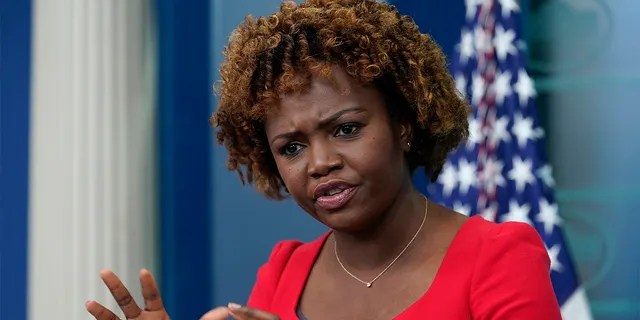
I would hope that even the most Trump-Deranged Democrat would agree that it will be a multilateral boon to have a White House spokesperson who is minimally competent even at the unethical main function of the job (that is, lying), rather than the current embarrassing occupant, Karine Jean-Pierre. She routinely demonstrates poor reasoning abilities and barely rudimentary comprehension of ethics as well as the Constitution; she is slow-witted, inarticulate, frequently unprepared and unprofessional.

I wonder if said Trump-Deranged Democrat might even agree that it will be a welcome change to have a President in office willing to fire someone he hired who hasn’t broken the law while holding a job in the administration (like Sam Brinton). I can’t swear that my research is conclusive, but so far, I’ve found no record of Biden dismissing anyone who was appointed, nominated or hired under his authority unless they were criminals. I am confident that this is an all-time record, and an ugly one, with Jean-Pierre standing as the poster girl for Biden’s acceptance of mediocrity (or worse) in government service.

This is the petard of DEI hiring: a President who makes “historic” selections based on group membership rather than ability is thereafter trapped: the hiring announces that what matters most is the sex, sexual preference, gender, race and/or ethnicity of the individual rather than that individual’s performance in the job. When my sister was complaining about Trump’s major agency nominations, I responded that if any of them proved to be disasters, he or she would be fired….unlike Pete Buttigeig, Tony Blinken, Alejandro Mayorkas, Merrick Garland, Lloyd Austin, the head of the Secret Service, the director of FEMA and others, such as Jean-Pierre. She had to concede the point.

Continue reading

Rationalization #19B, ‘The Insidious Confession,” or “It Wasn’t the Best Choice” Is Officially Re-Named: “The Bus Driver’s Mitigation.” Here’s Why…

Talk about a parent’s worst nightmare…

In Castle Rock, Colorado, a relief school bus driver got rattled and confused when the kids wouldn’t quiet down and the tablet showing his route broke down. His solution was to drop all the students off at an unscheduled stop miles from their homes. More than 40 students were abandoned at a busy intersection, and the bus drove away.

Parents were not pleased.

Continue reading

Unethical Quote Of The Month (And Maybe The Year): Bucks County Commissioner Diane Ellis-Marseglia [Updated and Expanded]

“I think we all know that precedent by a court doesn’t matter anymore in this country, and people violate laws any time they want. So, for me, if I violate this law, it’s because I want a court to pay attention to it. There’s nothing more important than counting votes.”

—Bucks County Commissioner Diane Ellis-Marseglia, excusing Bucks County’s decision to count misdated or undated mail-in ballots after the Pennsylvania Supreme Court clearly stated that such ballots were invalid.

[Expanded commentary is below, after the original post.]

You can’t get much more unethical than that in so few words.

1. The edict about the invalid ballots wasn’t a court precedent, it was a ruling.  If she doesn’t know the difference, she has no business being a commissioner. If she does know the difference, then she was lying.

2. Next she invokes the hoariest unethical rationalization of them all, #1 on the list,, “Everybody Does It.”

3. The statement that people violate laws any time they want is false and a direct attack on the Rule of Law as well as the character of Americans. In fact, the vast majority of American obey the law. Continue reading

Dear Ashli: You Do Know That What You Are Advocating Is Pure Bigotry, Right?

The self-indicting that is arising from the 2024 Election Freakout has nicely exposed the hypocrisy behind the progressive masks of decency and virtue. Let’s listen to Ashli, the lovely young thing above, who has enthusiastically embraced the South Korean “4B Movement.”  The name ‘4B’ comes from the Korean words for four ‘Nos’: no heterosexual sex, no marriage, no children, and no relationships, all starting with the letter ‘b.’ Her journey is described in a revealing piece in the Daily Mail.

The brutal murder of a woman in a subway station by a man who reportedly said he was ‘sick of being ignored by women.’ sparked the ptotest by many Korean women against all men. That seems fair and logical. No, in fact it makes no sense at all, but it does to Ashli.  “Out of this tragedy, a wave of female anger turned into action. Women took control of their lives,” she writes. I’ve come to the conclusion that men can be dangerous. That’s why, two years ago at the age of 34, I chose to disengage from men entirely.

She gives her reasons. “I knew so many women who were hurt by the men they loved and trusted. Men they vowed to love and who vowed to love them. Men they slept next to at night.” Then, “the overturning of Roe cemented everything I already knew. Five justices—four of them men—decided we didn’t deserve control over our own bodies. The new MAGA Republican Party, with its hyper-masculine, power-hungry grip, cheered it on.”

Continue reading

Comment of the Day: “Just So There Is Accountability and We Don’t Forget, Here’s a List of The Lying Media Propagandists Who Claimed Trump Said He Wanted Liz Cheney Shot…”

Time for a Trump Derangement report Comment of the Day. This admirable job by AM Golden fills the bill nicely, especially since I had almost the exact same conversation with my own “not unintelligent” relative who has been a raging, drooling, Trump Derangement victim getting progressively (double meaning, there) worse (Stage 1, 2, 3, 4, now 5, and I suspect Stage 6 is terminal) for almost a decade. There is a viral social media tale with video about a woman who interrupted a conversation between two black Trump supporters to start screaming about how he was a criminal who wants Liz Cheney to be put in front of a 9-person “firing squad.” This lunatic also claimed to be well-informed, though she must only frequent MSNBC and other propaganda outlets that haven’t thoroughly debunked this most recent desperate lie. (All you have to do is read what Trump said.) There may be a new one by now; I haven’t checked.

I am going to depart from the usual format with COTDs here and follow AM’s post with some supplemental analysis of my own.

In the meantime, here is AM Golden’s Comment of the Day on the post, Just So There Is Accountability and We Don’t Forget, Here’s a List of The Lying Media Propagandists Who Claimed Trump Said He Wanted Liz Cheney Shot…,” which is a follow-up to this earlier post regarding the unforgivable “Trump threatened Cheney” AXIS hit.

***

Trying to convince people that what Trump said is being misrepresented, and deliberately so, by the Democrats and their media advocates is like pulling teeth.

Continue reading

Yes, It’s Another Installment of “It’s Hell Being An Ethicist”

This weekend was Grace’s memorial event, and yes, it came off very well despite my long-standing dread. I have wonderful, talented and loving friends, as did Grace. My long-time musical collaborator on my pop music parodies ethics programs, Mike Messer, brought down the house and made Grace smile, I hope, with a rousing performance of her favorite John Lennon solo, “Twist and Shout,” backed up by the unusually musical crowd.

But I digress. The next day, when a friend who helped organize and mange the event (since I was useless), brought me the receipts. I expected the bill for the platters of food I had ordered from Safeway, for he had picked them up. “No,” he said,”they told me you had paid for them when you made the order.”

But I had not. I tried to pay, but the dead-eyed, barely conversant clerk refused to process my credit card, and insisted that payment would be due when the platters were ready. The price is almost $400.

Well, I’m an ethicist, so I have to pay it, though I may take my sweet time about it and wait until my cash flow is a bit more robust. I know what my mother’s reaction would have been—“What luck! The food was free!”—just as surely that I know that my father would have headed over to Safeway by now and paid the bill.

Now, my sister had a dandy rationalization, though she didn’t commit to it. “These stores are incompetent,” she said. “I’ve had similar experiences, though not $400 worth. The only way they’re ever going to get better as if sloppy work like this costs them money.”

“I’d be tempted not to pay,” she said.

Oh, I’m tempted all right. And I’m drowning in debt dating back to when the pandemic crashed my business and ruined my credit. Nevertheless, I got the food, I owe Safeway the money, and I’m an ethicist, dammit.

Phooey.