Celebrating the 110th Anniversary of the Strange But Ethical “Christmas Truce”

One of the weirdest events in world history took place on Christmas 1914, at the very beginning of the five year, pointless and stunningly destructive carnage of The Great War, what President Woodrow Wilson, right as usual, called “The War to End All Wars.”

World War I, as it was later called after the world war it caused succeeded it,  led to the deaths of more than 25 million people, and if anything was accomplished by this carnage, I have yet to read about it.

The much sentimentalized event was a spontaneous Christmas truce, as soldiers on opposing sides on the Western Front, defying orders from superiors, pretended the war didn’t exist and left their trenches, put their weapons and animus aside, sang carols,  shared food, buried their dead, and even played soccer against each other, as “The Christmas Truce” statue memorializes above.

The brass on both sides—this was a British and German phenomenon only—took steps to ensure that this would never happen again, and it never did.

It all began on Christmas Eve, when at 8:30 p.m. an officer of the Royal Irish Rifles reported to headquarters that “The Germans have illuminated their trenches, are singing songs and wishing us a Happy Xmas. Compliments are being exchanged but am nevertheless taking all military precautions.” The two sides progressed to serenading each other with Christmas carols, with the German combatants crooning  “Silent Night,” and the British adversaries responding with “The First Noel.“ The war diary of the Scots Guards reported that a private  “met a German Patrol and was given a glass of whisky and some cigars, and a message was sent back saying that if we didn’t fire at them, they would not fire at us.”

The same deal was struck spontaneously at other locales across the battlefield. Another British soldier reported that as Christmas Eve wound down into Christmas morning,  “all down our line of trenches there came to our ears a greeting unique in war: ‘English soldier, English soldier, a merry Christmas, a merry Christmas!’” He wrote in a letter home that he heard,

Continue reading

Reflections On The Ethical Holiday


“Christmas is built upon a beautiful and intentional paradox; that the birth of the homeless should be celebrated in every home.”

—G.K. Chesterton.

“It’s Christmas Eve. It’s the one night of the year when we all act a little nicer, we smile a little easier, we cheer a little more. For a couple of hours out of the whole year we are the people that we always hoped we would be.”

—Frank Cross (Bill Murray) in “Scrooged”

CHARLIE BROWN: I guess you were right, Linus. I shouldn’t have picked this little tree. Everything I do turns into a disaster. I guess I really don’t know what Christmas is all about. Isn’t there anyone who knows what Christmas is all about?

LINUS: Sure, Charlie Brown. I can tell you what Christmas is all about.  Lights, please?

“And there were in the same country shepherds abiding in the field, keeping watch over their flocks by night. And lo, the angel of the Lord came upon them, and the glory of the Lord shone round about them. And they were sore afraid. And the angel said unto them, ‘Fear not, for behold, I bring you tidings of great joy which shall be to all people. For unto you is born this day in the City of David a savior, which is Christ the Lord.’ And suddenly there was with the angel a multitude of the heavenly host, saying, ‘Glory to God in the highest, and on Earth peace, goodwill toward men.’”

That’s what Christmas is all about, Charlie Brown.

—Charles M. Schulz

“Our hearts grow tender with childhood memories and love of kindred, and we are better throughout the year for having, in spirit, become a child again at Christmas-time.”

—Laura Ingalls Wilder

“Then the Grinch thought of something he hadn’t before!

What if Christmas, he thought, doesn’t come from a store.

What if Christmas…perhaps…means a little bit more!”

—Dr. Seuss, “How the Grinch Stole Christmas”

“Want to keep Christ in Christmas? Feed the hungry, clothe the naked, forgive the guilty, welcome the unwanted, care for the ill, love your enemies, and do unto others as you would have done unto you.”

— Steve Maraboli, in “Unapologetically You: Reflections on Life and the Human Experience”

“My idea of Christmas, whether old-fashioned or modern, is very simple: loving others. Come to think of it, why do we have to wait for Christmas to do that?”

— Bob Hope

“I heard the bells on Christmas Day
Their old, familiar carols play,
And wild and sweet
The words repeat
Of peace on earth, good-will to men!”

—Henry Wadsworth Longfellow

“There are many things from which I might have derived good, by which I have not profited, I dare say,’ returned the nephew. ‘Christmas among the rest. But I am sure I have always thought of Christmas time, when it has come round—apart from the veneration due to its sacred name and origin, if anything belonging to it can be apart from that—as a good time; a kind, forgiving, charitable, pleasant time; the only time I know of, in the long calendar of the year, when men and women seem by one consent to open their shut-up hearts freely, and to think of people below them as if they really were fellow-passengers to the grave, and not another race of creatures bound on other journeys. And therefore, uncle, though it has never put a scrap of gold or silver in my pocket, I believe that it has done me good, and will do me good; and I say, God bless it!”

—Fred, Scrooge’s Nephew, in Charles Dickens’ “A Christmas Carol” Continue reading

Wait…So Everyone’s Been Lying To Me All These Years About What Angels Look Like?

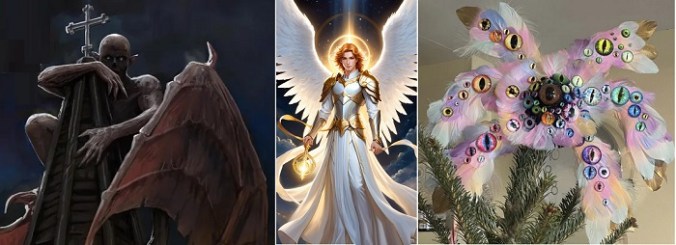
Above you will see three interpretations of what angels—you know, those benign, heavenly creatures we hear on high and observe, “Hark! They sing!,” the celestial guardians like the funny little old man who shows Jimmy Stewart that he’s really led a wonderful life, the kind of immortal being that appeared to Mary to tell her she was going to bear the Son of God, you know, those things?—really look like. The version on the left is from the Mike Flanagan horror series “Midnight Mass.” It’s a scary angel, but not as scary as the ones that show up in Robert and Michelle King’s scary TV series “Evil,” which look like this…

Yikes.

The version of Gabriel in the center is pretty much how I had been taught and told and shown how angels look for most of my life, and I assumed that was how they are represented in the Bible. Now, this is at least partially my own fault for not knowing the Bible better than I do, but when artists, churches, Sunday school teachers, movies, tree ornaments, Christmas cards and children’s books all show angels as friendly-looking Scandinavians with big, white, fluffy wings, I think I can be excused for assuming that there is at least as much authority for those representations as there is for anything else in the Bible—-an assertion to which Carnac the Magnificent (oh, look it up, ye of pop culture deficit!) would say to me, “You are wrong, Ethics Breath!”

Continue reading

Don’t Diss “Do You Hear What I Hear?”When I’m Around, and Other Rueful Notes On The Blue Christmas Ahead

I’m probably not celebrating Christmas anywhere but on Ethics Alarms this year. Last Christmas was truly awful in every way, with my wife Grace in pain and suffering from some creeping malady that killed her in February  and that I was too blind to detect (and so were her doctors). We were also in our worst financial crunch in 25 years of running our ethics business, my son was having personal problems, and all was definitely not happy and bright.

I am certainly conflicted about the holiday this year. I am a passionate Christmas booster, as long-time readers here know, because I regard the secular holiday as a vital social balm as well as an ethics catalyst. It is a unique holiday that calls on us to be kind, generous and forgiving, and, if possible (I’m trying!) to just be happy for life and its wonders. I am not religious, but I do believe that this is a profoundly ethical time of year. We all need Christmas, frankly. I need it, even though I dread every minute of it this year.

One of the special features of Christmas is that it is soaked with nostalgia and traditions along with bittersweet memories of people and events long past. Charles Dickens got this aspect of the holiday exactly right; it is why I love “A Christmas Carol” so much and have so often participated in public presentations of the story. My last professional directing gig was a staged reading of it, and that was the fourth time I have overseen one; I also have organized and directed three mass “radio” readings, using conference call technology and the sound effects wizardry of Keith Bell. (Where is Keith these days? See, there’s another memory knocking!).

With The American Century Theater, I co-wrote and presented two Christmas musical revues: “If Only In My Dreams,” which centered on the letters GIs wrote home at Christmastime during World War II, and “An American Century Christmas,” a salute to the old-fashioned TV Christmas specials and perennial Christmas movies like the three that have Ethics Alarms “guides’ here: “It’s A Wonderful Life,” which I posted at Thanksgiving, “White Christmas,” which will be updated and posted soon, and on Christmas Eve this year, “Miracle on 34th Street.” The first revue was more popular, but the second was my favorite, because it was generated entirely by my own warm memories of what Christmas was like for me and my sister growing up in Arlington, Massachusetts.

Both of our parents were Depression kids in poor families and their Christmases were spare at best, so both were determined to make the holiday magical for their children. And it was. We would decorate the tree carefully and lovingly a week before the 25th—I remember my mother insisting that each strand of genuine tin tinsel saved for years be placed individually on the branches—and go to bed after hanging our (huge) stockings with visions of sugarplums dancing in our heads. When we got up on Christmas morning, my parents had meticulous constructed a “Christmas panorama,” with the giant stockings stuffed with gadgets, oranges, walnuts and small packages lying by the fireplace, and the whole living room covered with presents, mine on the left of the living room, my sister’s on the right. The gifts were mostly unwrapped, and the vista was ever spectacular.

My father, a photography fanatic who was terrible at his hobby, had the old home movie projector spotlights blazing. He would record Edith and I coming down the stairs to see the amazing treasure left by Santa as mom looked on beaming and eager to see our reactions. My parents insisted on going through this ritual even after we were in college! My mother wouldn’t let the tradition go.

In 1963, the week before Christmas, Bing Crosby hosted “The Hollywood Palace,” a live variety show that was always headed by some entertainment legend, though Bing had the honor more than anyone else. That week he introduced a new Christmas song, the last popular Christmas song to have an unambiguous religious context. That was “Do You Hear What I Hear?,” and the video above was what I saw live. Something in the song immediately resonated with me; I was always a Bing Crosby fan, following the guidance of my father, but I loved everything about the new song despite its childlike simplicity. I said so immediately following Bing’s rendition. Sure enough, the song was playing on our old Magnavox stereo when my sister and I came down the stairs in our pajamas on Christmas morning.

“Do You Hear What I Hear?,” Bing’s version of course though there have been hundreds of covers, is the first Christmas song I play every year as soon as whiffs of holly, evergreens and mistletoe are in the air. It throws my mind back to those magical Christmases that Grace and I tried to recreate for our son every year while he was growing up. That magic was significantly dimmed when my father died, in his sleep, on my birthday in 2009, leading to the saddest Marshall Christmas. The spirit fell away a bit more the next year, when my mother, who never got over losing the love of her life after 58 years of marriage, was in the hospital fighting a voracious hospital infestion that killed her two months later. Christmas was never the same after Mom died: it was her joy and obsession. Still Christmas reminds me of her, and Dad, and that lost magic…and Bing.

I was pondering when and whether to put up a post about “Do You Here What I Hear?” this year when I checked out Ann Althouse’s blog and discovered that she had posted the video as a joke after her post about Jill Biden getting a laugh at her Christmas comments wishing the assembled “joy.” Apparently some took her choice of words as a sly swipe at Kamala Harris’s ill-fated “joy” theme.

In the comments to the post, some wags made jokes about how  the shepherd boy tells the king to bring the “child shivering in the cold” silver and gold when what the baby needed was a blanket or a space heater. Yeah, good one: they made those jokes in 1963. Some jackass wrote, “If you listen to the lyrics, “Do You Hear What I Hear” ranks right up there with “Santa Claus is Coming to Town” for supposedly secular seasonal songs with aggressively creepy quasi-Christian imagery applied to Progressive pieties.”

Oh, bite me. The song was never intended to be “secular” and how it can be heard as “anti-Christian” is beyond me. And Bing: he was a devout Catholic, and one of the reasons Crosby became the voice of Christmas is that he sang Christmas music with such reverence and conviction. (The other reason was that he had that amazing, rich, expressive voice.).

It is especially perverse to impugn the lyrics of a Christmas song written by a man with the first name “Noël.”  “Do You Hear What I Hear” was written in October of 1962 during the Cuban Missile Crisis, by a married songwriting team that wondered at the time if it would be the last thing they ever did. Regney, the lyricist, was born in France and had studied music at the Strasbourg Conservatory and at the Conservatoire National de Paris. When France was overwhelmed by Hitler’s troops in 1940, he was conscripted into the German army. As a Nazi soldier, Noël secretly joined the French underground and served as a spy, passing information along to the resistance. Once he led German soldiers into a trap where they were massacred by French fighters who cut them down in a crossfire. Regney was shot too, but survived.  He then deserted and worked with the French underground until the end of the war. Continue reading

Ethics Dunce (And Ethics Corrupter): John Pavlovitz

Quotes by his guy, a defrocked Methodist pastor known for his social and political activism and “writings from a liberal Christian perspective,” (I’m quoting Wikipedia there) always start popping up on social media this time of year. He’s been quoted a lot on Facebook especially lately because he is a vocal advocate of the idiotic “Mary and Joseph were immigrants too” analogy used by nice, deluded people to justify open borders and illegal immigrants.

These memes are notable because their emotion-based, legally and ethically bonkers argument is even more absurd than the one that claims the U.S. should let everybody in because the Statue of Liberty says so. I think I banned a commenter this year for using that one, invoking the Ethics Alarms “Stupidity Rule.” I will do the same if someone makes the “we should let illegals in because all they want is better lives for their children just like Mary and Joseph” argument. The same logic justifies theft. This is how shoplifting became legal in California.

Pavolovitz, who has about 374,000 followers on Twitter/X, every one of them dumber than when they first encountered him, was at it again this holiday season, posting after the election last month, “It’s good the Christians excited about the mass deportation of immigrants weren’t in Egypt when Jesus’s family fled there, or we’d have a much shorter Bible.”

It’s unethical to use one’s influence and reputation to make people ignorant and stupid: that fatuous statement (and his many like it) marks Pavolovitz as an Ethics Corrupter. I’m assuming readers here don’t have to have explained to them the reasons why analogies between public policies today in the United States and those in the Middle East 2,000 years ago are completely invalid and useless.

When one X-user pointed out to Pavolovitz that his argument was flawed, this modern follower of Jesus replied, “You’re a Trump lapdog. Your opinion of me is irrelevant. Shove it.”

To be fair, that last part is a rough translation of what Jesus said to the Romans…

Another Ethics Issue Highlighted By Biden’s Hunter Pardon [Corrected]

President Biden’s controversial and extreme pardon of his black sheep son did more than call into (further) question his honesty, integrity and trustworthiness. It also highlighted another ugly facet of his failed Presidency.

The power to grant clemency is enshrined in the Constitution is an important failsafe device against legal injustice.  When judges or juries convict an innocent person or impose an unjust sentence, often after unethical prosecutorial conduct, Presidents and governors, in the case of state crimes, possess the  irreversible power to either commute a sentence to issue a pardon, which wipes the slate clean and removes the conviction altogether. Sure the power, like all powers, can be abused, has been abused and will be abused, but it is still necessary. However, President Biden has used that power appropriately less frequently than any modern President, though our criminal laws have multiplied.

“Mr. Biden has granted 25 pardons and commuted the sentences of 131 other people, according to the most recent Justice Department data,” wrote law professors Rachel E. Barkow and Mark Osler in a September 2024 editorial in The New York Times. “That is a mere 1.4 percent of the petitions he has received, based on our analysis…Mr. Biden has issued fewer clemency grants so far than the 238—144 pardons and 94 commutations—issued by Mr. Trump during his first administration,” the Times’ Kenneth Vogel noted this week.

True, there is still time for Biden to do some good with his pardon and clemency powers, but he should have been using them all along. Biden is extending a pattern in which Presidents increasingly eschew the pardon power. “Between 1932 and 1988 the percentage of total cases acted on by the president that had been sent to him with the Justice Department’s blessing averaged around 30%,”  a 2015 piece by the Collateral Consequences Resource Center revealed. “The percentage of cases sent forward with a favorable recommendation dropped to single digits beginning with the presidency of George H.W. Bush, and it has dropped even lower in the past 15 years…The absolute numbers also tell a tale: President [Barack] Obama…granted more sentence commutations than any president since Richard Nixon, but fewer full pardons than any president since John Adams.”

Ah yes, Obama. He was a notable hypocrite on the matter of pardons. Continue reading

“Clayton Lockett Is Dead, Right? Then 1) Good! and 2) His Execution Wasn’t ‘Botched'”: The Sequel

Demonstrators in Washington rally against the death penalty outside the Supreme Court building Oct. 13, 2021. (CNS photo/Jonathan Ernst, Reuters)

Following this introduction is an EA post from ten years ago about a “botched” execution. The issue has come around again: The always woke online tabloid The Guardian is caterwauling over another messy execution, this time in Alabama. “The only lesson from this grim sequence of events is that when states use human beings as guinea pigs for lethal experiments, they are bound to suffer, whether at the point of a needle or behind a mask,” Matt Wells, deputy director of the human rights group Reprieve US, is quoted as saying. OK, they suffer. I have no sympathy for them. Killing human beings is hard, and murderers like Clayton Lockett and Carey Dale Grayson are at fault for making society kill them. There are ways of killing the condemned that involve no suffering at all, and I don’t know what we don’t make use of them except that they are a bit spectacular. In India, they used to execute people by training an elephant to step on their heads and smash them like a grape. I don’t understand why states have to be fooling around with methods as baroque as nitrogen poisoning.

The Guardian also includes the obligatory anti-capital punishment statement from the daughter of the victim. “Murdering inmates under the guise of justice needs to stop,” Jodi Haley, who was 12 when her mother was killed, told reporters. “No one should have the right to take a person’s possibilities, days, and life.” Well, Jodi, you have been indoctrinated to your disadvantage and society’s best interests. Nobody has the right to make me pay to keep them alive when they have violated the conditions of the social compact, and when allowing them to live devalues the lives of others while requiring lesser punishments for other terrible crimes.

I was going to reprint the post below substituting Grayson for Lockett, but that isn’t necessary. Everything below applies to the Alabama execution as well.

____________________

Capital punishment foes have no shame, and (I know I am a broken record on this, and it cheers me no more than it pleases you), the knee-jerk journalists who have been squarely in their camp for decades refuse to illuminate their constant hypocrisy. In Connecticut, for example, holding that putting to death the monstrous perpetrators of the Petit home invasion was “immoral,” anti-death penalty advocates argued that the extended time it took to handle appeals made the death penalty more expensive than life imprisonment—an added expense for which the advocates themselves are accountable.

A similar dynamic is at work in the aftermath of the execution of convicted murderer and rapist Clayton Lockett in Oklahoma.Witnesses to his execution by lethal injection said Lockett convulsed and writhed on the gurney, sat up and started to speak before officials blocked the witnesses’ view by pulling a curtain. Apparently his vein “blew,” and instead of killing him efficiently,  the new, three-drug “cocktail” arrived at as the means of execution in Oklahoma after extensive study and litigation failed to work as advertised.  Why was there an excessively complex system involving multiple drugs used in this execution? It was the result of cumulative efforts by anti-death penalty zealots to make sure the process was above all, “humane.” Of course, the more complicated a process is, the more moving parts it has, the more likely it is to fail.

Continue reading

Ethics Dunce: Nils Von Kalm, Whoever The Hell He Is…

For the second time in two days, Medium, to which I apparently have a minimal subscription to that allows me to read “public” articles, has sent me a “What are we going to do? WHAT ARE WE GOING TO DO??” piece in response to Trump’s election. It was titled, “Responding To The Reality Of Another Trump Presidency.”

As with the other one, I just got the beginning and was informed that “The author made this story available to Medium members only. Upgrade to instantly unlock this story plus other member-only benefits.” Yeah, bite me. As I did in this post, I tried to see if the article was available elsewhere. It began,

Well, it’s happened again. This time though, Trump’s election victory wasn’t the stunning upset it was in 2016. It’s still caused incredible shockwaves across America and the world though as we all ponder what it might mean.

So, strap yourselves in folks; it’s going to be a bumpy ride.

As the world comes to terms with how the next Trump Presidency might impact us all, much has already been written about the best way to respond. I have to confess to probably going a bit over the top with some of my emotional responses. When someone as divisive as Trump comes along, emotions can be pretty overwhelming.

Whatever our reactions and thoughts though, now is a time of great opportunity, an opportunity to bear witness to the Gospel loud and clear. Not the dualistic gospel that says you can get to heaven when you die if you just believe the right things; nor the same gospel that says you’re going to hell if you don’t believe those things.

I’m talking about the actual good news of Jesus, the one who came to inaugurate God’s reign of love, justice, peace and compassion right here on earth as it is in heaven. I’m talking about the good news that another world is possible and another…

Continue reading

The Editor-In-Chief of Scientific American Invokes The Demon Pazuzu!

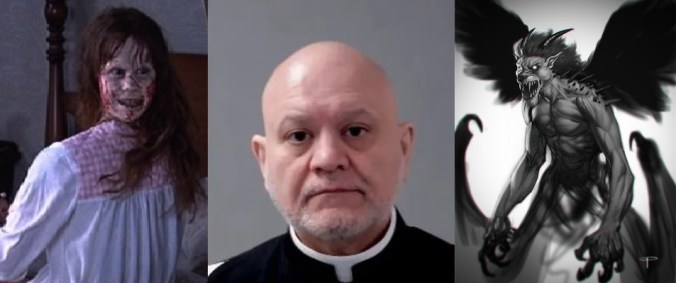
Odd. One would think that the editor of a (once) respected science magazine would not resort demonology to explain her own conduct. Indeed, one would think that such conduct would disqualify said editor from continuing in her position.

Laura Helmuth, a woke activist who has destroyed the credibility of Scientific American by politicizing its content, went bonkers after Trump defeated Kamala Harris and tweeted,

How professional! How trustworthy! How scientific! Who wouldn’t trust the analysis of a science magazine edited by someone who makes such declarations in public?

Continue reading

The Legitimate and Important Ethics Conflict Behind the Springfield Cat-Eating Controversy

As he does so often, Donald Trump accepted something he read or heard as gospel truth and repeated it as fact, this time in a Presidential debate, and was promptly ‘factchecked” and subsequently ridiculed. The back-ground: a large number of Haitian “migrants,” who may or may not be here legally, seem to have ended up in Springfield, Ohio. One resident complained that they were eating pet geese and cats, her claim went viral, and the meme-makers have had a field day…

…as you can see.

Continue reading