Comment of the Day: “Ethics Hero: Mother Jones Pundit Kevin Drum”

There are, I think, three regular commenters on Ethics Alarms who extend all the way back to Ethics Scoreboard days, or pre-2012. One of them is Tim Levier, who unlike the other two, I have actually met while I was in his state of Colorado. Tim posted the following on my Facebook page, and I invited him to cross-post here. In his post, he addresses the “do something!” lament that appears to be thoroughly rotting the brains of our leaders in both parties as they hustle to pander to the emotional responses to the Orlando tragedy. Tim wrote a younger friend about what somethings he would do, and not all of them are relevant to guns. They all, however, are relevant to building a society in which fewer people might choose to start shooting strangers.

Here is Tim’s Comment of the Day on the post, “Ethics Hero: Mother Jones Pundit Kevin Drum.

I’m 35 and was recently talking with someone slightly younger. He had the standard call for ideas to check the “do something” box. After I did some jumping jacks to show that I did something, I buckled down and wrote some ideas.

Now, I’m usually accustomed to reading some constitutional murky stuff, so I veered a different direction. Below is my list as I wrote it to him, perhaps there’s something in it that speaks to people. My 4 ideas for improvement (not solutions, because solutions don’t exist.):

Idea #1

I’ll tell you that the #1 thing I would like to see in this country (give me some slack here, I believe everything is connected), given the state of health care…

I’d like to see a 3 tier system of medical insurance & payments. (Tier 3 will be the part that relates back.)

Continue reading

From The Man Who Would Be President, And Who Thinks That Rationalizations Are Cogent Arguments, A Perfect #22

22

Just two weeks ago, I breathlessly announced that Former Secretary of State Madeleine Albright, against all odds. had pulled into a lead over Donald Trump for the 2016 Unethical Rationalizations Championship by giving us a perfect #22, the worst rationalization of them all. That’s this one:

22. The Comparative Virtue Excuse: “There are worse things.”

If “Everybody does it” is the Golden Rationalization, this is the bottom of the barrel. … It is true that for most ethical misconduct, there are indeed “worse things.” Lying to your boss in order to goof off at the golf course isn’t as bad as stealing a ham, and stealing a ham is nothing compared selling military secrets to North Korea. So what? We judge human conduct against ideals of good behavior that we aspire to, not by the bad behavior of others. One’s objective is to be the best human being that we can be, not to just avoid being the worst rotter anyone has ever met.

Behavior has to be assessed on its own terms, not according to some imaginary comparative scale. The fact that someone’s act is more or less ethical than yours has no effect on the ethical nature of your conduct. “There are worse things” is not an argument; it’s the desperate cry of someone who has run out of rationalizations.

Now, Donald Trump never runs out of rationalizations; as I wrote in the Albright post, “Trump is capable of hitting the entire list of rationalizations, all 68 of them (including the sub-rationalizations) given the opportunity.” He also rose to the challenge posed by Albright quickly, for he not only gave America a Full 22, he did so in the context of arguing for an unconstitutional government breach of First, Second, and Fifth Amendment rights on a massive scale! Bravo!

On Face the Nation  yesterday, talking about the Orlando shooting,  this idiot—sorry, sorry!—Mr. Trump said..

“Well I think profiling is something that we’re going to have to start thinking about as a country.Other countries do it, you look at Israel and you look at others, they do it and they do it successfully. [DINDINGDINGDINGDING! There are two more rationalizations right there:#1, Everybody Does It, and  #3, Consequentialism, or  “It Worked Out for the Best”! I mean,this guy is a rationalization machine! ] And I hate the concept of profiling but we have to start using common sense and we have to use our heads. It’s not the worst thing to do.” Continue reading

Comment of the Day: “Ethics (and Legal) Dunces: Hillary Clinton And Everyone Else Who Is Suggesting That The Government Should Be Able To Keep Someone From Buying A Gun By Placing Them On A “No-Fly List””

EYES of fear

From Comment of the Day auteur Chris Marschner comes more perspective on the post Orlando debate, and some of the irresponsible arguments being made. His focus: the distortion caused by fear,  and he adds a further rebuttal to the suddenly current “The Second Amendment only applies to muskets” nonsense, for which he has more patience that I. Here is his Comment of the Day on the post, Ethics (and Legal) Dunces: Hillary Clinton And Everyone Else Who Is Suggesting That The Government Should Be Able To Keep Someone From Buying A Gun By Placing Them On A “No-Fly List”

What I have not seen yet is an actual deconstruction of the events that took place well before the self-proclaimed radical set his sights on the Pulse night club. Furthermore, once again one side immediately attributes the root cause of mass shootings to an inanimate object that has the capability to inflict substantial casualties or, as the New York Times editorial(s) puts it, Republican rhetoric that fuels hate toward the LGBT community and other minorities and that the pro-gun lobby is complicit in facilitating these horrific events. It seems to me that such rhetoric fuels the intransigence by the pro gun side to stick to their guns, so to speak.

Whether it’s the NRA and the millions people that make up its membership, or non-gun owners who would not know an automatic weapon from a semi- automatic weapon used by the military both sides are arguing from a state of fear.

At the heart of the problem is how do we combat that fear without sacrificing the very freedoms we want to protect. We aid, abet and give comfort to our enemies when we fight internally over these issues. By dividing us they distract us from their activities; so they win a tactical advantage. By causing us to sacrifice our fundamental freedoms they win some battles. When they force our retreat into isolation they win the war.

Irrespective of what we call it, radical Islamists or simply extremists we do know the name of the organizations that seek to inflict as much death and destruction to the civilians living in western Europe, Israel and the United States. Each has a name and a state of war can be declared on each one. Continue reading

Can Anyone Analyze The Orlando Mass Shooting Objectively?

blind men elephant

We know that Omar Mateen planned an attack on the Pulse nightclub in Orlando. We know he used a pistol and an AR-15 rifle—which he purchased legally– to shoot over a hundred people, leaving  50 people dead and 53 injured. We know he was homophobic, that the FBI interviewed him three times,  and that he had pledged his allegiance to the Islamic State as his deadly assault began. We know that  his father is a pro-Taliban, anti-American activist. We know that the shooter’s  co-workers noticed that he was unstable, but that his bosses were reluctant to take any action for fear of appearing “racist.” We will Mateen’s ex-wife says he was prone to violence and that she believes he was mentally ill.

We will undoubtedly learn more. Still, that’s a lot of data. Isn’t it possible to objectively, dispassionately weigh and measure causes and effects and come to fair and reasonable conclusions that can guide policy without partisan gridlock?

It is possible to at least try, but so far, pundits, elected officials and activists aren’t trying. They are allowing confirmation bias to dominate their thoughts; what matters isn’t what caused this tragedy, but what they want to believe caused it.

To arch conservative pundit Michael Walsh, for example, the problem is that the United States allows Afghanis and Muslims to be citizens:

Ah, Afghanistan, the land of sexually primitive boy-molesters who channel their aggression into wife-beating and mass murder…That’s par for the course for marriages to Muslims, as many real American women who’ve married one of them knows. Flowers, limos, candy… and the second after the vows, domestic prison and beatings for life or until they can escape….The Florida shooter is Exhibit A why the notion of “birthright citizenship” — he was an Afghan Muslim who by sheer chance was born in New York — needs to be drastically curtailed in light of changed circumstances.

Continue reading

The Unethical Ethicist And Yale: If Bill Cosby Were A Famous Ethicist, He’d Be Prof. Thomas Pogge

The Accuser and the Ethicist

The Accuser and the Ethicist

Here is the short version:

Yale’s Thomas Pogge is a world famous Yale professor of philosophy and ethics who is especially renowned for condemning the terrible human rights effects caused by disparity of resources between rich countries and poor ones. His books, lectures and a well-recieved TED talk argue that the power imbalance between rich countries and poor countries is so great that poor countries cannot reasonably be said to “consent” to agreements between them. Pogge has also accumulated many credible accusations of exploiting, harassing, and taking sexual liberties with his female students in multiple institutions. In the case that has led to this contrast becoming public, Yale offered a female accuser, a Yale graduate named Fernanda Lopez Aguilar, $2000 in exchange for ending the matter and keeping the story out of the news media.

The long version is here. Because the publisher is BuzzFeed, which is not widely regarded as a sterling source of trustworthy journalism (to say the least), the detailed and apparently well-researched report will be easy for Pogge and Yale to ignore and shrug off. However, other publications, including the Yale Daily News, have investigated the work of author Kaitie J.M. Baker, and so far it has held up to scrutiny.

Pogge has responded, less than convincingly, I would say, to the Lopez Aguilar allegations here. I say unconvincingly because he does not address the previous accusations made against him at Columbia University, and if there is one common characteristic of sexual harassers and abusers that stands out above all others, it is that they are habitual and repeat offenders. Anyone who has spent any time in academia (like me) is well aware that the culture permitting professors, especially male professors, to use the student body and bodies as a sexual perk of the job is widespread and only weakly restrained, if at all. Does that prove that Pogge is one of the professors who partakes in the lusty opportunities presented to him as an object of trust and admiration? No. There is, however a lot of smoke surrounding him, and the smoke has been issuing for a long time.

Yale’s institutional conduct is more than smoke. Yale appears to be another example of a trusted institution deciding that it is preferable to cover up the possible, likely or proven misconduct of a valuable employee than to risk damaging the reputation of that institution, or alienating the loyalties of other employees, by addressing it openly and decisively. I’m sure you can name other infamous examples of this phenomenon, broadly covered by the rationalizations “The King’s Pass” and “The Saint’s Excuse” on the Rationalizations List. Among the most infamous of these are the Catholic Church’s decades, perhaps centuries-long enabling of child sexual predators in the priesthood, the Watergate cover-up by the White House, and Penn State’s failure to stop a known child predator from using the school’s football program and its campus as a base of operations. Yale’s particular variety of this unethical choice is an especially unsavory one, closer to the Joe Paterno/ Sandusky and “Spotlight”scandals, because it intentionally  places future innocent victims at risk of harm.

I accept that there is a possibility that Pogee is an impeccable  professional and as pure as the driven snow, and thus himself a victim of a smear, though this seems unlikely. What I am more interested in now is to address the questions asked in the BuzzFeed piece, which relate to how we should regard unethical ethicists as well as other prominent figures who defy, in their actions, the wisdom they are celebrated for dispensing to others—the Bill Cosbys of the world.

I have some additional questions of my own, but for now I will restrict myself now to those posed in the article. Continue reading

Do We Really Want To Live In A Society Where Tow-Truck Drivers Refuse To Tow The Cars Of Bernie Sanders Supporters?

Bernie Sticker

In Ashville, North Carolina,  tow truck driver Ken Shupe arrived on the scene to find motorist Cassy McWade standing by her accident-disabled vehicle  on Interstate 26. “He goes around back and comes back and says ‘I can’t tow you,” Wade told a reporter. “My first instinct was there must be something wrong with the car. And he says, ‘No, you’re a Bernie supporter.’ And I was like wait, really? And he says, ‘Yes ma’am,’ and just walks away.”

Here’s Shupe’s version:

“Something came over me, I think the Lord came to me, and he just said get in the truck and leave. And when I got in my truck, you know, I was so proud, because I felt like I finally drew a line in the sand and stood up for what I believed.”

A few quick points and then I’ll get to the real issue:

1. Shupe is an utter, virulent, IQ-deficient jerk whose conduct and attitude makes a mockery of whatever faith it is cursed to have him belonging to it, and constitute a blight on the society, community,culture and nation so unfortunate as to be stuck with him.

2. News reports make a big deal out of the fact that McWade is confined to a wheelchair. Ah: the theory is that we are only obligated to help our handicapped neighbors in need, is it? It shouldn’t matter if she was an Olympic medalist in the 50 yard dash. You don’t treat other human beings like that in any society that values human rights and common decency.

3. Shupe’s company is Shupee Max Towing in Traveler’s Rest, South Carolina. Nobody in their right mind should patronize this unAmerican creep, including his own family. This was anti-social,  cruel and objectively horrible behavior toward someone in need, and Shupe needs to be shunned, hard. If he can’t co-exist with others any better than this, he needs to live in a cave somewhere, because he’s not fit for human association.

4. To anticipate an objection: you may ask how it is that I can argue that friendship should outweigh political differences and advocacy of unethical conduct, and yet designate Ken for ignominy and rejection. If Ken were a friend of mine, I can see myself standing by him even after this miserable behavior. But, as Samuel L. Jackson tells John Travolta in “Pulp Fiction,” “We’d have to be talkin’ about one charming motherfucking pig.”

In a way, however, we should be grateful to Ken Shupe, who has provided in short order and timely fashion a near perfect example of the society-wrecking virus being actively spread by irresponsible zealots on both ends of the political spectrum who are determined to divide the nation and the culture as never before. Yes, never before. During the American Civil War, generals on opposite sides of some of the most bloody battles ever fought arranged to meet and exchange pleasantries, because they had been, and remained, friends. They understood what the self-righteous tow-truck operator, and, increasingly, our entire society, doesn’t. Continue reading

A Catastrophic Existential Failure Of Ethics And Institutions

Now what, Ben?

Now what, Ben?

I woke up this morning nauseous, after a restless night. It could have been dinner, but I’m pretty sure that it was Indiana.

Not that seeing Ted Cruz suspend his quest to be President was upsetting in and of itself. He’s a terrible candidate and a dangerous man, and almost certainly unelectable, which in his case is a good thing. As it did with Chris Christie, who was exposed as a character-free fraud; as it did with Jeb Bush, who demonstrated an inability to think; as it did with Ben Carson, who proved why his theory that leaders need no relevant experience at all was nonsense; as it did with Marco Rubio, who provided the definitive definition of “empty suit,” the primary system worked, and eliminated aspiring nominees who were unqualified and unfit in various ways.

It has not worked, however, with Donald Trump. This was not a failure of the primary system or the political system (Hillary Clinton’s impending nomination will be a failure of the political system) but something far more ominous. We are faced with the threat of an unstable, incoherent, ethics-free and irrational man becoming our President because of a catastrophic breakdown in the ethics of our cultural, societal and political institutions, over a long period of time. As a result, our democracy, ideals and way of life are imperiled as never before.

It didn’t have to be this way. It’s just how things broke, that’s all. The United States has sewn the seeds of its own destruction many times before and lucked out, smelling like a rose after mistakes, miscalculations and stupid actions that easily could have ended Mr. Jefferson’s experiment in tragedy and chaos. We might get lucky again, I suppose. Trump might get squished by a falling piece of space junk. Hillary Clinton might get possessed by the spirit of Julia Sand. I wouldn’t bet on it though. Continue reading

The Catholic Church, Its Rapist Priest, And Shattered Trust

The graphic artist didn't place that halo over the rapist priest's head. The Vatican did.

The graphic artist didn’t place that halo over the rapist priest’s head. The Vatican did.

In the year after “Spotlight” focused renewed public attention on the Catholic Church’s horrific betrayal of its mission, its members and humanity by the enabling of child sexual predators within its ranks, how could the Church not realize that reinstating a convicted rapist priest, as it did this week, undermines all of its efforts to regain the trust and faith it had forfeited?

After months in which Pope Francis presumed to tell the governments of the world what its moral obligations were, how could he allow this to occur?

In short, how can a credible religion have broken ethics alarms? How can the Catholic Church preach morality while rejecting ethics?

Father Joseph Jeyapaul,  a Catholic priest from India, served in the Crookston, Minnesota diocese from 2004 to 2005. While he was there, he raped at least two adolescent girls. I say “at least” because he admitted to raping them to cop a plea. Who knows who else he may have assaulted?

After being charged with the crimes, including rape and forcing at least one of his victims to perform fellatio on him, Father Joseph  escaped to India, where an Interpol warrant got him extradited back to Minnesota.  There he confessed, and as part of a plea bargain, received an outrageously light sentence of a year and a day for pleading guilty to one count of molestation.

Don’t ask me to explain why any prosecutor whose law license wasn’t obtained by passing a quiz about “Law and Order” episodes would make such a deal. I assume that some kind of political pressure from the Church was involved, or that the prosecutors were Catholic, or that they had brain lesions or something. Frankly, I’d rather not talk about it.

Jeyapaul was suspended from the priesthood and served his time in Minnesota. The U.S. deported him back to India with a DO NOT RETURN TO SENDER label after his release last July.  Meanwhile, the Minnesota diocese had to pay millions in a civil lawsuit, during which we learned that the rapist priest had told one of his victims  in the confessional that she was at fault, and had made Jeyapaul “impure” by letting him abuse her.

Does the term “evil” come to mind, or would you call that too judgmental?

Now comes the amazing part. In February, the Vatican lifted  Jeyapaul‘s suspension and restored him to the priesthood. It then assigned him to a new parish in India, where he is now the diocesan head of its commission for education. 

I’m sure it’s also a great place to meet chicks.

Continue reading

Rationalization #58: The Ironic Rationalization, or “It’s The Right Thing To Do”

Hmmmmm...

Hmmmmm…

I am embarrassed to admit that I missed this one, which is common and sinister. When I get around to re-numbering the list, it will be grouped with #13. The Saint’s Excuse: “It’s for a good cause,” and #14. Self-validating Virtue.

The rationalization eluded me because it seems like it could often be a fair statement of fact rather than a rationalization, a lie or logical fallacy that is used to justify conduct but does not. “It’s the right thing to do” is routinely used to end a debate, however, when it is only a proposition that must be supported with facts and ethical reasoning. Simply saying “I did it/support it/ believe in it because it’s the right thing to do” aims at ending opposition by asserting virtue and wisdom that may not exist.  The question that has to be answered is why “it’s the right thing to do,” and “Because it’s just right, that’s all,” “Everybody knows it’s right,” “My parents taught me so,” “That’s what God tells us in the Bible,” and many other non-answers do not justify the assertion.

Maybe it’s the right thing, and maybe not. Just saying it conduct is right without doing the hard work of ethical analysis is bluffing and deflection. “It’s the right thing to do” you say?

Prove it.

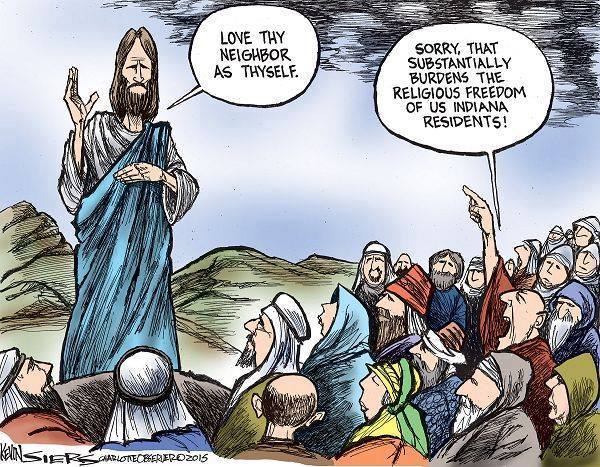
Considering the Retrograde Mississippi Freedom of Comment of the Day #2: “Conscience from Government Discrimination Act, This Shouldn’t Be Surprising At All…”

Jesus-Burdens-our-Religious-Freedom

The second Comment of the Day, also on the same post, comes from frequent COTD author Extradimensional Cephalopod. His topic is religious freedom. Here it is…

Human logic is so warped by truisms. Why are we discussing the competition between religious freedom and the principle of respecting others? Once we strip away the artificial distinction between religious beliefs and any other beliefs, everything becomes more obvious.

It makes no sense at all to say that people are free to believe whatever they want but that they should not impose those beliefs on others in public. Society is built on a foundation of mutual beliefs, beliefs about the best obligations we can all impose on ourselves on behalf of each other. Fundamental disagreements or paradigm mismatches about ethics and rights cannot be ignored, because they disrupt the fabric of society itself. (No, gay marriage in itself doesn’t disrupt the fabric of society; the fact that only a small percentage of the population can discuss it respectfully and intelligently indicates the fabric has been looking for an excuse to unravel.)

“Religious freedom” is an excuse to avoid difficult conversations and careful thought, and just sweep the differences under the rug. The only reason that’s possible is because (most) people decided they would prefer to ignore each other rather than kill each other, but that doesn’t make the underlying misunderstandings go away. They show up in politics because the law of the land is the only place where people have no alternative but to deal with each other’s beliefs about right and wrong (or leave the country). If we face our disagreements head on, but with the goal of learning, there is no reason “tolerance” needs to last forever.

I would never tell a person who believes that gay marriage is an offense against a magical energy being that they should keep that belief to themselves, any more than I would ask it of someone who believes that evolution is a more accurate and useful concept than creationism. People who keep beliefs to themselves rarely get the opportunity to learn they’re wrong. Of course, people who never shut up about their beliefs and listen to alternatives never learn either. Ideas should be sent out into the world to stand on their own. Most of them will be torn to shreds, and that’s good. The ideas that don’t survive weren’t useful, at least not by themselves.

There is no way to defend religion as a concept, let alone its exercise, because religion is an arbitrary collection of descriptive and normative beliefs with a lot of people who consider them somehow existentially important. Religion in general cannot be defended ethically or legally, because its beliefs could say literally anything. Any such defense would merely be an excuse to completely ignore skepticism and critical thinking in the name of… somehow being morally superior in a way that critical thinking and skepticism… somehow prevents. However, most (but not all) religions allow critical thinking in ways that don’t threaten their tenets, because the ones that don’t are even more horribly crippled due to their intellectual bankruptcy. Few complain because few know how to think critically, or value the practice.

Continue reading