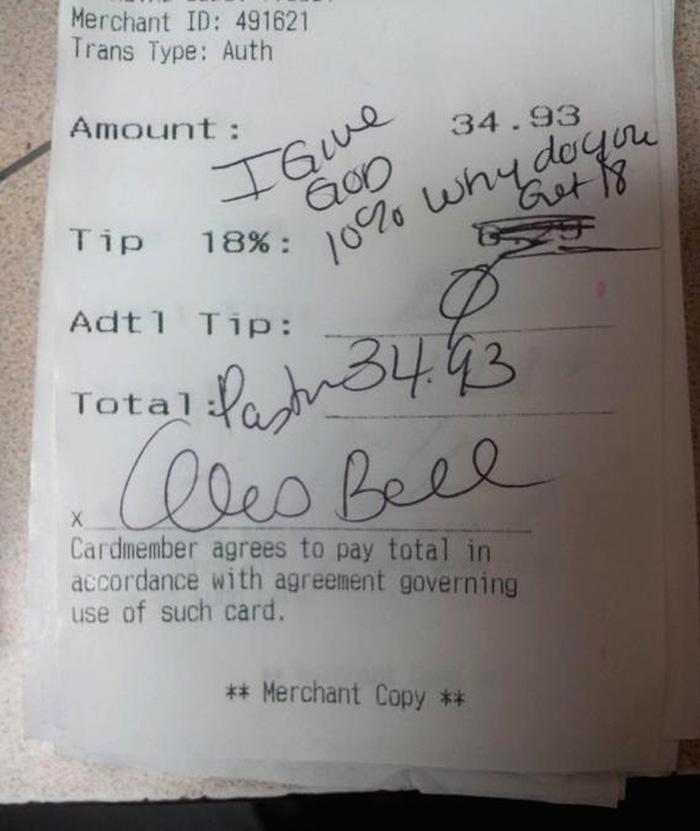
This post is approaching an Ethics Alarms record for comments, and as always in the case when my commentary strikes a nerve, almost never on the most serious issues [This earlier post from yesterday, for example, is one that matters, and that I wish would get wider distribution, since I appear to be the only one making these points], the later comments tend to re-iterate the earlier ones, which have already been addressed, and I hate explaining the same thing over and over. Also the trolls have come out to urinate on everything, and I’ve had to ban a few, which I don’t like to do.
Therefore, as I have done before, here is a summary of the thrust of the comments and my replies, as well as over-all observations about the issue and conversation generally. I wish any commenter would read this before repeating what has already been said:
1. Nobody is defending Bell, the cheap and arrogant pastor. Good, but if the update you’ll find at the end is correct, she is considerably less despicable than everyone, including Welch, presumed.
2. One clown, however, wrote an abusive comment accusing me of defending the pastor, insulting my work and character based on that accusation, which made about as much sense as accusing me of being Marie of Rumania. I banned her, and also told her why in intentionally unkind terms. I’m not sorry.
3. It continues to amaze me how many people feel they have to comment on commentary—often in abusive and indignant terms– when they haven’t taken the time to read the post. Unbelievable.
4. I expected some readers to defend the actions of the waitress, but not as many as turned up.
5. I am grateful for the assistance of texagg04, affectionately known as “Tex,” who jumped into the fray late last night when I was trying to deflect attacks left and right. I owe you, bro.
6. Facts:
- It is not against the law not to leave a tip.
- It is not against the law even it is a so-called “mandatory tip.”
- It is not against the law even if the mandatory tip is noted in the menu.
- It is not legally theft.
- It is unethical to leave an inadequate tip when the service was at least acceptable, as it apparently was at Applebee’s that fateful day.
- It is not unethical to leave less than the expected tip if the service was poor.
7. A server, or a server’s colleague, has no right to take any negative action against a diner who unfairly leaves an inadequate tip. That is the restaurant’s choice alone.
8. Applebee’s did nothing wrong whatsoever. The large number of posts asserting that Applebee’s or eating establishments in general mistreat their employees, justifying conduct like the waitress’s web-shaming are manufacturing rationalizations. Even if true, and I have no evidence of that in this instance, that is irrelevant to Chelsea’s duties as an employee, and subsequent misconduct.
9. There is no way to ethically shame the pastor without the participation and approval of the restaurant.
10. There are three problems with what the waitress did: 1) She worked for Applebee’s, and embarrassed an Applebee’s customer in a manner that involved the restaurant and that directly related to a patron’s visit there. That is employee misconduct, anywhere, no matter what the provocation. 2) She was engaging in vengeance, which is unethical—“tit for tat” conduct which is virtually always wrong. 3) The vigilante punishment was disproportional to the offense,
11. A restaurant does not have to specifically inform employees that taking unilateral action against restaurant patrons is a firing offense. That said, I’d be shocked if the employment manual didn’t include language broad enough to cover this incident. It didn’t have to say, “Don’t web-shame cheap customers.”
12. I think Applebee’s should ban Bell from eating at any of its restaurants. I said that in the post. But that does not mean that it should “show some spine” and endorse an employee unilaterally harming a patron in revenge. She was acting personally, but doing so in a way that reflected on her employers, involved them, and harmed them. No employer should be expected to tolerate that, and those who endorse such conduct are foolish.
13. Dumbest and most irritating ethics-free comment, repeated many times: “If you ever waited tables, you wouldn’t take that position! You don’t know what you’re taking about!” Translation: “I’m biased, because I’m a server, sympathize with servers, and can’t be objective. You can’t analyze this without being biased too.” The underlying ethical issues–vengeance, vigilante action, violation of duties to employers—have nothing to do with waiting tables, and apply the same way in other professions.
14. The expropriation and publication of data on a proprietary document belonging to the diner, Bell, and Applebee’s is per se unethical conduct. There is no defense for it.
15. A diner does not voluntarily put herself in the public eye by what she writes on a check that is between her and the restaurant.
16. An interesting spin-off was raised by a vengeful waitress who defended Chelsea and said that when she was stiffed on a large bill, she informed the mayor of the town that the diner, a city lawyer, was plotting against the city with his meal companion. Even if he was, servers are professionally obligated to keep the contents of conversations they overhear confidential. If she had done this as a whistle-blower, it is ethically defensible. She did it to get even, which is not a justifiable reason, and the restaurant would be justified in firing her for doing it.
17. Yes, I sometimes have typos and other errors in my replies to comments. As regular readers know, I have them in my posts, too, though I am constantly cleaning them up. The typos in the comments are mostly due to the fact that I answer a lot of them, in addition to the fact that I can’t type or spell. This does not, as one commenter asserted, mean that I did not graduate from the schools I “claim” I did. And what makes you think graduates of those schools necessarily proof-read any better than I do?
18. As for the web-shaming fans who argue that Chelsea’s act was virtuous because such evil conduct should exposed, and anyone who acts so disgracefully deserves to be held up to disparagement across the globe: None of us should want to live in a society where every mistake we make is at risk to be preserved forever online, warping the opinions that others form of us for the rest of our lives. In Europe, it is called “the right to be forgotten.” The Golden Rule applies, not that Pastor Bell would recognize it. This is a perfect example of the kind of minor lapse–it’s 7 lousy bucks!—that the elephant gun of public shaming should not be used against.
19. Novel (and bad) rationalizations: 1) Because the waiter collected money, he became a co-owner of Applebee’s. Ugh, no. He is the agent of Applebee’s, and still just an employee. 2) The bill wasn’t proprietary, because it wasn’t copyrighted of trademarked. Wrong. “Proprietary” also means “property belonging to someone,” and the someone wasn’t Chelsea. 3) Bell’s comment on the bill slip was directed at the waiter personally, so the retaliation was only personal too. Ridiculous. First, it is unclear that the comment was directed at the waiter at all; I’d say it was directed at the restaurant that mandated the 18%. But even if it was directed at the waiter, it was directed at the waiter in his capacity as an employee, not personally….not that it would justify retaliation even if it was intended personally. 4) Applebee’s has an obligation to support retaliation for “blatant abuse” or an employee being “taken advantage of.” This suggests that every time a waiter is given an unfair tip, the restaurant should support web-shaming. The “blatant abuse” was withholding a seven buck tip—not nice, but “abuse”? This wasn’t even why Chelsea posted the bill—it was what was written on it that outraged her, and that didn’t “take advantage of anyone.” That was just someone being a mega-jerk.
20. This is not a free speech issue.
21. The Applebee’s employee manual has plenty of provisions prohibiting Chelsea’s conduct.
22. If you are tempted to argue, as one commenter did, that my use of an Applebee’s menu as a background on a day when I am getting nothing but comments related to this post suggests that I am endorsing the restaurant or otherwise a shill for it, heed this warning: Don’t. There are some insults I won’t tolerate, and this is one of them. UPDATE (2/2): The Applebee’s menu background was scheduled to be replaced today, but I’m leaving it up in honor of the cognitively damaged commenters, currently numbering two–one banned and one likely to be—who have accused me of shilling for the restaurant.
UPDATE (2/1): Now it appears that the pastor left a tip in cash, and only complained about it on the slip. And that Applebee’s charged her credit card with the tip anyway, meaning that it owes her money. If true, this makes Bell far less of a villain, and also makes her complaint to the restaurant more justifiable. It also makes Welch’s conduct look reckless and unfair, further justifying her dismissal.