Ethics Dunce: Rep. Dennis Kucinich

Muslim women, in ethical garb

During last week’s hearings on the alleged radicalization of Muslim-Americans, Congressman Dennis Kucinich, protesting that the hearings were an example of prosecution and bigotry, said:

“Islam is a religion based upon peace, goodwill and the ethical treatment of all people on this planet.”

Politics involves advocacy, and zealous advocacy sometimes metastasizes into exaggerations, overstatements, and lies. Determined governors are called dictators and criminals; those questioning global warming models are compared to Holocaust deniers. Believing that an attack on an enemy nation is in the best interests of America, leaders who should be saying, “We have good reason to believe that this nation has weapons of mass destruction and is inclined to use them,” say instead, “We know where the weapons are and the threat is imminent.” Other leaders who are trying to get important health care reforms passed say, “Don’t worry—if you like your current plan, you’ll be able to keep it!”, neglecting to add the caveat that that plan you like may be forced out of existence if the bill is passed.

These excesses range from deceitful to outright lying, but they are all unethical, all disrespectful of the truth and the public that has a right to it, all aimed at manipulating public opinion with falsity.

I find Kucinich’s statement especially indefensible, because the degree of his presumably misstatement of the truth was completely unnecessary if his motives were good. Continue reading →
Comment of the Day: “The Tears of Keith Ellison”

Less to do with the original post and more concerned with weightier matters is this thoughtful comment by blameblakeart, the Comment of the Day:

“This event in Japan has crystalized for me Jack – we as Humanity, as Earthlings – are all in this together, side of the aisle being probably the least of our worries. We need to use our smarts and our will to manifest a better, more abundant, more perfect world, all together, not just for a chosen few.

“10000+ years ago there were hundreds of species that basically cease to exist. What the 8.9 Japanese earthquake tells at least me is that life is tremendously fleeting, but intensely beautiful, magic, and precious, of all things, Human and Of this Earth. I don’t know why there are those out there trying to distract us from these simple truths with all these bogus, hateful, incendiary tactics.”

The Tears of Keith Ellison

The grand drama at Rep. Peter King’s Congressional hearings investigating the radicalization of American Muslims last week was provided by Rep. Keith Ellison, who broke down crying while telling the story of a Muslim-American hero, Mohammed Salman Hamdani, who rushed to lower Manhattan on the morning of Sept. 11, 2001 to assist in rescue efforts, and died in the collapse of the World Trade Center. Ellison said:

After the tragedy some people tried to smear his character solely because of his Islamic faith. Some people spread false rumors and speculated that he was in league with the attackers only because he was Muslim. It was only when his remains were identified that these lies were fully exposed. Mohammed Salman Hamdani was a fellow American who gave his life for other Americans. His life should not be defined as a member of an ethnic group or a member of a religion, but as an American who gave everything for his fellow citizens.

I found the performance odd and vaguely troubling, and now that I’ve thought about it for a few days, I know why. The statement by Ellison, who converted to Islam, and the tears that accompanied it, raise a few ethical issues, beginning with the Ethics Alarms standard, “What’s going on here?” Continue reading →

Comment of the Day: “Why NPR’s Wrongs Don’t Make James O’Keefe Right”

Rick comments on my ethics verdict regarding the most recent James O’Keefe “sting,” this one exposing a biased NPR exec and an ethically-weak NPR fundraiser: Continue reading →

Why NPR’s Wrongs Don’t Make James O’Keefe Right

James O'Keefe, Ethics Corrupter

And the NPR Ethics Train Wreck continues…

Between union hysteria in Wisconsin, carnage in Libya, and tsunamis, the fact that James O’Keefe’s fake Muslim billionaire act exposed more NPR integrity issues was drowned out by shouting, gun shots and water. In fact, the second victim of O’Keefe’s sting may have taught us more about NPR than the first.

In the surreptitious audiotape of  NPR’s continued encounters with the fake potential big bucks donor, NPR’s director of institutional giving, Betsy Liley, is heard advising the supposedly wealthy Muslim donor how the network could help “shield” his group from a government audit if it accepted the $5 million he was offering. It seems pretty clear from the tape that this was not what the sting was set up to prove: what the “Muslim donor” really wants is to get a promise from NPR that it will slant the news content the his way if the gift is big enough. Liley stood her ground on this core journalistic principle admirably—so much for the claim that George Soros bought NPR’s advocacy with his recent gift—but fell into another trap of her own making.

NPR spokeswoman Dana Davis Rehm said in a statement that Liley’s comments on the tape “regarding the possibility of making an anonymous gift that would remain invisible to tax authorities is factually inaccurate and not reflective of NPR’s gift practices. All donations—anonymous and named—are fully reported to the IRS. NPR complies with all financial, tax, and disclosure regulations.” That’s undoubtedly correct; Liley was not merely ethically wrong but also literally wrong, for what she was suggesting almost certainly couldn’t happen. However, the fact that she would say such a thing believing it could happen, or think it was acceptable if it did happen, or try to acquire a large donation by persuading a donor to believe it could happen, all point to the one conclusion: NPR’s culture is ethically compromised, and the organization’s leadership has failed to meet its obligations to create an ethical culture  there. The sting is more disturbing than the earlier one that caught an outgoing NPR executive taking extreme partisan positions that belied NPR’s position that it is objective and unbiased. The comments of Ron Schiller just confirmed what many, including me, thought was already apparent in the tone of NPR’s work. I had also always assumed, however, that the place was professionally and ethically run (excepting the tendency to fire employees for expressing politically incorrect opinions on Fox News).

So this settles it, right? O’Keefe is a hero?

No, he’s not. James O’Keefe, in fact, is an ethics corrupter, an individual who weakens the public’s ethics by encouraging it to accept his dubious values. Continue reading →

Illinois’s Death Penalty Ban: Defensible Decision, Indefensible Reasoning

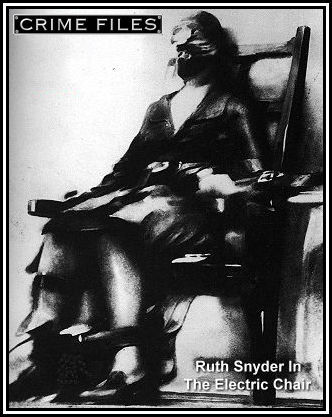
Justice.

Illinois Gov. Pat Quinn  signed legislation abolishing capital punishment in the state and commuted the sentences of the 15 inmates still on death row to life in prison without parole.

I disagree with the decision, and have stated my reasons for not abolishing the death penalty here and here. Never mind: this is a topic on which ethical and reasonable people can disagree with honor. But if one is going to abolish an important law enforcement tool, the official justification for it ought to be coherent and persuasive, and not just facile rhetoric. That, unfortunately, is what Gov. Quinn gave us.

Here is the relevant segment of Quinn’s statement after signing the bill into law during a private ceremony: Continue reading →

Unethical Quote of the Month: Newt Gingrich

“There’s no question at times of my life, partially driven by how passionately I felt about this country, that I worked far too hard and things happened in my life that were not appropriate. And what I can tell you is that when I did things that were wrong, I wasn’t trapped in situation ethics, I was doing things that were wrong, and yet, I was doing them. I found that I felt compelled to seek God’s forgiveness. Not God’s understanding, but God’s forgiveness. I do believe in a forgiving God. And I think most people, deep down in their hearts hope there’s a forgiving God.”

—–Former Speaker Newt Gingrich, preparing for a presidential run by attempting to explain and apologize for his serial marital betrayals, the most spectacular of which was visiting his first wife while she was in the hospital recovering from cancer surgery to announce that he was divorcing her to marry his mistress. Then he cheated on his second wife, the former mistress, with a member of his staff. He ditched Mistress #1, Wife #2, for Mistress #2, who became Wife #3. This is why he needs a forgiving God, or at least a forgiving electorate.

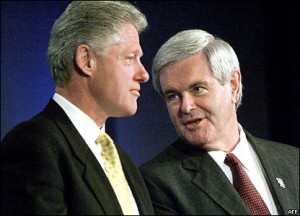
Newt’s defense now is that he felt so passionately about his country that it caused him to dump his cancer stricken wife (so much for all that “in sickness or in health” stuff), and later, while he was leading a party that was making the case that a U.S. President shouldn’t be having on-the-job sexual encounters with interns, using his staff and appointees to cover it up, and lying about it under oath in court, to commence a second extra-marital affair of his own. This, naturally, helped let President Clinton wiggle of his well-earned impeachment hook, and also helped cement the socially destructive public perception that 1) everyone cheats on their spouses, so it’s okay, and 2) you can’t trust any of our elected leaders.

Thanks for nothing, Newt.

God is welcome to forgive you; I won’t. You are obviously untrustworthy. Once cheating on a spouse may be a mistake; cheating on a second spouse is a behavior pattern. If a politician who likes to invoke God will lie to and betray two women who he swore, before God, to take “’til death us do part,” not to mention his children, I see no reason to assume that he won’t betray voters who has never met, loved, or lived with.

God’s forgiveness is irrelevant to the central issue of whether New Gingrich has the reliability of character and core values to justify entrusting him with great power. As his self-serving quote demonstrates, he does not.

But good luck with God, Newt.


The Naked Teacher Principle Strikes Again!

Once the class sees Teacher like this, it's over...

The Naked Teacher Principle holds, in essence, that once a teacher is seen by his or her students cavorting in the nude, school administrators and parents are not being unreasonable or unfair if they decide that the teacher can no longer teach effectively. From the classic example involving internet photos, to exceptions like the male teacher appearing in a community theater production of “The Full Monte”, to strange corollaries like “the Naked Butt-Painting Teacher with a Paper Bag Over His Head Variation,” naked teachers create headaches for their schools, giggles (at least) for their students, and anxiety for the teachers involved.

Now we have another variation. Continue reading →

Ethics Quote of the Week: Ex-Con John Collins

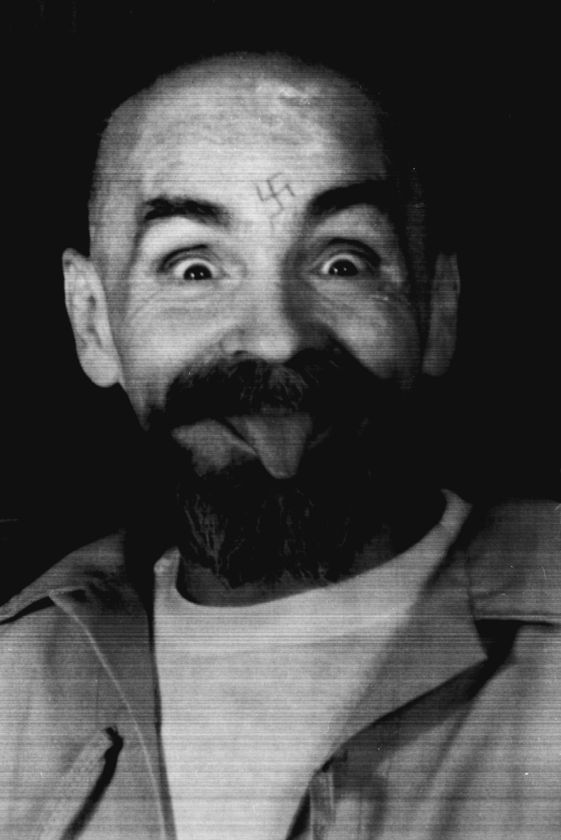
Charlie made a different kind of mistake, too!

“We’re people, we’re not monsters. We’ve just made a different type of mistake than someone else.”

— 34-year-old John Collins, who announced his support for a provision being pushed forward by the Seattle Office For Human Rights, which believes that convicted criminals should be made a protected class.

Collins sure made a different kind of mistake, all right. He served four years in prison for drugging and raping his estranged wife. Continue reading →

Announcing: The Incompetent Elected Official of the Month

"What, me legislate?"

With this post, Ethics Alarms announces a new continuing category for ethics infamy: Incompetent Elected Officials.

We tend to focus on corruption, dishonesty, conflicts of interest and lies when identifying unethical public officials, but it is the wildly incompetent of the breed who might carry the most ethics baggage of all. An incompetent elected official not only is irresponsible for taking on leadership that he or she is unable to deliver due to a lack of brains, skill, experience or judgment, but also keeps a more deserving and able individual from a distinguished position that needs him, jeopardizes the public, and undermines trust in the government generally. The public’s ethics are also implicated by the incompetent official’s ascension to power, as the truly inept can usually be identified with a modicum of diligence and care. Incompetent and irresponsible officials require the assistance of incompetent and irresponsible voters.

Thus incompetent elected officials warrant special attention. And the first incompetent elected official to be honored as the Ethics Alarms Incompetent Elected Official of the Month is….Alabama Republican State Senator Gerald Allen! Continue reading →