Ethics Observations on the Unethical Tweet of the Month

Wowsers.

No denial and Trump Derangement here! 

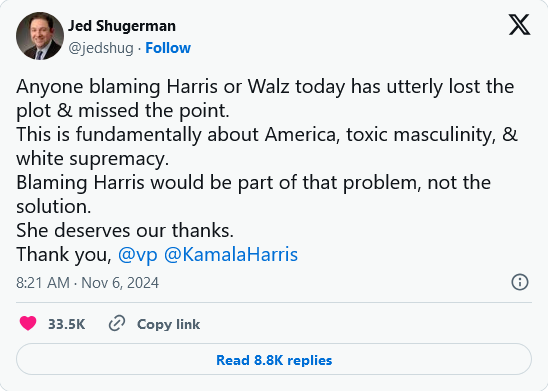
Jed Handelsman Shugerman is a renowned and respected law professor at Boston University. A credentialed legal scholar specializing in constitutional law and governance, he is a co-author of “Amicus briefs on the history of presidential power, the Emoluments Clauses, the Appointments Clause, the First Amendment rights of elected judges, and the due process problems of elected judges in death penalty cases,” among other publications. Yet the professor is apparently a Trump-Deranged, woke bigot no longer capable of rational and objective analysis.

Observations:

1. This guy blogged on Election Day that Harris would win easily. Such a declaraion was the result of inexplicable delusion for a government scholar, unless the explanation is that he is a fraud with no business teaching anyone. I regret my decision not to be more emphataic in my learned and informed conclusion that Trump would win the election and quite possibly in a landslide. I hinted at this belief in many comments, but never stated it in a post. I was discouraged from my previous failed predication that Mitt Romney would defeat Barack Obama. I shouldn’t have been: I was a weenie. I was much more certain that Trump would win than of my prediction in 2012. Romney was running against Obama, a skilled campaigner and incumbent President; Trump’s opponent was a terrible campaigner and a Vice-President. Romney was knee-capped by the biased news media, but its power and credibility was much stronger then. Romney never had enthusiastic support from conservatives, who rightly regarded him as technocrat with flexible principles. Not being willing to come out and predict that Trump would defeat Harris was wrong, but anyone stating from a position of authority that Harris would win is unforgivable. The polls that showed a dead heat made no sense, as many pointed out. Trump was running confidently, while Harris was running a desperation campaign, and running it badly, depending on voter amnesia and gullibility. By any objective observation and unbiased analysis of the issues around the election, the conclusion that Trump was a likely victor was unavoidable if one had to choose one result or another to predict. Predicting that Harris would prevail demonstrated an “It isn’t what it is” mindset and an abuse of authority by a presumed “expert.”

2. Blaming Harris or Walz for the most incompetent campaign in modern Presidential history is “missing the point”? It’s the only point anyone needs. The partisans who defend that campaign, with Walz being a walking, talking joke except that opposing free speech isn’t funny, and Harris resolutely refusing to answer direct questions directly while “protecting democracy” by using fascist tactics against her opponent can be fairly described as gaslighting.

3. Back to Romney in 2012: I predicted Mitt would win because, I wrote, Americans want strong Presidents. Obama was weak and feckless, but he played strong well. American still want strong leaders. Both Harris and Walz projected weakness. Indeed, the whole woke movement embraces weenyism. Strength is bad, toxic. Men tend to be more assertive, confrontational and agressive than women, so being a male is toxic. The United States was founded on risk-taking, defiance, strength, confrontation and willingness to fight for principles, so the United States itself is toxic.

Well…WRONG. These qualities have made the nation what it is, and what it is is brash, cocky, intolerant of weakness and anti-weenie. it’s a guy thing, but that doesn’t mean women can exhibit the same essential leadership qualities. There is a lot wrong with Hillary Clinton, but being a weenie isn’t one of them. “Toxic masculinity” is nothing better than a pejorative way to describe the unique character of the nation. I prefer American exceptionalism, and weenies need not apply. John Wayne lives, metaphorically of course. Good. Shugarman doesn’t understand or like his own country: why is he a professor anywhere?

4. Oh, fine, here it comes: “white supremacy.” Wouldn’t you think a scholar could come up with something more original (and true) than racism to explain Harris’s defeat? It’s insulting, but worse, it’s stupid. If Trump ran a campaign like Harris, ducking all substantive questions, basing his election on how bad Harris was rather than on what he wanted to do, he would have lost. If Harris hadn’t insulted young men, had she taken the interview with Joe Rogan, were she able to speak off scripts without sounding like Gabby Johnson, she would have won the election. If everything else were the same, but Trump were black and Harris was a white female weenie like, say, Amy Klobuchar, do you think the result would have been any different? I don’t.

5. This is a useful tweet, simultaneously indicting the competence and trustworthiness of academia, lawyers, law professors, law schools, Democrats and progressives.

Into The “Bias Makes You Stupid” Hall of Fame Goes American University Professor Allan Lichtman

I didn’t need a magic 8-Ball to predict that I would be writing this post on November 6. Back in July, I noted the absurdity and hubris of this epitome of a progressive-biased historian—but then aren’t they all?—pretending that he sees all amd knows all. Allan Lichtman’s claim to authority is that he has this formula, see, and it allows him to predict with astounding accuracy (9 out of 10 times! Oops, now it’s 9 out of 11 times…) who will win Presidential elections. I wrote in conclusion,

[Lichtman] went on Fox News Sunday to bloviate that if Democratic delegates rebel against President Joe Biden and choose another Democratic nominee, it will spell chaos for the party.  Lichtman, who is a progressive Democrat and once ran for the Senate as one, was relatively restrained on Fox News, but on MSNBC, he went full Trump Deranged, saying that if the Democrats don’t run Biden, it will mean Trump will win (his system says so!) and that will be the end of democracy!

Those are Lichtman’s warped priorities: he thinks it’s essential that his party wins even if it means electing an obviously deteriorating old man who won’t be able to do the job of President along with everything else that implies. A shadow government run by unelected apparatchiks, for example. He’s a Presidential historian: he knows about Woodrow Wilson, and still he thinks its in the best interest of the nation to vote for that. Lichtman is warning the MSNBC types—you know, morons—that all that matters is keeping The Party in control. Having a virtual basket case in the White House? That’s not a disaster to this guy, not like he says an open Democratic convention would be.

The professor’s shtick radiates poor civic values, sickening priorities, irresponsible advice and worst of all for a history professor, a rotten historical perspective. I have no interest in his prognostications and neither should anyone else. Lichtman should go away now, coming out of his hole in four years like Puxatawny Phil to fascinate the same kind of gullible suckers with his election predictions as are entranced by systems to win state lotteries.

Wonder of wonders, despite his prognostication of doom if Biden left the ticket, once Kamala Harris was installed as Joe’s replacement, Lichtman’s infallible “system” found that she was going to win the 2024 election. That was passing strange, since his system didn’t include categories for babbling empty-suits who alternate between taking two diametrically opposing positions simultaneously and running on “My opponent is Hitler” platforms.

One might justifiably think that, as as a historian, Lichtman would give the only precedent for a defeated single term President coming back four tears later and running for President again significant weight. Grover Cleveland won, after all. Nope. The professor was certain that his formula was correct. Not only was the professor wrong, he was spectacularly wrong. “Right now after a very long night I am taking some time off to assess why I was wrong and what the future holds for America,” Lichtman told USA TODAY this morning.

It’s obvious why he was wrong: bias made him stupid. Gee, who could have guessed that an incompetent candidate chosen without winning a single delegate or running in a single Presidential primary, with the lowest popularity numbers of any Vice-President and a strategy that depended on not letting voters know who she was or what she believed, wouldn’t defeat a previous President of the United States with a devoted, even fanatic, following?

Well, there’s me, and, oh, many thousands of other people with a passing knowledge of history and a modicum of common sense.

Here’s a tip Professor Lichtman: add “Terrible candidates running incompetent campaigns tend to lose” to the factors you consider next time. Trust me: it works.

Link Misinformation and Deceit

In the previous post, a link on “ludicrous and incompetent campaign” will take readers to an excellent Manhattan Contrarian essay documenting how Kamala Harris’s deliberately non-substantive campaign is the most “unserious” Presidential run in American history. That means that it is an honest link, doing what a link to another source is supposed to do: provide reference and authority.

This morning, I was reading Nate Silver’s Bulletin on substack. Nate, who is unalterably left-biased but tries really hard to pretend he’s not, was musing about Trump being too old to be running for President (he’s right about that) and gives us this sentence, with a link: “Considering the long history of old presidents seeking to hold onto power when they were clearly diminished — there were many such cases before Trump and Joe Biden — we should probably just have a Constitutional amendment that says a president can’t be older than 75 on Inauguration Day.”

“Really?” I thought. I think I’m a reasonably thorough and informed student of the American Presidency, and I’m not aware of “many such cases” before Biden. In fact, I can think of just one: FDR, who unforgivably ran for a fourth term in 1944 knowing that he was dying of heart failure. Roosevelt wasn’t particularly old, either: he was 63 when he died.

Seeking enlightenment from Silver on this fascinating topic, I clicked on the link. The link (to another Silver essay) does not show us “many cases” of “old” and “clearly diminished” Presidents seeking to hold on to office. It doesn’t give any examples other than Woodrow Wilson (he doesn’t mention FDR), and Silver’s evidence that Wilson was “seeking” to “hold onto office” before his stroke is like Obama once musing about how nice it would be to have a third term. Wilson told someone he thought he could win another term (he couldn’t). Silver also mentions Truman, who was neither decrepit nor diminished when he left office at 69. Until the Great Depression and World War II allowed Roosevelt—who would have kept running for more terms until he dropped, a true American dictator— to break the unwritten rule against more than two terms set by George Washington’s precedent, officially seeking a third elected term was taboo.

So Silver’s link falsely informed readers that there was authority for the statement it was linked to, and there was not. I should have written about the misleading link practice before, because it is increasingly common and it is unethical. I see it in the New York Times and the Washington Post; I see it on other blogs and substacks. Oh, the links don’t always go to sources that don’t fit the link description, that’s why the deceptive practice works.

False-linkers know that most people don’t click on links; they want to read one post, not two or five. So when they see Nate’s link on “many such cases,” they assume, reasonably enough, that the link will show them many such cases, and that’s all they want to know: Nate isn’t making this up. See, there’s a link to his source!

But he was making it up, and the link doesn’t support his assertion in the the post containing the link.

Link deceit is just an internet version of an earlier version of the practice that still is common: footnotes in scholarly works and case sites in legal documents that are not really what a reader will assume they are. I have a book right here on my desk, a historical tome, that has over 700 footnotes, many of them with nothing more than a book or published paper title and an author. I assume, with such footnotes, that they indicate there is authority for what the book author has written, but I won’t usually check the source footnoted. Almost nobody will. However, in the past, when writing my own scholarly articles, I have checked footnoted references, and sometime discovered that they were like Silver’s link—not what they were represented as supporting by the author. I am told by litigators that it is shocking how many cases cited in the memos and briefs they read contain cites that don’t stand for what the cite’s placement suggests, or in some instances, cites to cases that don’t exist.

Scholars do this at some risk: you never know when a Christoper Rufo might be checking on you. Lawyers doing it risk serious ethics sanctions. The journalists, bloggers and pundits who use this deceit, however, figure that the risks are minimal: if they are caught, they just say “Oopsie! I made a mistake!” and move on to the next article…and more misleading links.

Scientists Who Make Recommendations Like This Forfeit the Privilege of Being Taken Seriously

And yet how many climate change hysterics, including some regulators and elected officials, will quote them as authority anyway? Geena has an answer…

Researchers at the University of Cambridge announced their solution to the contribution of air travel to world-ending carbon emissions: force airplanes to fly more slowly. Reducing flight speeds about 15% would add an average of 50 minutes to flights. The measure would slash fuel burn by 5 to 7%, reducing the 4% industry contribution to overall climate change. These findings will be presented to the science-savvy delegates at the United Nations.

The scientists argue that longer flights could be offset by more efficiently organized airports with fewer holdups. Apparently these people haven’t flown recently. Can distinguished scientists also be deluded morons? It’s a rhetorical question.

Continue reading

Accountability, Please. If or When Trump Loses the 2024 Election And Says It Was Rigged, Ethics Villain ABC Will Join In The Chorus That His Claim Is “Baseless” [Corrected]

During the (one hopes) final 2024 Presidential Debate, GOP nominee Donald Trump stated that “Crime here is up and through the roof, despite their fraudulent statements that they made. Crime in this country is through the roof.” Since Democratic appointee Kamala Harris was indicating disagreement, ABC moderator David Muir rushed to her aid, saying, “President Trump, as you know, the FBI says overall violent crime is coming down in this country.”

As you know, Muir believed his role in the debate was to”factcheck” Trump while letting Harris declare outright falsehood if she chose to. This time, Trump tried to rebut Muir, saying “…the FBI — they were defrauding statements. They didn’t include the worst cities. They didn’t include the cities with the worst crime. It was a fraud. Just like their number of 818,000 jobs that they said they created turned out to be a fraud.”

Well, as usual Trump misused the word “fraud,”the FBI didn’t issue the jobs report, and if you think he is Satan, or Hitler, or Godzilla, you are not inclined to believe anything he says, but Trump was right and Muir was wrong in addition to being a biased and unethical debate moderator. Newly released data from the Dept. of Justice this week backed Trump. Okay, the crime didn’t literally break through any roofs, so I’m sure that characterization by Trump goes into the Washington Post’s Trump lies database, but still… This was DOJ’s survey from Bureau of Justice statistics  that includes crimes that may not have been reported to police. The annual National Crime Victimization Survey (NCVS) showed total instances of reported violent crime — including rape, robbery and aggravated assault — is up from 5.6 per 1,000 in 2020 to 8.7 per 1,000 in 2023.

The highest recent rate of violent crime during the Biden years was in 2022, when the survey counted 9.8 instances per 1,000 people over the age of 12 being victims, Rape increased from 1.2 incidents per 1,000 in 2020 to 1.7 in 2023. Robbery rose from 1.6 per 1,000 in 2020 to 2.6 per 1,000 in 2023. Aggravated assault rose from 2.9 per 1,000 in 2020 to 4.5 per 1,000 in 2023. As Crime Prevention Research Center president John Lott tried to explain in a piece published after Muir’s deliberately misleading “factcheck,”

Here’s the full report, and like so many statistics, one can spin and arrange the numbers to make various points, some contradictory. What you can’t do with them, at least ethically, if you are an alleged journalist is interrupt a Presidential debate to make one candidate look dishonest in front of a national audience because you and your employers want his opponent to win the election.

Muir and ABC should suffer serious consequences for their conduct, but they won’t. At very least, both should correct the false impression left by Muir and apologize to the public, and not just in a quiet tweet. That won’t happen either.

ABC is biased, corrupt and untrustworthy.

______________________

Source: Legal Insurrection

From the “NOW You Tell Me?” Files: Another Research “Oopsie!

Here we have another one of these stories that should be waved obnoxiously in anyone’s face who lectures you about blindly “following the science.”

For decades—really as long as I can remember—researchers have been telling us that moderate consumption of alcohol was not just safe but in fact beneficial. This wonderful news was welcomed by those who “needed a drink” after a hard day, or self-medicated with a glass of wine (or good scotch) before bedtime, or who tended to have just a bit more than a moderate amount of alcohol now, then, or frequently, but who’s counting?

Along comes a report from the Canadian Institute for Substance Use Research at the University of Victoria in British Columbia, Canada, that appeared a week ago in the Journal of Studies on Alcohol and Drugs published by the Center of Alcohol & Substance Use Studies at Rutgers University in New Jersey. It announced, in essence, “Oopsie! All of us trained scientific researchers made just a teeny mistake in our previous studies on this topic, repeatedly, over and over, and for half a century or more!”

Continue reading

Why We Can’t Trust Polls, Chapter 6,741…

I saw the NBC poll showing President Biden leading Trump by 3% in a six-way race over the weekend. I thought, “What the hell? This is proof positive that the U.S. public is too stupid to vote, and needs to be put under a conservatorship or something. Had the “Trump is Hitler! AHHHHHHH!” propaganda campaign by Biden, the Democrats and the news media really obliterated the natural implications of facts, like the fact that the President’s mind is falling apart in chunks, and that leaving him in office amounts to surrendering to a Soviet-style shadow collective? As it quickly turned out, no, the demonization campaign probably got Trump shot, but the public as a whole isn’t quite that hopeless.

Oopsie! The network issued a correction yesterday, citing “an error with the original polling documents.” The corrected network’s online article reported that Trump led Biden by 3% in a six-way race including Green Party candidate Jill Stein, Libertarian Party candidate Chase Oliver and independent candidates Robert F. Kennedy, Jr and Cornel West.

Continue reading

“Ignorance Saturday” Continues: If This Survey Is Accurate (And I’m Sure It Is) What Good Is College?

The American Council of Trustees and Alumni have released a survey titled LOSING AMERICA’S MEMORY 2.0,A Civic Literacy Assessment of College Students. It’s a follow-up to its earlier report, Losing America’s Memory: Historical Illiteracy in the 21st Century. None of the depressing results in either study surprised me, and, I presume, will surprise you, but they do raise obvious questions as well as compel some conclusions.

Among the findings in the most recent survey of more than 3,000 college and university students regarding their basic civic literacy:

Continue reading

And Now For Something Completely Different: An Ethics Challenge on Slavery Reparations

Except for one brief moment of frustration and madness, Ethics Alarms has been consistent in its derision of the concept of reparations for slavery. Illogical, legally unhinged, divisive, anti-democratic and most of all, impossible, this really bad idea, a favorite of get-rich-quick racial grievance hucksters and reality-resistant progressives, still hangs around like old unwashed socks, and no amount of argument or reasoning seems to be able to send them to the rag pile. Recently both California, where terrible leftist ideas go to thrive and ruin things, and New York, which really should be moved to the West Coast, have both at least pretended to endorse reparations for slavery. California’s ridiculous reparations task force has proposed giving $223,200 each to all descendants of slaves in California, on the theory that it will be a just remedy for housing discrimination against blacks between 1933 and 1977. The cost to California taxpayers would be about $559 billion, more than California’s entire annual budget (that the state already can’t afford), and that doesn’t include the massive cost of administrating the hand-outs and dealing with all the law suits it is bound to generate.

Brilliant. But that’s reparations for you! Logic, common sense and reality have nothing to do with it.

Now comes two wokey professors from—you guessed it, Harvard, to issue a scholarly paper published in “The Russell Sage Foundation Journal of the Social Sciences,” titled “Normalizing Reparations: U.S. Precedent, Norms, and Models for Compensating Harms and Implications for Reparations to Black Americans.” The thesis of this thing is essentially that reparations for slavery should be paid because “Everybody Does It,” offering variations of the #1 rationalization on the list that don’t properly apply to slavery at all. (What? The descendants of slaves are not like fishermen facing depleted fish stocks?) The paper is being called a “study”: it is not a study, but rather an activist advocacy piece. (I would have bet that both scholars are black; nope, just one is, although I would not be surprised to learn that Linda J. Bilmes signed on just to help Cornell William Brooks avoid the obvious accusation of bias and conflict of interest. And, naturally, at Harvard taking on such a mission, certifiably bats though it is, can only enhance her popularity on campus.)

Continue reading

Curmie’s Conjectures: Book Reviews and the Warm Fuzzies

by Curmie

[This is Jack: I have to insert an introduction here. Curmie’s headline is fine, but it would come under the Ethics Alarms “Is We Getting Dumber?” or “Tales of the Great Stupid” banners if I had composed it. What he is describing is a culture-wide phenomenon that is far more insidious than its effects on scholarly book reviews alone. I also want to salute Curmie for slyly paying homage in his section about typos to one of my own most common and annoying typos. I know it was no coincidence.]

I published my first book review in an academic journal in 1991.  In all, I’ve written about 30 reviews on a wide range of topics for about a dozen different publications.  In some cases, I was only marginally qualified in the subdiscipline in question.  In others, especially more recently, I’ve been a legitimate authority, as well as being a full Professor (or Professor emeritus) rather than a grad student or rather green Assistant Professor.

The process has changed significantly in recent years, the biggest change being the increased level of editorial scrutiny.  A generation or more ago, I’d send in a review and it would be printed as written.  That was back when I was an early-career scholar, at one point even without a terminal degree, often writing about topics on the periphery of my interests and expertise.  My most recent reviews, when I was a senior scholar writing about subjects in my proverbial wheelhouse, went through three or four drafts before they were deemed publishable.  Note: I didn’t become more ignorant or a worse writer in the interim.

Some of the changes came indirectly, no doubt, from the publishers rather than the editors: I received the same stupid comment—to include the chapter number rather than a descriptor like “longest” or “most interesting”—from book review editors from two different journals published by the same firm.  Actually, one of those “corrections” wasn’t from the book review editor himself, but was a snarky comment from his grad assistant.  You can imagine how much I appreciated being condescended to by a grad student.  Other changes were just kind of dumb: one editor insisted that I change “whereas” to “while” (“whereas” was the better term).

But these are the kind of revisions at which one just shakes one’s head and shrugs.  The ones that actually affect the argument are far more problematic.  One author was writing about the production of a play by a female playwright from the 1950s.  There’s no video footage (of course), and if literally anyone who saw that production is still alive, I think we could forgive them for not remembering many details.  But the author decried the (alleged) sexism of the male newspaper reviewers who weren’t impressed with the production.  Nothing they said, or at least nothing the author quoted, struck me as anything but a negative response to a poor performance. 

Remember, they’re not talking about the play as written, but as performed, so the fact that the text isn’t bad (I’ve read it) doesn’t render the criticism of the acting and directing invalid.  I said that in what amounted to my first draft, but was told that I needed to say that the allegations of sexism could have been true (well, duh!), but weren’t necessarily.  In my view, declaring suspicions as fact, even if there’s some supporting evidence, might cut it as a blog piece, but it isn’t scholarship.  But whatever…

In another review I suggested that the mere fact that male dramatists wrote plays with specific actresses—their “muses”—in mind for the leading roles doesn’t mean that those women should share authorship credit any more than Richard Burbage should get co-authorship credit for Shakespeare’s plays.  I was ultimately able to make that point, but in a watered-down version. 

More recently, I was asked to “tone down” a comment that several of the authors in what purported to be an interdisciplinary collection of essays were so committed to discipline-specific jargon, incredibly complex sentences, and sesquipedalian articulations (see what I did there?) that readers, even those well-versed in the subject matter—me, for example—would find those chapters unreasonably difficult read, and might be tempted to conclude that the authors were more interested in strutting their intellectuality than in enlightening the reader. 

I stand by the analysis, but the editor was probably right to ask me to temper the cynicism.  I did so, but I kept the rest in a slightly revised version.  She seemed pleased, and told me she’d sent it off to press.  When it appeared in print, only the comment about jargon remained… and the verb wasn’t changed from plural to singular.  Sigh.

Perhaps the most telling episode was when I said that a book was extremely poorly edited and proofread.  I’ve never written a book, but I have published several chapters in collections of scholarly essays.  The process varies a little from publisher to publisher, but for one recent chapter I sent a draft to the book editor, who made editorial suggestions and proofread, and sent it back to me.  I approved some of the changes he suggested and made my case for not changing other parts of the essay.  After about three drafts, we both pronounced ourselves satisfied, and the essay went off to the series editor, who requested a couple of very minor changes.  And then it went to the publisher.  And then the professional proofreader.  And then back to the publisher.  And then back to me.  At least five different people proofread that chapter, some of us several times.

It’s still almost inevitable that some typo will still sneak by.  Of course, some publishers will cheat and rely on spellcheck, sometimes without even checking the final product.  I once encountered a textbook that intended to reference the 19th century playwrights Henri Becque and Eugène Brieux, but rendered their surnames as Bisque and Brie—a nice lunch, perhaps, but hardly important dramatists.

But this book, published by a prominent academic press, was ridiculous.  There were four and five typos on a single page, inconsistent formatting so it was impossible to tell when quoted material began and ended, at least two (that I caught) glaring malapropisms, and a number of instances of sentences or paragraphs so convoluted it was literally impossible to tell what was intended.  We’re not talking “teh” for “the” or accidentally omitting the “l” in “public,” here.

I was insistent on making the point that the book was not yet ready to be published.  A lot of the scholarship was really excellent, but the volume read like a first draft, neither edited nor proofread.  Finally, the book review editor had to get permission from the journal’s editor-in-chief (!) for me to go ahead with that commentary.

So what’s going on, here?  I can offer no firm conclusions, only speculations… “conjectures,” to coin a phrase. 

Continue reading