Voter IDs And The “Don’t Lock The Barn Door Because The Horse Hasn’t Escaped Yet” Argument

horse-in-barn-door

There are some political and partisan controversies in which I just cannot comprehend, from an ethical perspective, why there is any serious disagreement. Illegal immigration is one of them. Of course we need to control immigration; of course it is madness to encourage illegal immigrants to enter the country; and of course we have to enforce our laws. The arguments against these obvious and undeniable facts are entirely based on rationalizations, emotion, cynical political strategies and group loyalties. The advocates for illegal immigrants have  one valid argument that only applies to those who currently live here: it’s too late and too difficult to get rid of them now. I agree, but that doesn’t mean it is responsible to keep adding to the problem.

Voter identification requirements is another one of those debates. Of course it makes sense to protect the integrity of elections by requiring valid IDs. The last time the Supreme Court visited the issue, an ideologically-mixed court found a voter ID requirement reasonable, necessary and constitutional. Writing for the 6-3 majority in 2008, Justice Stevens (who in retirement has become something of a progressive icon), wrote,

“The relevant burdens here are those imposed on eligible voters who lack photo identification cards that comply with [the Indiana law.] Because Indiana’s cards are free, the inconvenience of going to the Bureau of Motor Vehicles, gathering required documents, and posing for a photograph does not qualify as a substantial burden on most voters’ right to vote, or represent a significant increase over the usual burdens of voting. The severity of the somewhat heavier burden that may be placed on a limited number of persons—e.g., elderly persons born out-of-state, who may have difficulty obtaining a birth certificate—is mitigated by the fact that eligible voters without photo identification may cast provisional ballots that will be counted if they execute the required affidavit at the circuit court clerk’s office. Even assuming that the burden may not be justified as to a few voters, that conclusion is by no means sufficient to establish petitioners’ right to the relief they seek.”

Of course.  Our government is entirely dependent on elections. Nobody questions the reasonableness of requiring IDs to buy liquor, open a bank account, rent a car or check into a hotel, yet we’re going to rely on the honor system for our elections? The idea is madness, though, to be fair, two current members of the Court, Justice Ginsberg and Breyer,  argued that avoiding “disparate impact” justified allowing a gaping vulnerability in the integrity of elections to go unaddressed. Breyer wrote:

“Indiana’s statute requires registered voters to present photo identification at the polls. It imposes a burden upon some voters, but it does so in order to prevent fraud, to build confidence in the voting system, and thereby to maintain the integrity of the voting process. In determining whether this statute violates the Federal Constitution, I would balance the voting-related interests that the statute affects, asking “whether the statute burdens any one such interest in a manner out of proportion to the statute’s salutary effects upon the others (perhaps, but not necessarily, because of the existence of a clearly superior, less restrictive alternative)…”

Justice Breyer concluded that the alleged “burden” to some groups outweighed the integrity of the democratic system, thus embodying the current delusion of modern liberalism: race is more important that anything else, especially when that race is a reliable and uncritical source of power for Democrats.

It wasn’t until several political and judicial factors changed that the Ginsberg-Breyer rationale became politically weaponized, among them the increasing employment of the dubious “disparate impact” doctrine, the Democratic party strategists’ realization that painting Republicans as racists was an excellent way to get minorities to the polls; the growing tendency of African Americans to automatically vote a straight Democratic ticket regardless of who the candidates were and what they had accomplished; an aggressively political and partisan Justice Department and, yes, the realization that all those illegal immigrants here who are counting on keeping the borders as porous as possible might somehow find ways to vote, that requiring IDs became controversial.

Do some, even many, Republican legislators and conservative pundits promote state voter ID laws because they believe there would be a disparate impact on Democratic voting blocs? Absolutely; I have no doubts whatsoever. Does responsible and necessary legislation become magically irresponsible and unconstitutional because unethical motives merge with the ethical ones in passing it? Again, of course not. It is a principle of ethical analysis discussed here many times: many actions have both ethical and unethical motives, but the ethical nature of the conduct must be judged on its intended purpose, reasonably anticipated results, and effect on society as a whole. In the case of voter identification, the obvious and reasonable approach is to pass legislation to protect the integrity of the system and then seek to mitigate any inequities by separate means. In an ethical, reasonable system where one party didn’t see itself gaining power by allowing loose enforcement of voting requirements and the other party didn’t similarly see happy side-effect of enforcing them vigorously, this wouldn’t be a partisan issue at all. Of course we should have laws making sure that voters are who they say they are. Of course we should make sure that every citizen has access to such identification.

The current ascendant argument against voter ID laws is articulated by the New York Times in an editorial today titled, The Success of the Voter Fraud Myth.  Continue reading
Unethical Quote Of The Week: President Barack Obama

“If I hear anybody saying their vote does not matter, that it doesn’t matter who we elect — read up on your history. It matters. We’ve got to get people to vote,” Obama said. “I will consider it a personal insult — an insult to my legacy — if this community lets down its guard and fails to activate itself in this election. You want to give me a good sendoff? Go vote.”


President Obama's argument for electing Hillary Clinton...

President Obama’s argument for electing Hillary Clinton…

—-President Barack Obama, addressing the Congressional Black Caucus gala in a speech excoriating Donald Trump and praising Hillary Clinton as the candidate of black America. Obama warned that while his name would not be on the ballot in November, all of the progress that the country has made over the last eight years was on the line. 

Observations: 

1. What progress? This is the Big Lie that has been repeated from the beginning? The greatest progress made in the last eight years has been the stock market, which is not, I assume, the progress the Congressional Black Caucus cares about. Divisions in American society have been exacerbated, and grossly so. Racial trust is at its lowest level in decades. The schools? Higher education? The debt? The nation’s leadership abroad? The Affordable Care Act, which has helped health insurance become less affordable for anyone not receiving government subsidies? Gross incompetence, malfeasance and lack of accountability in one federal department and agency after another: is that progress?  Has there been progress in dealing with the threat of terrorism? Murder rates are up after years of decline. There have been more mass shootings in this administration than in the last three combined. More Americans are on public assistance: is that progress to Obama? A majority of the public thinks the country is off the tracks; public trust in government is at its lowest point in history, far lower than after Watergate. First Amendment, Second Amendment, and Fourth Amendment rights are under assault as never before. Progress?

The question isn’t political, it’s ethical: if there isn’t progress, then Obama’s statement is a lie. By his own benchmarks when he ran for office, the major one being governing as neither white or black, liberal or conservative, but for the welfare of the entire nation, he has failed disastrously, and the signs are everywhere. No, his spinners don’t get to argue that there would have been progress if the evil Republicans in Congress hadn’t foiled Obama (in part because he hasn’t the political skills to negotiate or the political courage to compromise), because Obama said there IS progress. Continue reading

Ethics Quote Of The Month: Hillary’s “Basket Of Deplorables”

basket-of-deplorables

“You know, to just be grossly generalistic, you could put half of Trump’s supporters into what I call the basket of deplorables. Right? The racist, sexist, homophobic, xenophobic, Islamophobic — you name it. And unfortunately there are people like that. And he has lifted them up. He has given voice to their websites that used to only have 11,000 people — now 11 million. He tweets and retweets their offensive, hateful, mean-spirited rhetoric. Now some of those folks — they are irredeemable, but thankfully they are not America.”

—-Democratic nominee Hillary Clinton during a fundraiser—just as Mitt Romney’s infamous “47%”  comment in 2012 was made at a fundraiser!—the LGBT for Hillary Gala in New York City on Sept. 9, 2016.

One of the consistent features of both Clintons is that they engage in so much problematic conduct that often one incident worthy of serious criticism will be knocked out of the headlines by another.

Hillary’s 9/11 “over-heating, well, dehydration, well, ok, since it’s on video, she has pneumonia” fiasco,  demonstrating that suspicions that she and her campaign aren’t being truthful about the state of her health are not “conspiracy theories,” effectively muted discussion about her “basket of deplorables” classic, complete with an imaginary word, “generalistic,” that if it had been uttered by George W. Bush would have been mocked far and wide.

I categorize this as an ethics quote rather than an unethical quote, because it is both ethical and unethical simultaneously. (The Clinton’\s seldom say things that aren’t adaptable to multiple interpretations; this allows them to leap from one to the other, like they are ice floes, when one meaning is justly condemned or found to be false.)

On the ethical side, it is completely fair and accurate to diagnose Trump supporters as deplorable, defined as “lamentable, or deserving censure or contempt.” This doesn’t apply to those conflicted potential voters who have reluctantly decided that in the terrible binary choice Americans have had shoved down their civic gullets by the two incompetent political parties, Donald Trump is preferable to Hillary Clinton. That is not the most responsible choice—it can’t ever be responsible to give such power to an unstable and ignorant boor—but it is an excusable mistake, given the horrible dilemma.

Supporting Trump, however, as in actively wanting him to become President, is as good a definition of “deplorable” as I can imagine. In this respect, Hillary was too generous. 100%, not merely 50%, of Trump’s supporters are deplorable. They lack the values, civic responsibility, understanding of their own nation and its history, or sufficient intelligence to be competent voters.

You know: deplorable. Continue reading

A Daughter Sues Her Parents For Being Assholes. Good.

photo

An 18-year-old Austrian woman is suing her parents for continually posting embarrassing childhood photos of her on Facebook without her consent. Since 2009, she alleges, they have willfully humiliated her by constantly posting intimate images from her childhood—about 500 to date. Among them are potty training photos and pictures of her having her diapers changed.

The abused daughter told reporters, “They knew no shame and no limit – and didn’t care whether it was a picture of me sitting on the toilet or lying naked in my cot – every stage was photographed and then made public.” Her parents have  700 Facebook friends.

The technical term for them is “cruel and merciless assholes.”

They have refused to delete the photos, with her father arguing that since he took the photos he has the right to publish them to the world.

Oh, what does the law have to do with this? If the parents had any decency, and sense of fairness, respect and caring, the law wouldn’t have to be involved in any way.  Their daughter feels humiliated, as most of us would be, by having such photos published. There is no ethical principle under which publishing photographs (or videos) of anyone that were taken without consent when the subject objects or one knows or should know that he or should would object can be justified. This controversy, if ethical parents were involved, would be settled with a simple exchange:

Her: “Please don’t put anymore of those photos on Facebook, and take down the ones that are up now. They are embarrassing.”

Them: “OK!”

How hard is that? I know it’s hard for parents to resist posting photos of their adorable infants and toddlers while they are too young to protest, but the protest should be presumed. The Golden Rule rules, and I go further: this is an absolute. Children should not have their lifetime privacy scarred by parents selfishly indulging themselves by treating their children like pets. Children should be able to trust their parents to respect their sensibilities and vulnerabilities, and not to sacrifice them for cheap Facebook “likes.”  Obviously, many of them can’t.

Continue reading

Now THIS Is Incompetence!

oops

Film studio Warner Brothers hired Vobile, a company that tracks down illegally-streamed copyrighted material online and files hundreds of thousands of takedown demands every month, to find which sites were stealing WB’s property and to handle the miscreants.

Vobile, on behalf of its client, asked Google to ban many websites from search results, because they violated copyright laws by containing Warner films and videos. Among the sites targeted:  legitimate movie streaming websites run by Amazon, Sky Cinema, the film database IMDB….and Warner’s own websites.  For example, Google was asked to remove links to the official websites for Warner films like  “Batman: The Dark Knight” and “The Matrix.”

Nice job, Vobile!

Warner Brothers has yet to comment, although I would guess its comment would be along the lines of “#!%@*&!”

This is what comes of letting robots do human jobs, while charging fees as if humans were doing them. To be fair to Vobile, one sure way to stop illicit streaming is to block all streaming, just to be safe.

____________________
Pointer: Fred


Res Ipsa Loquitur! The News Media’s Anti-Trump Bias Expressed As Naked Censorship

first version

“Nah, the news media isn’t biased! It’s just right wing Faux News lovers who say that! The news media OTHER than Fox is fair and objective!”

I get these protests all the time, and I am considering being more direct and unpleasant in my responses when I do. For this statement is either proof of ignorance, stupidity, or dishonesty. There is no fourth option, and the recent example I will now describe shows why.

Earlier this week, a woman noticed a four-month-old girl in a locked car in a New Jersey Kohl’s parking lot . She screamed, alerting passer-by Steve Eckel, the New York Daily News reported.  Eckel called 911 but didn’t wait: he used a sledgehammer to break a window in the car, rescuing the cooking child.

During an HLN interview on cable TV,  the retired New Jersey police officer wore a T-shirt with the legend, “2016 Trump for President.” Yet when the CNN headline news channel ran the interview an hour later, the message was blurred out.

Would a pro-Hillary Clinton, pro-Obama, Black Lives Matter, Planned Parenthood, anti-gun or virtually any other non-obscene message or image be so censored? Never. My assumption, if I saw such a blur, would be that the T-shirt was wildly offensive in some undeniable way, making that blur a slur on Eckel’s character.  (A pro-Trump T-shirt doesn’t exactly speak well of him either, but that’s irrelevant.) Continue reading

Pundit Malpractice: NBC Sports Defends Colin Kaepernick By Misrepresenting Jackie Robinson

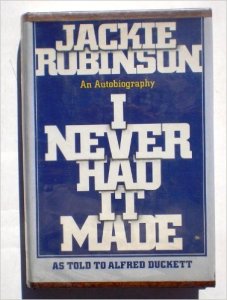
What does Jackie Robinson's autobiography have to do with Colin Kaepernick, you ask? Well...nothing at all, really.

What does Jackie Robinson’s autobiography have to do with Colin Kaepernick, you ask? Well…nothing at all, really.

It also represents a rationalization for unethical conduct that is not currently represented on the Ethics Alarms Rationalization List.

Someone sent Craig this quote, from Jackie Robinson’s  autobiography,  as baseball’s color-line breaker thought back to the first game of the 1947 World Series:

“There I was, the black grandson of a slave, the son of a black sharecropper, part of a historic occasion, a symbolic hero to my people. The air was sparkling. The sunlight was warm. The band struck up the national anthem. The flag billowed in the wind. It should have been a glorious moment for me as the stirring words of the national anthem poured from the stands. Perhaps, it was, but then again, perhaps, the anthem could be called the theme song for a drama called The Noble Experiment. Today, as I look back on that opening game of my first world series, I must tell you that it was Mr. Rickey’s drama and that I was only a principal actor. As I write this twenty years later, I cannot stand and sing the anthem. I cannot salute the flag; I know that I am a black man in a white world. In 1972, in 1947, at my birth in 1919, I know that I never had it made.”

This naturally made Craig, whose mind sometimes cannot help itself from shifting into progressive cant autopilot, think about Colin Kaepernick’s incoherent grandsitting as he refuses to stand on the field with his team for the National Anthem. He wrote,

“Colin Kaepernick is not Jackie Robinson and America in 2016 is not the same as America in 1919, 1947 or 1972. But it does not take one of Jackie Robinson’s stature or experience to see and take issue with injustice and inequality which manifestly still exists…the First Amendment gives us just as much right to criticize Kaepernick as it gives him a right to protest in the manner in which he chooses. But if and when we do, we should not consider his case in a vacuum or criticize him as some singular or radical actor. Because some other people — people who have been elevated to a level which has largely immunized them from criticism — felt and feel the same way he does. It’s worth asking yourself, if you take issue, whether you take issue with the message or the messenger and why. Such inquiries might complicate one’s feelings on the matter, but they’re quite illuminative as well.”

Let’s begin with the fact that there is nothing similar about Jackie Robinson and the 49ers quarterback, except their race and the broad occupation of “sports” that they shared. Continue reading

Health And Survival Rationing Ethics

cointoss

Beginning in 2012, Dr. Lee Daugherty Biddison, a critical care physician at Johns Hopkins and some colleagues have held public forums around Maryland to solicit the public’s opinions about how life-saving medical assistance should be distributed when there are too many desperately ill patients and not enough resources. The exercise was part of the preparation  for Biddenson’s participation in preparing official recommendations for state agencies that  might end up  as national guidelines regarding when doctors should remove one patient from a ventilator to save another who might have a better chance of surviving, or whether the young should have priority over the old.

Ethically, this is pure ends justifying the means stuff. The Golden Rule is useless—How would you like to be treated? I’d want to be left on the ventilator, of course!–and Kantian ethics break down, since Immanuel forbade using human life to achieve even the best objectives…like saving a human life. Such trade-offs of life for life (or lives) is the realm of utilitarianism, and an especially brutal variety….so brutal that I doubt that it is ethics at all.

When Dr. Biddenson justifies his public forums by saying that he wants to include current societal values in his life-for-a-life calculations, she is really seeking current biases, because that’s all they are. On the Titanic, it was women and children first, not because it made societal sense to allow some of the most productive and vibrant minds alive to drown simply because they had a Y chromosome, but because that’s just the way it was. Old women and sick children got on lifeboats;  young men, like emerging mystery writer Jacque Futrelle (and brilliant young artist Leonardo DiCaprio), went down with the ship. That’s not utilitarianism. That’s sentimentalism.

The New York Times article mostly demonstrates that human beings are incapable of making ethical guidelines, because Kant was right: when you start trading one life for another, it’s inherently unethical, even if you have no choice but to do it. Does it make societal sense to take away Stephen Hawking’s ventilator to help a drug-addicted, habitual criminal survive? Well, should violating drug laws sentence a kid to death? TILT! There are no ethical answers, just biased decisions. Continue reading

From The Ethics Alarms Mail Bag: “Does It Matter If A Lawyer Is A Neo-Nazi?”

"Anyone who would hire this lawyer is evil! EVIL!!!"

“Anyone who would hire this lawyer is evil! EVIL!!!”

“…What if he’s hired for a government job?”

This is a great question, and I’m going to bedevil the lawyers in my upcoming ethics seminars with it. It’s not a hard question, though.

The answer is, “No, it doesn’t matter, just as it doesn’t matter if the lawyer is a Republican, a vegan, a libertarian, a creationist, a global warming denier, an Adam Sandler fan, a Donald Trump loyalist, a Muslim, an ISIS sympathizer, a Druid, a Celine Dion worshiper, a New York Yankee fan or anything else. Lawyers have First Amendment rights. Lawyers can think what they want to, believe what they want to, donate where they want to and spout whatever unpopular or offensive opinions they want to, as long as it doesn’t interfere with their representation of their clients.

What prompted the question was this post on the Southern Poverty Law Center (SPLC) website, which attempts to use guilt by association and classic McCarthyism tactics to smear the City of Baltimore because of what the lawyer defending it in a law suit believes. The SPLC—which itself often resembles a hate group–writes, Continue reading

Was It Ethical For Donald Trump’s Former Lawyer To Trash Him In The Huffington Post?

Backstabbed

That’s an easy question.

The answer is maybe, and no.

A couple of weeks ago, a real estate lawyer named Thomas M. Wells provoked a lively debate in the legal ethics community when he authored a Huffington Post piece titled “Donald Trump Hired Me As An Attorney. Please Don’t Support Him For President.” I’m proud to say that I flagged the issue for my colleagues first, in part because they unanimously detest Trump, even the tiny minority who aren’t full-blooded Democrats or progressives, and may have been blinded by that bias.

For me, the issue was crystallized by the headline. Wells’ headline (it doesn’t matter if it was really his or the site’s: as a lawyer, he is obligated to make sure that his article doesn’t breach legal ethics rules and principles, and the headline is part of his article) suggested that he had some special knowledge and authority regarding Trump because of what he had learned while representing him decades ago. The ethics rules prohibit lawyers from revealing client confidences, which are usually defined as what a lawyer learns about a client during the course of a representation that the client would not obviously want revealed to the world. Confidences can be revealed by actions, as well as words, and the headline comes very, very close to saying “I know things you don’t about Donald Trump because of what learned when I was his trusted lawyer.” What follows from that may be  a reader’s conclusion that the post reflects secret information. Thus the headline made my legal ethics alarms sound.

Wells has the same right as you or I to register a public opinion about his former (or current, for that matter ) client, as long as the opinion doesn’t interfere with his representation. Lawyers do not give up free speech right by being lawyers. That’s where the “maybe” comes from. There is strong disagreement in the profession about whether the answer to “Is this unethical?” should be an outright yes. The status of loyalty among the legal ethics values hierarchy is as hotly contested now as it ever has been. If a lawyer wants to attack a former client in a matter unrelated to the representation and no confidences are revealed in the process, is that a legal ethics breach? If it is, it would be a very tough one to prosecute. I think it’s a general ethics breach, as in wrong and unprofessional. It is disloyal, and clients should be able to trust their lawyers not to come back years later, after a client let the lawyer see all of his or her warts, and say, “This guy’s an asshole.” It undermines the strength of the public’s trust in the profession. Continue reading