It has been a hugely informative and entertaining knockdown, drag-out comment battle over vaccine hesitancy the last few days on not just one but two posts on the topic. It’s time to add another. One irony of long comment threads, which make me happy as a blog proprietor, is that many readers don’t have the patience to pick through them. I’m sometimes guilty of that myself.
First, I want to take exception to conflating hesitancy to take the COVID-19 vaccines and anti-vaxxers. There’s a huge difference between being skeptical about one particular vaccine and being skeptical about all vaccines. And conflating the two blurs the issues and dismisses out of hand legitimate arguments and concerns.
I stand in an odd position, because I oppose getting any of the COVID-19 vaccines, and I have been vaccinated. I took the double doses of the Moderna vaccine when it became available at my workplace. Was it to protect my family (my wife is pregnant with our fourth)? Not at all. We’re all healthy, and the odds of the coronavirus having any effect other than a harsh cold for my household is surprisingly small. Was it because my workplace pressured me into it? No, though I will cite that the 14 days paid sick time goes away if I snag a sufficiently large batch of SARS-CoV-2 and I’m not vaccinated.
So why did I get the vaccine? At the time, I believed it the right thing to do to help the efforts of reaching herd immunity. So what has changed since then? Let’s consider my thinking, meandering as it is.
My wife and boss, Grace, emailed me this morning with a list of major events that occurred on August 9th, remarking, “NOW THIS WAS AN INTERESTING DAY IN HISTORY !” Indeed it was: this is a major marker of ethically provocative events, each worth not just a post, but a debate, a book, and museum:
Richard Nixon’s resignation as the 37th President of the United States took place at noon on August 9, 1974, avoiding the personals shame and the national trauma of an impeachment and trial, back when an impeachment was still an impeachment (and not, as the Democrats recently transformed it, a purely partisan device to demonstrate hatred of the elected President). This put an unelected President into office, Gerald Ford, who soon after taking office announced that he was pardoning the man who appointed. This act forever defined Ford’s brief Presidency, and was either a courageous act of political sacrifice on his part, or part of a corrupt scheme to allow Nixon to escape criminal prosecution. (I believe the former description is the correct one.)
On 2014, a black teen, Michael Brown, was shot to death in Ferguson, Missouri, by a white police officer. The episode launched an ongoing Ethics Train Wreck that is still stopping for passengers and causing great destruction to this day.
It was on August 9, 1969, that members of Charles Manson’s “family” murdered five people in movie director Roman Polanski’s Beverly Hills, California, home, including Polanski’s pregnant wife, actress Sharon Tate. Less than two days later, the cult members killed again, murdering Leno LaBianca and his wife Rosemary in their home. The murders finally ended the myth of the “peace and love” Sixties while casting a shadow over the lives of many not butchered that night, from the Beach Boys to Doris Day to Hollywood, especially perhaps Polanski, who eventually became a living Ethics Train Wreck himself.
Speaking of the hippies, Henry David Thoreau’s “Walden, or, A Life in the Woods” was published on August 9, 1854 and became a staple in the intellectual arsenal of those advocating “dropping out” of society. “Dropping out” of society is unethical.
August 9, 2010 was the day that JetBlue flight attendant Steven Slater actually attracted praise for his “fuck you” exit from his job as a Jet Blue flight attendant. Not from Ethics Alarms, though…
And speaking of metaphorical “funk you’s,” on this day in 1936, African American track star Jesse Owens won his fourth gold medal of the Berlin Olympics in the 4×100-meter relay, thus foiling and infuriating Nazi leader Adolf Hitler plan to use the Games for “master race” propaganda.
Finally, though it should probably by first, it was on August 9, 1945, that the U.S. dropped a second atom bomb on the citizens of Japan, at Nagasaki, finally speeding Japan’s unconditional surrender. If the decision to drop the first atom bomb is controversial, the ethics controversy over the second is even more contentious.
1. Oh, let’s start with another Wuhan vaccination matter, this one from the Ethicist, who was asked,
My elderly mother is in an independent-living facility where all the residents have been vaccinated …Protocols are very strict, and no resident has gotten sick. [A] relative who lives nearby… is not vaccinated. This facility will soon mandate that all visitors be vaccinated, but my relative plans to dissemble in order to evade the requirement. Should I … tell the facility that my relative is not vaccinated?
Does she really have to get expert advice to figure this out? Continue reading →
…the policy would be that every member of the cast, staff and crew would have to be vaccinated and show proof of it. They would, of course, be free to refuse, which is their right. But they still would have no right to work on the production, and to endanger the health of others essential to the show’s success. You can’t rehearse with social distancing, nor with actors wearing masks.
I’ve seen viruses run amuck through casts and ruin shows. Your rights stop when they start adversely and unnecessarily affecting my business and projects. Take your own risks and good fortune to you, but don’t impose them on me.
(Incidentally, I would never produce or direct the show you see above. I consider it unethical to put shows on stage that I can’t stand watching and listening to myself.)
I hate to inflict that song on you (the singer/composer was the late Jess Cain, once the most popular disc jockey in Boston) but I have limited options. The 2021 Red Sox, who were sailing all season to what looked like a certain play-off slot , are suddenly in freefall, with the hitters not hitting and the pitchers not pitching. They face a double-header today, and a double loss would be disastrous. After the 1967 Red Sox “Impossible Dream” season, the best summer of my life, when a team of virtual kids won the closest pennant race in baseball history by a single game after finishing in a tie for last place the year before, WHDH, which then carried Boston’s games, put out the cheesy but wonderful commemorative album above, containing clips from broadcasts of the most memorable games and Cain’s song, tied together by Sox play-by-play announcer Ken Coleman reciting one of the worst pieces of doggerel ever heard by human ears. At one point, Ken recounted a desperate point in the team’s underdog quest, and, having set up the rhyme with “zero,’ intoned, “We have to have a hero.” Cue the Yaz song!
I’ve been thinking about the need for a hero, indeed more than one, quite a bit lately, in matters more consequential than the Red Sox season (well, for normal people anyway.) The Sox sure need one today. If he shows up, maybe it will be an omen…
Incidentally, Yaz deserved the song. Modern metrics show that his Triple Crown, Gold Glove, MVP 1967 season was the second best of all time. (Babe Ruth had #1, naturally.) Anyone who followed that 1967 season knew it before the numbers were crunched.
1. More free speech threats in the Biden Era, but Donald Trump was a threat to democracy…The Baltimore Symphony fired Emily Skala, 59, the orchestra’s principal flutist for more than three decades, because she shared social media posts expressing doubt on the efficacy of vaccines and facemasks. Fellow musicians, audience members and donors complained, so it was bye-bye Emily. Skala, no weenie she, will challenge her dismissal, and accuses the orchestra of creating a hostile environment where she was being attacked for expressing unpopular views. I’d say that is likely. Musicians as a group are about as progressive and open to conservative views as college professors.
Skala angered many of her colleagues for sharing posts questioning the results of the 2020 presidential election—Oooh, can’t have that! She was also criticized for saying that black families needed to do more to support their children’s classical music studies. Wow, this woman is a veritable Nazi! Amusingly, the New York Times cites as among the examples of social media “disinformation” that got her fired were “false theories suggesting that the coronavirus was created in a laboratory in North Carolina” and posts “raising concerns about the safety of vaccines.”
That’s funny: it wasn’t too long ago that suggesting that the virus originated in a Wuhan lab was considered disinformation. And didn’t Joe Biden and other prominent Democrats raise “concerns” about any vaccine produced under the Trump Administration?
I’m just spitballing here, but if only we had some heroic organization that defended free speech, regardless of what side of the political spectrum it came from. It could call itself…let’s see…the National Civil Liberty Protection Alliance, or something like that…
2. Believe it or not, this Russian lawsuit isn’t frivolous, just mind-meltingly stupid. Thanks to Curmie for passing along the saga of Ksenia Ovchinnikova, an Orthodox Christian in Omsk, Russia, who is suing McDonald’s on the theory that its ads made burgers seem so yummy and irresistible that they made her break her fast for Lent in 2019 after years of successfully avoiding meat. She wants 1,000 rubles ($14) as damages for “sustained moral damage.”
The reason this isn’t frivolous (at least not in the US) is because a lawsuit clears the bar if it seeks a new interpretation of existing law, no matter how wacky. Of course, a heroic lawyer would tell the woman, no matter what she offered to pay, “You’re out of your mind, and I’d rather eat my foot than disgrace my profession by taking such a ridiculous case. By the way, would you like this corndog?” Continue reading →
Wow, the ethics train wrecks that pulled out of the station on this date: Irag invading Kuwait in 1990, the conclusion of the disastrous Potsdam Conference in 1945, and the ascension of Adolf Hitler to dictator of Germany in 1934! Maybe we should just skip August 2 on the calendar like some buildings have no 13th floor…
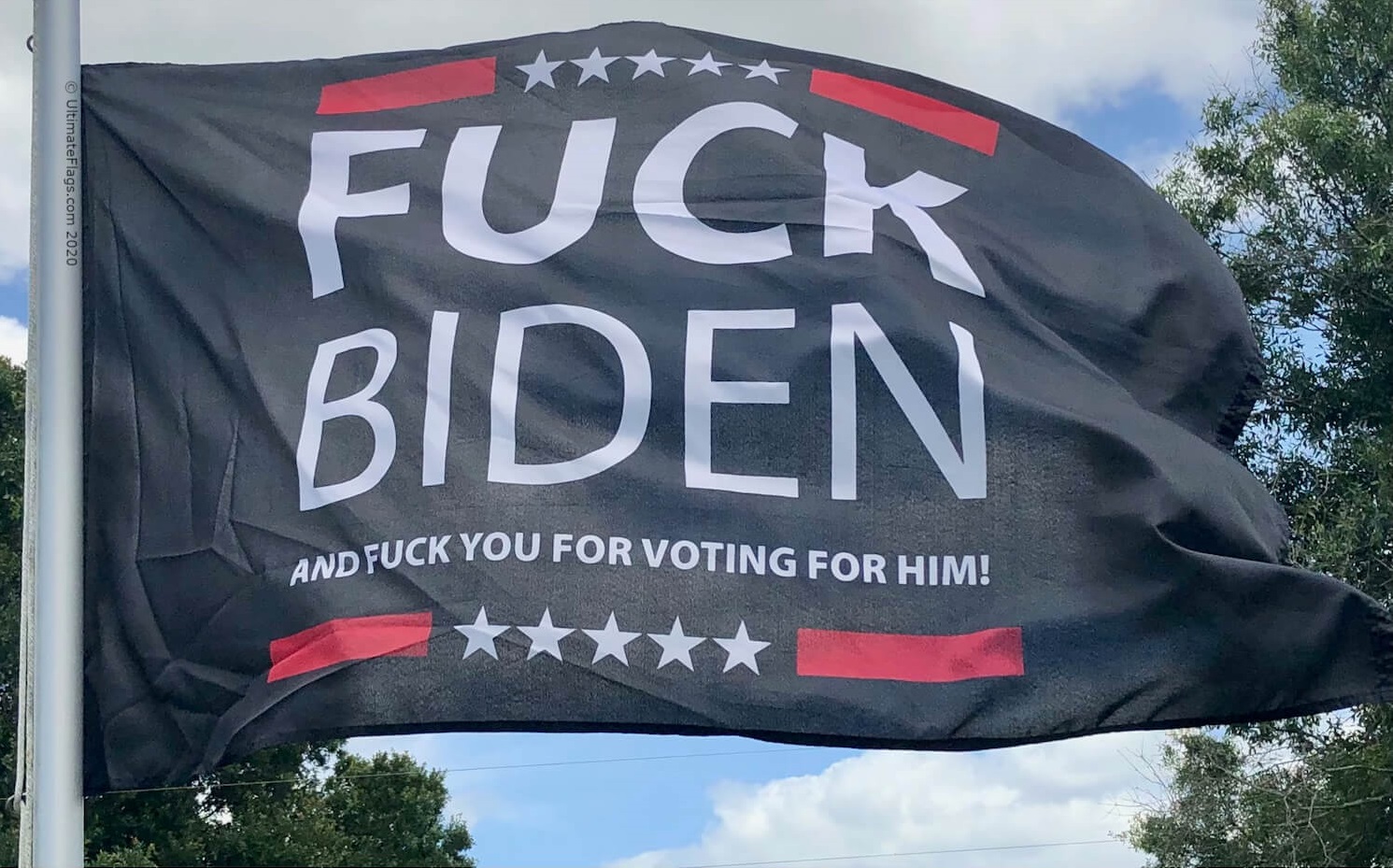
1. This is good news, sort of…The American Civil Liberties Union of New Jersey announced that the obscenity charges against Andrea Dick for refusing to take down her “Fuck Biden” banners had been withdrawn by the town of Roselle Park, New Jersey. A municipal court judge had ordered Dick to take down the three flags, finding that they violated the town’s obscenity ordinance, which was ridiculous: the ordinance defines obscenity as anything that “appeals to the prurient interest; depicts or describes in a patently offensive way sexual conduct as hereinafter specifically defined, or depicts or exhibits offensive nakedness as hereinafter specifically defined; and lacks serious literary, artistic, political or scientific value.” Dick was not calling for a gang rape of Joe Biden. Moreover, his ruling was in direct opposition to the Supreme Court’s landmark 1971 ruling in Cohen v. California. We discussed the case here.
I say “sort of” from a Golden Rule perspective. I sure wouldn’t want her as a neighbor. This is squarely in the “right to be an unethical jerk” category. But the government tried to intimidate her out exercising her right to free speech, and whatever else she is, Dick is not a weenie.
She should give lessons.
2. Today’s American Olympics narcissists: Raven Saunders and Race Imboden. Even though they were directed by the nation they represent not to make political theater out award ceremonies in Tokyo, Saunders, a silver medal winner in the women’s shot put, and Imboden, a bronze winner in foil, went ahead with obnoxious grandstanding anyway. Imboden, who is a serial offender, had a symbol marked on his hand, while Saunders treated fans to this attractive display:
They were protesting injustice or something, as if anyone cares or should care what they think. It’s not their stage to abuse. Apparently there is a big debate over what the U.S. officials and Olympics authorities should do. Easy: send them home, take their medals, and ban them from representing the U.S. again. They were warned.
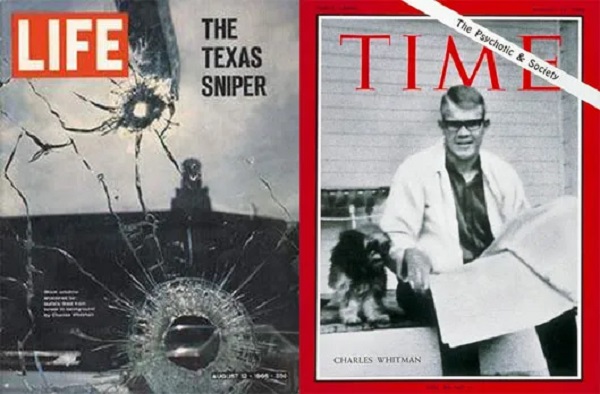
I don’t think that we need to debate the ethics of deranged mass shootings. The first one I was ever aware of occurred on this date in 1966. Charles Whitman, a former Eagle Scout and Marine, brought a stockpile of guns and ammunition to the observatory platform atop a 300-foot tower at the University of Texas. He had packed food and other supplies, and before settling in for 90 minutes of deadly target practice, killing some victims from as far away as 500 yards—he was a trained marksman—Whitman killed the tower receptionist and two tourists. He eventually shot 46 people, killing 14 and wounding 32 before being killed by police. The night before, on July 31, Whitman wrote a note saying, “After my death, I wish an autopsy on me be performed to see if there’s any mental disorders.” Whitman then went to his mother’s home to murder her, using a knife and a gun. He returned home to stab his wife to death.
Whitman’s story does raise medical ethics issues. He was seeing a psychiatrist, and in March told him that he was having uncontrollable fits of anger. Whitman apparently even said that he was thinking about going up to the tower with a rifle and shooting people. “Well, your hour is up, Mr. Whitman. Same time next week, then?” The intersection of mental illness with individual rights continues to be an unresolved ethics conflict 54 years later.In addition, the rare but media-hyped phenomenon of mass shootings has become a serious threat to the right of sane and responsible Americans to own firearms. See #5 below.
1. The King’s Pass in show business. A new book by James Lapine tells the antic story of how the Sondheim musical “Sunday in the Park With George” came to be a Broadway legend. Lapine wrote the book and directed the show. The cult musical—actually all Sondheim shows are cult musicals–eventually won a Pulitzer Prize ( you know, like the “1619 Project”) and bunch of Tony nominations. I was amazed to read that the show’s star, Mandy Patinkin, at one point walked out on the production and was barely persuaded to return. Lapine writes that he never fully trusted Patinkin again. Why does anyone trust him? In fact, how does he still have a career? Patinkin has made a habit of bailing on projects that depended on him. He quit “Chicago Hope,” and later abandoned “Criminal Minds,” which had him as its lead. To answer my own question, he still has a career because of “TheKing’s Pass,” Rationalization #11. He’s a unique talent, unusually versatile, and producers and directors give him tolerance that lesser actors would never receive. Mandy knows it, too, and so he kept indulging himself, throwing tantrums and breaking commitments, for decades. He appears to have mellowed a bit in his golden years.
2. Speaking of Broadway, the ethical value missed here is “competence”…There is more evidence that the theater community doesn’t realize the existential peril live theater is in (the medium has been on the endangered list for decades) as it copes with the cultural and financial wreckage from the Wuhan Virus Ethics Train Wreck. Just as theaters are re-opening, the Broadway theater owners have decreed that audience members will be required to wear masks at all times.
I have one word for that: “Bye!” Maybe some fools are rich, submissive and tolerant enough to pay $100 bucks or more for the privilege of being uncomfortable for three hours. Not me. My glasses fog up when I wear masks. I have been vaccinated; I’m fairly sure I was exposed to the virus before then and had minimal symptoms, and much as I believe in live theater, I will not indulge the politically-motivated dictatorship of virtue-signalling pandemic hysterics. The industry is cutting its own throat, but then theater has never been brimming with logic or common sense.
Warning: reading this story is likely to make you feel hopeless. For this is what the hyper-racialization and resulting division of American society breeds, and it can only go in one direction from here. Hint: it will not be a direction that will lead anywhere good.
A brief summary:
In Windsor, Connecticut—I once spent a summer there!—Amazon contracted to have a warehouse built, with the promise of jobs and economic revitalization.
Over the past three months, workers building the Amazon warehouse claimed to have found nooses, or ropes that looked like nooses, or “noose-like” ropes at the construction site.
Protests have been organized by activists who have never seen the alleged nooses. Demands are being made for police to find and charge the noosemakers. The presence of the nooses, if they are nooses, is being called a “hate crime” by the local NAACP.
Local community activists have organized several demonstrations to demand that Amazon take stronger action to ensure the safety of Black construction workers. One such demonstration included members from the Huey P. Newton Gun Club and the New Black Panthers, who showed up at the construction site carrying guns. The armed activists said they were there to defend the Black workers and make them feel empowered to speak their mind.
Amazon and the other companies involved claim they have done everything they can. They have delayed construction twice, adding security (to protect workers from the nooses, apparently) and cameras at the site and putting up $100,000 in award money for anyone who can provide information about the nooses.
The police say their investigation has determined that there were only two nooses, with six others being ropes with the kind of loop often used in construction projects.
I will state up front that I am confident that this decision will get to the U.S. Supreme Court, and that if and when it does, it will be reversed.
The 10th U.S. Circuit Court of Appeals at Denver ruled 2-1 that website designer Lorie Smith and her company, 303 Creative, violated a Colorado law by refusing to create a website celebrating a same sex union. She was represented by Alliance Defending Freedom, a conservative Christian nonprofit, who also represented Christian baker Jack Phillips, who refused to bake a cake for a same-sex wedding. There is a material difference, however, between a cake and a website. A cake is not generally thought of as expression, and there is a colorable argument that a bakery is a public accommodation. But Smith, whose company designs wedding websites, argues that forcing her to make one that supports a same-sex marriage violates her religious beliefs. It isn’t frosting and cake shades at issue, it’s words.
A Colorado public accommodation law bars public accommodations from refusing to provide equal access to services because of sexual orientation. The law’s communication clause also says public accommodations cannot publish any communication indicating that full access to services will not be provided because of sexual orientation. The appeals court majority decreed that neither provision violates Smith’s free speech and free exercise rights under the First Amendment, even though it acknowledged that Smith’s websites are pure speech that involve her unique creative talents. But, the Court claims, indulging in an “it isn’t what it is” rationalization, Colorado “has a compelling interest in protecting both the dignity interests of members of marginalized groups and their material interests in accessing the commercial marketplace…We agree with the dissent that a diversity of faiths and religious exercise, including appellants’, ‘enriches’ our society…Yet a faith that enriches society in one way might also damage society in other ways, particularly when that faith would exclude others from unique goods or services.”
This opinion is way, way over the traditional judicially-drawn line between compelling public accommodations to be equally accessible to all and compelling artistic expression. Under this theory, a singer who performs at weddings would have to warble at a same-sex ceremony, even if her faith held that such a ceremony was a sin.
I’ll be uncharacteristically brief: I think she is.
As I stated in the previous post, her conduct was unethical. She was uncivil and disrespectful to her neighbors. Posting “Fuck Biden” signs is protected speech, but it is still unethical speech. She isn’t doing any good by posting such rhetoric. She setting out to annoy and irritate people, while being verbally assault to her nation’s leader. She has no defense, other than the claim that she has a right to be an asshole. And indeed she has.
However, now that the government is attempting to abridge her rights of free expression and speech, and using an inapplicable obscenity ordinance to do it, she has a patriotic, legal and ethical duty to oppose the efforts to silence her even though she should have shut up in the first place.
Ironically, although her signs and banners represent unethical behavior, she has created an obligation for herself to stand behind them. This will take courage and resources, but it appears that she will not be intimidated. Good. Her abuses of free speech must be protected lest free speech itself be diminished.
Andrea may be an asshole, but she is not a weenie, like so, so many Americans of far greater power and influence than she who have been intimidated into apologizing and retracting their political or social views. We have little to fear from assholes. America was built by assholes—stubborn, ornery iconoclasts who marched to their own drummers and didn’t care who liked it. Weenies, however, are an existential threat. Weenies strip away our rights by being too timid to fight for their own.
Andrea Dick is now an Ethics Hero. After she wins, she can prove she’s not an asshole by taking down her “Fuck Biden” signs because she decides to, and not because the government demands it.
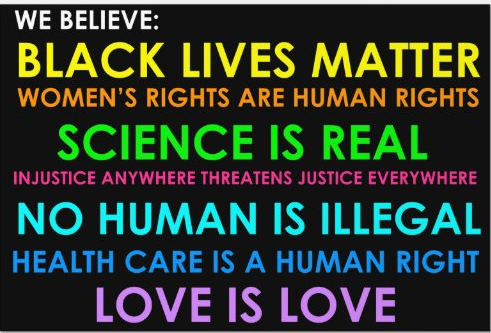
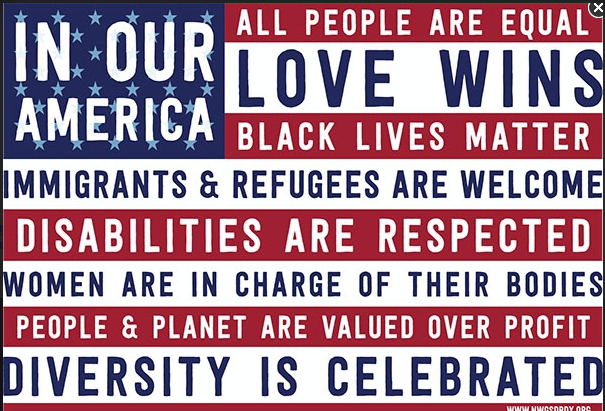
I was just thinking of neighbors like Andrea Dick yesterday, after I walked my politically tolerant dog Spuds past the many obnoxious lawn signs that have proliferated in my little corner of Alexandria, Virginia. There is, of course, the large, hand painted wooden sign reading “Black Lives Matter” that is festooned with rainbow flags and a full size suit of armor for some reason. That’s been an eyesore for more than a year. Then there are the moronic “End Racism” virtue-signaling signs—“End Stupidity” would be equally effective—and that list of facile progressive nostrums, including “No human is illegal.” You know, this one:
Well aren’t you wonderful! There is also that oldie but goodie, “Dissent is Patriotic,” whatever that means. There are several versions of this one…
All of them are the equivalent of the homeowner standing on his or her front lawn and preaching through a megaphone, and in the cases of the homes that post signs like this one…
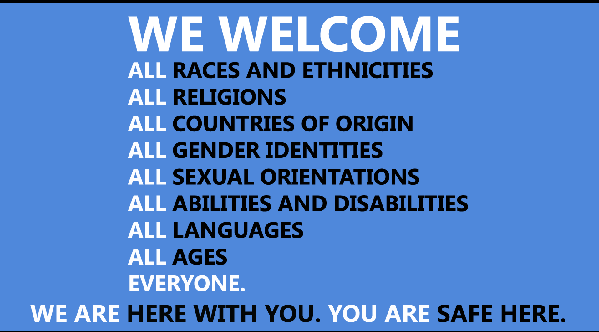
…the implication is that all the other houses nearby are full of greedy, racist bigots. All the signs offend me. The entire practice of using one’s property to preach, proselytize or politic is offensive. Yes, it’s protected speech, and using speech like that is abusing the right.
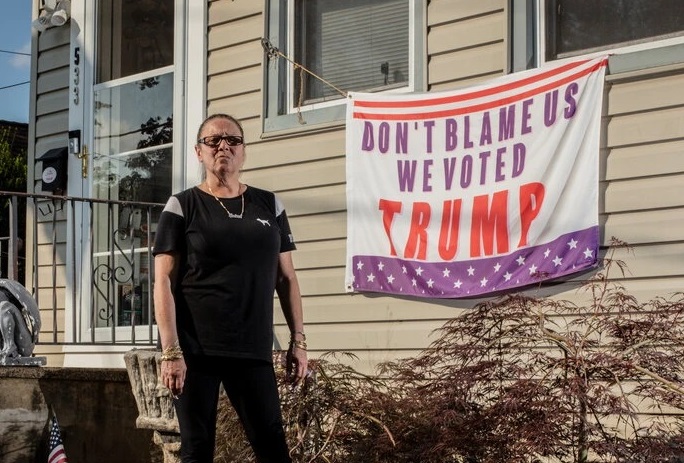
Andrea Dick is an angry supporter of former President Donald J. Trump and detests President Biden, so she has banners and signs expressing these view on her New Jersey house and lawn, including “Don’t Blame Me/I Voted for Trump” and several banners and signs with the message in the graphic under the post’s title. These are also ugly and offensive, but no more so than the virtue-signaling blather I have to see every day.
But her neighbors complained, so local officials first asked her to take down several of the banners that they said violated an anti-obscenity ordinance. She refused, and now she is resisting a judge’s order that she do so or face $250 fines every day the “Fuck Biden” banners and signs remain. Andrea Dick is pledging to fight it in court on free speech grounds.
“It’s my First Amendment right,” she said in an interview on Monday, “and I’m going to stick with that.”




 Ethics Alarms