The Worst Humanitarian Award Winner of the Year

Michael Brown---wife-beater, humanitarian.

Michael Brown founded Houston’s Brown Hand Center, which specializes in the treatment of carpal tunnel syndrome. He is now on trial for assault, after being arrested last year for attacking his his wife, twisting her arm behind her back and, among other things, hurling his 2010 Joanne King Herring Humanitarian Award at her.

I have often thought that those who give out humanitarian awards for specific instances of good conduct have an ethical obligation to make sure that recipients conform to the definition of “humanitarian” in their overall conduct. One of the definitions of humanitarian is “ethical.” Official pronouncements that an individual is ethical can be very effective false advertising for the character of someone who is anything but. Mr. Brown illustrates my concerns.

By 2010, when Brown received his award, he had already pleaded no-contest in 2002 to aggravated assault for beating then-pregnant wife, Darlina Brown, with a bed post. Call me a stickler, but I think there should be an automatic “Beating a pregnant woman with bedpost” disqualification provision for humanitarian awards. Then, in 2006, Dr. Brown’s medical license was revoked after he tested positive for cocaine use. So to summarize, at the time he was deemed worthy of the honor of being the 2010 humanitarian of the year, Brown was already an admitted wife-beater and an ex-doctor found unfit for the continued practice of medicine.

What a guy!

How about a rule that if you try to kill someone with your humanitarian award, it is automatically revoked?

Too strict?

 

The Tragedy of Monica Lewinsky

At 21, Monica Lewinsky was charmed into an illicit sexual relationship by the President of the United States, a master charmer with a long record of similar dalliances. There are millions of extra-marital affairs in the U.S., but one involving the most powerful man in the country was certain to be at the center of historic media attention. Bill Clinton knew it, and he understood the risks. Monica Lewinsky did not and could not, and it was her life that was thrown tragically, permanently, off its tracks. Continue reading

The Ethicist, the Farkel Family, and the Perils of “Maybe”

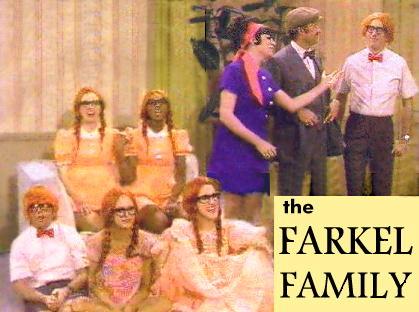
This photo is completely relevant to this post, but if you are under 50, you probably haven't a clue why. Pity. See below for an explanation.*

One of the reasons I started the Ethics Scoreboard, and continued with Ethics Alarms, was my frustration with the ethics profession’s reluctance to render useful opinions on complex ethical problems…unless, of course, the ethicist was being paid for them. Instead, ethicists are prone to issue obtuse and jargon-filled discussions allowing for every possible eventuality and interpretation, usually concluding with vague, equivocal pablum that allows the ethicist to avoid criticism and accountability. The result of this craven preference for “maybe” as the answer to every dilemma is that ethics are rarely included in public discourse or media coverage, as it solidifies its reputation for being technical, ambiguous, and pointless.

A perfect example of the reticence to make a clear choice occurs in this week’s installment of “The Ethicist,” the New York Times Magazine’s ethics column. An understandably anonymous inquirer writes that he unknowingly fathered a child with a married woman in his neighborhood, who raised the child as the offspring of her and her husband.  The mother asked the biological dad to have no contact with the girl, and he has complied. Now he asks, “Does she have a right to know her true parentage upon reaching adulthood? Sooner? Over the objection of the mother? Only when the husband dies? Who can make these decisions and when?” Continue reading

Ethics Bulletin: Payback Is Not Always Unethical

"Sure, honey, take all the photos you want. And if your girlfriend wants to see the birth of our daughter, she's welcome too!"

Washington Post advice columnist Carolyn Hax, as I have noted before, has an almost pitch-perfect ethical sense, and negotiates difficult relationship dilemmas with consistent skill and wisdom. She is too nice sometimes, however, and her recent advice to an expectant mother is a striking example.

The woman wrote Hax about how to handle the request of her AWOL husband, who left her mid-pregnancy to move in with his mistress, to witness the birth of his daughter. He also wants his family to be present. The mother-to-be said that she fully intends to allow her child to have a good relationship with her father, but she does not want either her weasel husband or his family, which hid his affair from her, around when the baby comes. “I don’t want any of them there,” Expectant Mom writes. “Many of them knew about the girlfriend but kept it from me, and I don’t want my husband to have the satisfaction of comforting me when I’m in pain. Do I have the right to tell them this, in some collected, nonconfrontational way?” Continue reading

The Tricky Ethics of Trading Sex For Tuition


It's not generally known, but Anna Nicole Smith initially hooked up with billionaire husband J. Herbert Marshall so he could pay her tuition at MIT.*

Seekingarrangement.com is undoubtedly an unethical website. The question is how unethical, and that is why I’ve taken longer than usual to write about it, and the social phenomenon it and other websites are fostering.

The site is per se unethical because it facilitates adultery, infidelity and improper workplace conduct, by definition and unequivocally, convicted by its own words:

“Rich and successful. Single or married, you have no time for games. You are looking to mentor or spoil someone special — perhaps a “personal secretary”? secret lover? student? or a mistress for an extra-marital affair?”

Based on this alone, Seekingarrangement.com is Ashley Madison (the adultery website) all over again. Case closed, no appeal. A website is unethical when it endorses, encourages, and assists in dishonest conduct that is guaranteed to cause harm to third parties. The “consenting adults” argument doesn’t work, and doesn’t apply, when the adults are consenting to something that violates commitments, agreements and promises made to other parties who don’t have the option of consenting.

Seekingarrangement.com, however, became the topic of much debate this month for another reason: its use by desperate students, aspiring students or indebted graduates to pay their college tuition. In this it is like the more specialized Seektuition.com, which is solely devoted to matching horny, rich, developmentally retarded and presumably repulsive older men who can’t find real relationships to hot, poor, young women willing to exchange their bodies and dignity to  “help sponsor” their “ dorm rent, books, or provide assistance for tuition.” (“Perhaps even take you shopping for those new clothes you want to impress your sorority sisters!”). The Huntington Post broke the story, telling the tales of both students who “hook up” with wealthy, older men over the internet using Seekingarrangement.com and similar sites, have sex with them, and get tuition money or tuition loan repayment funds in return, while the wealthy men gladly pay big bucks to have an evening of passion with a co-ed and some Viagra. Continue reading

Now THIS is Sexual Harassment!

The Arizona Supreme Court has both censured  former municipal court judge Theodore “Ted” Abrams, prohibiting him from serving as a judge again, and disciplined him as an attorney, suspending his law license for two years. Why, you may well ask?

Well, it seems that before he resigned as a judge there was  a bit of a woman problem: if an attractive woman appeared before Abrams as an attorney, she had a problem.

The State Bar of Arizona determined that Abrams, while serving as a judge, “engaged in a prolonged and relentless effort to sexually harass a female assistant public defender who appeared in his court,” as well as, “in a gross misuse of his power, … inflict[ing] his retribution from the bench for the victim’s refusal to yield to his pursuit.”  Over a 14-month period, Abrams sent the woman at least 28 voice mails and 85 text messages, many of which were sexually overt, including one in which he described a sex act he wanted to perform on her. He repeatedly pressured the lawyer for sex, made slurping noises—I’m pretty sure there is something in the judicial code of conduct that prohibits that-– and once fondled her buttocks. Continue reading

Another Sexting Pol: Drawing the Lines

"ARRGH! I didn't consent to THAT!"

From today’s  New York Daily News:

“Garden State Democrat Louis Magazzu announced his resignation Tuesday after nude pictures he sent to a woman he had been corresponding with were posted on a Republican activist’s website. At least two of the photos showed the Cumberland County freeholder’s crotch, two showed him dressed to the nines in a suit, and a fifth showed him waist up without a shirt.

Comments and observations:

  • Magazzu didn’t have to resign, but it was right for him to do so. Sexting is a problem among high school students, and it doesn’t help to have elected representatives indulging in it. He was humiliated by publication of the photos, and because the humiliation extended to his constituents and his party, resigning quickly was an appropriate, honorable, courageous thing to do—as it would have been for Bill Clinton, Sen. David Vitter, ex-Sen. Ensign, ex-South Carolina Governor Sanford, and others. He didn’t have to resign, however. Continue reading

Ethics Hero: Ameneh Bahrami

Ameneh Bahrami, now, and then

Ameneh Bahrami, the Iranian woman whom a spurned suitor blinded and hideously disfigured with acid,  had her long-awaited opportunity for both revenge and culturally-sanctioned justice today.  She watched a doctor prepare to put several drops of acid in one of Majid Movahedi’s eyes as his court-ordered punishment for maiming her. Then, at the last moment, she waived her right to have him blinded, as Movahedi, who had repeatedly asked her to marry him before responding to her rejections by throwing acid the young woman’s face, wept in gratitude.

The story of Banrani’s insistence on the full retribution available to her under Islamic law had spurred human rights protests around the globe. In the end, with all of Iran watching on live television, she decided on mercy instead of revenge. Continue reading

Scent Branding, Mind-Control, and Ethics

Agreed: this is scary. We're not there yet. We don't even know if "there" exists.

A recent article on the web that purported to explore the ethics of “scent branding” was fascinating for two reasons.

First, “scent branding” is a term I had never encountered before, for a practice that I had not focused on. About five seconds of thought, however, made me realize that indeed I was aware of the phenomenon, and had been for quite a while. “Scent branding”—using fragrances in a commercial environment to create a desired atmosphere and to prompt positive feelings, recollections and emotions from patrons—has been around a long, long time, though not under that label. When funeral parlors made sure that their premises smelled of flowers rather than formaldehyde, that was a form of scent branding. Progress in the science of scent allowed other businesses to get into the act: I was first conscious of the intentional use of smell when I spent a vacation at the Walt Disney World Polynesian Villages Resort. The lobby and the rooms had a powerful “tropical paradise” scent, a mixture of beach smells, torches and exotic fauna. It was obviously fake, like much in Disney World; also like much in Disney World, I found it effective, pleasant, and fun. I certainly didn’t think of it as unethical. I was normal in those days, however.

Well, more normal.

The second aspect of the article, entitled “Is it Ethical to Scent Brand Public Places?”, that caught my attention was that it had an obvious agenda. The piece was opposed to scent branding, and set out to find the practice unethical in order to justify condemning it. Continue reading

Comment of the Day: “The Provocative T-Shirt Problem”

Rick Jones, whose excellent blog posts on ethics, academia, politics and life can be read here, at Curmudgeon Central, again delivers the Comment of the Day, on my post about the gay couple asked to hide an innocuous T-shirt message while visiting Dollywood.

“It strikes me that attempting to draw clear lines of demarcation in terms of either content or location is inherently fraught with peril. The best determinant may indeed be the Golden Rule. But that inevitably touches on intent. The purpose of a “marriage is so gay” t-shirt isn’t to “get in the face of” opponents of gay marriage; it’s to make a mildly humorous point about an issue without being strident.

“The guy who wore the “I’m a Muslim. Don’t Panic” t-shirt to the Ground Zero celebration after the killing of Osama bin Laden—not terribly clever, but not at all offensive, either.

I wouldn’t be offended by a t-shirt backing a political candidate I’d never support (I might have an indication of whether to engage in conversation with this person as we wait in the queue, but that’s another matter); I would be by a t-shirt defaming that same candidate: comparing him to Hitler, for example. Yes, intent matters. Continue reading