You know when I mentioned that Ted Lieu was NOT the most “foolish, dumb, frightening” member of Congress? Steve King was one of the people I was thinking of.
In case you haven’t heard the widespread mockery, King asked Google’s CEO Sundar Pichai at this week’s House Judiciary Committee hearing about alleged bias and abuse of power by the tech behemoth,
“I have a 7-year old granddaughter who picked up her phone during the election, and she’s playing a little game, the kind of game a kid would play. And up on there pops a picture of her grandfather. And I’m not going to say into the record what kind of language was used around that picture of her grandfather, but I’d ask you: How does that show up on a 7-year old’s iPhone, who’s playing a kid’s game?”
Pichai responded, “Congressman, the iPhone is made by a different company.”
1. They are showing “Perry Mason” reruns again on cable TV. That was the show that made my generation want to be lawyers, under the delusion that a defense attorney could regularly prove a criminal defendant innocent. (Pssst! They are almost all guilty.) The show holds up, but boy, Perry was sleazy. In an episode I watched while I was sick, he had his investigator tell the hapless prosecutor, Hamilton Burger (Ham Burger to his friends) that he had found an incriminating piece of evidence that proved someone other than Perry’s client had committed murder. Ham relied on the information and got the killer to confess once he was faced with the production of the “smoking gun.” But Perry’s investigator hadn’t really found anything.
Having one’s agent lie to the state prosecutor is a serious ethics breach. Perry also caused the DA to tell a falsehood to get the confession, though Burger wasn’t lying, since he believed Perry’s contrivance. Prosecutors are no more allowed to lie than other lawyers, but when they do lie “in the public interest,” they seldom get more than a slap on the wrist from courts and bar ethics committees, if that. Burger didn’t seem very upset that Perry conned him, because the real killer was caught. The ends justifies the means, or did in “Perry Mason.”
2. Ick or ethics? A Chinese scientist claims that he had successfully employed embryonic gene editing to help protect twin baby girls from infection with HIV. We are told that bioethicists in China and elsewhere are reacting with “horror.” Writes the Times,
“Ever since scientists created the powerful gene editing technique Crispr, they have braced apprehensively for the day when it would be used to create a genetically altered human being. Many nations banned such work, fearing it could be misused to alter everything from eye color to I.Q….If human embryos can be routinely edited, many scientists, ethicists and policymakers fear a slippery slope to a future in which babies are genetically engineered for traits — like athletic or intellectual prowess — that have nothing to do with preventing devastating medical conditions.”
As with cloning, my view on this controversy is that a new technology does not become unethical because of how it might be used. That unethical use will be unethical, and that is what needs to be addressed when and if the problem arises. (Airplanes could be used to drop atom bombs!) The fear of “designer babies” also seems to be an example of “ick”—it’s strange and creepy!—being mistaken for unethical. Making stronger, smarter, more talented and healthier human beings is not in itself unethical, even if it is the stuff of science fiction horror novels and Josef Mengele’s dreams. Continue reading →
I can’t tell you how much I hate operating at quarter-steam like this. I have an ethics seminar to get through in two days, so I’m trying to be responsible. Luckily I have to deal with this about once every three years or so.
1. Baseball rejects consequentialism! New York Mets right-hander Jacob deGrom won the National League Cy Young Award after leading the majors in earned run average, meaning that he gave up fewer runs per 9 innings of any pitcher. Indeed, deGrom’s major-league-leading 1.70 ERA was two-thirds of a run lower than the next closest NL hurler, Philadelphia‘s Aaron Nola (2.37), and the second best by any starter this century. Despite his own excellence, his team, the disappointing New York Mets, lost most of his starts, and deGrom only had a 10-9 record for the season. Traditionally the Cy Young honor, meant to designate the best pitcher in each league, has gone to the pitcher who won the most games while not disgracing himself in other categories. With the advent of statistical analysis, however, it has even dawned on the most meat-headed sportswriters that all a pitcher can do is prevent the other team from scoring, and if his team can’t score behind him, it says nothing about his ability at all.
In other words, doing “good” must be judged by what an individual does, not what happens that is beyond his control as he does it or after. Continue reading →
Elizabeth Warren has been allowed to have her embarrassing experience with DNA testing slide back into the memory hole, and Massachusetts voters happily returned the Leftist demagogue to the Senate. Ignoring the character deficiencies of its Senators is a long tradition in my home state. For once, my sloth in not posting Comment of the Day in a timely fashion has paid dividends, for it allows me to raise the Warren fiasco of last month…yes, it was less than a month ago, incredibly—in all of its yummy ethics nastiness.
If all goes well, Elizabeth Warren’s triumphant discovery that she is 99.9% white and therefore was justified in representing herself as a “person of color” for institutional diversity purposes will sink her career aspirations as deep as they deserve to be sunk. The fact that so much of the mainstream media is willing to have their credibility brought down with her is indicative of how stupid bias will make people. The Daily Beast, for example, writes in a headline, “Warren revealed results show Native American heritage Monday.”
Keep it up, guys. Pretty soon the jig will be up for identify politics, since if 1/1,024th Native American means “Native American heritage,” then everyone is “of color” somehow. In that case, perhaps we’ll owe Warren a debt of gratitude….
Now here’s jb….
Warren had an easy out of this mangled story: She should/could have said that she believed her family’s telling of the events and, being originally from Oklahoma, it would be reasonable to believe that she had Native American heritage.* But, she elaborated on the story, to make it more compelling. She also told interviewers her father’s parents did not approve of his choice for a wife because her mother was Cherokee.**
Warren is a lawyer and, supposedly, is very bright. If you’ve watched or listened to CNN and MSNBC for the last four years or so, she is the very embodiment of moral authority over all things . . . erm . . . moral, guided by a passionate desire to help the poor and the middle class.
She knew, and reasonably should have know, that DNA is not determinative of Native American heritage. What matters is being included in the tribes’ relevant hereditary scrolls. In fact, she said that in an interview, so she was aware of the standard and she is aware that she is not so listed. Continue reading →
1. They’re NOT “bombs.” I urge everyone to call their friends on this. Until it is established that in fact the “suspicious packages” (the FBI’s current description) or the “potentially destructive devices” can blow up and that they were intended to blow up, referring to them (as the New York Times has done) as “pipe bombs” and the mysterious asshole who sent them as “the bomber” is misleading and, in many cases, deliberately inflammatory. Cut it out. Nor are the mailed whatevertheyares “attacks.” Nobody has been “attacked” until the intent to harm them has been established, and it hasn’t been.
This is driving me crazy, in case you can’t tell.
The news media obviously wants these to be bombs, wants the sender to be a deranged Trump fan, hell, they’d love it if the sender was Trump himself. So they can’t help themselves, apparently, in jumping the gun and dishonestly reporting what is still very much in doubt. Personally, I would love to have it determined that the perp is a “resistance” member pulling a false flag operation, just to teach the news media a lesson, not that they are capable of learning it.
2. Trump’s Tweets. CNN and MSNBC are melting down with faux fury over this morning’s Trump Tweet, which said,
Funny how lowly rated CNN, and others, can criticize me at will, even blaming me for the current spate of Bombs and ridiculously comparing this to September 11th and the Oklahoma City bombing, yet when I criticize them they go wild and scream, “it’s just not Presidential!”
1. Baseball Ethics: Again, Robocalls, please! Last night, Game #2 of the American League Championship Series between the 2017 World Champion Houston Astros and some team from Boston again showed why Major League Baseball must install automated ball and strike calls and automatic video review if the game is going to have any integrity at all. Regarding the latter, there was a play in which a Houston batter’s swing and miss for strike three was erroneously called a foul ball by the home plate umpire, and the replay claerly showed that the bat had missed any contact by inches. Nonetheless, the batter got another chance. He struck out (“no harm, no foul” literally) a second time, but that was just moral luck. If he had hit a home run, altering the game’s outcome, the system would have been changed with lightning speed: Ye Olde Barn Door Fallacy.
Regarding the constant missed call and strike calls that risk changing the outcome in every game, the previous game in the serious contained a classic example. In a close contest with the two runners on base and a 3-2 count, Red Sox batter Andrew Benintendi was called out on a pitch about six inches outside the strike zone. Instead of the inning continuing with the bases loaded and the AL season RBI leader, J.D. Martinez, coming to the plate, the inning was over. Listening to the ex-players like TBS color man Ron Darling babble excuses and rationalizations is almost as infuriating as the obviously wrong calls. “Well, the ball wasn’t too far off the plate” and “That pitch has been called a strike earlier tonight” and “The umpires have a difficult job”: Shut up, Ron. The strike zone is set by the rules; a ball is either a strike or it isn’t, so a call is either correct or it’s botched. Blatantly missed calls were “part of the game” in an earlier era when nothing could be done about them, but that’s not true now. Baseball is supposed to be determined by the skill and performance of the players, not by random, unpredictable mistakes by the bystanding officials. Can you imagine a criminal defendant sent to prison in a trial where the judge repeatedly allowed inadmissible evidence against him because he misinterpreted the law, and the appeals court shrugging and rejecting an appeal with a unanimous opinion that said, “Hey, mistakes happen! It’s part of the system’s tradition and charm!”
2. Run, Fauxahontas, Run! Fake Native American Senator Elizabeth Warren (D-Mass) announced that she finally did have her DNA tested. No cheapie home test for this aspiring Cherokee: she had the DNA test performed by Carlos D. Bustamante, a Stanford University professor (and Democrat) and expert in the field who won a 2010 MacArthur fellowship for his work on tracking population migration via DNA analysis. He concluded that “the vast majority” of Warren’s ancestry is European, but he added that “the results strongly support the existence of an “unadmixed Native American ancestor,” and calculated that Warren’s pure Native American ancestor appears in her family tree “in the range of 6-10 generations ago.” That’s a big range: six generations would make her 1/32nd American Indian, but ten generations would make her 1/1024th Native American. Nothing in the test proves she has the Cherokee ancestry she claims.
UPDATE: Apparently the Globe reporters and editors are among the math-challenged. Mid-day, it issued a second correction:
“Due to a math error, a story about Elizabeth Warren misstated the ancestry percentage of a potential 6th to 10th generation relative. The generational range based on the ancestor that the report identified suggests she’s between 1/64th and 1/1,024th Native American,” the Globe explained.
This means Warren is somewhere between 0.09 and 1.5 percent Native American, not between .19 and 3.1 percent as originally claimed.
Her article specifically employs several of the rationalizations on the Ethics Alarms list, quotes me with attribution, and does a terrific job demonstrating what the list is there for, and how it can and should be used. Thanks, April!
To begin with, quoting that Post piece is signature significance for a partisan media hack. “Most Americans” have insufficient information to oppose or support Kavanaugh on a substantive basis, and uninformed opinions are worthless at best. If “most Americans” opposed him, it was because they were misled, propagandized and fear-mongered into ignorance and bias. This is why we don’t elect Supreme Court justices. The complaint about the Senate that Dilanian glommed onto can be translated as “The Senate is the Senate.” It was designed not to represent the population as a whole, but the states, their interests and their cultures. “It may not happen in our lifetimes” is a statement of ignorance of what it would take to fundamentally change one of the three branches of government from its original form. I’d suggest to Ken that he try reading the Constitution, especially the formula for amending it. The chances that two-thirds of the states will accede to a new Senate construction that lets the big states dictate to the small ones are exactly zero, or essentially the same as the chances that the Electoral College will be abolished.
Dilanian is NBC’s intelligence and national security reporter and frequently appears on MSNBC, and now we know that the network’s intelligence reporter doesn’t understand his own country.
3. Be proud, Democrats! A Democratic Senator I had been blissfully unaware of until the Kavanaugh nomination stepped up during the hearings to reveal herself as exemplifying the ugly side of the partisan divide. Hawaii Democratic Sen. Mazie Hirono said that the fact that Kavanaugh was conservative was all she needed to determine that he was lying, for example. She’s a virulent bigot. Yesterday, she was asked twice by CNN’s Dana Bash about whether she thought harassing Republican senators in restaurants was inappropriate. She wouldn’t say “Yes,” sending a clear message that her real position is “No.”
Nearly 100 students attended a rally at noon on Monday demanding a tenured professor be fired after he sent a reply-all email last Thursday to the student body noting that “accusers sometimes lie.”
Professor James Moore, a tenured professor at the University of Southern California, replied to a campus wide email fatuously demanding that students “Believe Survivors” on the day of Christine Ford’s testimony with a reply-all message that…
“If the day comes you are accused of some crime or tort of which you are not guilty, and you find your peers automatically believing your accuser, I expect you find yourself a stronger proponent of due process than you are now.”
For a teacher, this was a responsible and important point to make. It is also undeniable, except in dishonesty, ignorance and hysteria. So what was the campus response? Hundreds of emails from “concerned” students and alumni condemning the engineering professor. USC students Audrey Mechling and Joelle Montier organized a Facebook rally against him, entitled “Times Up for James Moore.” Nearly 100 students gathered to shout, “Times Up, No Moore!” The crowd then paraded its bias and ignorance, and marched to the office of Dean Jack Knott. He, of course…
“What [Professor Moore] sent was extremely inappropriate, hurtful, insensitive. We are going to try to do everything we can to try to create a better school, to educate the faculty,” said Dean Knott to the crowd. “This is going to be a multi-pronged effort. We are going to have a faculty meeting later this week around implicit bias, sensitivity towards [sexual assault]….”
That’s academia today! At Georgetown, a professor tweets that white males should be killed and castrated, and the administrators shrug and say she has a right to her opinion. AT USC, a professor corrects indefensible cant that rejects basic ethical and judicial principles, and a dean says that he must be punished.
People actually pay to send their children to be warped by these places.
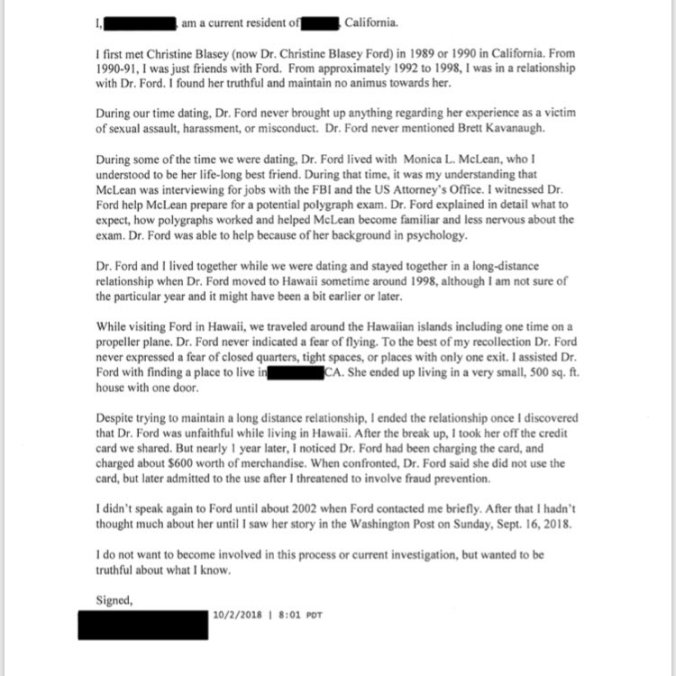
II. Let’s always believe survivors who know how to beat lie detectors.
The fact that Dr. Ford had been declared “truthful” in her polygraph test was always one of the worst reasons to believe her, but now that test throws legitimate suspicion on her account. The machines are notoriously unreliable, but the argument was that the fact that Ford was eager to take the test indicated her confidence in her account. Today, Fox News received this letter from a man who claims to be Ford’s ex-boyfriend:
Of course, it could be completely innocent that a woman who suddenly dredged up a forgotten alleged incident just in time to use it to derail the confirmation of a SCOTUS nominee her party opposes and submitted to a lie detector test as evidence of her veracity considered herself an expert on beating lie detector tests.
I wonder how many strategy sessions it took for the supporters and enablers of Senator Elizabeth Warren (D-Mass) to come up with their latest defense of her ongoing lie that she is part Cherokee? We know it’s a lie now—a deliberate misrepresentation designed to deceive—because the Bay State crypto-socialist has refused the obvious resolution of taking a DNA ancestry test….again. You know she’s taken at least one, and maybe more. Being able to wave scientific proof that she had Native American ancestors after all the “Fauxahontas” jibes would be a political bonanza for Warren, and solve her most daunting public relations problem outside of my home state, the Land of Michael Curley, where corruption, lies and letting young women drown don’t put a dent in your popularity or vote totals, for some reason. Sure, Warren took the test. She probably took another one just in case it was wrong….and she still doesn’t have the integrity or courage to admit her lie.
And that, now and forever, is why her Cherokee fantasy matters. It shows that Warren lies, and lacks integrity. It shows that she was willing to use a falsehood to gain traction in university employment competitions where gender, race and minority status often made all the difference….even if it meant that a real minority candidate failed because of her subterfuge.
Yet those strategy sessions yielded this defense on Warren’s behalf: according to an investigation by the Boston Globe, Warren’s fake Cherokee claim wasn’t a factor in her hiring by Harvard Law School:
The Globe examined hundreds of documents, many of them never before available, and reached out to all 52 of the law professors who are still living and were eligible to be in that Pound Hall room at Harvard Law School. Some are Warren’s allies. Others are not. Thirty-one agreed to talk to the Globe — including the law professor who was, at the time, in charge of recruiting minority faculty. Most said they were unaware of her claims to Native American heritage and all but one of the 31 said those claims were not discussed as part of her hire. One professor told the Globe he is unsure whether her heritage came up, but is certain that, if it did, it had no bearing on his vote on Warren’s appointment.
Perhaps the editors and journalists at the Globe never heard of moral luck, but I bet at least some of those law professors comprehend the concept. Whether or not Warren’s deliberate lie and misrepresentation of her ancestry actually was a factor in her hiring at Harvard was pure chance, and occurred after Warren had embraced a false identity. Once she did that, the consequences were out of her control. Her lie doesn’t become less unethical because it didn’t have any effect after the fact of it. A lot of people have trouble grasping this basic ethical concept, but it isn’t that hard. A person who drops a bowling ball from a bridge onto an express way is just as irresponsible and reckless if the ball misses every thing as he would be if the ball caused a ten car pile-up and the death of ten. He’s just as bad either way, and the rest is all luck. The same is true of Warren’s affirmative action-courting lie. Continue reading →
Nah, Google doesn’t abuse its power 0r manipulate information for a political agenda! Why would anyone suggest such a thing?
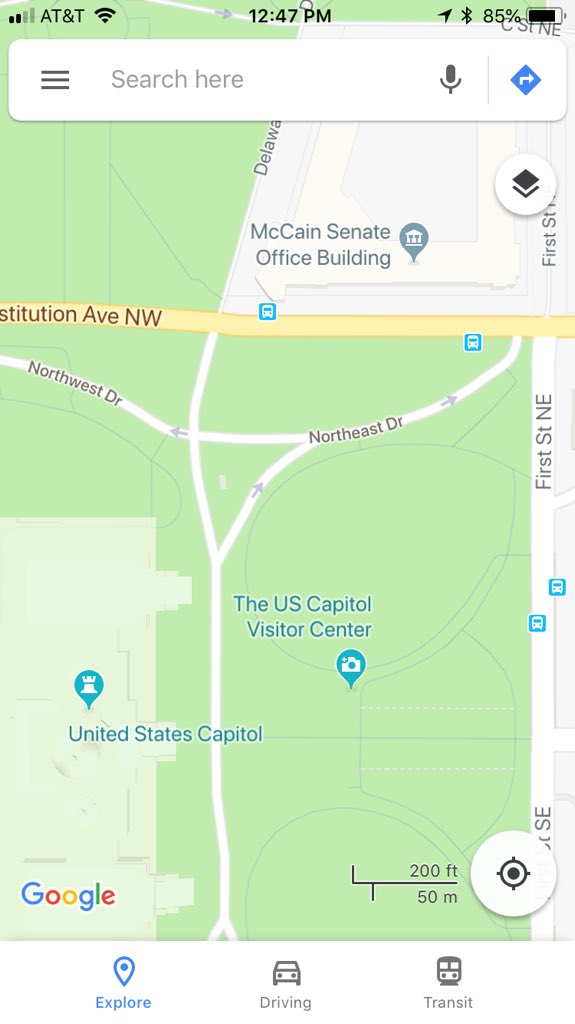
Chuck Schumer suggested that the Senate Office Building, currently named after the late Senator Richard Russell, 1897-1971, a Georgia Democrat who served in the Senate for almost 40 years, be re-named in honor of the late John McCain.
It’s a good suggestion. Russell was an adamant white supremacist, and opposed, unapologetically, civil rights measures his whole career. I’ve been rather surprised that the building’s name wasn’t changed long before, when Democrats controlled the Senate. Why didn’t the Democrats try to get Russell replaced by Edward Kennedy’s name, for example?
Go ahead, guess why.
But it’s not Google’s role to lobby for the change, or worse, to make it unilaterally, as it did today on Google Maps. This was especially bad—but helpful!– timing for the giant tech company, as it is under fire for political bias by the President, who tweeted that the search engine was “rigged,” and Congress, and Google’s CEO just refused to be questioned on the Hill. These companies, like Facebook, Amazon and Twitter, are arrogant beyond all measure, drunk with their growing power, and ethically inert. You can regard this episode as just a funny glitch if you like.


 Ethics Alarms