In the interest of time—mine—I’m going to list the relevant developments and my observations as bullet points, with the full knowledge that I will be posting on this again, and probably soon. So here we go, into the wreckage…
In the interest of time—mine—I’m going to list the relevant developments and my observations as bullet points, with the full knowledge that I will be posting on this again, and probably soon. So here we go, into the wreckage…
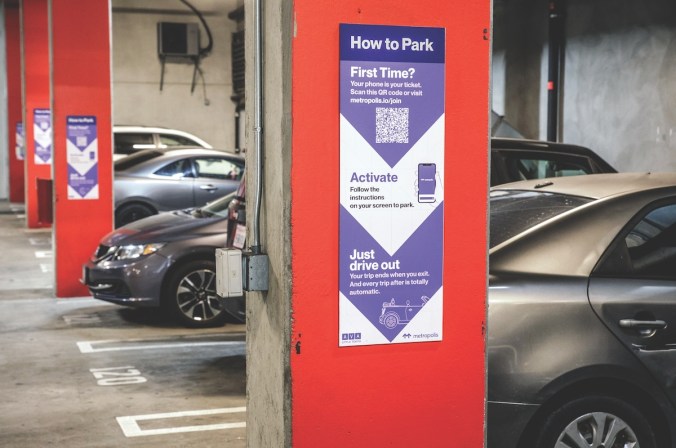
The photo above carries the caption: “Metropolis parking utilizing AI to create drive in drive out parking without the need for a ticket and validation. This lot is at 236 S. Los Angeles in Little Tokyo in Downtown Los Angeles.” Here’s my caption: “Metropolis parking can bite me.”
And did, come to think of it.

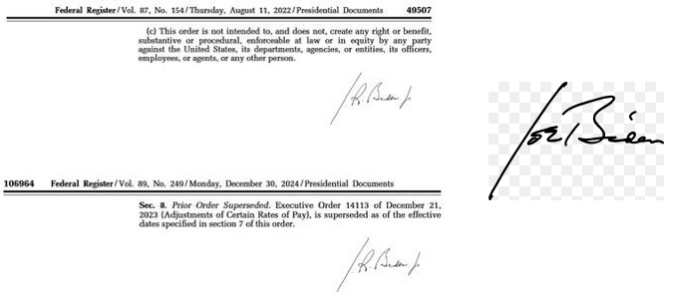
Wait, what? An Executive Order can be legal and go into effect without a President actually signing it? A so-called “autopen signature” counts? EVEN WHEN THE PRESIDENT MAY NOT BE CAPABLE OF KNOWING WHAT HE’S “SIGNING”?
A Heritage Foundation investigation has discovered that the majority of official documents signed by President Joe Biden used the same autopen signature. The Oversight Project, which is an initiative within the conservative Heritage Foundation that investigates the government, announced, “We gathered every document we could find with Biden’s signature over the course of his Presidency. All used the same autopen signature except for the announcement that the former President was dropping out of the race last year. Here is the autopen signature,” the group said, attaching photo examples like these:

…who shall remain nameless.
This:
“Experience the future of companionship with an AI girlfriend chatbot. Designed to listen engage and respond with intelligence and warmth this virtual partner offers meaningful conversations, emotional support, and personalized interactions. Whether you seek a friend a confidante or just casual chats this ai girlfriend chatbot companion is always there for you anytime anywhere. Enjoy a unique ever-evolving connection powered by artificial intelligence.”
I think a blow-up doll is more ethical. The product is as perilous as crack or heroin, and destined to cripple and manipulate vulnerable, lonely people, like, say, me. It is the logical and inevitable next step from 800 sex chat phone lines. They can’t be made illegal; someone will undoubtedly argue that AI girlfriend chatbots can be therapeutic and even, on balance, capable of accomplishing more good than bad.
Sure. As for me, I’m reminded of this post from 2017: The Unibomber Had A Point.
Res ipsa loquitur.
Aleysha Ortiz, 19, has sued the Hartford Board of Education and city officials alleging that she cannot read or write even though she graduated with honors from Hartford Public High School in 2024. Her suit accuses defendants of negligence by failing to provide adequate special education services. She told CNN that she was promoted all the way through 12 years in Hartford public school despite never acquiring fundamental literacy skills; in a May 2024 city council meeting, she testified that she was unable to read or write, yet was awarded an honors diploma.
Ortiz is now enrolled at the University of Connecticut: yes, she was accepted and got a scholarship despite being, in her own assessment, illiterate. She explains this by her adeptness in using technology such as speech-to-text and text-to-speech programs.
Says Newsweek, amusingly, “The case has drawn attention to how academic achievement is measured and whether special education students are truly receiving the skills they need to succeed beyond high school.”
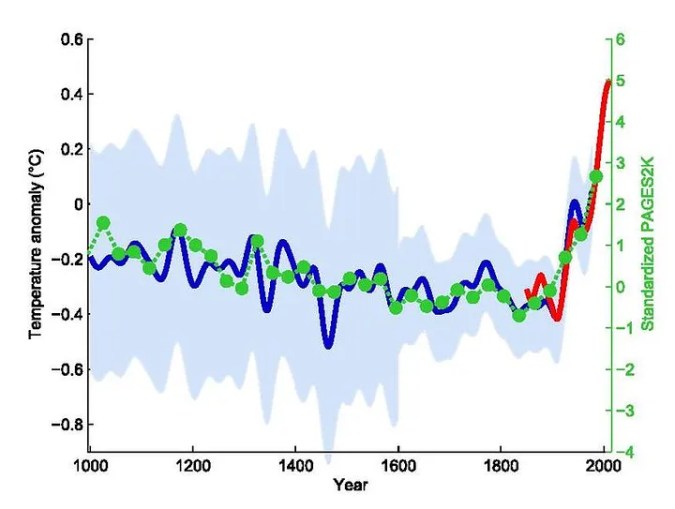
As it happens, the day that I posted on NOAA’s inherently ethically dubious “adjustments” to historical climate data, a blog post by The Manhattan Contrarian turned up in my email following up on the same ABC News story that sparked my post. It is well worth reading. His conclusion:
“If the NOAA data adjustments cannot be tied to specific metadata like station moves or instrumentation changes, then they are not really scientific “data,” but rather just opinions of people who are interested in promoting the global warming narrative. They are completely unusable for purposes of making public policy.”
Yes, but the manipulated data does make charts like the “hockey stick” graph above seem convincing, even though all those data points come from after-the-fact guesses about what the real data should be.
Of course, the corrupt news media sees no problem with this. As ABC helpfully points out, NOAA’s National Centers for Environmental Information “adjusts weather data to account for factors like instrument changes, station relocation and urbanization, and it does so through peer-reviewed studies that are published publicly through its federal website.”
And factors like the need for climate scientists to show that the climate change apocalypse that they constantly predict for us is based on convincing data, when in fact it is based on flawed data, as the scientists admit once you cut through the jargon. For example, traditional glass thermometers have been replaced with more precise digital sensors warranting “adjustments” to accurately compare readings between the two instruments. Sea surface temperatures used to be taken manually from a bucket off of a boat, unlike the network of buoys and satellites that are used to gauge water temperatures today. Then there is the “urban heat island effect”: Cities heat up more than rural areas due to human activity, infrastructure and the concentration of buildings, roads and other heat-absorbing materials, causing higher temperatures in cities compared to surrounding areas. This can distort temperature data, making an area appear hotter than it is. So the National Oceanic and Atmospheric Administration makes adjustments to account for that too.
The Billy Bob Thornton star vehicle “Landman,” following the stressful life of a West Texas “landman” and operational executive for an independent oil company in West Texas, has a lot going for it, mostly Thornton, who is one of our most interesting and versatile actors. The Paramount streaming series is already better, in my view, then the last two oil dramas I watched, the over-rated “Giant” and the relentlessly unpleasant “There Will Be Blood,” in great part because as with all of his roles, Thornton brings a great deal of humor to the proceedings.
I have not finished the series’ first season (I sure hope there is a second), but I was struck by the long scene above in which Tommy Norris (that’s Billy Bob) gives a quick primer to his company’s attorney on the facile conventional wisdom of the anti-fossil fuel lobby. The rant begins (at the 57 second mark), as Tommy denies the “cleanness” of wind power, and he takes off from there. It was an instant classic that quickly went viral on social media: as soon as I heard it I knew I could find the speech on YouTube and resolved to post it today.
There are also a lot of rebuttals to the speech on line, and that’s great: the ethics point is that for once Hollywood isn’t stuffing smug 21st Century woke politics into its audience’s brains, but is presenting a dissenting analysis. More more amazing yet, this one comes from a series’ protagonist and an appealing one at that.
Taylor Sheridan, who created “Landman,” cast Thornton and wrote and directed the speech deserves thanks and credit for packaging a provocative point of view that is sure to spark debate. Debate is ethical. What isn’t ethical is cultural indoctrination, which is how Hollywood has mostly been approaching the oil issue for decades.
Not surprisingly, the Wikipedia entry linked above states that the series contains “misinformation about renewable energy… “exposed as common propaganda tropes by Big Oil.” This is why Wikipedia should be considered a member in excellent standing with the Axis of Unethical Conduct. If Democrats had won another term in the White House, we would probably see “Landman” forced to include a disclaimer on Tommy’s speech.

Breaking: I have heard from WordPress regarding the site malfunction yesterday that made commenting either a chore or impossible. This morning Happiness Engineer Gary P. wrote in an email,
“Hi Jack, thank you for your patience. I really appreciate you reporting this issue. It’s been very helpful! As my colleague mentioned, our team has identified this as a bug and is actively working on a permanent fix. The latest update from our developers is that the comment box should now be working again. I took a look at your site and can see that the text box appears to be functioning normally. I’ve also recorded a short video showing that typing is now possible: https://cloudup.com/c1W5oqw88Qm.
Whenever you have a moment, could you check from your end and let me know if everything is working as expected? Do note that while the text box is working, our developer is still actively looking for a cause for the issue itself, and what’s working now might not be perfect.
Let me know how it goes and if you have any other questions. I’d be happy to help.
Well, Gary had better be happy to help…he’s a Happiness Engineer!
I’m so sorry this happened yesterday. It obviously frustrated a lot of you and wasted your valuable time, as it did mine. If its any consolation, I deal with WordPress bugs constantly. I can no longer comment directly as a host on my own posts for example: I have to log in as a commenter. When I’m in the favored “Paragraph” block, I can’t post pictures or quotes. When I’m in the “classic “mode links don’t work. Recently, whole sentences just disappear while I’m finishing them. But that’s my problem. You shouldn’t have to deal with any posting issues. Again, I am sorry.
Special thanks are due to Diego Garcia and Alicia who blew the whistle on this right away via email.
Maybe I’ll be able to get some paying work done today, after I finish shoveling snow…
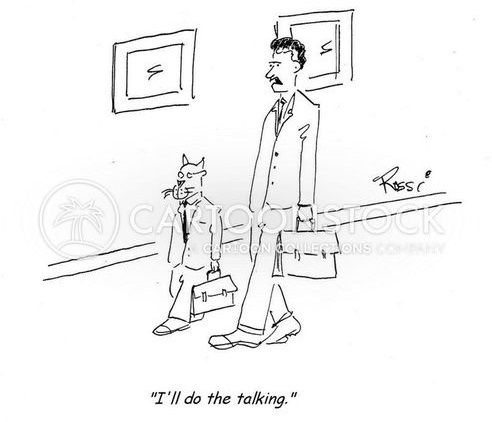
I must confess that one reason for this post is to entice one of Ethics Alarms’ stars, the perceptive and sharp metaphorical-penned Mrs. Q, into commenting, since she is our resident canine authority (among other things).
The New York Times recently published a feature [Gift link!]about a new fad among dog-owners: multi-colored buttons one can lay out on one’s floor. The buttons can be set to emit the dog-owner’s voice saying a single word like OUTSIDE, WATER, PLAY, FRIEND, AFRAID, WALK, BALL and so on. Dogs learn to step on the buttons to emit the desired word…
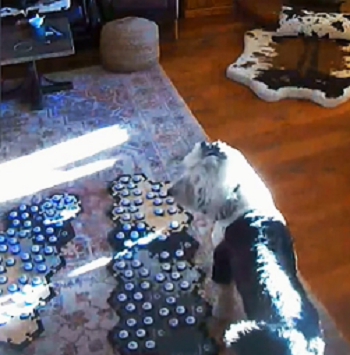
Voilà! Talking dogs.
Well, maybe. Researchers disagree whether the dogs are really using the buttons to communicate or just giving a Skinnerian response when they figure out that, for example, pressing a particular button will result in a treat. Dogs using the buttons are all over YouTube and other platforms on the web: that’s Bunny the Sheepadoodle above, who supposedly makes complex remarks and even existential ones, like “DOG WHY?”
 Ethics Alarms