The Editor-In-Chief of Scientific American Invokes The Demon Pazuzu!

Odd. One would think that the editor of a (once) respected science magazine would not resort demonology to explain her own conduct. Indeed, one would think that such conduct would disqualify said editor from continuing in her position.

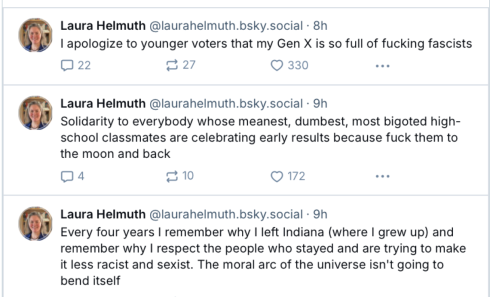
Laura Helmuth, a woke activist who has destroyed the credibility of Scientific American by politicizing its content, went bonkers after Trump defeated Kamala Harris and tweeted,

How professional! How trustworthy! How scientific! Who wouldn’t trust the analysis of a science magazine edited by someone who makes such declarations in public?

Continue reading

“The Dishonest Waiter” Strikes Again! [Corrected and Updated]

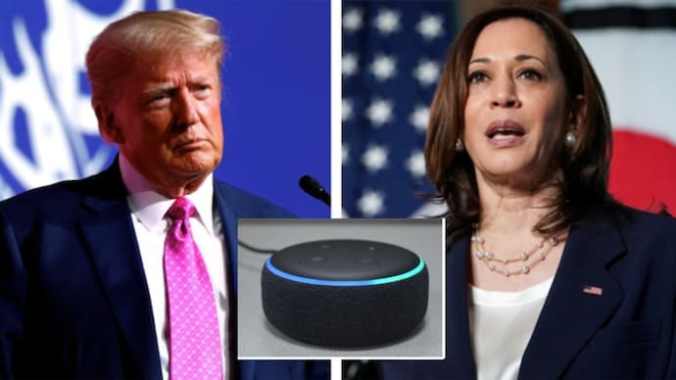
I immediately thought of the “dishonest waiter” when I stumbled upon this story, about a month late. (How did I miss it? You readers are supposed to keep me up to date!) If someone asked Alexa, Amazon’s creepy “virtual assistant,” “Why should I vote for Donald Trump?” “she” replied, “I cannot provide content that promotes a specific political party or a specific candidate.”

Continue reading

In “Denial,” the film about the lawsuit by British Holocaust denier and fake historian David Irving against American Deborah Lipstadt, the late, great Tom Wilkinson as Lipstadt’s barrister Richard Rampton, in the process of excoriating Irving to the court where the case is being tried, evokes the analogy of “the dishonest waiter” in a memorable speech:

My lord, during this trial, we have heard from Professor Evans and others of at least 25 major falsifications of history. Well, says Mr. Irving, “all historians make mistakes.” But there is a difference between negligence, which is random in its effect, and a deliberateness, which is far more one-sided. All Mr. Irving’s little fictions, all his tweaks of the evidence all tend in the same direction: the exculpation of Adolf Hitler. He is, to use an analogy, like the waiter who always gives the wrong change. If he is honest, we may expect sometimes his mistakes to favor the customers, sometimes himself. But Mr. Irving is the dishonest waiter. All his mistakes work in his favor. How far, if at all, Mr. Irving’s Antisemitism is the cause of his Hitler apology, or vice versa, is unimportant. Whether they are taken together or individually, it is clear that they have led him to prostitute his reputation as a serious historian in favor of a bogus rehabilitation of Adolf Hitler and the dissemination of virulent Antisemitic propaganda.

I immediately thought of the “dishonest waiter” when I stumbled upon this story, about a month late. (How did I miss it? You readers are supposed to keep me up to date!) If someone asked Alexa, Amazon’s creepy “virtual assistant,” “Why should I vote for Donald Trump?” “she” replied, “I cannot provide content that promotes a specific political party or a specific candidate.”

Continue reading

This Will Not End Well…

I know I have written about this general phenomenon before, but my sense of urgency is increasing.

Today, while walking Spuds on a gorgeous, sunny, breezy Northern Virginia day, I saw two young boys sitting near a field under a tree, They looked to be 10 or 11, maybe older. I watched them for almost 20 minutes: I was fascinated. They were within a foot of each other, and never said a word or looked up…from their smart phones.

The internet is the most stunning example of a technological development having unanticipated and in many ways devastating effects on society and culture at least since radio, yes, I think even more television. A close second, however, is the cell phone.

I remember as a kid the constant refrain from my parents was that it was a beautiful day and that I should go outside and “play” instead of watching TV. I’m pretty sure I watched more TV than most kids then, but I also did a lot of stuff outside with my friends. And we talked to each other—about our parents and siblings, our neighbors, cool things we had read, yes, TV episodes, movies, the Red Sox, girls, school, and our dreams. We even talked about politics. It is amazing how many groups of children and especially teenagers I see hanging out but not saying a word to each other, because they are texting, or following social media, or staring at little screens for other reasons.

I was trying to imagine “Stand by Me” with cell phones. All of those adventures, intimate conversations, fanciful exchanges and the rest wouldn’t happen today. Gordy and his pals would just stare at their “devices” and never get to know each other at all. They would have shallow friendships, shalllow experiences, and grow up to be shallow adults.

One of the half-completed posts that has been sitting stalled on the EA metaphorical runway for years has been an essay on life competencies. No doubt about it: mastering new technology is one of those crucial life skills, but so is learning to communicate verbally, recognize a person’s moods and body language, and to learn to function and thrive “unplugged.” For all their many advantages, the cell phones that dominate our children’s attention—and ours, but that’s another set of issues—are crippling them. They are growing up lacking the ability to reason with each other, argue, inspire, learn, flirt—so much more.

I would advocate parents forcing their kids to surrender phones when they leave the house “to play,” but modern parents are terrified that a phoneless child will be preyed upon by the evils that lurk outside. I would advocate limiting smartphone time, or making minors settle for actual phones and not wield mini-computers, but that horse has left the barn too.

This is a social pathogen, and one would think it could be flagged as such and dealt with. I have no idea how we can do that now. One of the Ethics Alarms mottoes is “Fix the problem!” What the consequences will be if we don’t, I am incapable of prognosticating.

But they won’t be good.

The Fake James Earl Jones Problem

Oh yeah, I can see where this is going…

Vanity Fair reports that in 2022, Lucasfilm and Skywalker Sound hired a Ukrainian startup called Respeech to recreate Darth Vader’s voice for its upcoming mini-series “Obi-Wan Kenobi.” The recently departed James Earl Jones was then alive but 91 and his voice was waeker and not as resonant as in his “THIS is CNN!” days. Using AI, Respeech used archived “Star Wars” sound tracks footage to recreate Jones’ iconic Darth Vader’s tones from the original 1980s trilogy. Jones was satsified with the fake version of him, and signed off on using his archival voice recordings for future (lousy) “Star Wars” spin-offs. When “Obi-Wan Kenobi” premiered, nobody guessed that Darth Vader’s voice was AI generated.

Continue reading

Harris Is Losing the Meme Wars, So Naturally Democrats Want To Censor Memes

Who would have expected the AI metaphorical tidal wave to have an influence on the Presidential election? Memes are a breeze to make using artificial intelligence, and while I got heartily sick of my Facebook friends bombarding me with political ones, I have to admit that the technology has the silver lining of taking blunt and biased punditry out of the political cartoonist monopoly and letting some very witty people make satirical political statements.

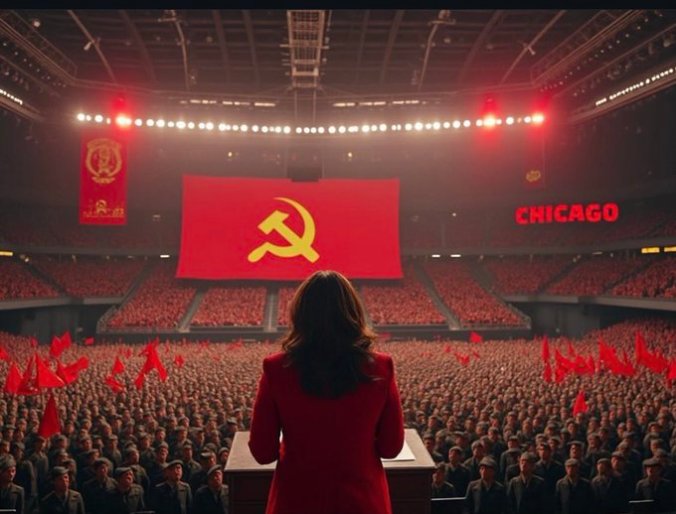
So far, at least, it appears that conservatives have mastered meming before the Left has, and in this race for President, that is having impact, though how much and how significant is impossible to tell. However, it is clear that the Kamala-Harris-as-a-Communist memes are getting under the skin of some Democrats—one of my Trump-Deranged relatives was complaining about those just yesterday—and so now there are calls for “something to be done” about anti-Harris memes. On MSNBC’s “The Sunday Show,” NPR’s Maria Hinojosa was very upset about AI images of Harris presented in Maoist uniforms:

Continue reading

Scientists Who Make Recommendations Like This Forfeit the Privilege of Being Taken Seriously

And yet how many climate change hysterics, including some regulators and elected officials, will quote them as authority anyway? Geena has an answer…

Researchers at the University of Cambridge announced their solution to the contribution of air travel to world-ending carbon emissions: force airplanes to fly more slowly. Reducing flight speeds about 15% would add an average of 50 minutes to flights. The measure would slash fuel burn by 5 to 7%, reducing the 4% industry contribution to overall climate change. These findings will be presented to the science-savvy delegates at the United Nations.

The scientists argue that longer flights could be offset by more efficiently organized airports with fewer holdups. Apparently these people haven’t flown recently. Can distinguished scientists also be deluded morons? It’s a rhetorical question.

Continue reading

Artificial Intelligence Raises a Lot of Ethics Issues, But This Isn’t One of Them…

From An Experiment in Lust, Regret and Kissing (gift link!) in the Times by novelist Curtis Sittenfeld :

My editor fed ChatGPT the same prompts I was writing from and asked it to write a story of the same length “in the style of Curtis Sittenfeld.” (I’m one of the many fiction writers whose novels were used, without my permission and without my being compensated, to train ChatGPT. Groups of fiction writers, including people I’m friends with, have sued OpenAI, which developed ChatGPT, for copyright infringement. The New York Times has sued Microsoft and OpenAI over the use of copyrighted work.)

The essay describes a contest between the bot and the human novelist, who also employed suggestions from readers. I do not see how an AI “writer” being programmed with another author’s work is any more of a copyright violation than a human writer reading a book or story for inspiration. Herman Melville wrote “Moby-Dick” after immersing himself in the works of William Shakespeare. Nor is imitating another author’s style unethical. All art involves borrowing, adopting, adapting and following the cues and lessons of those who came before. In “Follies,” Stephen Sondheim deliberately wrote songs that evoked the styles of specific earlier songwriters. He couldn’t have done this as effectively as he did without “programming” himself with their works. Continue reading

From the “NOW You Tell Me?” Files: Another Research “Oopsie!

Here we have another one of these stories that should be waved obnoxiously in anyone’s face who lectures you about blindly “following the science.”

For decades—really as long as I can remember—researchers have been telling us that moderate consumption of alcohol was not just safe but in fact beneficial. This wonderful news was welcomed by those who “needed a drink” after a hard day, or self-medicated with a glass of wine (or good scotch) before bedtime, or who tended to have just a bit more than a moderate amount of alcohol now, then, or frequently, but who’s counting?

Along comes a report from the Canadian Institute for Substance Use Research at the University of Victoria in British Columbia, Canada, that appeared a week ago in the Journal of Studies on Alcohol and Drugs published by the Center of Alcohol & Substance Use Studies at Rutgers University in New Jersey. It announced, in essence, “Oopsie! All of us trained scientific researchers made just a teeny mistake in our previous studies on this topic, repeatedly, over and over, and for half a century or more!”

Continue reading

Comment of the Day: “The Totalitarian Left’s Reaction To Trump’s Interview With Elon Musk Should Tell Voters All They Need To Know About ‘What’s Going On Here’”

I usually don’t elevate to Comment of the Day status comments that illustrate common fallacies and lack of perception. I’ve done it a few times: I know it can seem mean. But Cici’s Comment of the Day so exemplifies the abysmal level of comprehension and critical thought so many of our fellow citizens suffer from, thus making them prime targets of misdirection in this election year, that I felt attention should be paid.

Here was Cici’s comment, one of many she offered, on the post about the foreign and domestic Left arguing that a U.S. Presidential candidate should not be allowed free rein to say whatever he chose to in a discussion with Elon Musk, who owns the platform where the discussion was taking place:

“Third parties decide what you read and hear all the time. And I’m not even arguing for that so I’m not sure where you got that from. I trust that people in charge of these platforms are able to factcheck properly.

I don’t share in your mistrust of “institutions.” I think that leads to people not knowing what’s even true or not. You’re free to disagree with that notion.”

Analysis:

Continue reading

The U.S. District Court for D.C. Finds That Google’s Search Engine Is An Illegal Monopoly: 1) Of Course, and 2) Good!

The ruling found that Google acted illegally to maintain a monopoly in online search. Ya think? The statistics showed that Google had about 95% of the online search market, that “google” had become synonymous with “online search,” and that internal memos showed that executives acknowledged that Google’s quality of search could decline without having any negative impact on the company.

This is essentially the attitude and conditions that prevailed before the court-ordered break-up of Bell Telephone’s monopoly. “Rowan and Martin’s Laugh-In” had a running joke with Ernestine the Bell Operator (Lily Tomlin) snorting and responding to complaints with “We don’t care! We don’t have to care: we’re the phone company.” The D.C. District Court found that Google is like that.

The ruling doesn’t come soon enough to stop Google from trying to manipulate voter opinions and votes as November approaches, and the company that once had the motto “Don’t be evil” has been turned to the Dark Side for a long time. Nonetheless, this development is an important steep toward disassembling an unethical and dangerous source of power and influence in American society.

You can read the opinion here.

There is hope.