The O’Bannon Case: A Judge Explains How The Law Requires An Unethical and Corrupt Practice To Be Fair….But It’s Still Unethical and Corrupt

NCAA-ban

Now that a federal judge has declared the elite student-athletes at big time sports colleges to be what they are…paid mercenaries…and the sports programs at such institutions to be what we always knew they were…cynical sideshows that sacrificed education to greed…will the pubic, the media, educators, and universities now stop this slow-moving ethics train wreck?

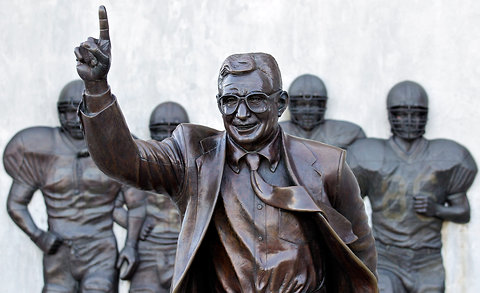
Of course not.  If they cared about how high-profile college sports were warping both America’s education and its values, they would have addressed the problem decades ago. They would have stopped it before, for example, schools started paying football and basketball coaches more than any professor. They would have stopped it before prestigious schools gave degrees to graduates whose entire education was a sham, who took ridiculously easy courses and who were held to infantile academic standards, all so rich, fat alumni would continue writing checks. They would have stopped it before a revered football coach held such power in a university that he was able to persuade the school’s leadership to allow a child sexual predator operate on campus.

U.S. District Judge Claudia Wilken, in a 99-page ruling agreeing with the claim of a group of plaintiffs fronted by former UCLA basketball player Ed O’Bannon, issued an injunction against the NCAA from “enforcing any rules or bylaws that would prohibit its member schools and conferences from offering their FBS football or Division I basketball recruits a limited share of the revenues generated from the use of their names, images, and likenesses in addition to a full grant-in-aid.”

The ruling will be appealed, and some of its legal conclusions certainly seem debatable. That is not my concern. The opinion effectively kills the fiction that the semi-literate youths who perform on-the-field heroics to burnish the images of universities and attract huge broadcast fees are what the NCAA, alumni, students , the schools and the media pretend that they are. Now that we know they are not truly students, what persuasive ethical justifications can be given for them to play college sports at all?

My answer?

None. Continue reading

Tony Stewart, the Suspicious Death of Kevin Ward Jr and NASCAR’s Bizarro World Ethics

If a real Columbo was on his case, Tony Stewart might be in trouble.

If a real Columbo was on his case, Tony Stewart might be in trouble.

The word “ethics” and NASCAR should never be uttered in the same sentence without irony. After all, the sport arose out of the exploits of outlaw bootleggers. The current billion dollar sport’s culture regards cheating as “breaking rules and getting caught doing it.” The fact that the team manager of one of the sport’s biggest stars would see no reason for his meal-ticket not to compete today just because he was being investigated for what might have been a mid-race homicide yesterday shouldn’t shock anyone.

In case you missed it Saturday (I did, having a visceral aversion to NASCAR stronger than my dislike of nightcrawlers), NASCAR superstar Tony Stewart drove his car into twenty-year-old driver Kevin Ward Jr., killing him, during a dirt-track race at Canandaigua Motorsports Park  in upstate New York. Ward’s car and Stewart’s car had swiped each other during the race, disabling Ward’s vehicle. Ward left his car and was walking on a track with the caution flag out, waving his arms and pointing at Stewart. One car swerved to avoid Ward, but Stewart’s hit him, injuring him fatally. Until the media and public began to register its objections, Stewart was preparing to race today as if nothing had happened. As recently as this morning, Stewart team manager Greg Zipadelli called it “business as usual.”

It’s business as usual in a culture where a participant who just killed someone in public under suspicious circumstances sees no reason to show, or even fake, any remorse or contrition whatsoever. Here’s the latest entry on Tony Stewart’s website, at least as I write this:

“Thanks to everyone who participated in this week’s edition of “Tony Trivia.” This week’s answer: There’s no track on the circuit where Tony Stewart is more dominant than at Watkins Glen International.”

[UPDATE: At 1:pm Sunday, Stewart finally posted the statement about the accident that is now up on the site. Note that he says nothing about his part in the accident at all. It could be about any NASCAR accident, anywhere.]

Call me a silly sentimentalist, but if I ran down another racer and killed him, I would make certain that a public statement expressing sorrow and regret at the incident would be up on my “official website” before the first ESPN headline was written about the incident. Meanwhile, why would NASCAR allow a racer to compete after an incident like this? Oh, that’s right: because the only ethics in NASCAR involve making money, protecting its stars, winning races, and keeping the fans entertained. After all, having Stewart race today would be a great story. Will he kill again? Will any driver have the guts to point at him this time?

Yes, it’s Bizarro World ethics again, another culture with inverted values like the fictional cube planet in Superman comics, where idiotic clones of Superman and Lois Lane think, live and speak illogically. Continue reading

Comment of the Day: “Ethics Dunce: ESPN”

domestic_violence

I know I have written a lot about the Ray Rice domestic abuse case and its aftermath, most recently this morning, regarding CNN’s Carol Costello’s warped argument for suspending ESPN commentator Stephen A. Smith. (The Rice-related posts are here, here, here and here, with an earlier Comment of the Day here.) I keep coming back to it because it involves many ethics issues: sports and violence, the “Star Syndrome,” and the special treatment of cultural celebrities, race, domestic abuse, women’s enabling of domestic abusers, political correctness, scapegoating, corporate cowardice, incompetent journalism, and more.  Chris Marschner’s recent comment on one of those posts is better than anything I’ve written on the topic, I think. As is often demonstrated here, the readers make Ethics Alarms work.

One connection I didn’t make until I read Chris’s comment is the relevance of the Gaza crisis and the public’s reaction to it to some of the ethical principles involved. There is no question that Hamas provoked a violent attack by Israel, knowing that women and children would be harmed, and that Israel would be condemned by many as a consequence. Israel is much more powerful than Palestinian forces, and provoking it to defend itself when the inevitable results will be harm to the powerless is irresponsible. Yet we hear the same absolutist reactions to the Gaza casualties that are at the root of the anger focused on Smith’s comments. The victims of violence are never responsible in any way, and suggesting otherwise is immoral.

It’s a very flawed analogy in other respects. The civilians are not the ones provoking Israel, for example, though Hamas represents them–their harm is harm to Gaza, and therefor Hamas. Most of all, Israel is not an abuser, though I could quote many commentators who regard it as one, and who might see the comparison with Ray Rice as apt.

Here is Chris Marschner’s Comment of the Day on the post, Ethics Dunce: ESPN: Continue reading

CNN Presents The Carol Costello Rule: If A Network Issues One Unethical Suspension Of An Innocent Employee Based On Deranged Political Correctness, It Is Obligated To Issue Another

Smug, dishonest, unprofessional, illogical, unfair, biased, unethical: "THIS is CNN."

Smug, dishonest, unprofessional, illogical, unfair, biased, unethical: “THIS is CNN.”

I just have to stop watching CNN is the morning, because it places everyone in my house at risk for head shrapnel.

The main danger is the smug, biased, ethically-jumbled Carol Costello, CNN’s late morning anchor after the New York governor’s telegenic brother has finished indoctrinating us into his view of the world. Today, Costello was taking a victory lap, implying that she helped get Stephen A. Smith suspended by ESPN for daring to suggest that women bear some responsibility for avoiding placing themselves within range of an abuser’s fists. (Interestingly, Costello had no similar directives for ABC, which quietly allowed Whoopie Goldberg to make the same (valid) point on “The View” with no adverse actions whatsoever. See, a woman is allowed to state some uncomfortable truths, but the same truth in the mouth of a man is offensive. Learn the rules, for heaven’s sake!) Then Costello played a clip of her earlier argument why ESPN was wrong not to suspend Smith. She said …

“It’s nice that Smith apologized, but I wonder if the network will do what it ought to do and suspend Smith. Look, in 2012, the management of ESPN expressed outrage when two employees used the phrase “a chink in the armor” when referencing  Jeremy Linn, the Asian Basketball player. One employee was suspended for 30 days and the other was fired. So why is ESPN giving Smith a pass?”

Continue reading

Ethics Dunce: ESPN

"That will teach you to fudge the truth, Smith. Remember, you're a journalist!"

“That will teach you to remember to fudge the truth, Smith. Remember, you’re a journalist!”

Item: ESPN suspends Stephen A. Smith. Why? In response to the uproar over the NFL’s suspension of domestic abuser Ray Rice only two games for punching a woman’s lights out—the love of his life!—Smith uttered the blasphemy that some victims of domestic abuse share responsibility for their plight. Of course, he is 100% correct, and this something that many women must hear, learn, and act upon, or perhaps die. The proof: the precise case that prompted Smith’s comments! Janay Palmer, Rice’s punching bag, refused to file a complaint against him, and married the bastard a couple of months after he hauled her unconscious body out of a hotel elevator like a sack of potatoes, caught on camera.

If (I would say “when”) she gets clocked again, is she partially responsible? Absolutely. I also think she’s responsible in part for the injuries of every abused woman who follows her high-profile, irresponsible, violence-provoking (I use that unfortunately inexact word as Smith used it) example.

Smith’s suspension—for a week, almost as long as Rice— to mollify the feminist apologists for their violence enabling sisters, is craven and wrong.

________________________

Facts: ESPN

Lessons of the Tulowitzki Jersey Fiasco

Troy Tulowitzki is the superstar Colorado Rockies shortstop, and has been since for nine years. He has been named an All-Star four times,won two Gold Glove awards and two Silver Sluggers; he is widely regarded as one of the best players in baseball. Last weekend was Tulowitzki jersey night, with 15,000 lucky fans getting a Rockies purple jersey with the home town hero’s name on the back.

Here is how the the jerseys looked…

His name is spelled T-U-L-O-W-I-T-Z-K-I...just like it sounds, in fact.

Tulo jersey

Observations: Continue reading

The Ray Rice Affair: Defending Stephen Smith (and Blaming the Victims Of Domestic Abuse When They Behave Like Rice’s)

The love birds. Luckily, she can take a punch.

The love birds. Luckily, she can take a punch.

I came close to writing about the latest disturbing turn in the Ray Rice affair—the fact that the Baltimore Ravens star’s ugly domestic abuse, caught on a hotel elevator camera, was recently deemed to warrant only a two game suspension by the NFL. I think this is a fairly accurate representation of how seriously that league and a segment of the professional sports culture take the problem of domestic abuse—wait until you hear all the cheers for Rice in his first day back on the field—but I had already registered my disgust at Rice’s lack of sufficient punishment for this incident. Then ESPN analyst Stephen A. Smith was pilloried by female pundits for daring to suggest that the victims of domestic abuse sometimes share responsibility for what happens to them, and need to take action to prevent further beatings. ESPN colleague Michelle Beadle, noting that she was once in an abusive relationship, erupted in indignation, saying she “would never feel clean again” after taking reading Smith’s comments, and wrote,”I’m thinking about wearing a miniskirt this weekend…I’d hate to think what I’d be asking for by doing so… “Violence isn’t the victim’s issue. It’s the abuser’s. To insinuate otherwise is irresponsible and disgusting. Walk. Away.”

Of course,  other pundits, websites and blogs followed Beadle’s leaddid you know there’s a war on women?—because you just don’t dare get on the wrong side of this kind of issue. The problem is that in the context of the Ray Rice episode, Smith was making a valid point that is made too seldom because of The Beadle Rule, that women who are abused share no responsibility for their fate, and to even suggest otherwise is proof positive of misogyny. That is a politically correct lie, and Smith should not be attacked for telling the truth, albeit inarticulately. Continue reading

Adam Wainwright’s Foul All-Star Ethics

"Boy, I'm  glad Wainwright threw me a pitch a Little Leaguer could hit, because I'm just about done. I sure hope he tells everyone about it,.."

“Boy, I’m glad Wainwright threw me a pitch a Little Leaguer could hit, because I’m just about done. I sure hope he tells everyone about it,..”

St. Louis Cardinals pitching ace Adam Wainwright lost MLB’s 2014 All-Star Game for the National League (though he was not the official losing pitcher). He gave up three quick runs in the first inning, and his squad never overcame the deficit, losing 5-3. As a result, his league’s champion at the end of the season, which could conceivably be his own team, will labor at a disadvantage: the league that wins the All-Star game get the home advantage, which recently, at least, has been decisive.

None of that reflects poorly on the pitcher. He got hit hard by a group of likely Hall of Famers (Derek Jeter, Mike Trout, Robinson Cano and Miguel Cabrera) in an exhibition game that doesn’t count in the standings. So what?

This, however, does reflect poorly on Wainwright:

The game began with a long ovation for AL lead-off batter Derek Jeter, the Yankee shortstop who is retiring after this season following a storied career. Wainwright, in what appeared to be a class move, placed his glove and the ball on the mound in Minnesota’s Target Field and  stepped off to applaud, becoming, for a moment, just another fan giving a well-earned tribute to an all-time great. Then, three pitches into Jeter’s at bat, the living legend lined a ringing double to right field as if scripted, giving the crowd another chance to cheer, and triggering the American League’s winning rally. Later, in the dugout being interviewed on live TV, Wainwright announced that he had given Jeter “a couple of pipe shots”—that is, grooved his pitches so Jeter could get a hit.

Horrible. This is wrong in every way, no matter how you turn it—poor sportsmanship, disrespectful to Jeter, damaging to the game, and dumb: Continue reading

A Proposed Guide To Spoiler Ethics

"It SINKS??? You spoiled the ending!!!"

“It SINKS??? You spoiled the ending!!!”

I was just admonished on Facebook by a friend (a real friend, not just the Facebook variety), for referencing the end of the last episode of Season One of “Orange is the New Black.”  He hadn’t finished viewing the season yet, and this was a breach of spoiler ethics. Or was it?

Ever since I encountered for real someone who was angry with me for “spoiling” the end of “Thirteen Days,” ( “Yes, World War III started and everybody died”), I have been dubious about spoiler etiquette. The advent of DVDs and Netflix has made this all the more annoying. If I’m in a group of five, and one individual hasn’t kept up with “House of Cards,” are the rest of us obligated to censor our discussion? As a devotee and fanatic devourer of popular culture, I admit that my first instinct is to say, “Keep up, get literate, or pay the price.” If I actually live by that rule, however, I will be a walking, talking, writing, spoiler machine.

Chuck Klosterman, “The Ethicist” in the world of the New York Times, recently pronounced himself an anti-spoiler absolutist:

“I’m an anti-spoiler fascist. I don’t believe that any conversation, review or sardonic tweet about a given TV show is more valuable than protecting an individual’s opportunity to experience the episode itself (and to watch it within the context for which it was designed). I’ve never heard a pro-spoiler argument that wasn’t fundamentally absurd.”

Even Klosterman, however, excepted sporting events (the question posed involved mentioning World Cup scores to a friend who was annoyed that the game had been “spoiled” for him) from his fascism, writing, reasonably:

“I must concede that live, unrehearsed events are not subject to “spoiler” embargoes A live event is a form of breaking news. It’s not just entertainment; it’s the first imprint of living history. …Because this guy is your buddy, you might want to avoid discussing the games’ outcomes out of common courtesy — but not out of any moral obligation. It’s his own responsibility to keep himself in the dark about current events.”

For once I agree with Chuck. But what are reasonable ethics rules for dealing with the other kind of spoiler, involving literature and entertainment?

Luckily, this is not new territory, though it is evolving territory. The underlying ethical principles include fairness, trust, consideration, compassion, and empathy, which means that the Golden Rule is also involved.

Back in 2010, an erudite blogger calling himself The Reading Ape proposed a draft “Guide to Responsible Spoiling.” That blog is defunct; the promised successor is not around, and so far, I haven’t been able to discover who the Ape is. Whoever he is (Oh Aaaaape! Come back, Ape!) , he did a very good job, though some tweeks might  improve his work, especially in light of the emergence of Netflix.  (I have edited it slightly, not substantively…I hope he doesn’t mind, or if he does, that he’s not a big ape.) His approach is to frame the problem as an ethical conflict, in which two competing ethics principles must be balanced. I think that’s right.

Here is his “draft”—what do you think?

“A Brief Guide to Responsible Spoiling”

by The Reading Ape (2010)

The objective is to balance two ethical principles:

I. The Right to Surprise: The inherent right of any viewer or reader to experience the pleasure of not knowing what’s
going to happen next.

II. The Right to Debate: The inherent right of any viewer or reader to engage in public discourse about the content of
a given work of narrative art.

Part 1: When Spoiling is Fair Game

In the following circumstances, one can discuss crucial plot details and reveal endings with a clear conscience. Continue reading

Is There An Ethical Obligation Not To Shock, Nauseate, Or Blind Your Neighbors? Of Obese Joggers and #FreetheNipple

A Facebook friend posted the following letter, posted by one of her friends, and supposedly passed along by the target of the letter. The individual subjected to the complaint is reputedly trying to overcome obesity and various health issues. The letter:

Mean letter

I have my doubts regarding the authenticity of this, but it doesn’t matter to this post. I assume we can all agree that the letter itself, if genuine, is cruel, mean-spirited, cowardly (it is anonymous), hurtful, and indefensible. It does raise an valid ethics question, though, which is this: Do we have any ethical obligation any more to exhibit modesty and a degree of public decorum out of doors, when we are likely to come under the gaze of others? If so, what are that obligation’s parameters? Continue reading