Saturday Afternoon Ethics Picnic, 6/5/2020

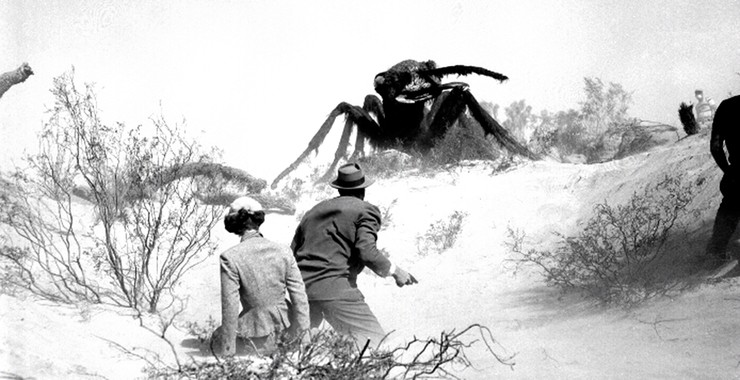
Giant ants

And what’s a picnic without ants?

June 5, the day before D-Day, is another date chock full of ethics history. It doesn’t count, but Ronald Reagan died on this date in 2004: I was just thinking that the Great Stupid would have killed him. In Presidential history, this was the day, in 1888, President Grover Cleveland vetoed a bill that would have given a pension to war widow Johanna Loewinger, whose Civil War vet husband died 14 years after being discharged from the army. He was discharged a little less than a year after enlisting for what the army surgeon’s certificate called chronic diarrhea. Loewinger received his pension until he cut his throat in 1876. When Johanna applied for a widow’s pension it was denied; his suicide was not considered to be caused by his military service. Johanna argued that the death was part of the insanity triggered by his war service, and appealed to a member of Congress to petition Cleveland with a bill. But the President declared all previous inquests into the former soldier’s unfortunate death to be satisfactory. Mrs. Loewinger got no pension.

I always thought this was gutsy of Cleveland (or something), since he had paid someone to serve in the Union army for him after he was drafted. But there were bigger ethics landmarks on June 5:

Continue reading

Ethics Dunce: Yahoo! Sportswriter Shalise Manza Young

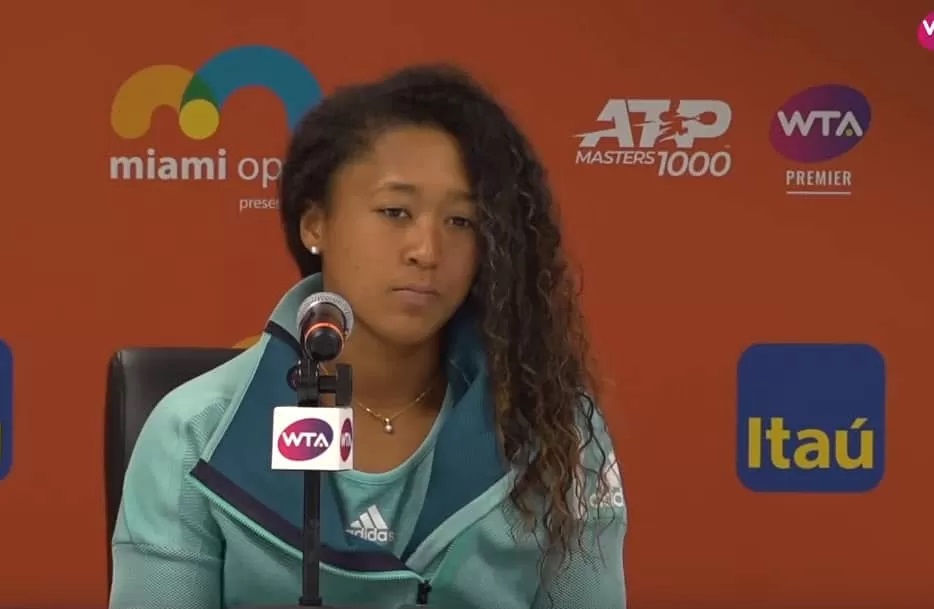
Naomi-Osaka interview

The withdrawal of female tennis star Naomi Osaka from the French Open because she wasn’t allowed to ignore rules all the other players were forced to play by has inspired a revealing amount of criticism…of the concept that stars should have to abide by the same rules and laws as everybody else. Since this is a massive ethics blind spot that defies persuasive advocacy, I’ve been somewhat surprised that so many commentators and athletes have been willing to put such an unethical position in print.

I shouldn’t have been, I guess. Osaka (predictably) played the victim, suddenly revealed that she suffered from depression (the old reliable “I’m not bad, I’m sick!” ploy satirized in “Officer Krupke”), and she had the triple benefit of being Asian, Black and female, the “Get Out Of Accountability Free” hat trick (that’s hockey, but you get the point) in the Age of The Great Stupid.

I was originally going to dedicate this post to the fatuous commentary of New York Times columnist Kurt Streeter, to whom all sports is about race, on l’affaire Osaka. “Using social media posts, first last Wednesday then on Monday, Osaka called out one of the most traditional practices in major sports: the obligatory news conference, vital to reporters seeking insight for their stories, but long regarded by many elite athletes as a plank walk. After monumental wins and difficult losses, Osaka has giggled and reflected through news conferences and also dissolved into tears. In Paris, she said she wanted nothing to do with the gatherings because they had exacted a steep emotional toll,” he wrote. “She sent a message with significant weight: The days of the Grand Slam tournaments and the huge media machine behind them holding all of the clout are done. In a predominantly white, ritual-bound sport, a smoothstroking young woman of Black and Asian descent, her confidence still evolving on and off the court, holds the power. Get used to it.”

Get used to what? Star athletes (and politicians, and other celebrities) thinking that if they are successful enough and popular enough, they get to break rules and get away with it? We’re used to that. But the point is that she doesn’t have the power. Tennis authorities fining her and threatening to kick her out of upcoming tournaments proved it. So she threw a tantrum, quit, took her ball and went home, and that’s admirable to Streeter, or anyone else? Well, but, you see, “it is impossible to know the depth of Osaka’s internal anguish” as “the rare champion of color in a tennis world dominated by fans, officials and a press corps that is overwhelmingly white.” Oh, gag me with a spoon. I’d be willing to suffer a lot of internal anguish in an enterprise I could make over 50 million dollars in a year, as Osaka has. Who wouldn’t?

Continue reading

Ethics Observations On The Naomi Osaka Affair [Corrected]

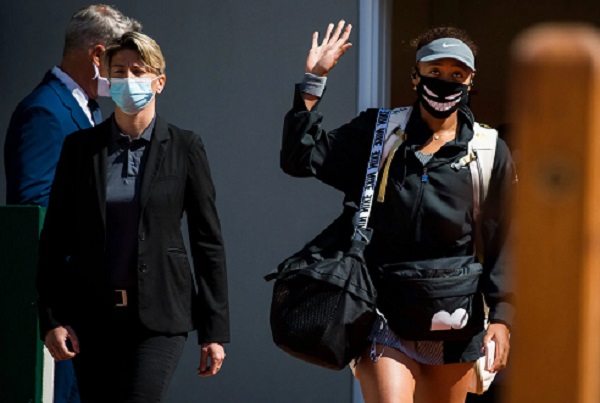
Osaka2

On Ethics Alarms yesterday, the controversy involving the current top female pro tennis star, Japan’s Naomi Osaka, was relegated to the morning warm-up rather than a stand-alone post. If you were not following EA yesterday, here’s a quick summary:

Citing her annoyance with repetitious questions from the news media that undermined her confidence, the 23-year old announced that she would violate the 2021 official Grand Slam rulebook, which requires players to participate in post-match news conferences. Violations result in fines of up to $20,000, but since Osaka made over 55 million dollars last year alone, more than all but the most elite U.S. professional athletes, this fine would be like a late fee at the library to normal people. I wrote in part,

This is literally an example of a star announcing that rules are for lesser mortals. Verdict: Ethics Dunce. The reason Osaka makes so much money is that athletes are paid heroes and entertainers, and submitting to the idiocy of reporters is part of their job. Fines obviously aren’t enough: a tennis player who refuses to fulfill her obligations to the sport should be banned from competing until she does.

Yesterday, after winning her first round match at the French Open, Osaka was fined (but only $15,000), and tennis officials proved that they read Ethics Alarms (I jest) and told Osaka that continuing her boycott of the media would result in her being suspended from the current tournament and others. Good. The organization had no other choice, unless it wanted to directly endorse the King’s Pass (Rationalization #11). If Osaka was allowed to snub the media with minimal consequences (for her), then no other player would feel obligated to cooperate either. Rennae Stubbs, a former player who is now a coach and ESPN analyst, stated the obvious while most of the players and former players were expressing sympathy for Osaka: “You cannot allow a player to have an unfair advantage by not doing post-match press. It’s time consuming, so if one player is not doing that and others are, that is not equal.”

Continue reading

Memorial Day Ethics Warm-Up, 5/31/2021…

It will be interesting to see if the news media discusses the Tulsa Race Massacre of 1921 any more this May 31 than it has in the past. Discussing this horrible mass murder of blacks in Oklahoma over Memorial Day weekend has always been seen as sufficiently tasteless that the story has suffered the equivalent of a historical airbrushing. When did you first learn about it? I didn’t encounter the episode in elementary school, high school, college or law school. I was 50, and furiously researching the life of Clarence Darrow so I could churn out a one man show (that was already in rehearsal) after Leslie Nielsen pulled the rights we had paid for on the Darrow show performed on Broadway by Henry Fonda. I was looking for the context of Darrow’s epic closing argument in the Sweet case (1925), in which he referenced examples of white mob violence against blacks. That was my introduction to the tragedy. How was this possible? I was and am a voracious consumer of American history, movies, and television. Yet the facts of the Tulsa Race Massacre never entered my consciousness.

Here’s one useful resource…there are many others available online. A brief summary: After World War I, Tulsa’s African American community was notable for its affluence. The Greenwood District was known as “Black Wall Street.” But on May 30, 1921, an incident between a white woman and a black man on an elevator—nobody knows exactly what happened—was reported in the Tulsa newspapers as an attempted rape. The young African-American, Dick Rowland, had been arrested, and members of the community believed that he might be lynched. When an angry white mob gathered in front of the courthouse, a group of over 70 back men, some of them World War I veterans with weapons, confronted them. A gun went off in a struggled, and chaos descended on Greenwood. A white mob of thousands overran the Greenwood District, shooting unarmed black citizens in the streets. It burned an area of some 35 city blocks, and more than 1,200 houses, numerous businesses, a school, a hospital and a dozen churches. It is estimated that 300 people were killed in the rampage, though official counts at the time were much lower. 300 is the same death toll as the 1871 Chicago fire. I knew about that tragedy by the time I was 8.

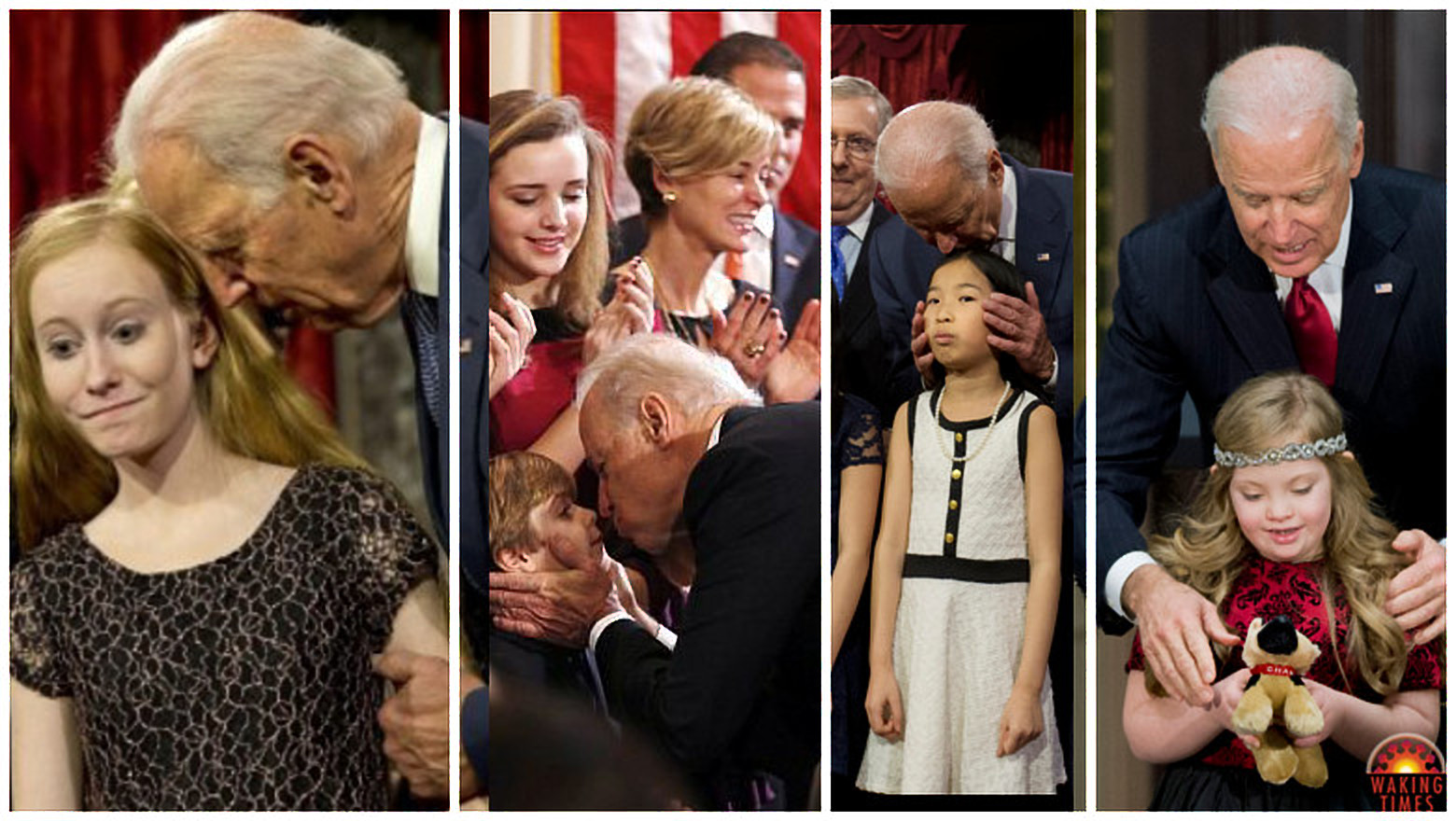
1. IIPTDXTTNMIAFB! That’s short for “Imagine if President Trump did X that the news media is accepting from Biden…”, introduced here. The current example: during a speech at Joint Base Langley-Eustis in Langley,Virginia two days ago, President Biden began spontaneously complimenting a pre-teen girl who had joined her parents and two older brothers on the stage after her mother had introduced Biden to the crowd. Biden said, inappropriately and creepily, “ I love those barrettes in your hair, man. I tell you what, look at her. She looks like she’s 19 years old sitting there like a little lady with her legs crossed.” Republicans pounced, as the MSM cliche goes whenever Democrats are legitimately criticized. The episode was barely mentioned by the media dedicated to propping up Biden—that is, almost all of it—at all. IIPTDXTTNMIAFB…and President Trump didn’t even have a photographically preserved series of encounters like this:

Creepy-Joe-Biden-President

2. AHHHH! It’s a virus ! Get a gun!!! The headline on the front page of the NYT website yesterday read, “Pandemic Fuels Surge in U.S. Gun Sales ‘Unlike Anything We’ve Ever Seen.'” Incredible. People bought guns for the first time because rioting was going on all over the country, and in many places the police were doing little or nothing to stop it. Buildings were burning and being looted; citizens were being threatened. Who gets a gun to fight a pandemic? (There was never any threat of the kind of civic breakdown from the virus like that portrayed in the movie “Contagion.” Toilet paper riots?)

The degree to which the Times—the “paper of record’!—continues to distort reality to mislead the public and warp public opinion is astounding. Later in the same article, the Times said, “While gun sales have been climbing for decades — they often spike in election years and after high-profile crimes — Americans have been on an unusual, prolonged buying spree fueled by the coronavirus pandemic, the protests last summer and the fears they both stoked.”

Continue reading

Morning Ethics Warm-Up, 5/28/2021: Memorial Day Weekend Edition

Jack Marshall Sr Army portrait

I’ll be visiting the Major (and Mom) at Arlington National Cemetery this weekend.

1. Well, let’s start the morning and end the week with evidence of progress…Mickey Callaway, the former manager of the New York Mets and recently fired pitching coach of the California Angels, has seen his baseball career implode because of what appears to be a habit of harrassing women in his workplace, which is Major League Baseball. Callaway, who has been banned from the game at least through 2022 after an investigation of the complaints made by more than five women, released a statement that is as close to a Level One apology on the Ethics Alarms Apology Scale as one is likely to see. That’s this one:

An apology motivated by the realization that one’s past conduct was unjust, unfair, and wrong, constituting an unequivocal admission of wrongdoing as well as regret, remorse and contrition, as part of a sincere effort to make amends and seek forgiveness.

Here’s Callaway’s version:

“My family and I fully support MLB’s strong stance against harassment and discrimination and are grateful to the Commissioner and his office for their thorough investigation. I apologize to the women who shared with investigators any interaction that made them feel uncomfortable. To be clear, I never intended to make anyone feel this way and didn’t understand that these interactions might do that or violate MLB policies. However, those are my own blind spots, and I take responsibility for the consequences.In my 25 years in professional baseball I have never taken for granted the privilege of being even a small part of this great game of ours. To say I regret my past poor choices would be an understatement. I remain hopeful that I can return to baseball when eligible at the conclusion of next season, but for now, I plan to work on my own shortcomings and repairing any damage I have caused with my colleagues and, particularly, my family.”

Joe Biden could have made that exact apology, without the baseball reference, of course. He never had to.

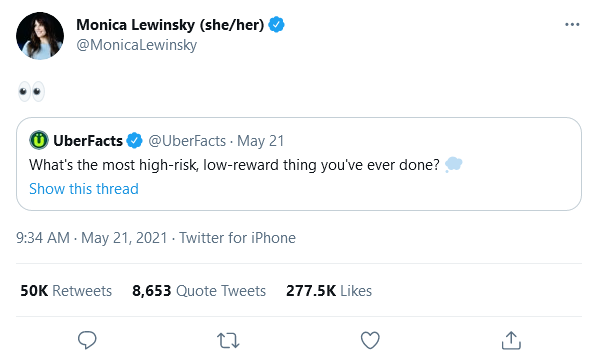
2. Incompetent question, perfect answer:

Monica tweet

Those are eye-roll emojis. Monica also gets points for brevity. She just missed tying author Victor Hugo for the record for shortest published message, in his case, a telegram to his publisher regarding the fate of his submitted manuscript for “Les Miserables.” Hugo wrote “?“. The publisher replied, “!“.

I won’t even take away ethics points from Monica for pandering to the Worst of the Woke by listing her preferred pronouns.

Continue reading

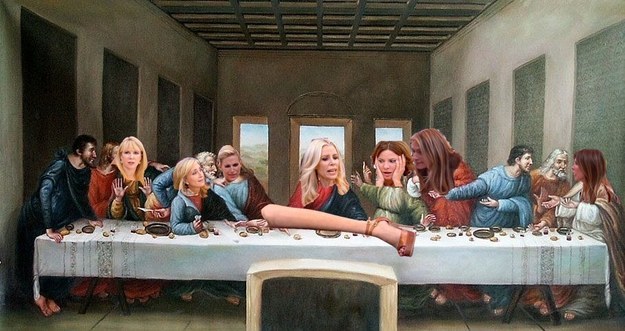
PM Ethics Medley, 5/26/2021: It’s A Strange, Strange World

Pastiche

1. Priorities! Major League Baseball has placed Angels pitching coach Mickey Callaway on its ineligible list through at least the 2022 season, MLB commissioner Rob Manfred announced. The league made the decision after investigating Callaway for sexual sexual harassment allegations reaching back several years, with several female sporstwriters among the alelged victims. The Angels fired Callaway this afternoon. Opines a major baseball news site: “Callaway is facing a year-plus ban, and it seems hard to believe any MLB team will hire him when he’s eligible to return.”

Hmmmm…

Alex Cora was suspended and fired as manager by the Boston Red Sox after a one-year suspension, then immediately hired back by the team. All he did was play a major role in devising a cheating scheme for one team, the Houston Astros, that extended through the play-offs and World Series, then oversaw a second team, Boston, that was found to have engaged in cheating, though less extensively, the next season. Cora’s cheating scheme with Astros was unprecedented, and cost two other professionals their jobs and the Astros millions in fines,while seriously scarring the integrity of the game. The conduct Callaway engaged in has been routine among professional athletes for decades, though in his case it was apparently 1) a bit more extreme than the norm and 2) “unwelcome.” After all, he was just a coach. So far, nobody has accused a player making more than $10 million a year of making sexual advances that were “unwelcome.’

Continue reading

Dear Hawaii: Aloha! You Can Be A State, Or You Can Be A Country. Pick One.

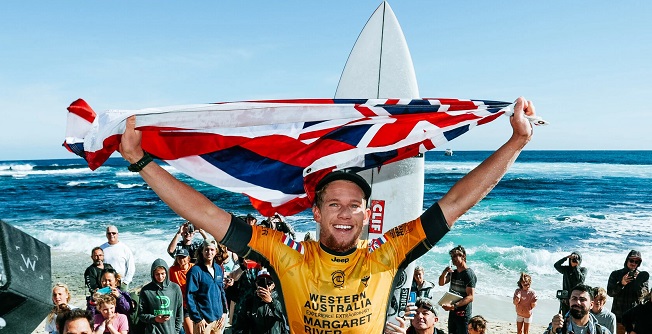
Surfer Hawaii

This was news to me: in the World Surf League and in international surfing competitions generally, surfers from Hawaii can represent island, or the United States. If they represent Hawaii, they are not regarded as representing the U.S.

Surfing will be an event in the Summer Olympics in Tokyo, and the option of just representing Hawaii will disappear. Hawaiian surfers will represent the United States, since, after all, Hawaii is a state. This, believe it or not, is causing outrage and consternation in the Aloha State. Two of the four Americans on the team, John John Florence (above) and the four-time world champion Carissa Moore, were born and raised in Hawaii and are accustomed to competing under the state flag. Moore is doing so again this month as the global tour holds major events in Australia.

Across the islands, on cars and on porches, Hawaii flags fly upside down, signifying distress. “Hawaii has had so much erased history,” said Duane DeSoto, the 2010 longboard world champion, told the New York Times. “Surfing prevailed against the possible suppression into oblivion. It endured the challenge of being exterminated at one time. And now it needs to be a source of Hawaiian pride.” Another surfer said, “In surfing culture worldwide, everybody looks at Hawaiian surfing as different. Even California surfers look at Hawaii different. But the Olympics see us as the same.”

Continue reading

Baseball Ethics Notes, Because I Know Baseball And I Know Ethics, And If You’re Not Interested, You Don’t Have To Read it

Pillar

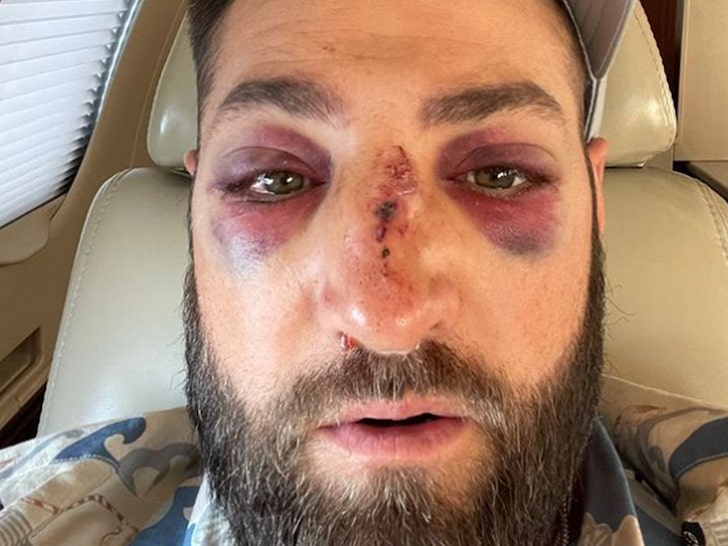
1. As predicted, Major League Baseball announced that Twins reliever Tyler Duffey has been suspended for three games and fined an undisclosed amount for “intentionally throwing a pitch behind Yermín Mercedes of the Chicago White Sox during the top of the seventh inning of Tuesday night’s game at Target Field.” Minnesota manager Rocco Baldelli was suspended for one game and fined for the incident. This all came out of the weird “unwritten rules” incident I wrote about here. Throwing at or near a player who breached an “unwritten rule” was how such rules were once enforced, and umpires allowed it. Now throwing at players deliberately is treated as the dangerous practice it always was, as the game was reminded of this week when Mets outfielder Kevin Pillar (above) was hit in the face by a fastball. Beanballs were once considered part of the game, and in fact an essential tool of the successful pitcher, and long before batters wore helmets.

2. Still more on the Mercedes incident: White Sox manager Tony LaRussa, who has been generally ridiculed for his insistence that his player should not have hit a home run on a softball league pitch when his team was ahead by 11 runs, keeps insisting that he is right and everyone else is wrong. “If you’re going to tell me that sportsmanship and respect for the game of baseball and respect for your opponent is not an important priority, then I can’t disagree with you more . . . Do you think you need more [runs] to win, you keep pushing. If you think you have enough, respect the game and opposition. Sportsmanship,” he told reporters. Well, in baseball, you never know how much you need to win. Eleven is pretty tough, but the Boston Red Sox scored 17 runs in one inning against the Detroit Tigers on June 18, 1953. You never know. It’s also sportsmanship not to cheat the fans by trying to pitch or hit as well as possible, every time, all the time. That means bad sportsmanship includes a team letting a position player pitch, which is the equivalent of a white flag. That’s how this whole thing started.

Continue reading

Morning Ethics Warm-Up, 5/20/21: Happy Birthday, John Stuart Mill!

Mill

John Stuart Mill (1806–73), was born on May 20, not merely the most important figure in ethics to have a connection to this day, but also the most important human being born on this day in the history of civilization—yes, even more than Cher, who turns 75 today. Mill’s refined the concept of liberty that required the freedom of the individual in opposition to state control. He was the most influential proponent of utilitarianism, the crucial ethical theory developed by Jeremy Bentham. He helped reform scientific inquiry and research, recognizing the pervasive risks of confirmation bias, by clearly explaining the premises of falsifiability as the key component in the scientific method.

Mill was also a Member of Parliament and a towering figure in liberal political philosophy. You have certainly heard or read his most famous quote: “A society that will trade a little liberty for a little order will lose both, and deserve neither.”

A thorough biography and analysis of his work is here.

1. Justice Breyer doesn’t care about making sure the Supreme Court doesn’t get more conservative. Good. That’s not his job. Democrats realize that their control of the Senate is hanging by a thread, “thread” defined as a few superannuated Senators who could drop dead any second, giving the GOP a majority. Thus they are increasingly pushing Justice Stephen G. Breyer, 82, to retire now so Joe Biden can name an appropriately liberal replacement (who will also have to be female and black, vastly limiting the pool of possible choices without concern for actual legal competence.) “Breyer’s best chance at protecting his legacy and impact on the law is to resign now, clearing the way for a younger justice who shares his judicial outlook,” wrote Erwin Chemerinsky, the hyper-partisan dean of the law school at the University of California, Berkeley in The Washington Post this month. Got that? The 80+year-old Democratic Senators have to hold on to their jobs like grim death, but Breyer is being lobbied to retire. Hypocrisy, they name is Democrat! But it isn’t Breyer:

The Justice has been particularly vocal about the importance of not allowing politics to influence judges’ work, including their decisions about when to retire. “My experience of more than 30 years as a judge has shown me that, once men and women take the judicial oath, they take the oath to heart,” he said last month in a lecture at Harvard Law School. “They are loyal to the rule of law, not to the political party that helped to secure their appointment….If the public sees judges as politicians in robes, its confidence in the courts, and in the rule of law itself, can only diminish, diminishing the court’s power.”

I wonder if he’s read (or seen) “The Pelican Brief”…Meanwhile, research suggest that retirement tends to kill Supreme Court Justices. A paper in The Journal of Demography studied the effects of retirement by Supreme Court justices on their future longevity, and found that the effect of retirement was about the same as smoking two packs of cigarettes a day. The Democrats don’t care if Breyer dies sooner than later, though, as long as he does it when they can pick his successor, or after he’s quit.

Continue reading

From The Ethics Alarms Mailbag: “Are Unwritten Rules Unethical?”

unwritten rules

The short answer is “No,” but the context of the question is fascinating, because it’s an example of the problem with unwritten rules generally. Unwritten rules are cultural norms, that’s all, and all cultures have them. They serve as manners, social balms and traditions that fill in the inevitable gaps and loopholes that formal, written rules inevitably leave uncovered. But cultures evolve, and extreme situations create exemptions where cultural norms no longer make sense.

No culture has more so-called unwritten rules than baseball, and this situation from two days ago triggered the question.

With the Chicago White Sox, currently with the best record in baseball, were ahead of the pathetic Minnesots Twins 15-4. The Twins, not wanting to waste a real pitcher on a blwo-out, turned to utility infielder Willians Astudillo to face the ChiSox in the final inning. Throwing a the classic “nothing ball” that most non-pitchers bring to the mound in such situations, Astudillo retired the first two batters but fell behind 3-0 to White Sox catcher Yermin Mercedes. On the next pitch, a lob to get the ball over the plate, Mercedes swung away blasted the 47 mph toss out of the ball parkfor a 16-4 lead.

The Twins broadcasters and many of the Twins players were offended, saying that Mercedes had breached the unwritten rule that says players shouldn’t try to “show up” the losing team in a rout. You don’t steal bases, you don’t sacrifice, and you don’t swing away at an “eephus pitch” to get a cheap home run. It’s essentially a Golden Rule based unwritten rule, though when it applies is a matter of dispute. Baseball teams have made up some very large deficits through the decades: a win is never a sure thing no matter what the score. Eleven runs, however, is certainly a big enough gap to make the rule relevant: the odds against a comeback are astronomical.

On the other hand, players are paid according to their statistics. Mercedes’ homer off of a non-pitcher will look the same in the record books as if Jacob DeGrom had thrown the ball.

But wait…there’s more! In the next game, an eventual 5-4 Minnesota win,Twins manager Rocco Baldelli andT wins reliever Tyler Duffey were ejected (they will also be fined and suspended) after Duffey threw a fastball behind Mercedes in retaliation for the “unwritten rule” breach. Baldelli, following the usual script, swore that the pitch was an accident, and that it was just a coincidence that his reliever scared the hell out of the same player who hit the controversial home run the previous night.

Then White Sox manager Tony La Russa announced that he agreed with the Twins throwing at his player, because Mercedes had broken an unwritten rule! This, in turn, was also an unwritten rule. Managers must not criticize their own players in public, and never, ever endorse the opposing team throwing at one of them. (I’ve never heard of any manager doing this.)

The White Sox did not take LaRussa’s violation well. Chicago pitcher Lance Lynn tweeted, “If a position player is on the mound, there are no rules. Let’s get the damn game over with. And if you have a problem with whatever happened, then put a pitcher out there.”

Exactly.

Unwritten rules are ethical if:

  • Everybody knows what they are
  • They have a legitimate purpose
  • It is understood that as there are always exceptions where written rules don’t apply, there are exceptions where unwritten rules don’t apply,
  • Everyone pays attention to the evolving nature of the culture involved, and
  • It is understood that unwritten rules exist to make a culture more reasonable and rational. If an unwritten rule doesn’t accomplish that, then the rule should be revoked.

___________________________

Pointer: JutGory

Continue reading