by Curmie
[This is Jack: It was bound to happen: Curmie and I decided to write posts on the same topic: my discourse on the Awful Aussie Breaker was posted earlier today. It’s not fair, really. Curmie is a lot more elegant a writer than I am. Enjoy his take: I did.]
When I was an undergrad, I wrote a fair number of theatre reviews for the college newspaper. One show I reviewed was a student-written revue-style piece that had everything from original songs to vulgar humor (the central shtick was that we should solve the energy crisis by harvesting buffalo farts for the methane). One segment I praised was a hilarious parody of a pretentious modern dance piece. There was one problem, though. The choreographer/dancer in question wasn’t pleased; he didn’t think it was a parody. Oops.
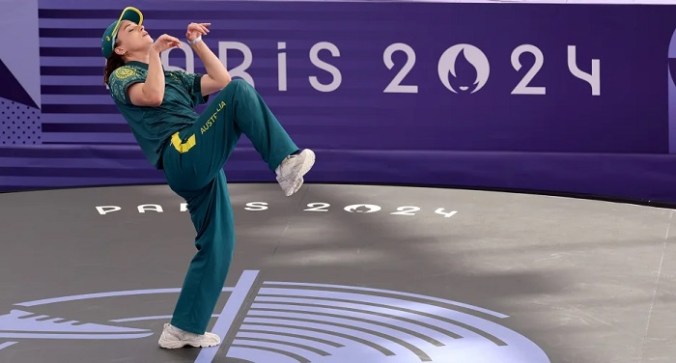
That incident was called to mind this week when I learned that Rachael Gunn, a 36-year-old Australian college professor with a PhD in cultural studies, has become an internet sensation by placing last in the breaking (formerly known as break-dancing) competition at the Olympics. Competing as B-girl Raygun (don’t blame her for that part; such noms de guerre are apparently required of competitors) she went through a series of maneuvers looking like a cross between a demented inchworm and flounder flopping on the deck of a fishing vessel. What it certainly was not was anything that could reasonably be described as a demonstration of strength, balance, or skill of any description.
There are a lot of questions here, not the least of which being what the hell breaking is doing as an Olympic event (I refuse to call it a “sport”). Like Jack, apparently, I have always despised the notion of “sports” in which the winners are determined by judges rather than by who got the most points or crossed the finish line first or whatever other objective criteria might be employed. This aversion is amplified when original moves are encouraged if not required. If a gymnast, diver, or figure skater does one more spin than anyone else has ever done or does it in a different position than it’s ever been done, that’s obviously harder and can be reasonably rewarded. But breaking has no apparent guidelines other than what each individual judge thinks is cool (or whatever term is currently in vogue). Gunn says all her routines were original. We can only hope so.
All of this, of course, is an extension of a belief that any activity that requires any measure of athleticism ought to be a sport. Hence artistic (formerly “synchronized”) swimming, skateboarding, rhythmic gymnastics, breaking, etc. appear as Summer Olympic sports. I’m not here to suggest that these events don’t require a combination of strength, precision, stamina, timing, and agility. Of course they do! So does ballet. So does roofing a house. I’m just not interested in seeing how many style points are deducted for using more nails than necessary or having a little caulk spill out of the gun.
Anyway, revenons à nos moutons… Gunn was, not to put too fine a point on it, pretty awful. Could I do her routine? Not now, no. But I’m pretty sure I could have when I was her age, and that puts her well beneath the status of an elite athlete. So what’s going on here? Well, she apparently won the qualifying tournament for Oceania (I really don’t want to see who came in second), and she’s represented Australia at the world championships three years in a row, so she’s at the Olympics fair and square. There is a qualifying time in, say, a track event (I have a former student who placed second in the Olympic trials in a middle-distance race, but missed the qualifying time by a fraction of a second), but if you’re the best your nation or geographical area has to offer, you get to go, and it’s difficult to establish a qualifying standard if there’s nothing objective about the decision-making.
So, what’s going on? Well, there’s the post on X that calls her a “grievance studies scholar” and claims she has argued that “breaking’s institutionalization via the Olympics will place breaking more firmly within this sporting nation’s hegemonic settler-colonial structures that rely upon racialized and gendered hierarchies.” Speaking as a PhD in the humanities, I respond, “Huh?”
Continue reading →