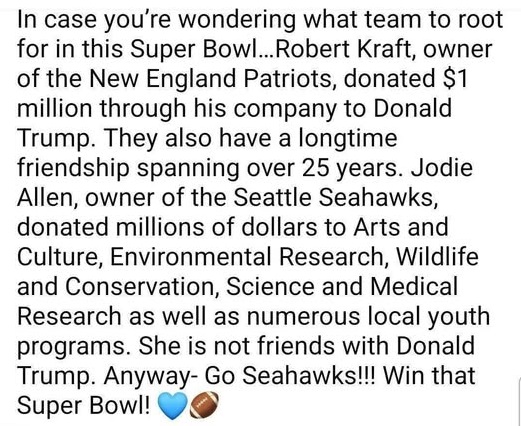
The above tweet (Do they still call them that even though it is no longer Twitter? We need a new word. “Xeet”? “Exit”?) is being circulated on social media followed by declarations that the only ethical course is to root for the Seattle Seahawks in this weekend’s Superbowl broadcast. My Facebook friend, an esteemed professor whom I have known in an arts context since 1969, making him also one of my oldest friends, posted it with commentary stating that the contents made it clear that every decent, thinking person should be rooting for Seattle.
My friend calls football “concussion-ball”) and reviles the sport for the same reason I do, though I have extra ethical ammunition against the National Football League, easily the most unethical among the spectacularly unethical professional sports organizations. If I were inclined to watch the Superbowl, the fact that the NFL was so irresponsible as to pick a cross-dressing, open-borders Trump-Deranged performer who will mostly perform in Spanish to lead its half-time show in what was once a non-partisan, All-American event that everyone could watch without feeling political anxiety would end that inclination instantly.
Who decides what sports teams to root for according to whom their owners are friends with, or where their political contributions go? My answer: crazy people. These factors have absolutely nothing to do with the sports, the teams, the players, or the entertainment value of the team’s games.
If one is looking for a professional sports team to favor and one is a wokeness-obsessed loony, it is probably impossible to cheer on any of them. They are all owned by billionaires or consortia including big, bad corporations. They are all privileged tycoon who reliable act as if they can make their own rules, because much of the time, they can. Jody Allen, for example, was sued along with her brother and Vulcan, the holding company she served as CEO in 2013 by five of her former security guards who alleged sexual harassment by Jodie, illegal activity, cover-ups and more, including bribing customs officials to smuggle animal bones out of Africa and Antarctica. The lawsuit was settled out of court, probably because that’s what rich people and corrupt corporations do when they are scared to death of what discovery will uncover. Not that any of that should matter to a Seattle Seahawks fan.





 Ethics Alarms