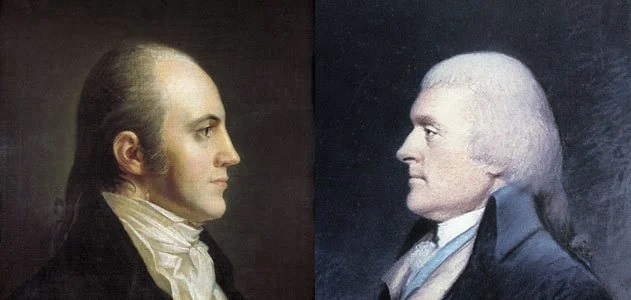
Those who like to maintain that the Founders were infallible and the Constitution flawless would do well to remember this date, when the U.S. narrowly averted a disaster entirely made possible by bone-headed drafting of our road-map to a republic. On February 17, 1801, Thomas Jefferson was elected the third president of the United States, the first peaceful transfer of power from one political party in our history, as Jefferson’s fledgling Democratic-Republicans upset the Federalists of Washington, Adams and Hamilton. It was a close call, however, because Jefferson was nearly defeated by hos own Vice-President, the sinister Aaron Burr (That’s him on the left above.)Though Jefferson and Burr ran on the same ticket, the Constitution required state elector votes for both men to be counted separately. As a result, Jefferson and Burr emerged from the process tied at 73 electoral votes apiece, while the sitting President, John Adams, came in third at 65 votes. This sent the final vote to the House of Representatives. Of course, if Burr weren’t a sociopathic cur, he could have solved the botch by simply withdrawing from the Presidential race since nobody voted for him to be President. The Federalist-controlled House of Representatives, meanwhile, was happy to see Jefferson enmeshed in the controversy, and were delighted in the dealock In the end it was Federalist Alexander Hamilton who saved the day and the nation, as he persuaded the House to vote against Burr, whom he called unfit. (This moment of high principle—Jefferson and Hamilton were far from pals–led to the duel with Burr in 1804 that resulted in Hamilton’s death.) As for the ridiculously incompetent voting system, it was cleared up by the 12th Amendment, ratified in 1804. The fact that the first version didn’t inflict Aaron Burr on the still-vulnerable United States, however, was pure moral luck.
1. “Best Excuse for Unethical Conduct” of the Month: Bruce Lee, a Chicago ticket broker, was convicted of fraudulently selling tickets to White Sox games and sentenced to prison this week. The federal judge rejected his defense that he had actually helped the team, because it wasn’t going fill those seats anyway and the fans who bought his fake tickets spent money on food, drink, and souvenirs. The judge called the argument that nobody was harmed “delusional,” and saying that it was important to make the point to others who might try similar schemes that getting caught would have negative consequences.
The judge must be a Republican, since that line of reasoning appears to be taboo on the other side of the aisle regarding “minor” crimes. Continue reading