I Dunno…The Latest From “The Ethicist” Has Me Tempted To Cancel Him

Prof. Kwame Appiah, the latest (and arguably the most ethical) in a long line of proprietors of the Sunday Times “The Ethicist” column has long provided me with fodder for ethics posts, often critical ones. Appiah might finally have jumped the shark however: I don’t know that I can continue to regard him highly after his collection of rationalizations employed to answer a TV screenwriter’s query about whether it is ethical for him to use generative artificial intelligence bots to write screenplays he is paid for and puts his name on. “So what ethical line would I be crossing? Would it be plagiarism? Theft? Misrepresentation?” the inquirer asks.

My answer is simple: using AI as inspiration or even a model isn’t any of those things, just like a screenwriter reading other writers and watching movies with deft screenplays is legitimate source material inspiration. Most artists “steal” from other sources, altering their models sufficiently to pass as original, and rightly so. There’s a line where imitation and inspiration becomes theft and plagiarism—like when the Beach Boys lifted Chuck Berry’s “Sweet Little Sixteen” almost note for note—but short of that line is just art as usual. At least, however, the artist is the one doing the adapting and ethical tight-rope walking, not a machine. I feel the same way about authors using AI to write their products exactly the way I feel about AI judging: the human being, his or her experience, quirks, patterns, world view and more is why a screenwriter has the job. Using a bot, and I don’t care how it has been programmed, to produce full scenes and dialogues is lazy and dishonest. Individuality is a writer’s, indeed any artist’s, most valuable commodity.

In short: what the screenwriter is proposing is unethical. Now here’s “The Ethicist’s” take. I’m going to post it all, and leave it to you to name the rationalizations, which you can find here.

“We’re done here.” Some years ago, sleepless in a hotel room, I flicked through TV channels and landed on three or four shows in which someone was making that declaration, maybe thunderously, maybe in an ominous hush. “We have nothing more to discuss.” “This conversation is over!” Do people really talk like that? Possibly, if they’ve watched enough television.

“My point is that a good deal of scripted TV has long felt pretty algorithmic, an ecosystem of heavily recycled tropes. In a sitcom, the person others are discussing pipes up with “I’m right here!” After a meeting goes off the rails, someone must deadpan, “That went well.” In a drama, a furious character must sweep everything off the desk. And so on. For some, A.I. is another soulless contraption we should toss aside, like a politician in the movies who stops reading, crumples the pages and starts speaking from the heart. (How many times have we seen that one?) But human beings have been churning out prefab dialogue and scene structures for generations without artificial assistance. Few seem to mind.

“When screenwriters I know talk about generative A.I., they’re not dismissive, though they’re clear about its limits. One writer says he brainstorms with a chatbot when he’s “breaking story,” sketching major plot points and turns. The bot doesn’t solve the problem, but in effect, it prompts him to go past the obvious. Another, an illustrious writer-director, used it to turn a finished screenplay into the “treatment” the studio wanted first, saving himself days of busywork. A third, hired to write a period feature, has found it helpful in coming up with cadences that felt true to a certain historical figure. These writers loathe cliché. But for those charged with creating “lean back” entertainment — second-screen viewing — the aim isn’t achieving originality so much as landing beats cleanly for a mass audience.

“So why don’t the writers feel threatened? A big reason is that suspense, in some form, is what keeps people watching anything longer than a TikTok clip, and it’s where A.I. flounders. A writer, uniquely, can juggle the big picture and the small one, shift between the 30,000-foot view and the three-foot view, build an emotional arc across multiple acts, plant premonitory details that pay off only much later and track what the audience knows against what the characters know. A recent study found that large language models simply couldn’t tell how suspenseful readers would find a piece of writing.

“That’s why I hear screenwriters talk about A.I. as a tool, not an understudy with ambitions. I realize you’ve got another perspective right now: “We’re not so different, you and I,” as the villain tells the hero in a zillion movies. But don’t sell yourself short. You fed the machine your writing before you asked it to draft a scene. You made it clear what dramatic work was to be done. And so long as you and the studio or production company are consenting parties on this score, you’ll be on the right side of the Writers Guild of America rules. Your employers wanted a script; you’ll be accountable for each page they read. And though generative A.I. was trained on the work of human creators, so were you: Every show you’ve watched, every script you’ve read, surely left its mark. You have no cause to apologize.

“Does the entertainment industry? It was hooked on formula, as I’ve stressed, long before the L.L.M.s arrived. Some contrivances endure simply because they’re legible, efficient and easy to execute. Take the one where one character has news to share with another, but is interrupted by the other’s news, which gives the first character reason not to share her own news. Then comes the inevitable: “So what was it you wanted to tell me?” Ulp! Writers have flogged that one for decades; why wouldn’t a bot cough it up? The truth is that many viewers cherish familiarity and prefer shows, especially soaps and franchise fare, to deliver surprises in unsurprising ways. Still, there will always be an audience for work that spurns the template — for writers who, shall we say, think outside the bot.

“That’s the bigger story. In the day-to-day life of a working writer, the question is less abstract. If people press you about your A.I. policy, point to the guild’s rules. Tell them that every page you submit reads the way you want it to. Then announce: We’re done here.

Continue reading →

When Ethics Alarms Don’t Ring: The Firemen and the Baseball Field

In July, a Silver Spring, Maryland fire house captain became so annoyed by home runs landing in the department’s parking lot from a nearby baseball field that he used a hose from a fire truck to flood the field. There is no question about what he did: a video recorded the deluge over the outfield fence that lasted three minutes.

This government employee tantrum, according to Montgomery County court records, caused at least $1,000 in damage and left the baseball field in such bad shape that two home games had to be canceled. Police have filed criminal charges against the captain and a fellow firefighter accused of backing up the truck to assist with the flooding scheme. Christopher J. Reilly, the captain, and Alan K. Barnes, a master firefighter, have each been charged with three misdemeanor counts: disorderly conduct, malicious destruction of property valued at more than $1,000 and conspiring with each other to commit malicious destruction of property.

The Washington Post’s story about the incident goes to great lengths to let apologists for the juvenile fireman have their say. Even if the firemen were to plead guilty, one defense lawyer told the Post, their motives could might be seen by a jury understandable. After all, the Montgomery County fire department explained that baseballs have damaged both the fire station just behind the ball field’s left field fence and vehicles parked in its lot. “I would argue that they thought a little water would be a harmless way to teach them a lesson,” the lawyer said.

Oh. Well, as long as they thought flooding the field was harmless, it was harmless, right? The firemen should both be fired and convicted, but I’ll bet that they get the lightest slap on the wrists at most. They are heroes, after all, and Rationalization # 11, the Kings Pass will protect them if Rationalization #2 or #33 don’t.

Moral Luck and Baseball: The High-Profile Ruinous Ball-Strike Call Comes AFTER The Problem Has Been Addressed


Next season, Major League Baseball will implement the Automated Ball-Strike (ABS) Challenge System. For the first time in regular-season history, batters, catchers and pitchers will have the right to challenge balls and strikes. Teams will begin each game with two available challenges and can continue challenging until they lose challenges twice.

The system has been desperately needed for many years, ever since each player’s strike zone could be seen on television screens during game broadcasts. As usual, baseball dragged its metaphorical feet addressing the problem, with the idiotic “bad calls by the umpire are part of the game” argument that traditionalists and ex-players are still using. That logic makes as much sense as defending medical malpractice because “everyone makes mistakes.” Sure, before video technology could prove a key ball or strike call was a bad one, tolerating home plate umpire mistakes (like the one that cost the Boston Red Sox Game 3 of the 1975 World Series and conceivably the Series itself) were part of the game, because nothing could be done about it. Now something can.

Continue reading →

Oh Look! Another Alleged “Professional” Showing Disrespect For This President That He Would Never Show For Any Other…

…Or that any previous holder of his position would have ever dreamed of displaying to any previous President.

The White House, you see, asked the Dwight D. Eisenhower Presidential Library, Museum and Boyhood Home to turn over the Sword of Honor given to Ike in 1947 by the city of London for his role as Allied Supreme Commander during World War II, so President Trump could now give it to King Charles last month during the President Trump’s state visit to the United Kingdom. The gift would symbolize the continuing bond between the two nations that was most powerfully forged during that war, but never mind: Todd Arrington, a career historian who was director of the museum, refused to allow the President to use the sword as a weapon of diplomacy, insisting that it had been donated to the institution and “belonged to the American people.”

Oh. Well, anything the government uses for any purpose “belongs to the American people.” Trump was reduced to giving the King a replica of the sword, and was, justifiably, ticked off. Arrington was told he could resign or be fired. He resigned.

Continue reading →

Ethics Heroes: Hundreds of Northwestern Students

Northwestern University required mandatory viewing of an anti-Semitism training video to comply with President Trump’s crackdown on campus harassment and abuse of Jews. At least 300 of the school’s 22,000 students have boycotted the training, so the university barred them from registering for fall classes. Northwestern also requires students to watch anti-bias training regarding Muslims, and its email to the campus earlier this year announced that the new anti-Semitism training “will adhere to federal policy” in compliance with the President’s January executive order “Additional Measures to Combat Anti-Semitism.”

Indoctrination is indoctrination, and the subject of the indoctrination is irrelevant. The students who are refusing this abuse of education are right and principled, and I hope they refuse to fold.

The 17-minute video was produced by the Jewish United Fund and claims to teach students about “who Jews are, how Jews understand themselves, and how anti-Semitism has morphed throughout time.” The video defines anti-Zionism, which has gained popularity among radical anti-Israel protesters, as “the opposition to the Jewish right of self-determination,” warning that anti-Zionism “takes many forms, most of which are anti-Semitic because they work against Jewish human rights.”

Maybe it’s effective propaganda and maybe the video is generally or mostly true, but such a video is also an advocacy piece, and as with the Al Gore climate change hysteria film that my son was forced to watch at his over-priced private school where he attended 7th grade until we pulled him out of it, it is not the job or role of educational institutions to force their beliefs and political positions on their students.

“Sensitivity training,” “anti-bias training,” and any similar mandatory programs aimed at brainwashing attendees and eliminating “WrongThink” are unethical and abuses of power that are absolutely contrary to our nation’s values. The practice is indistinguishable from the “re-education camps” of the former Soviet Union. That current practitioners from the Left or the Right do not put cages with hungry rats in them on their victims’ faces doesn’t change the fact that the objective is the same: “Change how you think, or else.”

True: it would be nice if the boycotting students were also similarly sensitive to the unethical nature of indoctrination that aligns with their belief systems, in part the product of indoctrination.

But one has to start standing up for principles somewhere.

J.K. Rowling Smacks Down “Hermione”: Is It Ethical To Attack The Person You Owe Your Wealth, Fame and Influence To?

To be clear, the one attacking the person she owes her wealth, fame and influence to isn’t Rowling, the creator of the Harry Potter books and the billion dollar industry it spawned, but Emma Watson, the now grown child actress who played cute Hermione in the films. It is Watson who has been criticizing Rowling by name for years because the British author has openly challenged the whole concept of transsexual ideology: that people can change their sex by just deciding they are the opposite sex than their genes make them and have the law accede to their decision.

The ethics issue today is not whether Rowling is right or wrong. The question is whether Watson (along with her fellow Harry Potter child stars Rupert Grint and Daniel Radcliffe) has behaved with gratuitous disloyalty and ingratitude by attacking Rowling by name while she is being vilified and threatened by other celebrities and the woke news media.

Not to keep you in suspense, the answer is yes. Rowling finally had enough, and responded with the scathing social media take-down of Watson that the actress deserves.

What was apparently the magical straw for Rowling was Watson saying in a recent podcast that that their opposing views on trans rights do not mean she can’t or doesn’t “treasure” Rowling as a person. “I will never believe that one negates the other and that my experience of that person, I don’t get to keep and cherish,” the has-been star blathered. “I think it’s my deepest wish that I hope people who don’t agree with my opinion will love me, and I hope I can keep loving people who I don’t necessarily share the same opinion with.”

That hypocrisy, for that’s what it is, was too much for Rowling, who unleashed her considerable rhetorical talents on Watson, and brava to that. Rowling wrote in part,

Continue reading →

Unethical Tit-For Tat: Great, Now The Trump Administration Is Playing “WrongSpeak” Games…

This revolting development was completely predictable to the extent of being virtually inevitable. Nonetheless, it is ominous, dangerous and disgusting, not to mention Orwellian, for the government to try to manipulate public opinion by banning words and phrases that can support opinions and beliefs authorities don’t want the public to hold.

The Energy Department last week added “climate change,” “green” “emissions” and “decarbonization” to its list of banned words and phrases at its Office of Energy Efficiency and Renewable Energy. The WrongSpeak/ThoughtCrime linguistic offenses already included “energy transition,” “sustainability/sustainable,” “‘clean’ or ‘dirty’ energy,” “Carbon/CO2 ‘Footprint’” and “Tax breaks/tax credits/subsidies.”

“Please ensure that every member of your team is aware that this is the latest list of words to avoid — and continue to be conscientious about avoiding any terminology that you know to be misaligned with the Administration’s perspectives and priorities,” the acting director of external affairs Rachel Overbey decreed.

The order applies to both public and internal communications and extends to documents such as requests for information for federal funding opportunities, reports and briefings. It’s obvious why the Trump Administration is going down this pro-indoctrination path. “It works!” as the late Harry Reid assures us from Hell. The ends justify the means, “They (the Democrats) did it first,” “Everybody does it,” yada yada yada: there are at least a dozen rationalizations on the list including #31. The Troublesome Luxury: “Ethics is a luxury we can’t afford right now” that will doubtlessly be resorted to by our current ruling censors. The practice is still unethical and the impulse is anti-American.

I believe that the linguistic attacks are encouraged by the reality that the news media is engaged in permanent pro-climate change hysteria propaganda. “Climate change is caused by rising greenhouse gas emissions, which is driven primarily by burning oil, coal and natural gas for energy,” Politico states confidently while reporting on the new language edict at Energy. More:

Continue reading →

The Democrats’ Way: When The Facts Are Damning Just Make Stuff Up and Count On Your Complicit News Media To Have Your Back.

Kamala Harris, the worst, most unqualified major party Presidential candidate since Horace Greeley, continued her ridiculous “It wasn’t my fault!” tour last week by telling Rachel Maddow on MS (MSNBC) that 2024 was “the closest presidential election in the 21st Century.”

It wasn’t. It wasn’t even close to the closest. Donald Trump beat Harris in the Electoral College 312-226. Joe Biden beat Trump in 2020 by a tighter margin, 306-232. Trump beat Hillary Clinton 304-227 in 2016. also closer. Only two elections in the 21st Century have been decided by wider margins in the EC, 2008 and 2012.

The 2024 election wasn’t closer than most of the recent elections in the popular vote either. Bush lost the popular vote, but won the Electoral College in 2000, as did Trump in 2016. Al Gore in 2000, John Kerry in 2004, Clinton in 2016, and Trump in 2020 all needed fewer votes to flip to win the Electoral College than Harris in 2024 too. In short, Harris’s claim had no basis in reality. At all. Whatsoever. Sort of like the claims that she ran a “flawless” campaign. Or the DNC’s spin that Harris lost because America is racist and sexist.

Did you know Donald Trump lies all the time? He exaggerated the size of his inauguration crowd in 2017!

Yet there was Rachel Maddow, nodding and smirking away as Kamala flogged her fake history, helping to make her show’s viewers more ignorant and misinformed that they already were, which, he show being on MSNBC, was already considerable.

Nice.

End of an Awful Week Ethics Potpourri, 9/17/2025

How awful? Oh, awful for me personally, a I was sick for most of it and had a serious Missing My Dead Wife relapse; awful for ethics, as there were even more disgusting events than usual; awful for good taste, as Jimmy Kimmel was back on the air, where he is and has always been a toxic pollutant, and the Trump Administration’s ham-handed attempts at censorship turned the creep into some kind of First Amendment martyr—is that enough for you? It’s enough for me. Meanwhile…

1. Kash Patel fired all of the FBI agents who kneeled to honor George Floyd, or Black Lives Matter, or something. Ooooh, another freedom of speech controversy, and another opportunity to accuse the Trump Administration of being racist! Was this move necessary, fair and responsible, never mind legal? My verdict: unnecessary, fair and arguably responsible, as such conduct shows wretched judgment and possible anti-law enforcement bias, but as speech goes its rather vague to justify firing, don’t you think? Or is it just MAGA grandstanding?

2. Speaking of grandstanding, former child star and #MeToo activist Alyssa Milano decided to make a public spectacle of having her breast implants removed. The 52-year-old shared an Instagram photo of herself in a hospital gown, and explained why she’s undergoing the removal process. “Today I’m releasing those false narratives, the parts of me that were never actually parts of me,” she wrote “I’m letting go of the body that was sexualized, that was abused, that I believed was necessary for me to be attractive; to be loved; to be successful; to be happy.” Translation: “I haven’t worked in years, and the implants weren’t doing me any good, so my publicist thought I could get some interviews and podcasts by making a big deal out of getting rid of the things.” Is she also eschewing make-up, hair extensions, false eyelashes, tooth implants, botox and other parts of her that were never actually parts of her? Those implants did their job (they got her the role of “Long Island Lolita” Amy Fisher once upon a time), but now that they have outlived their usefulness, she’s kicking them on their way out. Seems mighty ungrateful to me! Aging, desperate celebrities and attention addicts are a tragic group….

Continue reading →

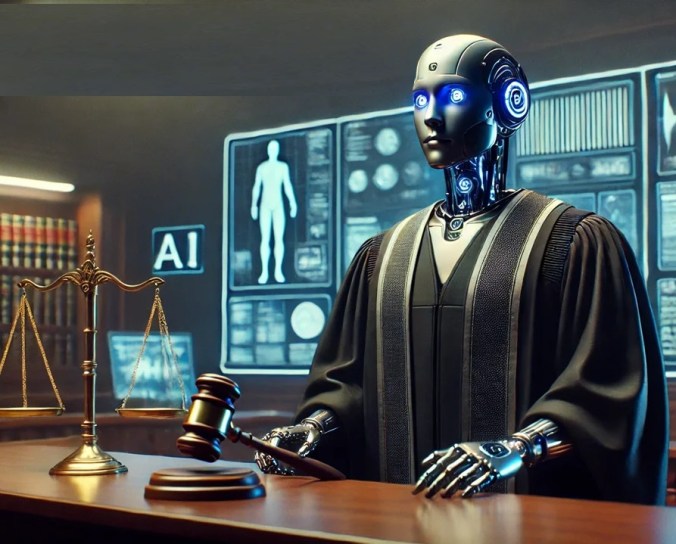
Oh-Oh. Here Come the Robo-Judges…

Google “AI judges” and you will see many links to news articles and even scholarly treatises about the use of artificial intelligence in the judiciary. There are already bots trained as “judicial opinion drafting tools,” and manuals written to help judges master them.

There have already been incidents where judicial opinions have been flagged as having tell-tale signs of robo-judging, and at least two judges have admitted to using AI to prepare their opinions.

I hate to appear to be a full-fledged Luddite, but I am inclined to take a hard line on this question. The title “judge” implies judgment. Judgement is a skill developed over a lifetime, and is the product of upbringing, education, study, observation, trial and error, personality, proclivities and experience. Every individual’s judgement is different, and in the law, this fact tends to imbue the law with the so-called “wisdom of crowds.” There will be so many eccentric or individual analyses of the troublesome, gray area issues that cumulatively there develops a learned consensus. That is how the law has always evolved. In matters of the law and ethics, an area judges also must often explore, diversity is an invaluable ingredient. So is humanity.

Continue reading →