Baby steps: it apparently is too much right now to expect American journalism to report important events and developments objectively and fairly so the citizens of the republic can intelligently govern themselves. For now, Ethics Alarms would be satisfied if it would just avoid making the public more ignorant and less able to do its own analysis. This also appears to be, if attainable, a long way off.
Two CNN pieces today show how far the news media has to come to meet that standard, assuming they want to—which I doubt.
First, here is Harry Enten, CNN’s Senior Political Data Reporter who supposedly specializes in data-driven journalism, stating the obvious as if he had just translated the Rosetta Stone. In “2024 marks a 21st century rarity: Almost everyone thinks the election results are legitimate,” he takes more than 800 words to “analyze” a phenomenon he should have been able to explain in fewer than 50. Here, Harry, try this: “The 2024 election victory by Trump isn’t being challenged as illegitimate because he won the popular vote and his decisive Electoral College victory was not dependent on a few razor-thin margins in swing states where the rules were violated due to a pandemic.”
Incredibly Harry, who has been much praised since the election for not being as biased against Republicans and Trump as virtually everyone else at his network, doesn’t focus on that fact at all, but rather hypothesizes about the U.S. entering a new “era of acceptance.” There is nothing “new” about accepting a President-elect’s clear win in both the popular and electoral vote. The 21st Century has seen just seven Presidential elections. In 2000 and 2016, the winner lost the popular vote. The American public doesn’t comprehend the Electoral College or why we have it, our educational system doesn’t teach it, so the public is ignorant and thinks such an election has produced an “illegitimate” President. That’s two out of seven elections that were not “accepted.”
Then there was 2020, where the news media had been undermining Trump for four years, the pandemic allowed the Democratic challenger to hide while the news media lobbied for his election, and obviously insecure voting methods were allowed in key states without adequate preparation or oversight. (Enten repeats the Axis mantra that Trump’s claims about the election were “unfounded.” That’s a lie. The proper words would be “substantially, but not entirely, unprovable.”) The 2004 election, like 2020, would have had a popular vote loser win the Electoral College if just a couple of close states had flipped, so many Democrats claimed that Kerry’s loss was “illegitimate.”
To support his theme, like so many unethical “experts,” Enten elides over inconvenient facts. He says that nobody thought Obama’s reelection in 2012 was “illegitimate,” but in truth there were many reasons to feel Mitt Romney was jobbed, starting with, again, the news media bias against him, Candy Crowley’s unethical interference on Obama’s behalf when the Benghazi scandal came up in the Presidential debate, and later, when it was discovered that Obama’s IRS illicitly sabotaged the political activities of Tea Party non-profits until after Obama was safely elected.
In short, the Presidential elections where the public saw good reasons to question their legitimacy (2000, 2004, 2012, 2016, and 2020) were questioned, and those where such conditions—-close votes in swing states, egregious cheating by the news media on behalf of the winner, dodgy election security— didn’t exist were substantially without controversy (2008 and 2024). There has been no cultural shift to “acceptance.” The next time a popular vote loser wins in the Electoral College, it will be back to same old refrain.
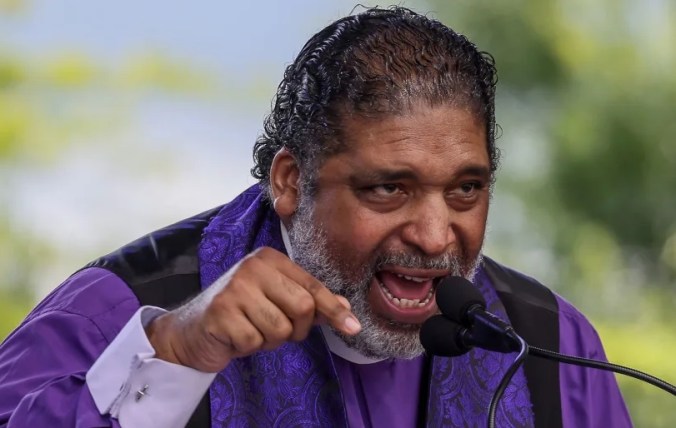
Next we have this flagrant propaganda from CNN: “This fiery evangelical pastor offers a blueprint for Democrats’ revival in Trump’s second term.”Elevating a religious huckster to the status of an authority figure is an unethical ploy by CNN to justify more Trump-bashing using the Axis’s newly popular “Trump supporters are immoral” theme. Funny, this was a mode of analysis the current practitioners mocked when Bill Clinton was caught exploiting his intern in Oval Office hummer sessions.
The article introduces the Rev. William J. Barber II (above) as “one of America’s most persistent and eloquent spokespersons for poor and working-class Americans” who has been called “the closest person we have to MLK.” In fact, he sounds like the closest person we have to Jesse Jackson, or maybe Al Sharpton (other than Al himself, of course). Thus the Reverend is used as an excuse for CNN to publish “analysis” like this…
Continue reading →






 Ethics Alarms