Good.
Late, but it was the only ethical course.
Now what?
Good.
Late, but it was the only ethical course.
Now what?
I’m going to have to complain to the Politics Gods about their timing: letting the “Oh no! Biden just let everybody know that we’ve been hiding his dementia all this time!,” story, the “Trump only cares about himself but Biden won’t do the obvious responsible thing and step down and a candidate because that will hurt his ego!” and the Trump assassination attempt all overlap each other is just malpractice. It’s especially tough on me as I try in an election year to avoid my ethics blog turning into a politics blog. Hear my plea, ye Gods!
Meanwhile…
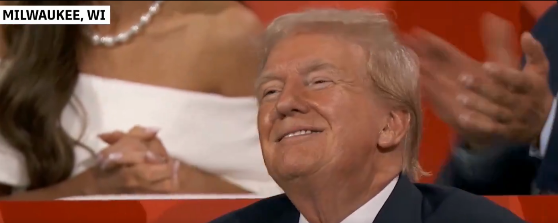
1. That graphic above is a screen shot from last night’s live broadcast of the GOP convention. Trump was a prominent audience member, which itself was historically unique: traditionally the putative nominee stays incommunicado until he makes his dramatic entrance to accept the nomination. Well, why shouldn’t he bask in the spotlight? Atheme of my honors thesis in American Government [“The Great Man Theory and the American Presidency”] was that a disproportionate number of our Presidents were “survivors” who lived through dramatic life-threatening ordeals that left them with convictions of their own invulnerability as well as the belief that they were destined to do great things. Trump didn’t fit that template, but he does now. Those death-defying incidents may have made Washington, Jackson, Polk, Lincoln, Teddy, FDR and others very different men, and better leaders, than they would have been without them. It will be fascinating to see if surviving an assassins bullet by a nanosecond has the same effect on Trump.
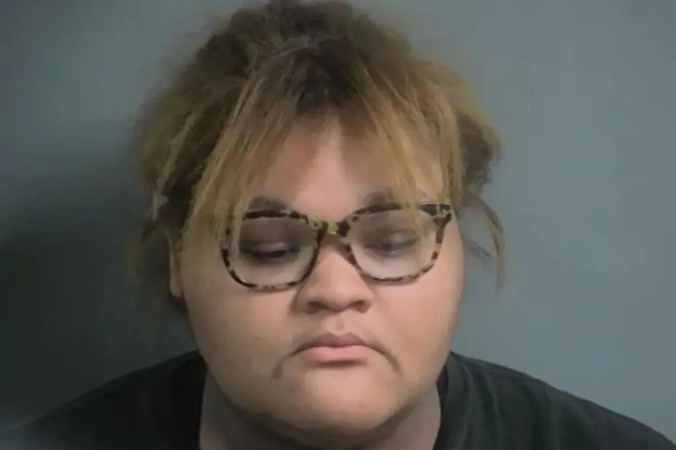
18-year-old Sumaya Thomas of North Liberty, Iowa was supposed to go on a blind date with a young man she had met on an online dating app. But by the time her date arrived at her abode to pick her up on the evening of June 16, Thomas had changed her mind. Did she tell him that to his face, like any normal, decent human being, apologizing for wasting his time and dashing his hopes? Oh noooo. Did she text him, the weenie’s way out? No. Did she just leave him on her doorstep, knocking and buzzing while she hid under the bed? No. Did she sneak out the back door? No, not that either.
Instead, Thomas called 911 and said her abusive ex- was outside harassing her because she was seven months pregnant with their child. She said she needed the police to get him off her property as he was threatening to “hit, punch, kick and stab her.”
Nice! A police car was dispatched, and when officers arrived they found an apparently calm, confused young man in the process of walking away. Upon being questioned about the situation, he explained that he had arrived to go on a date with the woman inside the house, and that he had only met her online a week ago.

The memo has gone out to alert Democrats that part of the plan to vilify and delegitimize the candidacy of Donald Trump is to constantly refer to him as a “34 times convicted felon,” or just “convicted felon” for short. The former is a deceitful description, though I’d guess 99% of those using it have no idea what Trump was charged with in the infamous “hush money” trial. In an egregious example of over-charging, Alvin Bragg’s lackeys turned a single misdemeanor into 34 felony counts, a slimy prosecutorial tactic but unfortunately a common one. But even “convicted felon” is misleading. A conviction in New York (and just about everywhere else) isn’t final until appeals have been exhausted and the defendant is sentenced. Neither has taken place yet in Trump’s case, and since the trial was as much of a partisan contrived travesty of justice as the charges, the smart money is on all those convictions being reversed.
Meanwhile, New York still operates under the common law doctrine of abatement ab intio, which holds that if a convicted individual dies before his or her appeals have been exhausted, the convictions no longer stand. That means, then, that if the aspiring assassin who shot the former President in the ear had killed Trump, he would have also rendered him innocent of those “34 charges.”
Trump would have been vindicated! Dead, but vindicated..
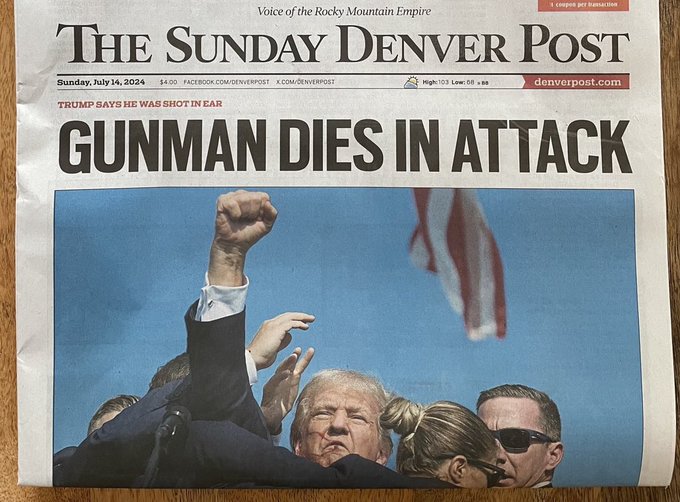
There are so many stunning examples of the apparently irrepressible Trump hate and anti-Trump bias in the news media that it would take an over-long post to thoroughly document it. I decided that the one above was the blue ribbon winner; I can’t even imagine the degree of ugly bias in a news room that would permit a headline like that to reach publication. Then there was CNN’s characteristically disgusting fake news spin:
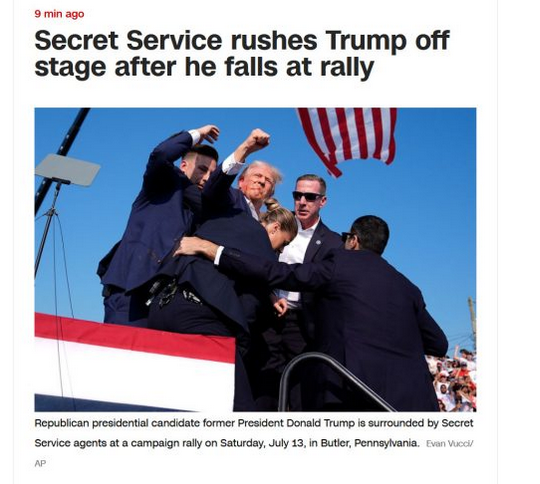 Anyone looking at the video could see that Trump didn’t “fall;” he ducked down after feeling a bullet hit his ear and hearing gunshots. In its front page photo, the New York Times carefully cropped out the American flag over Trump’s head, making the spectacular composition of the original photo…
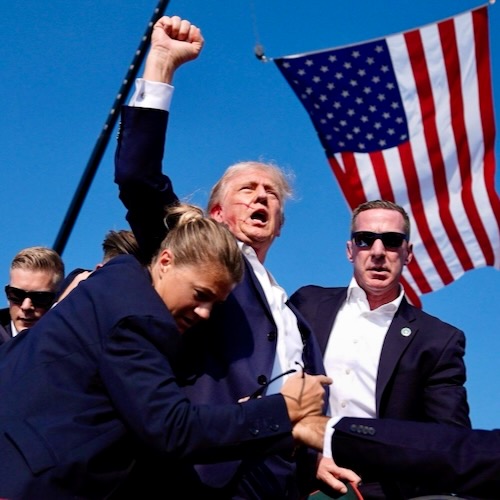
…look ugly: this was obvious cognitive dissonance scale manipulation. Mustn’t have any positive imagery linked to that monster Trump! Quickly after the incident, as EA already noted, a CNN talking head criticized him for saying “Fight!” minutes after he was shot, as blood dripped down his face. As I also noted, some found it an appropriate time to suggest that Trump’s upraised fist was another fascist “dog whistle.”
This was a confirmation bias classic: commenter Joel Mundt sent me these photos, none of which inspired a similar interpretation.
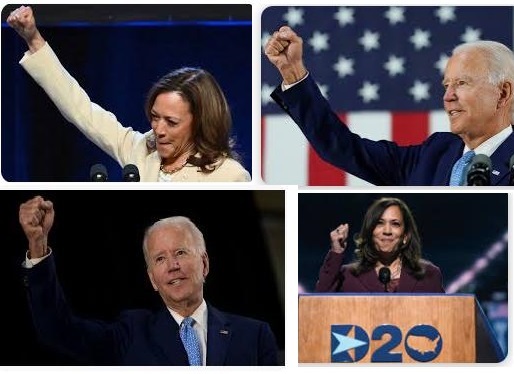
Gee, I wonder why? There was also a lot of triumphal fist-raising yesterday at Wimbledon too, but then we all know that pro tennis is a hotbed of fascism.

Ethics never sleeps. There I was, having a nice dinner cooked by a friend, my first dinner invitation in the four months since Grace’s death, and my night of escape from grim reality was shattered when my host informed me that someone took a shot at Donald Trump in Pennsylvania.
I have some observations about that….
1. The Democrats, resistance and mainstream media are accountable for this. Of course they are. They have been saying and writing that Trump is an existential danger to democracy and the nation. They have said that if he wins there will be no more election, no more Constitution, that he is an American Hitler. They have gone further than mere fearmongering, to terror-mongering. What did they expect? The Left is full of hysterical, reality-challenged whack jobs that Biden, Pelosi, the New York Times and many, many others have been priming for violence. Trump is “dangerous,” said the Times today. What does a patriot do when someone or something is a clear and present danger, in Joe Biden’s words, to the nation? Eliminate the danger.
2. This is on the Axis. They built up the narrative that Trump was a demon from Hell, and suddenly all of the Democrats’ cheats, devices and conspiracies were failing. The effort to put Trump in prison was transparent and faltering. Trump’s opposing candidate had exposed himself as an empty, debilitated, prop leader. All of the Big Lies have been used, discredited, and debunked. What was left? Why, killing Trump, of course!
I expected this, didn’t you?
3. The blather from the Biden Cabinet and White House condemning violence should be metaphorically spat back in these villains’ faces. They are the same people who blamed Sarah Palin for the shooting of a random Congresswoman because Palin had “targeted” Democratic districts on her website. These are the same people who blamed Rush Limbaugh and conservatives for the Oklahoma City bombing because of their relentless attacks on “big government.” But the insane levels of hate and hysteria the Left has heaped on Donald Trump wasn’t general like those partisan attacks, but very personal and specific: one man was the danger to the continued existence of the Land of the Free and the Home of the Brave. One single evil man. Biden and the rest said this over and over. The nation had to be saved from this monster, and it became obvious over the last two weeks that Joe Biden wasn’t going be able to do it.
4. Now, the fact that Trump was shot at doesn’t make the unethical, unforgivable nature of the unrestrained vilification of him over the last nine years any worse. That’s just moral luck: what the Axis has been doing would be just as wrong and irresponsible if no fanatic was moved to violence by it. The incident does have a way of sharpening one’s focus, however.
5. I’ll put it simply: the Democrats and their Machiavellian allies were asking for this to happen. They got it. They must not be allowed to duck responsibility.
Other observations:
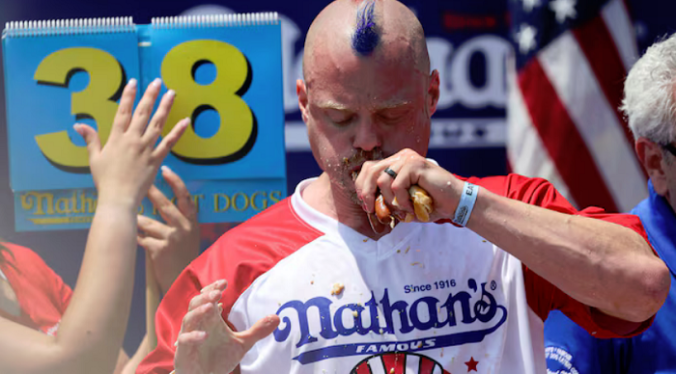
The President of the United States cheated in several ways last night, and we have been watching cheating become an accepted norm in the worlds of government, politics, law, academia, and sports. And so it has come to this: there was either cheating or an “appearance of impropriety” at Nathan’s Famous International Hot Dog Eating Contest over the Fourth of July.
When competitor Nick Wehry finished the 10 minute contest, judges ruled that he had eaten 46.75 hot dogs and buns, placing him 4th. But Wehry asked to have the officials check his results and they determined that there was an additional empty plate in his “finished” stack, which is how judges determine how many wieners an individual has eaten. The recount gave him a new score of 51.75.
Then the New York Post published “Buns of Steal”, reporting that witnesses accused Wehry of tampering with the empty plate total to add to his score. On EatFeats, an anonymous commenter posted links to videos with timestamps seeming to show that Wehry illicitly added to his empty plate count.
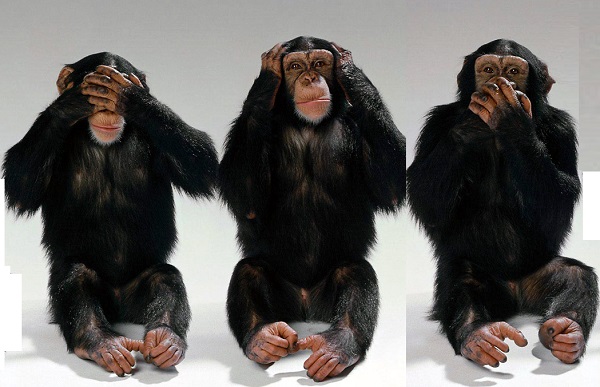
…or anything else, of course.
Today’s relevant story: a Milwaukee radio station admitted late yesterday that it edited a taped interview with President Biden when his campaign asked them to, because two of Biden’s responses were, in turn, embarrassing and incoherent. The station apologized and came clean, because now the mainstream media allies of the progressive and Democratic Party are dedicated to dumping Biden rather than pretending he’s a great President.
How many media outlets were working with the White House to deceive the public about Biden’s cognitive problems before his debate disaster? How much smoking gun evidence has been “scrubbed” over the past four years, including during the 2020 campaign?
It’s all truly disgusting, and Biden has the gall to claim that Trump is the threat to democracy.
Don’t get me started. Write about whatever ethics issues intrigues you.

My poor, MSNBC-addled sister, who is thoroughly Trump-Deranged (and I resent the mainstream media for doing this to her), keeps saying that though it isn’t ideal, of course, having a puppet President managed by competent professionals and handlers who are the ones really running the country is still preferable to having an evil President like You Know Who.
I have pointed out that this seems like an odd stance from a supporter of the party that purports to be defending democracy, since figurehead leaders are a traditional feature of non-democratic governments (much as, you know, trying to throw the political opposition in prison is). Aren’t The People supposed to know who is running their nation and aren’t they supposed to be the onesThe People voted for on the ballot?
“Humminahumina,” she replies. Besides, all those shadow managers and handlers know what they are doing, unlike the Evil Orange Man.
Suuuure. Ann Althouse just focused on a perfect example of just how inept these mysterious rulers are: they have dubbed today’s Make or Break Post Debate Test II the President’s “big boy press conference.”
Well, if nothing else, Stephen Colbert knows when to jump ship.
Last night, after 8 years of being almost entirely a Trump-bashing, pro-Democrat, pro-progressive, pro-Biden mouthpiece, late night comic Stephen Colbert (who also hosted a Biden fundraiser) decided to pick the low-hanging fruit and start ridiculing Joe Biden. Trump is used to this treatment, Biden is not. “They laughed at me, Mother,” the Willaim Jenning Bryan-based character Mattew Harrison Brady laments at the end of “Inherit the Wind” speaking of his previously loyal supporters right before Brady’s fatal stroke. The comics and Saturday Night Live had been one of Biden’s (and Obama’s, and even Hillary’s) most reliable lines of biased defense. If that crumbles—and it should—the President and his party’s fortunes will become even more dire.
Good.
2. Biden’s physician was obviously asked to release a letter insisting that Biden is in tip-top shape, based entirely on last February’s annual physical. Here it is. It raises more questions than it answers, primarily, “If this is true, then why won’t Biden take a cognitive function test now?” We know the answer to that; it’s obvious. Then the question is, “Are doctors ethically required to tell the truth in public statements?” Lawyers are. The answer us no. Doctors can lie if they believe doing so is in the best interests of their patients—like, say, helping them stay in their jobs. The final questions is, “What isn’t he telling us?”
3. Remember now, Biden tells the truth, and Trump lies all the time. Biden said on MSNBC yesterday, “All the data shows that the average Democrat out there who voted…for me still want me to be the nominee.” That’s completely false. A post-debate CBS/YouGov poll found that 72 % of registered voters believe that Biden has insufficient mental and cognitive health to serve as president. A New York Times/Siena poll found that 74 % of voters think Biden as too old to be President.
ADDED: Commenter Sarah correctly points out that this poll doesn’t prove Biden’s statement was “completely false” because it only references registered voters, not whatever Joe meant by the “average Democrat who voted” for him. Here’s a better poll from March that found that 61% of 2020 Biden voters now think he’s too old, and that was before his debate crash. Of course, who knows how “average” they are….
 Ethics Alarms