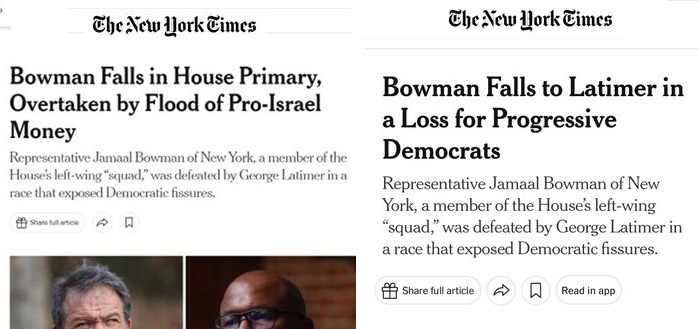
“Nah, there’s no mainstream media bias” is a tag here, representing the sarcastic like EA uses periodically to mock the stubborn gaslighters who insist against overwhelming evidence that we have a benign, honest, objective journalistic establishment when we do not, much to the nation’s despond. Sometimes the metaphorical smoking guns are more choking than others. (One of the reasons I will not be watching tonight’s “debate” is because I fully expect the smoke to be especially thick.)
U.S. Society
Confronting My Biases, Episode 11: People Who Knock On My Door
Unlike a lot of the biases in this series, I know this bias is irrational, neighborly and unfair. However, I just can’t shake it. My first instinct, always, when I hear a knock on the door (I disconnected the door bell long ago when it kept going off on its own) is some mixture of anger, annoyance, and dread.
The bias became full blown when a large female Alzheimer patient startled Grace and I awake one morning shortly after we were married by banging on our front door while roaring angry gibberish. It turned out she had wandered off from a facility and thought she lived here. Four police officers had a hard time corralling her. Long before that, though, my mother had poisoned me against the whole concept of surprise visitors: she distrusted them. Then there was that mentally ill guy with an old Weimeraner on a leash who would knock on our door in Arlington, Mass. still thinking he was an air raid warden and that it was World War II. I remember that he had clear blue eyes, dead eyes, like a zombie. This was before I had ever encountered Jehovah’s Witnesses, kids selling magazines to pay for a trip to Disney World, and Comcast salesmen.
And before I had watched so many home-invasion movies.
Why I Won’t Be Watching the Biden-Trump Debate
The short answer is that I don’t feel like cleaning up all the brains, blood and bone after multiple head-explosions. The long answer follows.
The fact that a Presidential election (Is it “the most important Presidential election” ever? This has been claimed about almost every election I can remember, and I remember all of them since I was 10 years old. The Chicken Little Principle applies. Maybe it is, but the whole concept has been abused) is really and truly going forward with these two epically bad candidates as the public’s only serious alternatives represents a catastrophic failure of our system on many levels. This is not a good sign. We could not reach such a dire point if both parties, the public, our institutions, culture and values had not fallen apart in chunks. For me, watching the debate would feel like watching a bloody car crash involving close friends and relatives, except in their car seats instead, without seat belts, will be the United States of America.
Wait—Why Is Snopes Choosing Now to Factcheck a 2017 Axis Big Lie That Has Been Used Against Donald Trump for 7 Years?
Any theories?
Two day’s ago, Snopes, the thoroughly disgraced and discredited fact-checking site that routinely covers for Democrats and progressives while spinning to attack conservatives and Republicans, posted a factcheck headlined, “No, Trump Did Not Call Neo-Nazis and White Supremacists ‘Very Fine People.'”
I’ve written several posts about this persistent lie; it was in the original draft (in 2019) of the “The Big Lies Of The ‘Resistance’: A Directory” under Big Lie #4: “Trump Is A Racist/White Supremacist.” Before that, Ethics Alarms had posted in 2017 repeatedly about the Axis’s distortion of the Charlottesville riot; it was so long ago that I wasn’t even calling the “resistance”/Democrats/MSM propaganda trio “The Axis of Unethical Conduct”yet.
It would have been helpful if Snopes had weighed in then, but that would have undermined the Trump-smearing efforts of its supporters and allies. (Others have debunked this smear against Trump in the interim, such as CNN’s Jake Tapper. Joe Biden, for one, never stopped using it.)
Saturday Ethics Hot Mess, 6/22/2024: Willie, Schumer and the Duke…
I guess I’m strange: relatively trivial things are tipping points with me when it comes to trusting politicians and elected officials. As I’ve mentioned here more than once, I realized Bill Clinton was a pathological liar—much, much , much worse than Trump—when he told a crowd that Thomas Jefferson would be shocked today if he could see that the U.S. had no national health care. Clinton’s named after Tom, and knows that Jefferson believed that the less governments did the better: that was a ridiculous, insulting lie, and for me, signature significance. Now comes the PR photo of Senator Chuck Schumer (estimated net worth: $75 million) proving he’s a regular guy by grilling hamburgers. Based on that shot, Chuck has never grilled a burger in his life. Who puts a slice of cheese on a raw burger? This is a visual lie, and a really dumb one.
Meanwhile…
1. Maybe THIS is the dumbest question anyone’s ever asked “The Ethicist”: Is it okay for her friend to secretly slip a drug into her “manic” husband’s drinks? Apparently the guy is a little too intense, so the friend spikes her spouse’s water bottles with melatonin. The query prompted the shortest answer I’ve ever seen Professor Appiah offer, and it was just what you’d think.
The Guinness Book of Records Is a Catalyst For Self-Destructive Conduct, Not That There’s Anything Wrong With That…
I guess it’s that time on a sweltering Friday afternoon that I am not quite up to finishing any of the more substantive posts on the runway, and only feel like tackling the stupid stuff. (These are the posts long-time critic/commenter Neil Dorr prefers. This one’s for you, Neil!)
Tara Berry just set the Guinness Book of Records record for “‘most tattoos of the same musician on the body.” She has 18. ( The former record-holder has 15 portraits of Eminem tattooed on her body.) A big Madonna fan from the beginning of The Material Girls’ pop-culture ascent in 1983 ,Tara only started her Madonna tattoo collection in 2016 when she was looking for fans who had Madonna’s image tattooed on their bodies to feature in a video. I guess she’s suggestive (or <cough> or something): she had an overwhelming urge to get her own Madonna tattoo. Once she started, she couldn’t stop.
Well, bless her heart. It’s her skin and her body: this is one example of “choice” that doesn’t hurt anybody except the chooser. Hey, if she wants to go for 20, or 50, I won’t criticize.
I do hear a bit of a ping one of my smaller ethics alarms about the Guinness Book of Records. Why does it even have a record in this category? I’ve touched on the issue in the past: the GBOR seeds the needs of narcissists and sad, insecure people searching for some level of fame or notoriety with records that can only be set or sought with some danger to the aspiring record-setter. There were “the Biking Vogels,” the various children endangered by their parents to have them be the “youngest” to achieve some pointless and dangerous goal, and my personal favorite, Sheyla Hershey, who ended up with size M breasts to set the Guinness record for “largest breast implants.” I concluded that 2010 post by stating that it was unethical for Guinness to publish “records” that can only be achieved by risking long-term harm.
And yet…blaming Guinness for Tara Barry mutilating her body is like blaming hip-hop records and violent TV shows or movies for people doing in reality what is only sung about or shown on a screen. It was her choice, albeit a crazy one. Tara is supposedly an “artist,” so maybe being festooned with pictures of a washed-up and aging pop-star won’t harm her at all, as long as she doesn’t seek employment at a school or a bank. Or with me.
As I said, that ethics alarm isn’t pinging very loudly. The GBOR doesn’t make anyone do anything. But the alarm has been pinging, however faintly, for 13 years.
What Is Most Ethically Significant About United States v. Rahimi…
“When an individual has been found by a court to pose a credible threat to the physical safety of another, that individual may be temporarily disarmed consistent with the Second Amendment.”
That, in a nutshell, is the holding in United States v. Rahimi, the SCOTUS decision handed down this morning.
I’m a hardliner regarding “pre-crime,” and I am unalterably opposed to measures removing citizens’ rights without a finding of guilt in a criminal prosecution. However, Justice Roberts’ majority opinion is well-reasoned and carefully limited, with “temporary” being the key word. I also think it is crafted in such a way that so-called “red flag” laws are not going to be able to use this case as precedent to survive constitutional challenges. I have not yet read all of the concurrences, of which there are many.
What is perhaps more significant than the decision itself was the vote: 8-1 in favor of the law in question. (Anyone who can’t guess who the lone dissenter was, as well as the basis for his dissent, has not been paying attention.) This, along with the less consequential decisions handed down yesterday, powerfully counters the false Democratic narrative that the current Supreme Court is an ideologically biased body unalterably allied with the far right, as three heroic and caring progressive women futilely battle for the soul of the nation.
This unethical framing has been concocted to justify an assault on the legitimacy on the Court and its decisions, all as part of the “Stop Trump or it will be the end of democracy!” campaign. In reality, the characterization is garbage, and has always been garbage. The lie is still effective because the percentage of the public that reads SCOTUS decisions, never mind understands them, can reliably be estimated to be in single digits.
None of yesterday’s decisions split along the supposedly frozen-in-granite 6-3 blocs, and today’s decision infuriating Second Amendment absolutists even had the hated Justice Alito voting with the majority.
Of course, I suppose he should be expected to favor red flag laws….
‘Everything Is Seemingly Spinning Out of Control!’ Open Forum
See if you can make any sense of things, ethically of course.
Everywhere I’m looking today, I see insanity and chaos. Conservative activist Scott Presler is being applauded for saying,”If every Christian voted, we would never lose another Presidential election ever,” noting that many evangelicals are not even registered to vote. This same statement could be made about almost any group imaginable: it’s not news, it’s not remarkable, its not perceptive, and its not useful.
Then, in a “Great Stupid” incident that shocked even me, Fani Willis toy-boy Nathan Wade appeared on Comedy Central’s “The Daily Show” in its feature “Choppin’ It Up With ‘Quon,” where he was interviewed by satirist Marlon Wayans playing ‘Quon. (The character Quon has been described as a “Hip-hop Borat.”) Yeah, this will help the case that he was hired to help Willis prosecute Donald Trump on his merits as a serious, qualified lawyer! Wade apparently thought he could defend his sexual relationship with Willis in the appearance as Wayans, who is approximately 6.78 times smarter than Wade, used his improvisational talents to make Wade look like the idiot he is.
“How can you not hit that?! How can you not?!” Wayans/Quon declared, as Wade laughed. “We spending that much time together, we doing everything, we might as well!” Anthony Michael Kreis, a constitutional law professor at Georgia State University College of Law, tweeted, “This is gross. Nathan Wade should be embarrassed. And Fani Willis, whatever her mistakes, deserves better than this. As do the people of Fulton County.”
How does Willis “deserve better” if she’s the one who hired Wade, almost certainly sabotaged her own dubious prosecution of Trump by mixing her prosecution duties with nookie, and, like Wade, has continued to argue that using a high-profile case for personal benefit is no big deal? How does Fulton County “deserve better” if its voters elected someone that incompetent?
Don’t get me started. You start instead…
From the Res Ipsa Loquitur Files: the Woke Shackles Tighten…
Jennifer Sey, once a competitive gymnast on the U.S. Women’s Olympic team, has launched a new clothing line focused on the threat to women’s sports by the woke-driven incursion of “transitioned” or “transitioning” biological males.
TikTok responded to her ad on that platform by banning he company from advertising with this:
Curmie’s Conjectures: Book Reviews and the Warm Fuzzies
by Curmie
[This is Jack: I have to insert an introduction here. Curmie’s headline is fine, but it would come under the Ethics Alarms “Is We Getting Dumber?” or “Tales of the Great Stupid” banners if I had composed it. What he is describing is a culture-wide phenomenon that is far more insidious than its effects on scholarly book reviews alone. I also want to salute Curmie for slyly paying homage in his section about typos to one of my own most common and annoying typos. I know it was no coincidence.]
I published my first book review in an academic journal in 1991. In all, I’ve written about 30 reviews on a wide range of topics for about a dozen different publications. In some cases, I was only marginally qualified in the subdiscipline in question. In others, especially more recently, I’ve been a legitimate authority, as well as being a full Professor (or Professor emeritus) rather than a grad student or rather green Assistant Professor.
The process has changed significantly in recent years, the biggest change being the increased level of editorial scrutiny. A generation or more ago, I’d send in a review and it would be printed as written. That was back when I was an early-career scholar, at one point even without a terminal degree, often writing about topics on the periphery of my interests and expertise. My most recent reviews, when I was a senior scholar writing about subjects in my proverbial wheelhouse, went through three or four drafts before they were deemed publishable. Note: I didn’t become more ignorant or a worse writer in the interim.
Some of the changes came indirectly, no doubt, from the publishers rather than the editors: I received the same stupid comment—to include the chapter number rather than a descriptor like “longest” or “most interesting”—from book review editors from two different journals published by the same firm. Actually, one of those “corrections” wasn’t from the book review editor himself, but was a snarky comment from his grad assistant. You can imagine how much I appreciated being condescended to by a grad student. Other changes were just kind of dumb: one editor insisted that I change “whereas” to “while” (“whereas” was the better term).
But these are the kind of revisions at which one just shakes one’s head and shrugs. The ones that actually affect the argument are far more problematic. One author was writing about the production of a play by a female playwright from the 1950s. There’s no video footage (of course), and if literally anyone who saw that production is still alive, I think we could forgive them for not remembering many details. But the author decried the (alleged) sexism of the male newspaper reviewers who weren’t impressed with the production. Nothing they said, or at least nothing the author quoted, struck me as anything but a negative response to a poor performance.
Remember, they’re not talking about the play as written, but as performed, so the fact that the text isn’t bad (I’ve read it) doesn’t render the criticism of the acting and directing invalid. I said that in what amounted to my first draft, but was told that I needed to say that the allegations of sexism could have been true (well, duh!), but weren’t necessarily. In my view, declaring suspicions as fact, even if there’s some supporting evidence, might cut it as a blog piece, but it isn’t scholarship. But whatever…
In another review I suggested that the mere fact that male dramatists wrote plays with specific actresses—their “muses”—in mind for the leading roles doesn’t mean that those women should share authorship credit any more than Richard Burbage should get co-authorship credit for Shakespeare’s plays. I was ultimately able to make that point, but in a watered-down version.
More recently, I was asked to “tone down” a comment that several of the authors in what purported to be an interdisciplinary collection of essays were so committed to discipline-specific jargon, incredibly complex sentences, and sesquipedalian articulations (see what I did there?) that readers, even those well-versed in the subject matter—me, for example—would find those chapters unreasonably difficult read, and might be tempted to conclude that the authors were more interested in strutting their intellectuality than in enlightening the reader.
I stand by the analysis, but the editor was probably right to ask me to temper the cynicism. I did so, but I kept the rest in a slightly revised version. She seemed pleased, and told me she’d sent it off to press. When it appeared in print, only the comment about jargon remained… and the verb wasn’t changed from plural to singular. Sigh.
Perhaps the most telling episode was when I said that a book was extremely poorly edited and proofread. I’ve never written a book, but I have published several chapters in collections of scholarly essays. The process varies a little from publisher to publisher, but for one recent chapter I sent a draft to the book editor, who made editorial suggestions and proofread, and sent it back to me. I approved some of the changes he suggested and made my case for not changing other parts of the essay. After about three drafts, we both pronounced ourselves satisfied, and the essay went off to the series editor, who requested a couple of very minor changes. And then it went to the publisher. And then the professional proofreader. And then back to the publisher. And then back to me. At least five different people proofread that chapter, some of us several times.
It’s still almost inevitable that some typo will still sneak by. Of course, some publishers will cheat and rely on spellcheck, sometimes without even checking the final product. I once encountered a textbook that intended to reference the 19th century playwrights Henri Becque and Eugène Brieux, but rendered their surnames as Bisque and Brie—a nice lunch, perhaps, but hardly important dramatists.
But this book, published by a prominent academic press, was ridiculous. There were four and five typos on a single page, inconsistent formatting so it was impossible to tell when quoted material began and ended, at least two (that I caught) glaring malapropisms, and a number of instances of sentences or paragraphs so convoluted it was literally impossible to tell what was intended. We’re not talking “teh” for “the” or accidentally omitting the “l” in “public,” here.
I was insistent on making the point that the book was not yet ready to be published. A lot of the scholarship was really excellent, but the volume read like a first draft, neither edited nor proofread. Finally, the book review editor had to get permission from the journal’s editor-in-chief (!) for me to go ahead with that commentary.
So what’s going on, here? I can offer no firm conclusions, only speculations… “conjectures,” to coin a phrase.