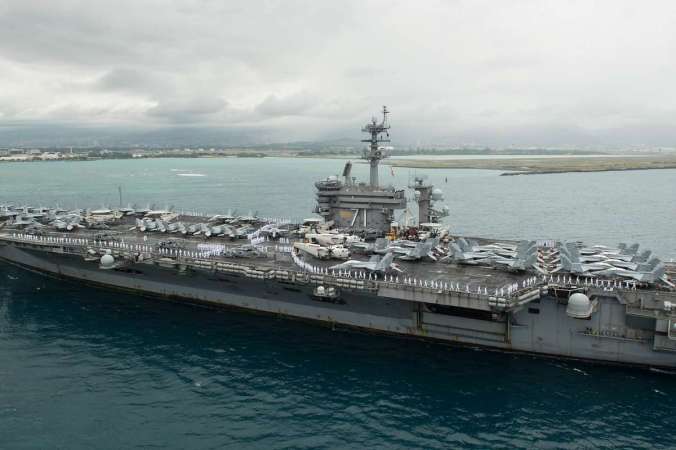
Captain Brett Crozier was the commander of the aircraft carrier Theodore Roosevelt which had been docked in Guam following a Wuhan virus outbreak among the crew of more than 4,000. With about a hundred members of his crew infected, he decided to take the extraordinary step of sending a letter to the Navy pleading for resources and to have the afflicted sailors quarantined from the rest. In the four-page letter sent via a “non-secure, unclassified” email that included at least “20 to 30” recipients in addition to the captain’s immediate chain of command, including some crew members.
Crozier wrote that only a small contingent of infected sailors had been off-boarded, with most of the crew remaining on board the carrier, where following official guidelines for 14-day quarantines and social distancing was physically impossible. He wrote
“Due to a warship’s inherent limitations of space, we are not doing this. The spread of the disease is ongoing and accelerating…Removing the majority of personnel from a deployed U.S. nuclear aircraft carrier and isolating them for two weeks may seem like an extraordinary measure. … This is a necessary risk…We are not at war. Sailors do not need to die. If we do not act now, we are failing to properly take care of our most trusted asset — our Sailors….Keeping over 4,000 young men and women on board the TR is an unnecessary risk and breaks faith with those Sailors entrusted to our care.”
Of course, the letter leaked to the press, and the situation became a news story and a subject of unwelcome controversy for the Navy. Acting Navy Secretary Thomas Modly initially told CNN in response to questions about the appeal,
“I know that our command organization has been aware of this for about 24 hours and we have been working actually the last seven days to move those sailors off the ship and get them into accommodations in Guam. The problem is that Guam doesn’t have enough beds right now and we’re having to talk to the government there to see if we can get some hotel space, create tent-type facilities.”
Although the letter had the desired result, with members of the crew gradually being removed from the carrier, the Captain had broken the cardinal military rule never to go outside the chain of command. Crozier had multiple conversations with the chief of staff to Modly before his letter was publicized in the San Francisco Chronicle. The Navy had told Crozier to “call us any time day or night,” and gave him Modly’s personal cell phone number to update the situation and raise further concerns.
Then the e-mail leaked. Crozier was dismissed as captain by the acting Navy Secretary for what Modly called “extremely poor judgment,” going outside the chain of command, and disseminating the memo over an unsecured system. President Trump backed his appointee’s unpopular decision. Continue reading








 Ethics Alarms