The Washington Post—Finally—Admits The Truth About President Obama

fingers-pointing

I will reprint The Washington Post’s lead editorial here nearly in full. I will have comments after, though I will make this one now: every character trait and leadership deficit the Post points to  was evident to objective observers—like me—from the beginning of Obama’s administration. That one of the most consistent and prominent Democratic Party and liberal policy boosters in the national news media finally mounts the integrity, honesty and integrity to admit it now is not all that satisfying.

Here is, with a few omissions so you will link to the site and read the whole thing (it’s only fair), is the damning and undeniable editorial:

Charles E. Schumer (D-N.Y.) decided he would vote against President Obama’s nuclear deal with Iran, he explained his reasoning in a 1,700-word essay. On balance, he concluded, “the very real risk that Iran will not moderate and will, instead, use the agreement to pursue its nefarious goals is too great.” We disagree with that conclusion, but not with serene confidence; we share the senator’s concern that Iran will use the lifting of sanctions to intensify its toxic behavior in the region. We understand and respect Mr. Schumer’s decision; also, it’s generally better to treat policy disagreements in good faith.

That has not been the spirit in which Mr. Obama and his team have met his Iran-deal critics. The president has countered them with certitude and ad hominem attacks, the combined import of which is that there are no alternatives to his policy, that support for the deal is an obvious call and that nearly anyone who suggests otherwise is motivated by politics or ideology. Mr. Obama’s rhetoric reached its low point when he observed that the deal’s opponents value war over diplomacy and that Iranian extremists were “making common cause with the Republican caucus.”

Continue reading

Hiroshima Ethics And The Washington Post’s Misleading “Five Myths” Feature

Atom bomb cloud

The Washington Post’s Sunday “Five Myths About…” feature is a weekly irritation, as it begins with a misleading definition, and proceeds to a series of dubious and sometimes dishonest conclusions. In spirit it is like the fact-checking columns,  (though, ironically, the Post’s less than most) in that it claims to “disprove” opinions. This week’s installment, however, was too much.

Gregg Herken was this week’s guest bloviator, and the Post gave the emeritus professor of U.S. diplomatic history at the University of California a chance to plug his books on the atomic bomb, so I don’t blame him for taking it. I do blame him for allowing the column’s format and the editors to turn what could have been informative and edifying into lazy scholarship, sophistry, and nit-picking. Now I don’t want to read his books.

His entry was called “Five myths about the atomic bomb.” As is typically the case, no myths were debunked. Myths, in the parlance the Post is evoking, are a “traditional stories of ostensibly historical events that serve to unfold part of the world view of a people or explain a practice, belief, or natural phenomenon.” They are, by definition, false. Herken, however, neither identifies nor disproves any true myths. What he does is offer contrary opinions to those of others that are as provable as true as the opinions he claims to be debunking, which is to say, not provable at all. That means that the headline/title states an unprovable assertion as fact: “These statements are untrue.” Herken cannot ethically say that, but he does anyway.

Bad historian. Bad.

Herken starts off well:

“On Aug. 6, 1945, the United States dropped an atomic bomb on the Japanese city of Hiroshima. Another bomb fell Aug. 9 on Nagasaki. Decades later, controversy and misinformation still surround the decision to use nuclear weapons during World War II. The 70th anniversary of the event presents an opportunity to set the record straight on five widely held myths about the bomb.”

His first myth is that “The (Hiroshima) bomb ended the war.” Continue reading

Eight Ethics Observations On Donald Trump’s Prisoner Of War Slur…And Another New Rationalization: “Popeye’s Excuse”

PopeyeFrom the New York Times:

“Mr. Trump upended a Republican presidential forum here [Ames, Iowa] , and the race more broadly, by saying of the Arizona senator and former prisoner of war: “He’s not a war hero. He’s a war hero because he was captured. I like people who weren’t captured.” Mr. McCain, a naval aviator, was shot down during the Vietnam War and held prisoner for more than five years in Hanoi, refusing early release even after being repeatedly beaten.

The only news outlet that isn’t covering this is the Huffington Post, because controversies that directly affect who will be President of the United States aren’t news when they involve candidates the HuffPo ideologues don’t respect.

I thought I should remind you.

Ethics observations:

1. The statement is signature significance that Trump is a jerk as well as a fool, and not very bright as well. The latter is especially important: being an idiot should disqualify anyone for high elected office. Not that Trump’s intelligence, or lack of it, hasn’t been a matter of record for a long, long time, but this is as blazing a tell as anyone could wish for. Anyone who voluntarily places his or her life at risk for their country is a hero; circumstances and moral luck determine what other tests warfare will present to such an individual’s character. When a hero passes such a test with distinction, as McCain did in his prisoner of war ordeal during the Vietnam war, the military makes a special effort to recognize that heroism, in part to inspire others. My father refused to make a big deal about his Silver Star and Bronze Star, because he was aware that the man who was blown up by a shell while virtually standing next to him could have just as easily been the decorated war hero, and my father a statistic, had the shell landed a little bit to the right. My father regarded the man who was killed in his foxhole as much of a hero as he was. Trump would say, “I like people who aren’t killed.”

Only a stupid man could believe that.

2. For Trump to denigrate McCain’s service when he took every possible step to avoid service in the same war is especially nauseating. The ethical values being rejected here are fairness and respect. John McCain displayed courage, patriotism, devotion to civic duty, selflessness and integrity that Trump could not. It’s really that simple. Trump lacks any standing to criticize Senator McCain’s war record.

3. On ABC this morning, Donald Trump was asked about his habit of name-calling and using personal insults as his response to political criticism. He justified his incivility by evoking the Tit for Tat excuse: if you insult him, he’ll insult you, and that includes calling you fat, old, stupid, or–his favorite—“a loser.” This is playground ethics, worthy of a 12-year-old. Your duty to be fair, civil and ethical is not reduced by the unethical conduct of someone else, even when it is aimed at you. Ethical people understand this, often before they are 20. Ethically, Trump is a case of arrested development. Continue reading

A Brief, Depressing Follow-Up On The Iran Deal

mushroom-cloud

I have been reading a lot about the Iran deal, hoping against hope that I just don’t understand it, and that it might be more responsible than it seems, because it seems to be astoundingly irresponsible.

Comes the Washington Post editorial board, reliably supportive of the President—any Democratic President, really–and a good bet to find the silver lining in any cloud. Surely, if this agreement isn’t the crowning, most dangerous incompetence on the mountain of incompetence that is the Obama Presidency, the Washington Post will move that mountain aside to show why.

Here are some direct quotes from this pro Obama, pro-Iran deal editorial by a liberal media standard bearer:

If the transformation of Iranian behavior the president hopes for does not occur, the deal on its nuclear program may ultimately prove to be a poor one — a temporary curb that, when it lapses, will enable a dangerous threshold nuclear state that poses a major threat to the United States and its allies.

In other words, the deal does not ensure this “transformation” will occur, the U.S. has no control overwhwether the “transformation” does occur, and the treaty doesn’t have anything in it that will compel such a transformation. Keep your fingers crossed.

 Its most immediate effect will be to provide Tehran with up to $150 billion in fresh assets from sanctions relief over the next year, funds that its leaders will probably use to revive the domestic economy but also to finance wars and terrorist groups in Iraq, Syria, the Gaza Strip, Yemen and elsewhere.

Gee, what a great deal.

Though Mr. Obama has promised to mitigate that outcome with new support for Israel and U.S. Arab allies, one effect of the deal may be an increase in the sectarian bloodshed wracking the region, as well as the conventional threat to Israel. When embargoes on arms and missile sales to Iran expire in five and eight years, that threat could further escalate, and Tehran could seek missiles capable of striking U.S. warships in the Persian Gulf or reaching the U.S. homeland.

That’s what the treaty allows, mind you.

These strictures, according to the administration’s experts, will keep Iran a year away from producing a weapon during that time — provided that it does not cheat by secretly conducting nuclear work elsewhere.Because Iran twice has been caught in such clandestine work, that is a critical concern — and the provisions for deterring and detecting violations are the areas in which Tehran fought for, and won, some troubling compromises. International inspectors seeking access to a suspected Iranian site could be delayed by a 24-day, multi-step process ultimately requiring five votes on an eight-member committee; at a minimum, the United States and four European representatives would have to concur. While a U.S. president could, in theory, unilaterally determine that Iran was cheating and force the reimposition of U.N. sanctions, it could take 65 days and might prove politically unworkable.

Wow! I see another Peace Prize!

 Mr. Obama settled for terms far short of those he originally aimed for.

This is what happens when you want a deal of any kind, and don’t have the guts to walk away.

Whether he is right in claiming that his successor in 10 or 15 years “will be in a far stronger position” with Iran will depend on whether his hopeful theory about its political future proves correct.

No, we can only judge the competence and reasonableness of an agreement at the time it is made. “We might get lucky” is no defense.

I’m convinced, and by The Washington Post: this was a craven, inept, dangerous agreement made by a foolish, desperate, deluded man and an tragically incompetent leader. The American people have an obligation to the entire world, and their children and grandchildren, to insist that Democrats join Republicans in killing it.

Later they can explain why they would again hand the nation over to a party that placed the fate of civilization in the unqualified hands of a President like this.

Ethics Observations On The Iran Deal And Its Media Coverage

treaty1. Throughout the negotiations for the apparently now completed Iran nuclear deal, all I could think about is how it would have made my old negotiation professor, the late Adrian Fisher  (who negotiated the SALT treaty) throw up. He taught his negotiation class at Georgetown Law Center, where he was the Dean, that no advantageous negotiation can occur unless your side is willing to walk away from the table. It has been clear from the beginning that the Obama Administration was desperate for this deal for political purposes, not national security, which the treaty does not assist in any way.

Dean Fisher—and his frequent guests, like Averill Harriman— taught his class that deadlines were essential in the negotiation process, both as a tool to force the other side to make tough decisions, and as a demonstration of resolve.  In this negotiation, the U.S. repeatedly allowed “deadlines” to pass, with no consequences. That tells the Iranians all they need to know about the U.S.’s likely response when they violate the terms of the agreement, as they are certain to do, at least as long as this weak, feckless, posturing and irresolute President is in office.

Of course, to be fair, the Iranians had plenty of evidence on that score already, as did we all.  “Red line,” you know.

2. The administration admits that it does not trust Iran. GOP Senator Lindsey Graham, who opposes the treaty, stated that Iran has never kept any international agreement or promise,, and thus cannot be trusted to keep this one. Nobody is seriously disputing that. Under such conditions, the whole concept of the deal is irresponsible. Who signs a treaty that it seriously doubts the other side will obey? Graham called this is the equivalent of making a deal with “religious Nazis.” The comparison is apt, except that the Obama arrangement with Iran is in some ways even more reckless than the one Neville Chamberlain made with Hitler. At least Chamberlain believed—stupidly, naively—that Hitler wanted peace. The Iran deal is what the Munich treaty would have been if Chamberlain was pretty sure Germany would invade Czechoslovakia and Poland anyway.

Chamberlain’s “peace in our time” was a pathetic hope. Obama’s is more like a lie. Continue reading

Observations On The George W. Bush Speaking Fee Controversy

Paying George to speak is a little like paying Hillary to tell the truth...

Paying George to speak is a little like paying Hillary to tell the truth…

Former President George W. Bush was paid a speakers fee of $100,000 to address a charity fundraiser for U.S. military veterans severely wounded in Iraq and Afghanistan. The  Texas-based Helping a Hero charity also confirmed  that W. was also provided with a private jet to travel to Houston at a cost of $20,000.

Observations:

  • Neither the former President, nor anyone, is obligated to donate his time and effort any time a charity whistles, regardless of its worthy mission. He is also within his rights to charge whatever he chooses: nobody has to pay it.Would it be an ethical act to donate that fee back to the charity, or waive it entirely? Sure. Is it unethical not to do so? Of course not.
  • Why is this story suddenly all over the news and internet? Why, to protect Hillary Clinton, of course. This is another res ipsa loquitur example of the news media acting like Democratic Party operatives. They are trying an “everybody does it” excuse for Hillary’s greed; in turn, the former President’s defnders counter with #22, “It’s not the worst thing.”
  • “For him to be paid to raise money for veterans that were wounded in combat under his orders, I don’t think that’s right,” former Marine Eddie Wright, who lost both hands in a rocket attack in Iraq in 2004, complained to ABC News “You sent me to war. I was doing what you told me to do, gladly for you and our country and I have no regrets. But it’s kind of a slap in the face.” I’m sympathetic, but the argument is absurd. Wright was soldier, and had his duty; Bush was Commander-in-Chief, and had his. Wright wasn’t doing Bush a favor, and Bush owes him no more and no less than any other American. Wright’s argument would obligate Bush to appear, on demand, free of charge to every military and veterans group, or be accused, variously, of playing favorites, not properly respecting non-wounded veterans, and dozens of other equally unavoidable complaints.
  • Is $100,000 an unreasonable speaker’s fee for a former President? Well, if his presence on the dais raises a lot more than that, and the charity seems to think it does, then from a strictly economic standpoint, it is not unreasonable, nor unethical for him to charge it, nor unethical for a charity to pay it.

Continue reading

Of Shoes and Socks, and the Soothing, Unethical Device of Lowered Obama Leadership Goals and Aspirations

shoes and socks

I had a friend in college named David, a talented musician and a funny guy, who one regaled me with his new theory of how to be a success and eliminate anxiety and stress in the bargain.

“See, we make ourselves miserable and guarantee failure by setting our goals impossibly high,” he said. “The secret to a happy, successful, care-free life is to set one’s goals extremely low. Last week, I was depressed because I had aimed at attending all my classes, writing 50 pages on my thesis, and finishing my reading assignments. I didn’t come close to accomplishing this, and I was miserable and guilty as a result.”

“Then I had an epiphany! Today I set my goal, my only one, as putting on my shoes and socks,” David explained. “That was it, the whole thing. Look! I did it! And it’s only noon!” He laughed and skipped away, not a care in the world.

I’m pretty sure he was kidding. Yet the Obama Administration, and its increasingly zombie-like, denial-motivated supporters, appears to have adopted this approach to leadership. Continue reading

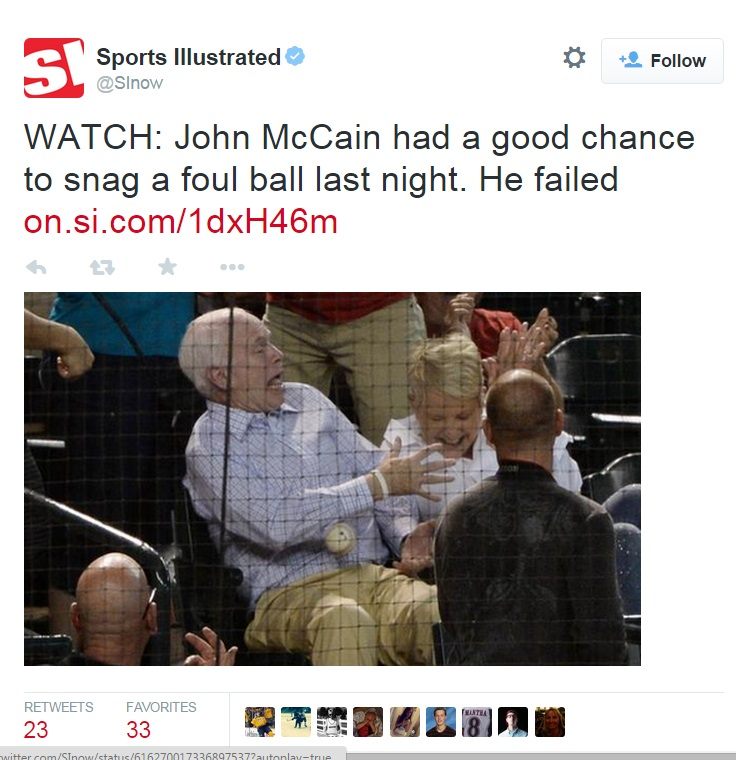
Independence Day Ethics Dunce: Sports Illustrated Illustrates How Too Many Americans Regard The Nation’s Veterans

McCain tweet

Sports Illustrated tweeted out the above image and message that linked to a story by “Extra Mustard.” That masterpiece noted that

Senator John McCain attended Tuesday night’s Dodgers–Diamondbacks game and had a chance to grab a souvenir in the seventh inning.Dodgers’ shortstop Jimmy Rollins fouled a ball over the backstop that went bouncing into the lap of the senior senator from Arizona, but McCain couldn’t get his hands on the ball. But McCain deserves a break from critics: As you can see the ball was approaching from a very awkward angle. Still, this photo from Dodgers photographer Jon SooHoo does not make the former presidential candidate look particularly athletic.

Apparently neither the reporter nor any of his/her/its editors were aware that McCain has extremely limited use of his arms as a result of being tortured as a North Vietnam prisoner of war. Both arms were broken by his captors and left untreated for so long that he was permanently handicapped, as anyone who watched even a little bit of his 2008 campaign for President could hardly fail to notice. McCain is also 78 years old, not that respect for seniors who have spent their lives in public service could be expected to be a factor in SI’s commentary.

Would any of the magazine’s staff attending a game dare to openly mock a disabled serviceman who didn’t catch a foul ball?  Probably not, since the likelihood of some fans of the National Pastime taking offense and throwing a beer in their smug, ignorant faces would be a real risk. Ah, but from the safety of an office  in New York City and hiding behind a pseudonym—of course, Extra Mustard might be the jerk’s real name, I suppose—it’s easy to insult an elderly U.S. Senator, military veteran and war hero for the consequences of the wounds he sustained in the service of his nation.

Eventually SI was tipped off to its error, and it quietly removed the last sentence. No apology, of course. Such is the historical, cultural, political and ethical ignorance of a substantial portion of our national media.

_____________________

Pointer: Newsbusters

Ethics Hero Emeritus: Sir Nicholas Winton (1909 – 2015)

winton and child

Another hero of the Holocaust has died. Nicholas Winton organized and substantially financed the last-minute escape of 669 Jewish children from Czechoslovakia on the eve of World War II, but never sought the fame and public accolades that Oskar Schindler and Raoul Wallenberg received. He got the accolades anyway, especially in his native Great Britain and Czechoslovakia, once his heroics were publicized long after they occurred.

I had never heard of him or his exploits until the news reports of his death. Continue reading

Ethics Dunces: The 21 Republicans Who Voted Against The Torture Ban

torture

As I explained long ago, torture is already a human rights abomination forbidden by U.S. principles, values, tradition and culture. That does not mean, and has never meant, that the nation’s official and sincere opposition to torture as an ethical absolute must not be subject to a genuine existential exception.  It does mean that an official policy that allows torture degrades the very reason for the nation’s existence.

This vital reason doesn’t even reach the fact that the United States has signed international treaties that state, unequivocally, that it deplores and rejects torture. That one is less complex; as I wrote about the Bush Administration’s doubletalk at the time…

Typically, the Administration is trying to finesse this uncomfortable fact by playing legalistic word games, requesting a “clarification” of what constitutes torture. This is intellectually dishonest, and blatantly so. The methods it wants to define as “something other than torture”…threatened drowning, cold room interrogations with subjects doused with water, beatings and other forms of assault and battery, obviously violate provisions of the Geneva Convention such as those requiring prisoners of war to be treated with “personal dignity” and “humanely,” and that they should not be subjected to “hardships and sufferings.” Meanwhile, torture is defined in Article 1 of the 1984 Convention as “any act by which severe pain or suffering, whether physical or mental, is intentionally inflicted on a person for such purposes as obtaining from him or a third person information or a confession.” Simulated drowning, by this definition, is torture, and passing some official “clarification” that declares otherwise won’t change that. Depriving prisoners of sleep and making them stand wet in 50 degree temperatures aren’t going to suddenly become “humane” either, nor will such treatment suddenly cease to cause “hardship” and “suffering.”

The United States exists on the ideal that it, unique among nations past and present, asserts and acts upon its original dedication to the values of human life, liberty and pursuit of happiness above all else. The United States’ identity is that of the Good Citizen, the hero, the trustworthy one. Of course that’s a high aspiration; of course we will fall short of it sometimes, of course such an aspiration appears arrogant and superior to others, and so what? Continue reading