Ethics Quote of the Year (So Far): Donald Sensing

“Finally, hating Trump is merely cheap virtue signaling. It is neither a method nor a plan. But if you feel better about hating Trump than you feel bad about Ukrainians getting killed with no end in sight, then you are morally bankrupt and God forbid you have any say in what happens.”

—-Military expert, commentator and Methodist minister Daniel Sensing concluding his blog post, ‘I stand with Ukraine’ means what, exactly?”

Last night, probably the smartest and most reliably reasonable of my Trump-Deranged lawyer friends published a much-loved diatribe on Facebook condemning President Trump for the Oval Office meltdown with Zelenskyy last week. He doesn’t post often, but every one recently has been to take issue with a Trump, quote, policy or action. I’ve had to wrestle my metaphorical tongue to the floor every time. It would do no good to rebut him, and all my effort would do would diminish the respect he has for me because, on this topic, his powers of reasoning are gone. If I wanted to start a stampede of unfriending on my Facebook page, I would point him to the superb post by Donald Sensing flagged this morning on Instapundit by Prof. Glenn Reynolds. My friend would never see the post otherwise, since Reynolds’ legendary blog is relentlessly conservative and my friend would sooner draw a pentagram on his kitchen floor than sample anything written there. But Sensing, whose fascinating CV is here and who is better qualified to opine on the Ukraine-Russian conflict than either of us, has provided a superb analysis with clarity and logical force.

Continue reading

Ethics Quiz: Honoring Roland Bragg

The North Carolina military base long called Fort Bragg was stripped of its familiar name in 2023 and changed to Fort Liberty by the Biden administration. With this Democrats joined forces with and essentially endorsed the statue-topping and historical airbrushing that removed statues, street and school names and other memorials to Americans judged insufficiently dedicated to the woke values that hadn’t surfaced until long after their deaths.

Particularly targeted were Confederate generals and other major figures in the Confederacy. Fort Bragg was named after Confederate General Braxton Bragg. Of all the Confederates stripped of honors in 2020 as The Great Stupid spread over the land, Bragg’s might have deserved that fate most. Bragg is generally considered among the worst generals of the Civil War, with most of the battles he engaged in, Shiloh, for example, ending in his army’s defeat. He was also unpopular with both the officers and soldiers under his command. Why he had a fort named after him is something of a mystery. Well, maybe not so mysterious: the North Carolina fort was named during the Wilson administration while that President was undoing civil rights advances for blacks.

Continue reading

The Hegseth Confirmation, and Great Moments in Ethics Estoppel: The Concern That New DOD Sec. Hegseth Won’t Be Ready “24-7”

I probably wouldn’t have voted for Pete Hegseth to be Trump’s DOD Secretary; certainly not until he answered a lot of crucial questions he never was asked. He should have been grilled about the extent of his management, oversight and negotiation experience, but the Democrats, because they have no principles, decided to use the Kavanaugh strategy to slime him (because that worked so well the first time).

Hegseth is easily the worst of Trump’s major appointments, and the fact that he was confirmed last night (by the narrowest margin possible) demonstrates that the terror expressed by the Trump Deranged that unlike last time around, the Republicans in Congress are inclined to help their party’s President achieve his goals rather than obstruct them is justified. (To that, my reaction is “Tough. You have nobody but your own party to blame, along with people like you who enabled and supported an arrogant, incompetent, corrupt, untrustworthy, and increasingly totalitarianism-embracing government.”)

This morning I decided to surf between MSNBC and CNN to hear the screams of the Axis propagandists who hang out there [Oh NOOO! ICE is really arresting illegals! Oh NOOO! Trump is making villains like Anthony Fauci pay for their own security details! Oh NOOO! Trump is killing DEI!] When they weren’t screaming about all of that, they were indignant that someone was now leading the Pentagon who could not be trusted to be ready for a crisis phone call every hour of the day, 365 days a year. These assorted partisan hacks and the Democratic party “contributors” who joined in their self-righteous lament are ethically estopped from making that complaint about Hegseth.

Continue reading

Boy, One Of Our Most Deified Presidents Sure Agreed To Some Bone-Headed Ideas…

As I have mentioned here many times, there is no way around ranking Franklin Roosevelt as one of our top five Presidents: his handling of World War II from the U.S. perspective and his leadership during the Great Depression, which didn’t so much fix the economic problems as raise the public’s faith in our system of government when it easily could have collapsed, are so important and momentous that all of his missteps and blunders pale by comparison. Nevertheless there were many of these, some quite damning.

I only recently learned about one of them that I somehow had missed all these years—probably because our historians have been and are still overwhelmingly left-biased and inclined towards hagiography where FDR is concerned.

Henry Morgenthau Jr. was Roosevelt’s Secretary of the Treasury from 1934 until FDR’s death. He was a trusted advisor whose scope of interest and influence far exceeded the usual territory of his office. In 1944, Morgenthau got far over his metaphorical skis and proposed a scheme for the post-war world, specifically, as he said, “I want to make Germany so impotent that she cannot forge the tools of war – another world war.”

You know, because that strategy worked out so well the first time, after World War I…

Continue reading

Celebrating the 110th Anniversary of the Strange But Ethical “Christmas Truce”

One of the weirdest events in world history took place on Christmas 1914, at the very beginning of the five year, pointless and stunningly destructive carnage of The Great War, what President Woodrow Wilson, right as usual, called “The War to End All Wars.”

World War I, as it was later called after the world war it caused succeeded it,  led to the deaths of more than 25 million people, and if anything was accomplished by this carnage, I have yet to read about it.

The much sentimentalized event was a spontaneous Christmas truce, as soldiers on opposing sides on the Western Front, defying orders from superiors, pretended the war didn’t exist and left their trenches, put their weapons and animus aside, sang carols,  shared food, buried their dead, and even played soccer against each other, as “The Christmas Truce” statue memorializes above.

The brass on both sides—this was a British and German phenomenon only—took steps to ensure that this would never happen again, and it never did.

It all began on Christmas Eve, when at 8:30 p.m. an officer of the Royal Irish Rifles reported to headquarters that “The Germans have illuminated their trenches, are singing songs and wishing us a Happy Xmas. Compliments are being exchanged but am nevertheless taking all military precautions.” The two sides progressed to serenading each other with Christmas carols, with the German combatants crooning  “Silent Night,” and the British adversaries responding with “The First Noel.“ The war diary of the Scots Guards reported that a private  “met a German Patrol and was given a glass of whisky and some cigars, and a message was sent back saying that if we didn’t fire at them, they would not fire at us.”

The same deal was struck spontaneously at other locales across the battlefield. Another British soldier reported that as Christmas Eve wound down into Christmas morning,  “all down our line of trenches there came to our ears a greeting unique in war: ‘English soldier, English soldier, a merry Christmas, a merry Christmas!’” He wrote in a letter home that he heard,

Continue reading

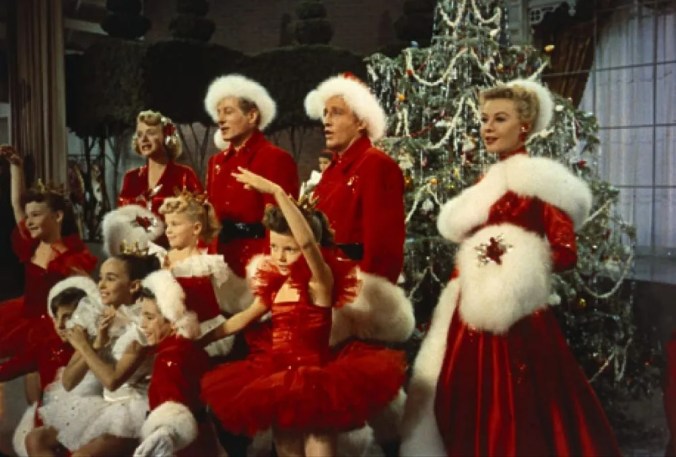
The Complete “White Christmas” Ethics Companion, Expanded and With a New Introduction For 2024

2024 Introduction

In 2022 I wondered whether the 1954 Christmas movie musical “White Christmas” was on the way out of the Christmas movie canon as anti-white racism took root during “The Great Stupid.”  It is, after all, about as white as a movie can get, even for the Fifties.  The movie has been sort of “cancelled,” it seems, and we will see if it has a resurgence as  the anti-woke backlash many think has arrived does its duty. If it is canceled, the loss will matter. “White Christmas” is an entertaining Christmas romantic comedy and family film with an excellent Irving Berlin score, a brilliant cast and an effectively sentimental and moving climax.

That should be enough; it certainly is better than any Christmas since, although an argument can be made for “The Santa Clause.” In 1954 the movie was a critical and box office hit. If “White Christmas” doesn’t mesh with the cynicism of our current culture, well, maybe that’s our problem less than it is the movie’s. In 2022, I said, “As for the film losing popularity because it isn’t ‘diverse’ and ‘inclusive,’ I will posit this: if there comes a time when an innocent fable about kindness toward an old hero down on his luck no longer resonates because of the skin-shades of the characters, the values and priorities of American arts and society will have reached a dangerous level of confusion.”

In 2024, I must state that American arts and society have reached a dangerous level of confusion (I’m looking at you, Disney!)

I also wrote, “If your children can’t enjoy music, laughter and  sentiment expertly inspired by some of the greatest talents this nation has ever produced, you’ve raised them wrong.” I should backtrack a bit on that. Of the four stars only the women are at their best. Rosemary Clooney, who shortly thereafter had a breakdown that sent her into near retirement for more than a decade, never looked or sounded better, and Vera-Ellen does what she always did in a tragically short career: she danced marvelously, and moved her mouth while someone else sang for her.

Bing Crosby sings wonderfully as he always did, but Bing was best when that’s all he was doing, though he was a deft straight man and actor when the need arose. What he wasn’t was a dancer, and he has far too much moving around to do in “White Christmas.” Bing wasn’t even a hoofer: he could dance passably enough not to be a complete embarrassment, but even so, his feet were community theater level at best. I am in the minority camp that fervently believes that Bing was superior to his successor Frank Sinatra as a vocalist and also as a dramatic actor and comic. Frank could really dance, however.

Danny Kaye, as I will explain in more detail below, was underutilized in “White Christmas.” The movie doesn’t give him much opportunity to display his unique talents.

My commentary on this movie, in contrast to the tone of the ethics guides to “It’s a Wonderful Life” and “Miracle on 34th Street,” has been criticized by some commenters. Just this month someone ran across one of the earlier versions and wrote that such “nitpicking” misses the point: “White Christmas” is just supposed to be a light-hearted, feel-good move and it doesn’t have to be ethical or make sense. (Two very close friends who love the film get mad at me every year for posting this.)  I confess: I am not the right audience for “White Christmas.” As a stage director and critic I prize narrative clarity and consistency; as an ethicist I find the usual ethics short-cuts the protagonists in movies often stoop to more distracting than the typical audience member. The film also seems to radiate a certain “we know this movie can’t miss, so we can blow off a lot of stuff” vibe, and that’s unethical—unprofessional and disrespectful of the audience. I expect better of director Michael Curtiz, who, after all, directed “Casablanca.”

But the producers knew they had a hit in the making: a remake of the very successful “Holiday Inn”; a Christmas movie (and also a ridiculous one); a film built around the best-selling record of all time (then and now); a star, Bing Crosby, whose films seldom missed and who was identified with Christmas;  a score by one of the most successful and popular song-writers of his generation in Irving Berlin; a sui generis performer with his own fan base in Danny Kaye, and a very popular Fifties chanteuse at the peak of her popularity and talents in Rosemary Clooney. “White Christmas” was certain to be good enough, but as Bing Crosby groused years later, it could have been great, and should have been. I admire Bing for admitting that. For all his flaws, he was a perfectionist, and had great integrity as an artist. Would that those who wrote and made the film devoted to as high standards. (That reminds me: the other Bing Crosby musical remake, “High Society,” was also a disappointment, and also was the hit movie musical of the year when it was released.) The film-makers were satisfied with making it just good enough, and were confident that the audience wouldn’t notice or care. That ticks me off in the arts and in any other field. It really ticks me off when that cynical approach works.

I also believe that popular culture does effect societal ethics, and movies who portray their heroes as charmingly unethical do real, if unmeasureable damage. I did not find Jim Carey’s “The Mask” funny in the least, because we were supposed to cheer on the hero’s “Mask” alter-ego, and he was a psychopath.

One of the most ethical features of “White Christmas” was behind the scenes, an ethical act that allowed it to be made, undertaken by one of the most unlikely people imaginable, Danny Kaye.  Kaye was a major factor in launching my interest in performing, musicals, and comedy, but my research into the real man, when I was in the process of collaborating on a musical about his relationship with his wife and muse, songwriter Sylvia Fine, revealed that the real Danny Kaye was a miserable, paranoid, selfish, mean and insecure sociopath when he wasn’t playing “Danny Kaye,” which could be on stage or off it. In this case, however—and nobody know why—the abused Jewish kid went to unusual lengths to save a Christmas movie.

“White Christmas” had been conceived as a remake of “Holiday Inn” with the same stars as that black-and-white musical, Bing Crosby and Fred Astaire. Fred couldn’t do the project, so his part was re-written for Donald O’Connor, who became ill so close to shooting that there was no time to retool the whole script and have the film ready for its target holiday release. In desperation, the producers asked Kaye if he would play Bing’s sidekick even though it meant 1) playing a support, which Kaye had never done in a movie since becoming a star 2) playing a role that didn’t’ highlight his special talents (for those, watch “The Court Jester”), and 3) subordinating himself to Bing Crosby, who was indeed the bigger star and box office draw, and 4) most daring of all, exposing his own limitations by doing dance numbers created for Donald O’Connor. Kaye was not a trained dancer, just a gifted mimic and athlete who could do almost anything he tried well. Danny demanded $200,000 and 10% of the gross to rescue the project, but he still was doing so at considerable personal risk…and he didn’t need the money, because Sylvia was a financial whiz.

Everyone around Danny Kaye was shocked that he agreed to all of this. Not only did he agree, he also amazed everyone by not playing the under-appreciated star on set, by doing O’Connor’s choreography as well as he did, and by knowing how not to steal focus from the star, something he infamously refused to do on Broadway when he was in “Lady in the Dark” with Gertrude Lawrence. “White Christmas” was the top grossing film of 1954 and the most financially successful movie musical up to that time. Kaye’s uncharacteristic unselfishness and characteristic versatility made that level of success possible. The secret of why Danny was on his best behavior was another one of his pathologies from an abused childhood: he was always in awe of the superstars like Bing Crosby, and felt inferior to them. (He wasn’t.)

The movie works (even I get choked up at the end); you just have to turn off your brain to fully enjoy it the way it was meant to be enjoyed. It has many high points, musical and comedic, for most viewer they justify the flaws, and we will never see the likes of Crosby, Kaye and Clooney again (and Vera-Ellen was no slouch). I miss all of them, which adds an extra bit of wistfulness to my annual viewing

And whatever faults “White Christmas” may have, it’s whiteness isn’t one of them.

Last year I wrote that “White Christmas” brought back memories of happier holidays, which I needed. 2024 said, “Hold my beer!”  Once again there will be no Christmas tree that takes me five hours to decorate, no festive banquet at a table surrounded by family and friends, no stockings or presents…just a big empty house with a needy dog and a lot of scary problems to solve and ticking time bombs to defuse. The sappy Christmas movie that ends with two happy couples, an old man being reassured that his life had meaning and Bing singing “White Christmas” is, as it was last year, just what the psych ward prescribed. I’m trying to count my blessings. What choice do I have?

1. The First Scene

Continue reading

On Pete Hegseth’s Strange Drinking Pledge

Pete Hegseth, the former Fox News host and Army veteran told Megyn Kelly on her Sirius/XM radio show that he would stop drinking alcohol completely if confirmed as Doanld Trump’s Secretary of Defense. He referenced “general order number 1,” which prohibits military personnel from consuming alcohol during deployment, saying, “This is the biggest deployment of my life, and there won’t be a drop of alcohol on my lips while I’m doing it.” He continued, “That’s how I view this role as Secretary of Defense is, I’m not going to have a drink, at all. And it’s not hard for me because it’s not a problem for me.”

This is an issue because along with allegations that he has engaged in sexual misconduct in the past and the uncovered email in which his mother accused him of abusing women, CBS News has reported that when Hegseth accepted a six-figure severance payment and signed a non-disclosure agreement in his 2016 exit from Concerned Veterans of America, there had been reports (from unnamed sources, of course) that he was intoxicated on the job more than once.

I find Hegseth’s pledge more than a little strange. It is like a man being accused of beating his wife saying, “I have never beaten my wife and if you give me this job, I promise that I will never beat her again.”

“A drinking problem” typically suggests alcoholism, though there are non-alcoholic alcohol abusers. The latter can, in fact, just decide not to drink any more and do so successfully. Alcoholics, in contrast, have metabolic and psychological disorders that make sobriety a lifetime battle that they are likely to occasionally lose.

Continue reading

Critics Say Trump Is Only Appointing Those Who Are Reliably Loyal To Him. Damn Right, and Here’s Why…

Representative Barry Loudermilk  chairs the Committee on House Administration’s Subcommittee on Oversight, and released a report this week showing that the Department of Defense Inspector General was part of a coverup of the Department of Defense’s intentional choice to delay the deployment of the D.C. National Guard to the Capitol on January 6, 2021.

The DOD IG concealed the extent and cause of the delay in order to protect Department of Defense and Pentagon leadership, the report found, and did not candidly evaluate the actions of senior officials including Secretary of the Army, Ryan McCarthy, who failed to relay deployment orders to Major General William Walker, the Commander of the DC National Guard on January 6.

Continue reading

Ethics Dunce: Pete Hegseth, Trump’s Nominee To Be Defense Secretary

This will not end well.

Oh, I get it. Trump ran through six Defense Secretaries in four years (a record) and had an adversary relationship with the Pentagon. As with so many other Departments, entrenched resistance to Trump’s leadership flourishes there, and there are cultural issues as well.

The sort-of new President has learned a hard lesson, and wants a loyal outsider to tackle the Defense Department. Harry Truman once described the department as a feather bed where you punched a problem in one part of the bed and another problem would pop right up.

DOD is huge, a labyrinth of interlocking bureaucracies, and managing it requires superb leadership skills, diplomacy, organization and more. There is no reason to believe that Pete Hegseth possesses any of these.

Continue reading

A Ballad For Veterans Day

I saw Marlene sing that song, which always ended her concerts, in her penultimate performance in the U.S. That time, she shouted out “Gone to graveyards every one!” I have never felt such a jolt of emotion in any live performance I have ever attended. A woman near me broke into tears. It was particular effective because of Dietrich’s personal history, and her work for the Allies, some of it covert, during World War II.

We will never see her like again.