Ethical Quote Of The Week: Andrew Sullivan

You are dead to me, Firefox. Tell your mama.

You are dead to me, Firefox. Tell your mama.

“Will he now be forced to walk through the streets in shame? Why not the stocks? The whole episode disgusts me – as it should disgust anyone interested in a tolerant and diverse society. If this is the gay rights movement today – hounding our opponents with a fanaticism more like the religious right than anyone else – then count me out. If we are about intimidating the free speech of others, we are no better than the anti-gay bullies who came before us”

—-Blogging pioneer and gay rights advocate Andrew Sullivan, writing yesterday about Mozilla’s craven capitulation to gay rights bullies who demanded the removal of new CEO Brendan Eich “who had the gall to express his First Amendment rights and favor Prop 8 in California by donating $1,000.”

Corporations, as the Duck Dynasty flap depressingly illustrated, tend to be spineless, irresolute and principle-free. This instance of that tendency, however, is more alarming and harmful than most. Capitulating to arrogant, self-righteous, power-hungry forces on the left or right only makes them more voracious: we will know who to thank first when boycotts abound demanding that anyone who questioned Al Gore’s climate change hysteria be sacked.

Thank you, Mozilla.

Continue reading

Comment of the Day: “Ethics Rant: Here Is The Smoking Gun Proof That The Government Doesn’t Care How Much Money…”

Whatever anyone might think of Ethics Alarms, it can’t be accused of not being eclectic. Today’s Comment of the Day illustrates the point, with an impressive  and informative debut by new commenter Dave on the cost savings to be had based on choice of  printing fonts, and more. The original post used a sixth-graders science project conclusion that our federal and state governments could save hundreds of millions of dollars by simply conserving ink as a departure point for a general critique of government diligence, responsibility, and competence.

Here is his exposition, inspired by the post, Ethics Rant: Here Is The Smoking Gun Proof That The Government Doesn’t Care How Much Money It Wastes, Or, In The Alternative, That It Isn’t Run By Sufficiently Competent People To Be Trusted To Spend What It Does:

The most important aspect of the 14 year old’s study is valid. You can save money with a better font. How you get there is not important. So I support the hypothesis of the study. Of course, as in almost all studies, it requires more study. Adding paper to the mix makes it more hopeful.

I like his study for three reasons:

1. It puts ink and paper into the public discussion
2. It illustrates that really large numbers times really small numbers equals a big number.
3. It moves us ahead in our quest to the use of something other than Times New Roman. It’s a newspaper font!

First off, names are useless in discussing typefaces as they were trashed by the patent/copyright office many years ago. Garamond is one of dozens of great type families. Each has it’s unique features but most do not perform optimally in all applications. The criticism of using Garamond in the testing misses the point entirely. Successfully curtailing the weight of an optimized font, versus a newspaper font, to image on bond paper is likely. Let’s move on from nitpicking Garamond. 

Ink is measured in dimes with inkjet, nickels with toner and pennies with printer’s ink. Breaking down the imaging techniques of all government documents is a massive effort, census like. But, for now, let’s address word processed documents. This is probably the largest population of original documents. (We’re not going to make much headway in savings attacking the professional typeset material that is printed in the millions.)

Given we tune a font for ink/toner use, one of the last considerations influencing legibility and readability of a word processed document is typeface. Because MS Word is used exhaustively for this application, I would order the priorities leading to better legibility and readability as follows:

1. Word Spacing. You can see in the example used to trash the study (3rd line of Garamond) It’s like talking to someone who says “uh” every other word.

2. Serifs v. Sans Serif. This choice is more of a readability thing than a legibility thing.  I choose sans-serif for heads (eliminating the need for bold italic serif fonts) and serif for text  when I create a typical Word doc. Generally, type really doesn’t have to be serif if the document is short but the longer it gets….

3. Line Measure. This goes together with word spacing, the longer the measure the worse word spacing becomes with MS Word. And personally I have attention issues so I need a break more often.

4. Body leading. Otherwise known as line spacing in the world of glorified type writers; it’s like word spacing only in the vertical direction.

5. Letter-spacing. This is font design dependent but not typeface dependent. They can screw this up no matter how the the letters look. It’s one of MS Times New Roman most nasty offenses. It’s not only looks awful, it wastes paper.

6. Hyphenation and Justification (H&J). Justified type is lined up on both sides of the page. Word Processors are not good at this, MS is particularly bad at both H&J.  It’s an old requirement with setting type, but it helps readability with long documents. It generally saves paper to boot but it’s not worth botching up word spacing to get these advantages. (It’s not as critical with 1-2 page documents so that’s why it’s 6th on the list.)

7. Type Style. If we excel at all of the above, like professional design software, then the particular type design is a factor. Because we are focused on text, the theory is if we significantly adjust the design for 12 point and with word processing in mind we can do well here in ink savings.

8. Paper color. Office paper is very good here.

9. Type color. Anything other than black type can’t be discussed here but it is realistic to discuss grey. I exclusively  use draft mode on my inkjet printer and nobody notices.

10 . Room light. Using serifs or not and setting an appropriate type size is about wearing out your eyes with too little or too much light. Serifs on text cut back on light, while size impacts detail helping legibility. Sans serif type in headlines are not an issue because they are short and it provides contrast with the text.

So, the student’s focus on the smaller, most used type is appropriate. The focus on weight relative to ink usage is also appropriate. A focus on more sophisticated typography than MS offers today would significantly impact paper usage, even without using two sided features we have today.

TrueType, GX stuff, et al were all awesome in 1996, a big accomplishment. They are still relevant for designers, but here we are stuck with MS Word; Opentype features are wasted. Moving to a maybe more primitive technology but optimized for both savings and readability would be a good start towards the $400 million goal.

We are in a transition period, so it may be awhile. Saving money along the way to fully electronic isn’t a bad thing. These no valid reason to make trade offs during the transition. It will be complicated but in step with the transition. All ideas are worthwhile, there is no reason not to implement all of them.


Continue reading

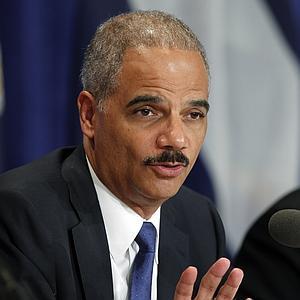
OK, OK, He Steals Our Money Too. But I Still Hear Eric Holder’s One Hell Of A Guy….

But what really matters is whether he's better than Alberto Gonzalez, right?

But what really matters is whether he’s better than Alberto Gonzalez, right?

From the Washington Post:

The agency that tracks federal travel did not report hundreds of personal and other “nonmission” trips aboard government planes for senior Justice Department officials including Attorney General Eric Holder and former FBI Director Robert Mueller, according to a watchdog report.

Congress’s nonpartisan Government Accountability Office determined that the 395 flights cost taxpayers $7.8 million. But the General Services Administration, which oversees trips aboard federal jets, did not require documentation because of a GSA reporting exemption that covers intelligence agencies, even in cases of unclassified personal travel.

The GSA exemption contradicts decades-old executive-branch requirements, specifically guidelines established by President Bill Clinton and the Office of Management and Budget, according to the report. The report said GSA “has not provided a basis for deviating from executive branch requirements.”

The findings, released Thursday, came out nearly 19 months after Republican lawmakers began questioning Holder’s use of an FBI jet for travel unrelated to Justice Department work. Sen. Charles Grassley (R-Iowa), the ranking member of the Senate Judiciary Committee, asked the GAO to look into the matter.

In its report, the non-partisan Congressional GAO reprimands the GSA, noting that “GSA regulations that allow intelligence agencies not to report unclassified data on senior federal official travel for non-mission purposes are not consistent with executive branch requirements, and GSA has not provided a basis for deviating from these requirements.” Now the GSA is promising to rectify the non-mission exemption.

But never mind all that. The gravamen of the report is that Attorney General Holder and former FBI Director Robert Mueller spent $7.8 million dollars of taxpayer money for personal travel, and haven’t reimbursed it. What does this tell us? Nothing we shouldn’t have been able to figure out before:

Continue reading

What Is An Ethical Tiger Lily?

Believe it or not, this is Disney's version of an Indian chief.

Disney’s version of an Indian chief.

I recently watched the Disney “Peter Pan,” long my favorite of the classic animated films, which I had not seen from beginning to end in decades. I was genuinely shocked at the portrayal of the Indians, which would make the average movie Western seem politically correct and the Washington Redskins seem like a compliment. I know the story is a fantasy; I know that these are not supposed to represent real Native Americans, but a Victorian child’s visualization of the villains of their games. Nevertheless, it is hard to imagine the effect of such a film on a Native American child as being anything but devastating. The Neverland Indians, and their heroine, Tiger Lily, have been a human relations problem since at least the civil rights era, and the provocation is legitimate: did you recall (I had forgotten) that Tiger Lily belonged to the “Piccaninny tribe”? That James Barrie was a funny guy. Continue reading

Ethics Observations On A Journalism Scandal

washington-post-logo

Shame.

Executive Summary: Washington Post reporters Steven Mufson and Juliet Eilperin wrote a story for the website’s Wonkblog headlined, “The biggest lease holder in Canada’s oil sands isn’t Exxon Mobil or Chevron. It’s the Koch brothers.” The story was essentially false. It was based on easily disproved data from a progressive activist organization. Eilperin has close ties to both the environmental advocates opposing the Keystone pipeline, and desperately trying to turn public opinion against it. She also has tied to the White House. John Hinderaker, on Powerline, his respected conservative politics blog, exposed the Post story as a blatant misinformation with a likely political motive. The reporters responded with a jaw-dropping rationalization, and are currently being excoriated by the Post’s readers online.

The Facts: The Post article by Mufson and Eilperin begins: Continue reading

The Fundamental Attribution Error And The Gender Pay Gap: When We Say “Women Need To Learn To Negotiate,” We Meant “Learn To Negotiate WELL”

GenderGapIt isn’t 23 cents less than every dollar earned by men in the same jobs, as the President dishonestly claimed in the State of the Union address, but women’s compensation is not yet equal to what men earn. Part of the reason is the choices women make regarding child-bearing and career timing; part is indeed bias. Some of it is also attributable to the fact that women are less aggressive and perhaps less skilled in negotiation. They often get lower salaries because, unlike their male counterparts, they don’t ask for higher ones.

Now comes “W,” who writes into an academic blog to show that women are penalized for daring to negotiate. She claims she was offered a tenure-track philosophy position at Nazareth College, a liberal arts school in Rochester, N.Y.  She replied, she says, by emailing the selection committee:

“As you know, I am very enthusiastic about the possibility of coming to Nazareth. Granting some of the following provisions would make my decision easier: 1) An increase of my starting salary to $65,000, which is more in line with what assistant professors in philosophy have been getting in the last few years. 2) An official semester of maternity leave. 3) A pre-tenure sabbatical at some point during the bottom half of my tenure clock. 4) No more than three new class preps per year for the first three years. 5) A start date of academic year 2015 so I can complete my postdoc.

I know that some of these might be easier to grant than others. Let me know what you think.”

Let me pause here to point out that this is a terrible response, incompetent negotiation, and career self-sabotage. First, you do not negotiate in a potential employer-employee setting through e-mail. You talk. Then you can gauge how you are being received. She should have asked for an appointment. Continue reading

Self-Promotion Alert: Army Magazine on Candor and Honesty

COVER_March2014Rick Maze, a reporter for Army Magazine, was kind enough to quote me extensively in his article, “Candor: Can the Army Handle the Truth?” which is available here. He also includes an extensive reference to the Rationalizations List.

Government Ethics: Luxury On The Taxpayer’s Dime

And the best part is, those poor suckers in coach are paying for all of this! Bwahahahaha!!!

“And the best part is, those poor suckers in coach are paying for all of this! Bwahahahaha!!!”

The Washington Examiner acquired records of federal agency travel through the Freedom of Information Act, and made an interesting discovery:

“The federal government spent millions of dollars on thousands of upgraded flights for employees in 2012 and 2013, paying many times more for business and first-class seats than the same flights would have cost in coach or the government-contracted rate. Premium travel reports from 14 federal agencies documenting the flights show these agencies alone spent an estimated $8.7 million on 1,903 upgraded flights in those two years. That was about $6.4 million more than the same coach and government-rate flights would have cost. The agencies spent $5.7 million in 2012, almost double the $3 million they paid for premium travel in 2013. The cost of coach and government-rate flights is approximate because several agencies either reported estimates for some coach fare or didn’t report them at all.”

There is just no excuse for this. None. I can conceive of some rare situations when first class travel would be called for, but not many. The accommodations in coach for most international air travel is perfectly endurable, and the huge difference in price isn’t justified unless you have serious back problems or some other malady. The basic ethical question every public servant should ask himself or herself is this: would I fly First Class if I had to pay for it? Almost always, the answer will be “no,’ and even if the answer is yes, the standard for buying luxury seating on the public’s tab should be more stringent.  It’s not their money. That’s really the answer to the threshold “What’s going on here?”  ethics query in this instance. What’s going on is that the public’s trust is being abused by officials casually using scarce taxpayer resources for their own comfort and convenience. Continue reading

How Can Lawyers Be Shockingly Unethical Without Breaching Any Legal Ethics Rules? Meet Styles & Pumpian

"Let's have a moment of silence for Ira, our troubled friend, partner and colleague, a fine lawyer who left this world too soon....Ok, now that's over, how can we keep his fee from his family?"

“Let’s have a moment of silence for Ira, our troubled friend, partner and colleague, a fine lawyer who left this world too soon….OK, now that’s over, how can we keep his fee from his family?”

Ira Bordow, a partner in the Wisconsin law firm of Styles & Pumpian, had been handling a family’s dispute with an insurance company. Successfully too: he negotiated a $250,000 settlement, and the company sent him the check for that amount, to be divided among the plaintiffs and Bordow’s firm. Bordow, as a partner, was going to get a $41,666 share.

The 54-year-old lawyer, however, had problems of his own that money could not solve, and committed suicide. His brother found the quarter of a million dollar check on the seat of Bordow’s Lexus coupe, and properly and correctly sent it on to  Styles & Pumpian.  Bordow had already earned his cut of the settlement at before he took his own life, for he, and the firm, were working on a contingent fee basis. The representation was at an end. Apparently, however, once the firm had the check in hand, the brilliant legal minds at Styles & Pumpian applied their craft to thinking of ways they could avoid paying the grieving family of their tragically demised partner any of the loot. They thought of one too, at least one they felt was worth a shot.  The firm is refusing to pay the Bordow estate the late lawyer’s $41,666 cut, arguing that Bordow’s suicide in his River Hills home negated his partnership agreement with the firm. It was a breach of contract, they say, and thus, even though he would have received the money if he had lived, the firm can keep it now.

Continue reading

KABOOM! And THIS Is Why Teachers Need An Ethics Code

Actor-Teacher Richard Graffanino, who knows how to play a teacher, but not how to act like one.

Actor-Teacher Richard Graffanino, who knows how to play a teacher, but not how to act like one.

Yes, there apparently is an Actor-Teacher Showing His Middle School Class Film Clips Of Himself In Bed With A Naked Actress As He Regales The Students With His Romantic Designs On Another Teacher While Wagering On NFL Games Using Food As Bets Principle.

The principle: such teachers get fired, and are damn lucky if that’s the worst thing that happens to them.

I sure hope the A-TSHNSCFCOHIBWANAAHRTSWHRDOATWWONGUFABP doesn’t come into play often, but nothing surprises me any more.

River Dell Middle School teacher Richard Graffanino, teaches impressionable young teenaged minds, and he also acts professionally, with roles on “Law & Order,” “30 Rock,” and some independent films.  He was suspended in September of 2013 after complaints from female students, and a sexual harassment claim by a fellow teacher. It looks like he is going to be fired, following an arbitrator’s report last month that found that Graffanino showed a sexually-oriented, inappropriate video, featuring him, in class; discussed his personal relationship with another teacher; and was “inappropriately using food when interacting with students.” Continue reading