Morning Ethics Warm-Up, 4/7/2018: “Ruggles Of Red Gap” And “Williamson No Longer Of The Atlantic'”


Good Morning…

(Do you remember when Saturday morning was fun? Stupid, but fun…)

1. Your cultural literacy note of the day. The Charles Laughton classic “Ruggles of Red Gap” was on Turner Movie Classics last night. The movie itself is wonderful—I recommended it in an Independence Day post here—but it is also a cultural literacy triumph.  In 1935, when the film was released, Lincoln’s Gettysburg address was in the process of falling out of the public’s consciousness. The film’s most famous scene, however, revived it. In a saloon, reference is made to “what Lincoln said at Gettysburg,” and all the cowboys in Red Gap ask each other, “What did Lincoln say at Gettysburg?” Then, quietly, unexpectedly, Ruggles the English butler (Laughton) and the only foreign-born man in the room, recites the speech. TCM host Ben Mankiewicz, in his post showing observations, revealed that when the film was first shown, audiences frequently stood and applauded Laughton’s rendition, and the Address itself became more widely known and quoted.

This is how popular culture works when it is in sync with national values, and not attempting to undermine them.

Here is the scene…for some reason YouTube doesn’t have it, but does have the entire film. The saloon scene begins at about the 56:09 mark:


2. The Atlantic-Kevin Williamson controversy. Unless you routinely plumb the depths of pundit wars and cultural bloodletting, you might well be completely unaware of this skirmish, but it is ultimately an ethics story. Continue reading

Comment Of The Day: “No Wonder We Can’t Communicate With Each Other Or Have Coherent Debates: We’re Culturally Illiterate”

[I’m using this morning to post some important, backlogged Comments of the Day. Today’s Warm-Up will be after noon, if all does according to plan.]

Keith Walker registered a fascinating reflection on his experiences as a teacher in response to the post regarding the decline of cultural literacy. I do take umbrage at his categorization of my commentary about public school’s ongoing failure as “ranting” and his implication that I have designated teachers as “useless.” If I have criticized teachers and administrators, it has always been based on specific conduct. In Alexandria, VA., I had to pull my son out of one public school, a Catholic school and two private ones upon observing exactly the kind of incompetence, bias and abuse I have written about over the past eight years.  Indoctrination, child abuse, incompetence and sexual predation in the schools are real, and teaching is still a “profession” without codified ethics standards. Dedicated, smart, competent teachers are heroic, but their existence does not make my criticism and analysis less valid or less urgent.

Here is Keith’s Comment of the Day on the post, “No Wonder We Can’t Communicate With Each Other Or Have Coherent Debates: We’re Culturally Illiterate”

As one of those useless public school teachers so often ranted about in this space, I want to rise to the occasion here and, if not defend our profession, at least offer my take on things over my 31 years in the business.

I was a fairly new teacher when Hirsch’s book came out. I thought then that it was a silly tome, written from the perspective of a grumpy old man. I still don’t hold much respect for it, though I have become a grumpy old man myself. Who gets to decide what’s important cultural literacy? (Yes, I am about to say something like “it’s always been old white guys…”) I wonder if someone else had written that book if it would have contained different things?

But since 1988 several things have happened to make teaching these important things virtually impossible, the internet and standardized testing being two major ones. Yes, I know that standardized testing has been around for many decades; I remember taking the MEAP (Michigan’s state test) when I was a small boy in the 70s. But in the 70s test scores were not blasted across the front pages of newspapers everywhere, and politicians were not decrying our “failing public schools” and telling everyone that privatization and profits would be a much better plan for education.

The pressure on schools, teachers, and students to “succeed” on these tests is ridiculous, and it has gotten to the point that if it can’t be measured, we don’t have time to teach it. And everything is measured. As a music teacher I am happy to have a job any more; much of my curriculum isn’t “measurable” to a certain extent, and it certainly isn’t required for success in life. But I digress… Believe me, if Cromwell was going to be on the ACT, SAT, or AP History exams, you can bet he’d be talked about in schools. It’s all about competition, and everyone is fearing for jobs, funding, and students as we move to a market-based system of educating our next generations, and the members of that generation all want to get a 7.0 GPA and get into Harvard (starting as freshmen with 75 credits due to all of their AP test scores), and the way to do it is to excel on those tests. It’s fairly terrifying. Continue reading

Morning Ethics Warm-Up, 4/3/2018: Hypocrisy, Exploitation, Fake Definitions And Fake News

Good Morning…

…and believe me, it takes a super-human effort for me to say that right now…

1.  Good. Rep. Esty is not running for re-election. We discussed her hypocrisy in a post two days ago. Now she says, “Too many women have been harmed by harassment in the workplace. In the terrible situation in my office, I could have and should have done better.” This would have been a meaningful and productive statement if she hadn’t previously insisted that she handled the matter correctly and refused to be accountable. She did, however, and mouthing platitudes now should not alter the verdict that she was a cynical and grandstanding #MeToo performer who, when time came to act according to the standards she was demanding of others, failed miserably.

2. Anybody know of an ethical computer protection service? I now have two ghost services torturing me with pop-up ads, slowing down my computer, and generally behaving like a virus because I cancelled them. When I cancel a service I allowed onto my computer, I expect them to say good-bye and leave. I do not recall agreeing in my original contracts that “the undersigned hereby agrees that if for any reason he chooses to end his relationship with ____________, the service will continue to hound him with warnings, special offers, unrequested scans and other harassment until he dies or throws his computer out the window.”

The two companies at issue are AVG and McAfee. I will chew off my foot before I engage either of them again.

3. Big Brother’s way of winning a debate: change the meaning of the terms so you can’t lose.  After the repeated misuses of the term “assault rifle” as a disinformation and fear-mongering tactic by the anti-gun mob were flagged by Second Amendment supporters to the embarrassment of the zealots, Mirriam-Webster rode to the rescue,  changing its online dictionary entry for the term so its ignorant ideological allies could now cite authority:

On March 31, 2018, the following definition was published:

noun: any of various intermediate-range, magazine-fed military rifles (such as the AK-47) that can be set for automatic or semiautomatic fire; also a rifle that resembles a military assault rifle but is designed to allow only semiautomatic fire

Translation: “This is what the term really means, but it also means what ignorant politicians, journalists and activist refer to erroneously as the same thing even though it’s not, because we support them and this will make it easier for them to mislead other without looking dishonest and foolish.”

[UPDATE: There is some question of whether that definition was added before or after Parkland. Reader Steve Langton reports that he read the current version a couple of days after the shooting.]

Continue reading

Comment Of The Day: “Harassing McGruff: Oh-Oh…Am I Going Crazy?”

I’m going to post the whole ad at issue again, because it is an essential reference point for context:

My almost entirely serious post about the GEICO ad showing McGruff the Crime Dog being subjected to office harassment based on his appearance and species/race prompted more and more diverse commentary than I expected, and one slam-dunk Comment of the Day, by Zanshin, who has a record of deconstructing oddball Ethics Alarms posts.

Three points:

1. I was not aware that McGruff had starred in anti-bullying videos, and I doubt that any but a tiny fraction of the intended audience for the GEICO commercial is either,

2. Kudos to Zanshin for seeing a connection to The Jehovah Paradox, which I did not. It is not often that I am told that I don’t understand my own inventions, but he makes an excellent argument. I also need to add TJP to the Ethics Alarms list of concepts and special terms, which I had neglected to do.

3. I just saw the ad again, and it still feels to me like GEICO is making light of workplace racism, bullying and harassment, and

Here is Zanshin’s Comment of the Day on the post, Harassing McGruff: Oh-Oh…Am I Going Crazy?:

Jack asked, […] am I just seeing an ethics breach that isn’t there?

My answer, You saw only the unethical part in this commercial because you didn’t have the context to ‘see’ the ethical part in it.

tl/dr

1. McGruff is subjected to cruel bullying and office harassment.

2. Is that an ethics breach? No, not if one understands “The Jehovah Paradox”.

3. In the commercial McGruff doesn’t break character.

4. (At the minimal) the commercial doesn’t go against the teachings of McGruff.

5. The commercial makers should have done a better job in making the teachings of McGruff more explicit.
(But maybe couldn’t given intellectual property/licensing issues?)

Let me explain. Continue reading

Morning Ethics Warm-Up, 4/1/2018: The Easter-April Fools Edition [UPDATED]

Happy Easter, or April Fools Day,

…whichever you chose, or both.

[My family celebrated Greek Easter (next Sunday, this year), or not, depending on how Greek my mother was feeling. The whole thing left me thoroughly confused. And why no Greek April Fool’s?]

1 Hey, it’s only the Pope carelessly allowing centuries of Catholic teachings to be declared, if informally, null and void. What’s everyone so upset about? Recipe for a fiasco:

  • The Pope inexplicably has a meeting with a 93-year-old atheist reporter, Eugenio Scalfari, who has reported on the alleged contents of their private meetings before.
  • Scalfari has admitted “on more than one occasion” that he doesn’t take notes or record his conversations with the Pope.
  • The Pope either opines, or doesn’t, or sort of does depending on your interpretation, and if you are an atheist confirmation bias comes into play, opine that Hell doesn’t exist, saying, according to his pal, “Hell does not exist…The disappearance of sinful souls exists.”
  • Scalfari, presumably without permission or consent, but he’s a journalist, so he’s going to report the news, and the Pope saying that all that stuff in the Bible about Satan is a lot of hooey is, you have to admit, news (although who knows if Matt Pearce would report it as news; I guess it would depend on whether he wanted the public to know there was no Hell, right?), naturally lets the world know that the Pope doesn’t believe what his predecessors and follower have been using to scare the Hell out of sinners all this time.
  • The Vatican issued a statement saying:

“What is reported by the author in today’s article is the fruit of his reconstruction, in which the precise words uttered by the Pope are not cited. No quotations in the aforementioned article, then, should be considered as a faithful transcription of the words of the Holy Father.”

That’s called “spin.” Why do we trust these people?

2. Why is NPR taxpayer-funded again? This “correction” actually appeared in the NPR story about the Pope’s Hell problems:

Correction March 30, 2018: An earlier version of this post incorrectly described Easter as “the day celebrating the idea that Jesus did not die and go to hell or purgatory or anywhere at all, but rather arose into heaven.”

Competence? Editors? Basic education? Respect for people’s faith? Knowing something about the predominant religion ins the nation you are reporting on? Hello? Continue reading

Ethics Observations On The Astounding Yet Predictable Hypocrisy Of Connecticut Congresswoman Elizabeth Esty

The abuser and his enabler, who is also a devoted champion of protecting women in the workplace for male predators unless the particular predator is useful to her.

Rep. Elizabeth Esty (D-Conn) was quick to demand the Rep. John Conyers resign when the facts surfaced of his habitual sexual harassment of staff and other women. She backed the shaming and eviction of Minnesota Senator Al Franken, another Democrat, based on allegations of sexual misconduct. She has been a vocal  champion of the #MeToo movement on Capitol Hill.

But it has all been posturing, for Esty doesn’t embrace the actual principles of It’s Time or #MeToo. Like so many other employers, businesses and cultures, like NBC, CBS, Hollywood, the Weinstein Company, the Metropolitan Opera, the Trump White House, and, of course, the Catholic Church, Esty believes  that sexual harassment and sexual abuse are unacceptable and a reason to point fingers and level accusations when someone else does it, enables it or ignores it, but when the abusive employee is your own and is a “high performer,” as in “a star,” it’s different somehow.

When she learned that her own valuable Congressional aide, chief of staff Tony Baker, had engaged in harassment and abuse of Esty’s own female staff members, Esty moved to protect Baker rather than the women. He was not dismissed from his position until three full months after his wrongful and illegal conduct was known to her, continuing to work with the same women he had threatened.  Then she signed a non-disclosure agreement and paid him $5000, while also writing a glowing recommendation so he could be free to harass women someplace else. Baker got himself employed  by Sandy Hook Promise, a gun control group, which dismissed him after the full story of the reasons behind his leaving Esty’s staff came out last week.

“You better fucking reply to me or I will fucking kill you,” Baker had said  in a voice mail message to Estes aide Anna Kain. Kain was granted a restraining order against Baker after she signed a sworn affidavit that the Esty chief of staff punched and threatened to kill her. This and more was still not enough for Rep. Esty to see her way to firing him. Woke is apparently not the same as “awake.” Or sincere. Continue reading

Harassing McGruff: Oh-Oh…Am I Going Crazy?

Being an ethicist, especially a blogging ethicist, has its disadvantages. One bad one is that your ethics alarms are tuned to be so sensitive that you see, or think you see, ethics issues in just about everything. Now I think I just may have crossed the line into ethics-hypersensitivity madness, or EHM.

That GEICO commercial above really, really bothers me, and apparently I am the only one.

What is looks like to me, and did from the very first time I saw it, is cruel bullying and office harassment. Despite the stated gag in the ad, this isn’t human beings talking “baby-talk” to a dog. The ad depicts co-workers being deliberately cruel to a colleague because of his appearance, and arguably his race. (McGruff isn’t a dog; he’s a “Goofy,” one of the strange dog-headed animated human mutants most prominently represented by Disney’s slapstick star. Pluto, as made quite clear by the kids in “Stand By Me,” is the dog..)

I find it incredible that GEICO would put out a TV ad that makes a joke about bigotry and workplace harassment now, of all times. How is that funny? Poor McGruff is trying to do his job, and his entire office refuses to take him seriously because he has a dog-face. They humiliate him. They show they don’t respect him. They gang up on him. And GEICO’s announcer just calls it “surprising,” meaning “hilarious.”

I don’t find someone being made to feel like they are being relegated to the role of an office joke as hilarious. We are watching a classic hostile work environment scenario, and GEICO is telling us that it’s funny. Doesn’t that inform children that this kind of peer bullying and denigration is OK, indeed fun? Why doesn’t it? Because McGruff is a ‘toon?” Why isn’t that tantamount to racism? Because of how he looks? If there was a comedy scene in “Who Framed Roger Rabbit?” where Jessica Rabbit was mercilessly ridiculed and hazed because of her body, would that have been all right? Why isn’t the depicted treatment of McGruff the Crime Dog the equivalent of making relentless comments about a co-worker’s unusually large breasts, or weight?

Or am I just seeing an ethics breach that isn’t there? Go ahead, you can tell me. I can take it.

From The Ethics Alarms “Ethics Mysteries” Files: Explain To Me Again Why Public Employees Like Police Have A Right For The Public Not To Know They Should Have Been Fired…

Only three states—New York, Delaware and California–have laws specifically shielding police misconduct records from the public. How can this possibly be justified?

From BuzzFeed, which was working from leaked documents:

…from 2011 to 2015 at least 319 New York Police Department employees who committed offenses serious enough to merit firing were allowed to keep their jobs. Many of the officers lied, cheated, stole, or assaulted New York City residents. At least fifty employees lied on official reports, under oath, or during an internal affairs investigation. Thirty-eight were found guilty by a police tribunal of excessive force, getting into a fight, or firing their gun unnecessarily. Fifty-seven were guilty of driving under the influence. Seventy-one were guilty of ticket-fixing. One officer, Jarrett Dill, threatened to kill someone. Another, Roberson Tunis, sexually harassed and inappropriately touched a fellow officer…At least two dozen of these employees worked in schools. Andrew Bailey was found guilty of touching a female student on the thigh and kissing her on the cheek while she was sitting in his car. In a school parking lot, while he was supposed to be on duty, Lester Robinson kissed a woman, removed his shirt, and began to remove his pants. And Juan Garcia, while off duty, illegally sold prescription medication to an undercover officer.

In every instance, the police commissioner, who has final authority in disciplinary decisions, assigned these officers to “dismissal probation,” a penalty with few practical consequences. The officer continues to do their job at their usual salary. They may get less overtime and won’t be promoted during that period, which usually lasts a year. When the year is over, so is the probation.

Wait—that’s not how they show it on “Blue Bloods!” More… Continue reading

Morning Ethics Warm-Up, 3/30/18: Classless


1. Of unethical, and useless, unpaid internships. There is about as a good a summary of what is wrong with unpaid internships at the UConn website as you will find. My only complaint is that the piece, by Henry Zehner, ignores my long-time objection to these positions based on my experiences with various employers who forced me to use out-of-class students in ill-defined roles. (Yes, one of them was the current Secretary of Education.) Zehner mentions that the law requires interns to do substantive work rather than low level office tasks. He doesn’t mention that only the rare intern is able to do tasks “not requiring specialized training.” My experience was that interns usually had negative effects on my time, management and productivity, as I not only had to instruct them, but also often had to re-do whatever work they completed. (Julie and LeeAnn, wherever you are, I don’t mean you.) But as for the young man who was assigned to assemble  my foundation’s annual meeting board books and explained that it took him so long because the “little slips to label the dividers kept falling into the typewriter,” the less said the better.

2. More on the art vs the artist. Last week we discussed the folly of judging art according to the character of the artist, in my post [#3 in a Warm-Up] on the op-ed. “We’ve been too forgiving of unethical artists.”

Here is an example of an artist of disgusting art being found to be disgusting: John Kricfalusi, the creator of the animated “The Ren & Stimpy Show” has been accused by a 37-year old woman of sexually abusing her 20+ years ago, apparently with her consent, but since she was under 18 at the time, such consent is legally meaningless.  So, really, is her late hit, except to gain #MeToo creds. It’s too late to prosecute the cartoonist, and he was remarkably candid about his relationships with teens while he was having them. Kricfalusi had always admitted to his disturbing taste for under-age teenage girls.

Does this old/new information mean that parents should treat “The Ren & Stimpy Show” as taboo, and that channels that feature cartoons should refuse to show it, thus robbing the show’s creator of residuals and income?

No. Kricfalusi’s art has value, if it has value, independent of his own private misconduct. “Lohengrin” is no worse or better because Wagner was a racist and an anti-Semite. The “Alice” books are wonderful, and our culture shouldn’t be robbed of them because Lewis Carroll was creepily obsessed with little girls.

Kricfalusi, for me, is an easy case. I always thought his work was sick and disturbing, and that no parent should allow any child under the age of 13 to watch it. I would feel the same if Kricfalusi was a certified saint. Continue reading

Morning Ethics Warm-Up, 3/22/18: Nanoo Nanoo, And The Oxford Comma

Good Morning!

1 . From the “Oh, Come on!” files. As I have mentioned here several times, Georgetown Law professor Professor Paul Butler decided to ambush me with a cheap shot on NPR last year, interjecting “Oh come on!” as I was explaining how a celebrity or prominent man’s inappropriate sexual advances could be initially welcome to a female subordinate, and then later, after, say, the same celebrity is regarded as toxic by that woman’s peer group, what were originally “welcome” (or not unwelcome) attentions could become retroactively unwelcome, prompting an accusation of sexual harassment. I was 100% correct. Last month, in an email exchange on ten topic with the NPR host, I was told that both she and the professor thought I was making excuses for Donald Trump.

Thus does Trump hate and bias make intelligent discourse increasingly difficult. If I had used Al Franken as my example instead of the President, I presume my commentary would not have been kneecapped. But I digress…

In jaw-dropping revelations in a new book coming out in May, actress Pam Dawber and others describe how co-star Robin Williams often treated her and other actresses on the set of “Mork and Mindy.” The book discusses Williams’ “improvisations”…

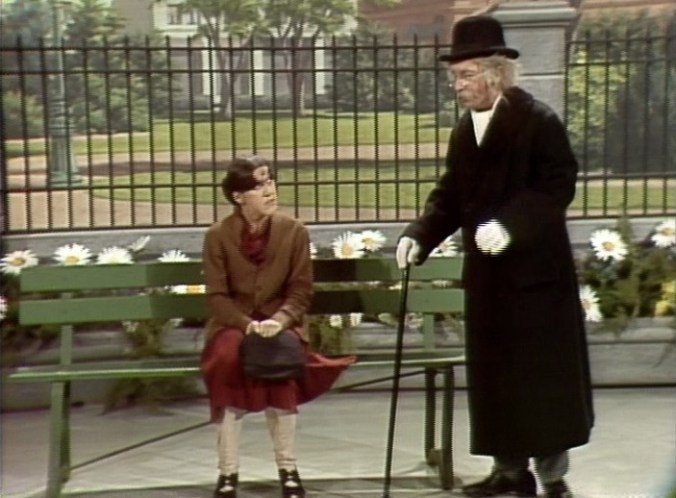
[M]any of these additions were sexual and directed at the women in the cast, such as when he goosed the actress who played Mindy’s grandmother with a cane.

[Director Howard] Storm said: ‘I’m standing there watching this and I’m thinking, “oh my god” and I just laughed. I thought she was going to turn and say: “How dare you stick a cane in a woman’s ass?” That sweet old lady.’There was nothing lascivious about it, in his mind. It was just Robin being Robin, and he thought it would be funny. He could get away with murder.’

Other times Williams would grab Dawber’s bottom or her breasts simply because he was ‘bored.’ 

‘He’d be doing a paragraph and in the middle of it he would just turn and grab her ass. Or grab a breast. And we’d start again. I’d say, “Robin, there’s nothing in the script that says you grab Pam’s ass.” And he’d say: “Oh, ok,”‘ Storm added.  

Garry Marshall, the producer of the show, said: ‘He would take all his clothes off, he would be standing there totally naked and she was trying to act. His aim in life was to make Pam Dawber blush.’

But Dawber remained unfazed, she admits: ‘I had the grossest things done to me – by him. And I never took offense. I mean I was flashed, humped, bumped, grabbed. I think he probably did it to a lot of people…but it was so much fun.

‘Somehow he had that magic. If you put it on paper you would be appalled. But somehow he had this guileless little thing that he would do – those sparkly eyes. He’d look at you, really playful, like a puppy, all of a sudden. And then he’d grab your tits and then run away. And somehow he could get away with it. It was the Seventies, after all’.

Wait: if it was the 70’s, does that mean that in the parallel universe where Robin Williams has conquered his demons and is running for the U.S. Senate as a Republican (those parallel universes are funky, let me tell you), Dawber couldn’t come out and destroy his candidacy by describing his outrageous behavior? Does it mean everyone would say that she was being unfair, and that she wouldn’t be lionized as another #MeToo hero?

Continue reading