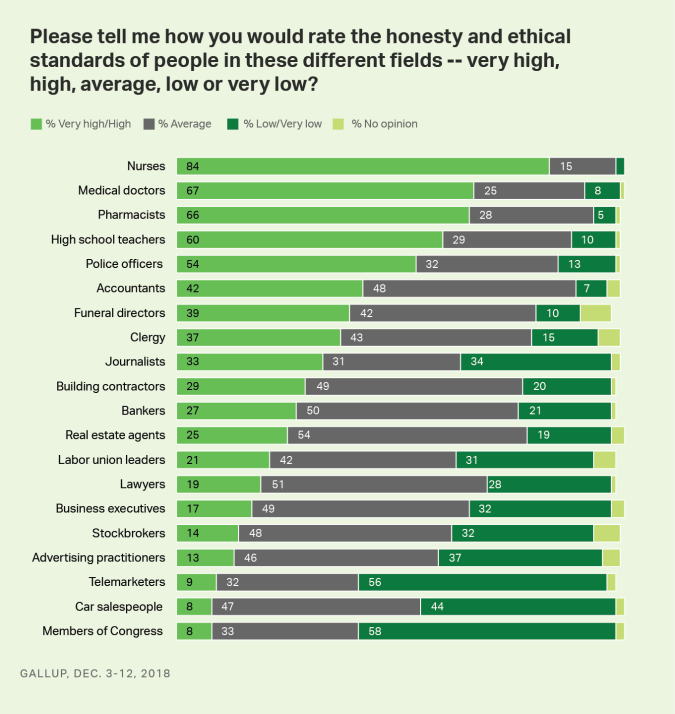
The chart above shows the summary results of Gallup’s annual survey of the public’s trust in various professions. The venerable polling organization has set out to measure the public attitudes toward the honesty and ethical standards of professions and occupations since 1976. The poll, conducted between December 3 and 12, 1,025, asked U.S. adults, as Johnny Carson’s quiz show didfrom 1957-1962, “Who Do You Trust?” and also “How much?” The survey has never revealed whether and how much any of these groups should be trusted, for trust is often irrational, and based more on perception than reality. If you want to be cynical about it, you can conclude that it only tells us who does the better job of conning those who depend on them.
As in every year for two decades, (with the exception of 2001, when firefighters were on the list after the 9/11 terrorist attacks) nurses topped the list. Before that, pharmacists and clergymen exchanged yearly titles for most-trusted. I have wondered if pharmacists lost votes once “It’s A Wonderful Life” started being shown on the networks every holiday season, with old Mr. Gower shown drunkenly loading pill capsules meant for a sick kid from the contents of a jar labeled “POISON.” However, there isn’t much mystery why public regard for the clergy’s ethics has dived. Continue reading →
1. Quotation ethics. The church next door has a message out front this week that says, “The time is right to always do the right thing”—Martin Luther King.
That’s not the quote. Misquotes get into the public lexicon that way; it’s unethical to go around posting sloppy versions of quotes on message boards. Stated like that, the quote is a tautology: if you always do the right thing, of course the time is right to do what you do anyway. Not that King’s actual quote is one of his best. The actual quote—“The time is always right to do the right thing” is pretty fatuous, and incorporates Rationalization #60. The Ironic Rationalization, or “It’s The Right Thing To Do” by assuming that what is the right thing to do is intrinsically obvious. Sometimes the right thing is to wait. Sometimes the right thing is yo be sure what you think is the right thing really is. King was dangerously arming ideologues and the self-righteous who think they are the ultimate arbiters of what is “right.”
Davey Crockett’s quote is better: “Be sure you are right, and then go ahead.”
2. Is it political correctness to point out that Jeff Dunham’s act is racist? After being told by my wife that I couldn’t watch any more holiday movies or the Mormon Tabernacle Choir, my channel surfing today took me to Comedy Central and Christmas-themed performance by ventriloquist Jeff Dunham. Dunham’s low-brow act makes Charlie McCarthy seem like Oscar Wilde, and I cannot watch him and his howling audiences without thinking about this scene in “Blazing Saddles”…
He began his set with “Walter,” his bitter old curmudgeon dummy, whose face is perpetually scowling and whose arms are crossed in disgust with the world. To my amazement, Walter launched into an extended section ridiculing black speech, black slang, hip-hop, Kwanza and the Black Entertainment Network, and the huge, apparently all-white mid-West audience roared with laughter. How ugly and disturbing. These were jokes of denigration, about people who weren’t there. This was never anything but hate-mongering humor, not in 1948, 1958, 1968, or now. It’s an audience laughing at other people for simply being different than they are.
I kn ow, I know: how is this different from what Stephen Colbert, or Bill Maher, or Samantha Bee does in every performance? It isn’t different, really: it’s just that treating white people who aren’t “woke” as the “other” is considered acceptable, while doing this to minorities, gays or women is considered bigotry, hateful, and cowardly.
3. It annoys me that I should even have to say this, but calling “Die Hard” a Christmas movie is nothing but a cynical way to diminish Christmas and the spirit of kindness and love that the holidays are supposed to foster in order to promote future holiday marathons of a violent action movie. Celebrating the film’s 30 Anniversary, some Grinch at 20th Century Fox decided that it would be cute to promote Bruce Willis’s break-out film as “The Greatest Christmas Story” ever told, according to 20th Century Fox. Right: the movie ends with a strained family brought back together, takes place during a Christmas party, and Bruce’s wife is named “Holly.” It also involves the killing of more than twenty people, including police,l FBI agents, and innocent victims in addition to the bad guys the hero smokes.
And I like “Die Hard.” I even like two of its four vastly inferior sequels. Continue reading →
Bing Crosby memorably introduced this last of the popular Christmas songs to have a religious theme to most Americans in 1963, on this live broadcast of “The Hollywood Palace.” It was written in October of 1962 during the Cuban Missile Crisis, by a married songwriting team that wondered at the time if it would be the last thing they ever did.
Noel Regney, who wrote the lyrics, was born in France and had studied music at the Strasbourg Conservatory and at the Conservatoire National de Paris. When France was overwhelmed by Hitler’s troops in 1940, he was conscripted into the German army. As a Nazi soldier, he secretly joined the French underground and served as a spy, passing information along to the resistance. Once he led German soldiers into a trap where they were massacred by French fighters who cut them down in a crossfire. He was shot too, but survived.
After that traumatic encounter, Regney deserted and worked with the French underground until the end of the war. Continue reading →
1 Christmas gift ethics. What’s your opinion of a relative who says that the only thing she wants for Christmas is for family members to donate to her favorite leftist candidate for City Council? I don’t recall the Christmas tradition being “Make people do whatever you would do” Day, do you? Let’s have a Christmas Eve poll!
2. Change: I now believe “the wall” is necessary and the President’s resolve is ethical. My change of heart comes after watching all Democrats and many Republicans simultaneously say they want secure borders and then continue to encourage illegal immigration with their rhetoric and votes. The wall is necessary to send an unequivocal message, which has been Trump’s message since he announced his candidacy: “Come here legally, or don’t come. If you get here by breaking our laws, you are not welcome and will never be welcome, no matter what you do.”
Correctamundo!
Anti-Trump GOP Senator Bob Corker claims that the showdown over authorization of funding for the Wall is a “made-up fight, so the president can look like he’s fighting, but even if he wins, our borders are going to be insecure.” It’s not a “made-up” fight at all. Republicans have been afraid to upset Hispanic-Americans and Democrats want nice, reliable, left-voting poor folks to swell the voting rolls, so they have sent deliberately mixed messages, particularly regarding the “Dreamers.” If a wall did nothing other than stop “migrant caravans,” it would be worth it.
Trump also promised a wall. Breaking promises is not the same as a lie, unless the promise was a lie when it was made, but Trump, who we have been told lies incessantly, has also been far more determined to fulfill campaign promises than any President within memory. (Obama promised to address the national debt. He promised to have the most transparent administration in history. He promised that lthe use of chemical weapons by Syria would be the “red line.” He promised to be President of all the people, not just Democratic base demographic groups. He promised that if you like your heath care plan…well, you know the rest.)
It is the Democratic position on the wall that is a sham, because the money involved is a relative pittance. They are grandstanding, and the President is not.
3. Slot machine ethics. How did I miss this? Three Las Vegas visitors who hit multi-million dollar jackpots playing slot machines are fighting the casinos’ efforts to void the pay-offs on the grounds that the machines “malfunctioned.” The episodes all occurred earlier this year. Unless there is a prominent notice on or around the slots pointing out that there is a limit to the payoff in any single play and specifying what the limit is, I think the casinos are obligated to live with losing whatever one of their evil, manipulative, Skinnerian machines cough up.
This isn’t like a malfunctioning ATM machine. Players are led to believe that whatever comes out when they pull the lever or push the button is theirs. If casinos can say that their machines malfunctioned and they are not responsible for the result, then gamblers should have the same option: “I’m sorry, but my limit on gambling losses was just $500. I shouldn’t be responsible for the additional $10,000 I lost on blackjack, because I malfunctioned.” Continue reading →
This is, I know, a poor topic for Christmas, but it just came down the chimney.
While shopping yesterday, we encountered a man who lived in the neighborhood. Rugby had enjoyed conversing with the two dogs owned by the man and his wife, two friendly, lively min-pins. As shoppers bustled around us, our neighbor announced that he was more our neighbor than ever: he and his wife had moved from where I had met them to a home less than a block away from ours, on the long street that our cul de sac opens onto. The reason for the move: their next-door neighbor had poisoned their dogs. One had survived.
Our neighbor said that they had called the police, who investigated. Based on motive (the there had been a property dispute, and the resulting law suit had gone our friends’ way), opportunity, and the demeanor and comments the police got while questioning the suspects as well as accounts about their threats and general sociopathic tendencies from others on the street, the police reported that they were pretty sure my neighbors’ neighbor were the culprits, but that they did not have sufficient evidence to make an arrest.
This story had unpleasant resonations for me. My Dad, when he was a 10 year-old only child being raised by a single mother during the depression and having to move to new neighborhoods constantly, owned a large, loyal Airedale named Bumbo. One day someone put ground glass in his beloved dog’s food dish, and my father had to see his best friend die in agony in his arms. It was one of the great tragedies of his life. His mother was certain who had killed the dog, but again, there was insufficient proof.
Your Ethics Alarms Ethics Quiz of the Day:
Is my neighbor obligated to tell anyone who is interested in renting or buying his now-abandoned property that the neighbor poisoned his dogs?
You know, it’s late, I’m finally finished decorating the tree, nobody’s visiting the blog anyway, and when they do and try to share an article without an scintilla of “hate speech” in it, Facebook blocks it. But ethics never rest, and I’m going to post this anyway.
The President announced that ol’ Mad Dog won’t be staying on for an” orderly transition” at DOD after all: today the President announced that Mattis’s deputy would take over on January 1, and Mattis can get head start on collecting shells in Boca, or something. One more time, the news media and social media are acting like this is some kind of scandal, because they 1) hate the President and 2) couldn’t manage a lemonade stand themselves.
I’m sure Mattis would have been welcome to stay on a couple more months as originally announced—if hadn’t publicized a resignation letter that implicitly attacked the President. You can’t do that and expect to stay in any job, much less one as powerful and important as Secretary of Defense.Oddly, Trump’s perpetual critics don’t understand this, either because bias has made them stupid, or they were ignorant to begin with. Continue reading →
Many, many excellent comments followed this post. The issue, covered here before but long ago, was when a transgender individual is ethically obligated to reveal that fact to a romantic target, or partner. The Ethics Alarms poll on the question reached these results:
I voted “before having sex” and/or “when the relationship becomes serious”; as these were the earliest stages on the list. I also included “when marriage becomes a possibility” as the latest possible time to reveal. (I did not include “first kiss”, as this is too vague a time period)
My take would be as soon as practical (including at soon as the overt risk of a violent reaction is ruled out). The current consensus is that gender and orientation are spectrums, not binary absolutes. Within this logic, we have a duty to understand and respect our romantic partner’s place on the spectrum. One (of ant orientation) might be exclusively attracted to the extreme end of the female gender spectrum, for instance. This might preclude attraction someone with a surgically transitioned body. Since gender and orientation are considered persistent traits, it is not necessarily bias alone that dictates this exclusive attraction.
One must also consider cultural values of a partner. Any relationship I’ve been in, I’ve made known early on that kids (naturally conceived) are a long term goal of mine. On this basis alone, I might decline to pursue any women with known infertility. Were such detail withheld, I would feel extremely hurt and betrayed. Continue reading →
Director Gregory Mosher quit the Broadway revival of Arthur Miller’s “All My Sons” (scheduled to open in the Spring) when Miller’s estate, run by his daughter Rebecca Miller, blocked him from casting a black actor to play George Deever, one of the main characters in the classic. Miller objected to the director’s choice of making the Deever family black when the play’s other central family, the Kellers, had already been cast as white. If the Deevers were black, it would introduce the concept of an interracial relationship in the 1940s.
“My concern was that to cast the Deevers as black puts a burden on the play to justify the relationship in the historical context,” Miller said “I was worried that it would whitewash the racism that really was in existence in that period by creating this pretend-Valhalla-special family where no one would mention this.”
Nice attempt to put her position in a politically correct context, I have to admit. The objection really is that the play is a period piece, firmly and unavoidably set in the post-World War II era. It will have period costumes, sets and props, and the audience seeing the story unfold in the proper historical time period is essential to the play’s success. An inter-racial romance shatters that illusion, and unnecessarily so. The play is not about race, so race should not be injected into the plot by reckless casting. Miller had previously approved of a production in which both families were black.
Interestingly, she also was willing to approve the casting of a black actor if his sister were cast as white. You see, then the casting would be “color blind,” meaning that it was just a black actor playing a white character (without white make-up, which would be “white-face,” which would suggest blackface, and—oh, never mind…), and that his family wasn’t really “black.” Got that? Otherwise, it would be “color-conscious” casting, in which the race of the performer necessarily requires a different approach to the material. Continue reading →
[As promised, here is the Ethics Alarms Christmas package, lightly revised, last posted three years ago]
I don’t know what perverted instinct it is that has persuaded colleges and schools to make their campuses a Christmas-free experience. Nor can I get into the scrimy and misguided minds of people like Roselle Park New Jersey Councilwoman Charlene Storey, who resigned over the city council’s decision to call its Christmas tree lighting a Christmas Tree Lighting, pouting that this wasn’t “inclusive,” or the CNN goon who dictated the bizarre policy that the Christmas Party shot up by the husband-wife Muslim terrorists had to be called a “Holiday Party.” Christmas, as the cultural tradition it evolved to be, is about inclusion, and if someone feels excluded, they are excluding themselves. Is it the name that is so forbidding? Well, too bad. That’s its name, not “holiday.” Arbor Day is a holiday. Christmas is a state of mind. [The Ethics Alarms Christmas posts are here.]
Many years ago, I lost a friend over a workplace dispute on this topic, when a colleague and fellow executive at a large Washington association threw a fit of indignation over the designation of the headquarters party as a Christmas party, and the gift exchange (yes, it was stupid) as “Christmas Elves.” Marcia was Jewish, and a militant unionist, pro-abortion, feminist, all-liberal all-the-time activist of considerable power and passion. She cowed our pusillanimous, spineless executive to re-name the party a “holiday party” and the gift giving “Holiday Pixies,” whatever the hell they are.
I told Marcia straight out that she was wrong, and that people like her were harming the culture. Christmas practiced in the workplace, streets, schools and the rest is a cultural holiday of immense value to everyone open enough to experience it, and I told her to read “A Christmas Carol” again. Dickens got it, Scrooge got it, and there was no reason that the time of year culturally assigned by tradition to re-establish our best instincts of love, kindness, gratitude, empathy, charity and generosity should be attacked, shunned or avoided as any kind of religious indoctrination or “government endorsement of religion.” Jews, Muslims, atheists and Mayans who take part in a secular Christmas and all of its traditions—including the Christmas carols and the Christian traditions of the star, the manger and the rest, lose nothing, and gain a great deal.
Christmas is supposed to bring everyone in a society together after the conflicts of the past years have pulled them apart. What could possibly be objectionable to that? What could be more important than that, especially in these especially divisive times? How could it possibly be responsible, sensible or ethical to try to sabotage such a benign, healing, joyful tradition and weaken it in our culture, when we need it most?
I liked and respected Marcia, but I deplore the negative and corrosive effect people like her have had on Christmas, and as a result, the strength of American community. I told her so too, and that was the end of that friendship. Killing America’s strong embrace of Christmas is a terrible, damaging, self-destructive activity, but it is well underway. I wrote about how the process was advancing here, and re-reading what I wrote, I can only see the phenomenon deepening, and hardening like Scrooge’s pre-ghost heart. Then I said… Continue reading →
1. Yes, Merry Christmas, dammit. Those responsible for that moment of doubt and ethical uncertainty every time I encountered a stranger on my just completed Ethics Rock Extreme road trip to New Brunswick, New Jersey deserve to be entombed alive in peppermint and plum pudding. The greeting simply says, “I wish you to be joyful and happy in a season where people are a little less selfish and a little more ethical: I’m not trying to indoctrinate you into Christianity!” Much of this completely unnecessary addition to holiday stress is due to to jerks—yes, I think the word is fair—like Julia Ioffe, the author of “Please don’t wish me ‘Merry Christmas’/It’s impolite and alienating to assume I follow your religion.”
I thought Charles Dickens slam-dunked that nonsense definitively in “A Christmas Carol,” followed by almost all the Christmas movies that make the same obvious point except to deliberate holiday wet-blankets like Ioffe. No, jerk, the greeting is an expression of cultural unity among human beings, and the celebration of values that need have not be restricted to religious Christmas holiday because this is also a secular tradition as well. As soon as I get this post up, I’m going to re-post the Ethics Alarms Christmas commentary.
Somebody send it to Julia.
2. 2018 Hypocrisy Award, locked up! It doesn’t matter if you are happy or disappointed to see President Trump pull U.S. troops out of Syria and Afghanistan; you should still be able to marvel at the blatant, shameless, pandering, hateful and, really, laughable—if the cultural fad of denigrating the President of the United States regardless of what he does wasn’t so destructive and wrong— hypocrisy by news media Trump-haters, among others. Glenn Greenwald, who sees the world from a leftward perspective but maintains his integrity, called out MSNBC’s Rachel Maddow, who could be the symbol of the whole nauseating. He tweeted,
This upset Glenn’s loyal progressive followers, one of whom sent this fascinating retort:
“The most bizarre aspect of Glenn Greenwald’s inexplicable credibility is his ability to appear as first an advocate and then an opponent of almost everyone and everything. Can’t choose one perspective.”
See? To people like this—the commenter’s handle is IstandwithMaxine, which pretty much explains everything—is that they have been brainwashed to believe that is is bizarre unless adopts a single view—theirs. of course, otherwise you are evil–and never alters it or admits that it may need re-thinking when that view leads to dead ends, disasters and pitfalls, no matter what new information arises. Someone like Greenwald, who tries to apply the same standards of analysis and ethical judgment to all regardless of whether it advances an ideology, is just untrustworthy, a traitor.
This cartoon has been circulating online. It is 100% fair and accurate regarding Trump’s critics self-indicting reaction: Continue reading →



Many, many excellent comments followed this post. The issue, covered here before but long ago, was when a transgender individual is ethically obligated to reveal that fact to a romantic target, or partner. The Ethics Alarms poll on the question reached these results:
Here is the first of two Comments of the Day from The Transgender Secret: Was I Right Then, Or Am I Right Now?; this one is by Rich in CT.