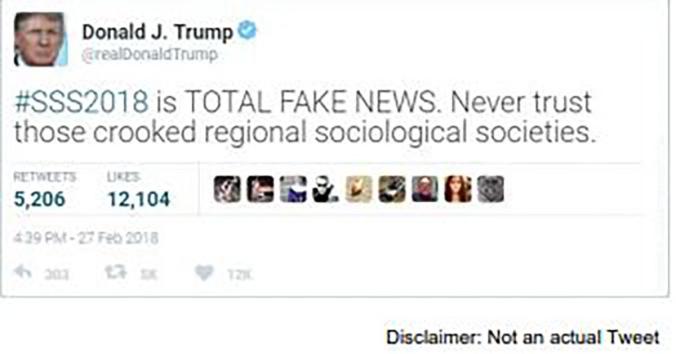
That fake tweet above? It was created by the Southern Sociological Society as promotion for its conference this week. It is also, amusingly, accurate. Based on the conference, titled “Racial Theory, Analysis, and Politics in Trump America,” you can’t trust sociologists any more. Like so many other professional, including among them historians, lawyer, journalists, educators, ethicists and psychiatrists, this group has decided to abandon professional ethics and standards of objectivity and civility for juvenile virtue-signaling and partisan name-calling.
At first I thought this was an Onion parody. From Campus Reform:
…The conference program features two full-color illustrations that crudely depict the President as a baby, six sketches employing similar themes, and nine satirical presidential tweets (each of which comes with a disclaimer alerting the sociologists that it is “not an actual tweet”). The front cover shows the president as a grotesque and overweight infant, sitting in a soiled diaper on top of an image of hooded Klansmen while playing with missiles and nuclear bombs. His outstretched left arm, replete with a tiny hand, may be an attempt to depict him performing the Nazi salute.
A cross superimposed on a series of concentric circles appears above the word “Trump” in the conference title, suggesting the crosshairs on a rifle site…The back cover depicts a similarly-styled Trump, this time with his diaper sagging down and kneeling in a pool of urine inside his crib. Black and white sketches scattered throughout the program, meanwhile, depict Trump in various other unflattering ways, with one showing him urinating on the floor while holding what appears to be a balloon labeled “WW3,” while another drawing portrays him smashing the EPA and healthcare.
The conference schedule indicates that there will be 32 workshops, papers, lectures, discussions, and other sessions that explicitly deal with Trump, including a discussion about “Approaching Resistance to TrumpAmerica” and a session on “How to Talk About Current Events in the Classroom in the Age of Trump without Getting Fired.”
Some sessions, such as “Organizing a Campus-Wide Social Justice Event,” appear to advise professors on how to use their positions to influence campus politics. Continue reading




Here is another Comment of the Day emerging from the discussion of Harvard’s suspension of a student religious organization.
The topic is a bit tangential, but interesting nonetheless. One of EA’s readers from across the Atlantic—you can tell he’s British because he spell “theater” wrong— clarifies some history regarding England’s unpleasantness with the Colonies, and as you all know, correcting historical misconceptions is always welcome here.
This is P.M. Lawrence’s Comment of the Day on the post, “Ethics Quiz: Harvard And Evangelicals”:
Though I mostly just lurk these days, I have seen that misconception so much that I want to rebut it here, as this is one of the few places where the search for truth might let it be taken seriously. Feel free to check what follows for yourselves.
Britain had only just acquired Canada and Bengal, along with hegemony over some (not all) of the rest of India. At that point, all of its gains were yet to be consolidated, and represented drains rather than sources of strength; the same applies to Gibraltar and Minorca too, of which more below. In military, geographical, and economic terms, Britain was weaker than the Chinese, Russian and Ottoman Empires – though all those fell back in one or more of those respects very soon afterwards, when Britain was surging ahead, which may give people the wrong idea from looking anachronistically at what came later. More to the point, Britain was then behind both France and Spain too in most of those respects, and those countries were allied with the revolting colonists.
Britain had just two advantages over France and Spain: it had a more resilient financial system than France and Spain (though not than Holland, a minor rebel ally), and it had denied France more territory even though it had not yet consolidated that for itself.
Britain was – at the time – equal in naval power to France, though not yet to France and Spain combined, which it only became after the Battle of Trafalgar in 1805. That was why Britain lost the.Battle of Chesapeake Bay, which in turn made Yorktown into a Dien Bien Phu rather than at worst a Corunna or a Dunkirk, or at best even a Torres Vedras. Continue reading →