Ethics Quote Of The Month: Professor Jonathan Turley

“This is Larry Tribe’s brain on Trump…”

“There is an open frustration among many who want confirmation that we are finally close to a Trump indictment. It is neither satisfying nor entertaining to consistently say that this is far short of any cognizable criminal case. However, the cable news is filled with experts assuring viewers that we are closer than we are. It is like finding a scientist willing to assure viewers that the moon is half its actual distance. It may be an exciting prospect, but it makes any attempt a dangerous pursuit.”

—-George Washington University Law School Professor Jonathan Turley, decisively debunking claims that President Trump was guilty of “witness tampering” when he helped hos son craft a misleading description of his meeting with Russians offering “opposition research.”

When the nauseating history of “the resistance” is written, laying out how Democrats, progressives and the news media abused, harassed, undermined, obstructed and withheld basic respect of his office from this President unlike any before him in hopes of  overturning an election, Professor Turley will stand tall, just as he did during the run-up to the Clinton impeachment, when he was one of the few liberal scholars with the courage to spit on the Democrats’ “everybody does it” and “it’s just sex” defenses. Along with fellow liberal legal scholar Alan Dershowitz, Turley has steadfastly insisted on legal precision and fairness from the various members of his profession, some distinguished indeed, who have rushed to give aid and comport to  anti-Trump zealots by jamming the square pegs of Trump’s conduct into the round holes of criminal statutes.

One of the repeat offenders has been former Harvard law professor Lawrence Tribe.  Tribe quickly announced that what Trump had done by working on his son’s statement was witness tampering.  Tribe previously has opined that Trump and his family was guilty of evidence of obstruction of justice, criminal election violations, Logan Act violations, extortion and possible treason by the president or his family, as well as by May joining Maxine Waters in the indefensible fantasy that Trump could and should be impeached. Tribe also recently tweeted that White House aide Stephen Miller was a “non human,” though that tweet has been taken down by its impulsive author.

Come on, Larry! You can’t do “the resistance” any good by broadcasting your biases like that!

Yes, there is strong evidence that the Trump Hate Virus has eaten away at the once brilliant professor’s prodigious brain, but Turley respectfully treats his latest impeachment fantasy with the respect it might deserve if Tribe were still at its peak:

[A] misleading statement is not a crime in itself — or half of Washington would be serving time. It is spin. It turned out to be remarkably ill-advised and self-defeating spin, but it was a classic effort to emphasize the least damaging part of the story. It was also dumb. The president knew there was a special counsel in the field investigating his role into a possible effort to obstruct the Russian investigation. There were various options in responding to the New York Times story about emails to Trump’s son.

This was the worst of all available options. The president prevented his staff from insulating himself from the story and creating some crush space between him and his controversy. By inserting himself into the controversy, he harmed both his and his son’s legal position. Trump, once again, made the White House the center of gravity for the scandal rather than Trump Tower or the campaign….

However, it still does not make it a crime. Take Tribe’s witness tampering claim. The statutory provision in 18 U.S.C. 1512 addresses an effort to “corruptly persuade another person” to “influence” testimony of that person in the withholding of information. This language has never been extended to a public statement of this kind.

First, there was no existing demand for testimony from Trump Jr. on this meeting. Second, there is no evidence that Trump told his son to lie about the email or the original understanding of the meeting. This was not coaching for testimony but a public defense. Third, even if this were construed to be about testimony, the law contains an express affirmative defense (that needs only be proven by a preponderance of the evidence) that “the conduct consisted solely of lawful conduct” and that the defendant intended to encourage truthful testimony. The Trumps have emphasized what the meeting primarily addressed while downplaying what it was intended to address. They did not address the original purpose in the statement.

Turley goes on to note the pernicious double standards being employed by Tribe and others corrupted by their “resistance” fervor.”

“The Clintons were famous for such spins. Indeed, with knowledge of an ongoing investigation in the field, Clinton repeatedly changed her account of the use of a personal server to transmit sensitive and classified information. It went from an assertion that no classified material was sent (which is untrue) to a statement that she never “received nor sent any material that was marked classified” (which is also untrue).”

Of course, Tribe never raised a peep about Hillary’s conduct on Twitter or anywhere else. Continue reading →
Morning Ethics Warm-Up: 8/5/17

Good morning!

1. I’ll have more later on the leaked transcripts of the President’s private conversations with the presidents of Mexico and Australia. Whoever did it was betraying his or her superior and the nation, and  needs to be identified and prosecuted. This is malicious sabotage, and nothing less, designed to make it more difficult for this President to function. Those attempting to justify it and rationalize it disqualify themselves as objective critics of the President and also as responsible citizens. The conduct cannot be justified, and no one should attempt to justify it.

The Washington Post publishing the transcripts is a hostile act. True, in today’s Wikileaks world they would have been put online somewhere, but absent some scandalous disclosure in one or both of them, this wasn’t news. The news is that embedded foes of ourelected government are willing to harm the nation in order to undermine the President.

Eventually, the question turned yesterday to why the contents of the transcripts did not prompt any further headlines or allegations of scandal. The answer is that the hoped-for smoking gun proof of the President’s incompetence did not surface in either conversation, so they were no longer of any interest. Ann Althouse, to her credit, waded through the entire exchange with  Peña Nieto, and you can read her analysis. The liberal blogger’s conclusion:

“But what can his antagonists grab onto? They can’t very well oppose crushing the drug gangs or better trade deals. So it’s no wonder they went big with Oh! He insulted New Hampshire! And that’s it for the transcripts. Don’t encourage people to actually read them. They might think Trump did just fine.”

Can’t have that.

2.  Rep. Maxine Waters responded to the leaked discussions by saying that she hoped such leaks continued. She is calling for and endorsing illegal and unethical conduct that is damaging to the United States, as a sitting member of Congress. I wonder if she could say anything, including calling for Trump’s assassination, that would attarct rebuke from her party? I doubt it. I remember the howls of horror from Democrats during the 2016 campaign when candidate Trump said,

“I will tell you this, Russia: If you’re listening, I hope you’re able to find the 30,000 emails that are missing. I think you will probably be rewarded mightily by our press”

There is no ethical difference between calling for Russia to hack a U.S. citizen’s e-mails and calling for government employees to break the law to reveal secret government communications. If there is a difference, it was that Trump was joking, and Waters is not.

3.  With tattoos more popular and visible than ever, the Federalist is suggesting that there is something wrong with getting them—that is, wrong other than the fact that many people think they are unsightly; that the more people have them, the less effective the things are as statements of rebellion and individuality; that they trigger biases in many people (like me), including employers (Did you know that the Armed Services will to accept a volunteer with more than 25% of his or her body covered by tattoos, on the theory that this is res ipsa loquitur for someone with dubious judgment?); and that they are excessive expenditures for a permanent ink-blotch that the odds say you will regret sooner or later. Continue reading →

Ethics Dunce: West Virginia Governor: Jim Justice

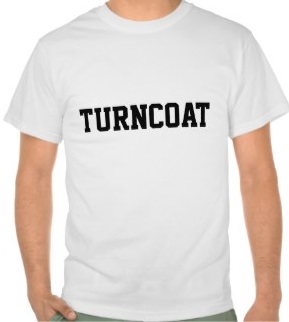
Gov Justice went to a Republican rally, and all he got was this T-shirt…seemed to fit, though…

I’ve written about party-switching by elected officials before; unfortunately, it was on the old Ethics Scoreboard, which is temporarily in limbo thanks to an incompetent web hosting service and some corrupted old disks. I can summarize the proper ethics standard for the practice, however. It was demonstrated perfectly by the  now retired former Republican U.S. Senator from Texas, Phil Gramm. Just days after  he had been reelected to a House seat  as a Democrat in 1982, Gramm was thrown off the House Budget Committee in a dispute with party leadership. In response, Gramm resigned as a Representative, changed parties, and ran for his old seat as a Republican in a special election. He won easily, and  was a Republican ever after. That’s the honorable way to do it.

Or, you could be like West Virginia Governor Jim Justice, who announced that he was flipping  from the Democratic Party to the GOP at last night’s  rally with President Trump. Continue reading →

Comment Of The Day: “Morning Ethics Warm-Up: 8/2/17”

From Emily, a marvelous Comment of the Day so full of wisdom and good advice that it stands on its own:

I’m not from flyover country, but I live on the Eastern Shore of Maryland, red counties that include the poorest counties in the state (the lower shore has Baltimore City beat.) My family of three hovers around the federal poverty line.

However, my husband and I were both raised middle class. And while there are no major economic differences between us and our friends and neighbors, there are a lot of differences in the choices we make, which allow us to use the same amount of money to give our daughter opportunities that other parents in our economic class are unaware of or neglect.

This, more than money, is what affects the opportunities that my daughter has access to (as well as the ones my husband and I have access to.)

Despite the economic hardship, I’m a stay at home mom, which allows me to be dedicated full time to my daughter’s developmental delays. I could go to work and make *slightly* more money for us, after childcare expenses, but that would be a very different level of care for my daughter, and it turns out she needs it. The expert we’ve consulted is almost certain she’ll catch up, and has indicated me being home with her is an important part of that certainty.

I mentioned above that my daughter does have a tablet, a $30 one from Amazon. I found that tablet because I got a $20 Amazon giftcard for Christmas, and I was saving it for something special. I had to dig in the library’s website to find the link to borrow ebooks, but I figured there must be something like that.

We have internet, despite having no long distance for our phone (and no cellphone service where we live.) My husband and I manage to pick up extra money doing work online, despite neither of us having college degrees. This is part of what allows us to get by while still having plenty of time for our daughter.

These are just examples of things *we’ve* figured out. Everyone’s situation is different, especially among the poor. The thing that most people don’t seem to see is that down here social capital (the network of friends and family you have and what they’re willing to help you with,) knowing how to allocate resources carefully, and understanding how to navigate the various systems — both private and government — are more important to the kind of life you have than income, and those are highly individual things. Continue reading →

Morning Ethics Warm-Up: 8/4/17

Good Morning!

1. An update to the Michelle Carter fiasco from Taunton, Mass., where the judge in the case discussed here sentenced the young woman to 15 months in jail for her supposedly deadly words, which “made” her boyfriend commit suicide. This classic example of the axiom “hard cases make bad law” provides the censorious camel’s nose access to the tent for advocates of  the criminalization of “hate speech,” opposition to climate change propaganda, and the gradual castration of freedom of speech. Carter should have never been charged or tried; doing so was an abuse of process, prosecutorial ethics and judicial ethics. I strongly suspect that the judge knows the case will be reversed on appeal as unconstitutional, hence his decision to stay the sentence, allowing Carter to remain free while her case winds its way to the Supreme Court. Meanwhile, her life will be stalled, and completely absorbed by the consequences of her texts urging teen Conrad Roy III to act on his expressed desire to kill himself, which he did. This is her real punishment, because the sentence will not and must not stand.

It is unethical to use the legal system this way. When the government takes it upon itself to punish citizens despite the absence of applicable laws, it is treading over the line dividing democracy from totalitarianism.

2. What is to be done about California? States have always maintained their own unique cultures, and that is a national strength. When a state’s culture becomes wholly estranged from and hostile to the values and principles of the nation it belongs to, however, it becomes a danger to that nation and perhaps to its citizens. What, if anything, is the responsibility of the federal government when this happens? What is the duty of the state’s elected officials?

Tucker Carlson’s creepy interview on Fox with a leader of the California secession movement,Shankar Singam, raised these questions and more. Among Singam’s jaw-dropping positions was that the documented exodus of middle class Californians and small businesses from the state was a good thing. “If everyone in the middle class is leaving, that’s actually a good thing. We need these spots opened up for the new wave of immigrants to come up. It’s what we do,” Singam told Carlson. He also told Carlson that “This is California. We’re not the United States.”

At least that settles the question of whether Hillary Clinton won the popular vote.

An ethical, responsible, loyal American governor would recognize the danger inherent in allowing his state to see itself as separate from the rest of the country, and actively work to reverse that dangerous trend and attitude. That governor is not Jerry Brown. Continue reading →

The Unabomber Had A Point. [UPDATED]

FX has a new limited series about the hunt for the Unabomber, Theodore John Kaczynski. I didn’t pay much attention to the story when it was going on; I just thought it was one more Harvard-grad-turns-serial-killer episode, and that was that. I certainly didn’t pay attention to his “manifesto.” The series, however, enlightened me.  As I understand it, Ted believed that technology was destroying society, making us all slaves to it, and taking the joy out of life. I have yet to see how blowing people up addressed this problem, but then he shouldn’t have to be right about everything. The evidence has been mounting since 1995, when he killed his final victim,that  the Unabomber  wasn’t quite as crazy as we thought.

I could bury you in links, but will not.  We are slaves, for example, to passwords. I teach lawyers that their devices containing client confidences should, to be properly protective of them under ethics standards, have passwords of at least 18 random letters, characters and numbers, with the password for every such device being different, and all of them changed every month. Or you can go the John Podesta route, use “password.” and get hacked, and eventually disciplined by your bar association, once they decide to get serious.

[CORRECTION: In the original post, I relayed a link to a site where you can check your password to see if it’s been compromised. I had been forwarded the link by another tech-interested lawyer. But as I was just alerted by a commenter (Than you, Brian!) It’s apotential trap and an unethical site, making you reveal your password to check it. I apologize for posting it. See how dangerous and tricky this stuff is? See? SEE?.I fell for the trap of depending on technology to protect us from technology! Ted warned us about that, too.]

Then there is this feature in The Atlantic. An excerpt: Continue reading →

Al Luplow And The Duty To Remember


A culture is defined by what it chooses to remember and what it chooses to forget. Ideally, a culture would remember everything, because knowing the past, as Santayana famously observed, was insurance against repeating its mistakes.  But time is a huge eraser, as Shelley told us:

I met a traveller from an antique land,
Who said—“Two vast and trunkless legs of stone
Stand in the desert. . . . Near them, on the sand,
Half sunk a shattered visage lies, whose frown,
And wrinkled lip, and sneer of cold command,
Tell that its sculptor well those passions read
Which yet survive, stamped on these lifeless things,
The hand that mocked them, and the heart that fed;
And on the pedestal, these words appear:
My name is Ozymandias, King of Kings;
Look on my Works, ye Mighty, and despair!
Nothing beside remains. Round the decay
Of that colossal Wreck, boundless and bare
The lone and level sands stretch far away.”
This is why historians have such a crucial role to play in preserving our culture, by preserving stories, lives and memories along with the inspiration and wisdom they can provide.Sometimes a lost memory is rescued from neglect. Today we remember Colonel Joshua Chamberlain as one of the central heroes of the Battle of Gettysburg for his desperate stand with the 20th Maine Volunteer Infantry Regiment at Little Round Top, culminating in his using his knowledge of military history (he was a college professor) to improvise the bayonet charge that held his position and turned defeat into victory. That was not the case for almost a century, however, until the historical novel “The Killer Angels” retold the story so vividly that Chamberlain’s entire career became the object of new scholarship and admiration. This was truth emerging, but it was also justice. Chamberlain deserved to be remembered.

Unfortunately, Chamberlain is an exception. Once a life, a deed, a remarkable moment is forgotten, it is usually gone. That is a tragedy for the culture. The duty to remember, which I have discussed here before, is the duty to protect the culture and its riches. It is also based on the Golden Rule. We all would like our lives to be remembered as long as possible, especially when we accomplished something that future generations could and would appreciate or benefit from recalling.

This brings us to Al Luplow.

Two nights ago, in an outrageously antic and entertaining game between the Cleveland Indians and the Boston Red Sox, Indians outfielder Austin Jackson robbed Hanley Ramirez of a home run by leaping in the air at the right centerfield bullpen fence reaching over it mid-air to catch the ball, and tumbling over it. He still held on to the ball—he could have easily broken his neck—and the home run became an out.

Although outfielders have fallen over that fence from time to time, notably in the 2013 play-offs…

Continue reading →

Morning Ethics Warm-Up: 8/3/17

Baaaaad Morning for me, GOOD MORNING to you, I hope.

1.  The New York Times, I thought, has an unusually fair story on the two phantom Trump phone calls that roiled “the resistance” yesterday. The President had said that he had received “calls” from the President of Mexico and the Boy Scout leadership, the former to salute him for getting tough at the border and the other to praise his controversial remarks at the annual Jamboree. There were no such calls, as the Mexico and the BSA had strongly suggested, and the White House confirmed this yesterday. In its piece this morning, the Times included a germane quote from pre-politics Trump in his 1987 book “The Art of the Deal”:

“People want to believe that something is the biggest and the greatest and the most spectacular. I call it truthful hyperbole. It’s an innocent form of exaggeration — and a very effective form of promotion.”

Germane, except that we already know that he thinks this way—and I don’t think referring to a conversation (in the case of Mexico) or multiple members of the Boy Scouts leadership”praising his speech in person after he was done (“Nice job!” “Great speech!” “The boys really appreciated it!”) as phone calls qualifies as “hyperbole,” truthful or otherwise.

These are examples of the President’s well-established addiction to speaking in word clouds and approximations. He “saw” (well, maybe not literally) “thousands of Muslims” (Okay, maybe he didn’t see them, but they were there! ) celebrating the doom of the Twin Towers in New Jersey. He never supported the Iraq invasion (saying otherwise to Howard Stern doesn’t count). Now add the hundreds of others we either discussed here or that were flashpoints during the campaign. The President’s attitude toward these little and large imprecisions of language has been, apparently since childhood, “Whatever.” He really doesn’t think they matter, because to him the difference between, for example, “calls” and other communications doesn’t matter.

It’s a terrible habit. It undermines his credibility. It weakens his ability to persuade and lead. It makes him look foolish, careless and stupid, and shows a lack of discipline. It gives his intractable foes easy bullets to shoot at him. It’s also an established trait, at this point. This is, again, the Julie Principle. This is how he is, and both his supporters and detractors know it. What  is accomplished by treating each new example as a major scandal? “Well, you can’t just let him get away with it!” is the reply.

He doesn’t get away with it. It undermines his credibility. It weaken his ability to persuade and lead. It makes him look foolish,  careless and stupid, and shows a lack of discipline.

2. The Times seems to make a mild “everybody does it” excuse for the President, citing the examples of two Presidents the Times also hated, LBJ and Reagan, mostly Reagan. “It is hardly unprecedented for a president to use a story to inspire or motivate, or to embellish a yarn for the sake of punctuating a poignant message,” the Times says. Then it recounts this: Continue reading →

UPDATE: So THAT’S What Really Is Going On. Boy, Wouldn’t It Be Great If There Was Some Trustworthy Professional Source That Would Report Events Without Spin And Intentional Distortions?


Somehow, I expect the New York Times to be better than this.

Today’s Morning Warm-Up included this item as its final note:

Ethics Alarms will certainly feature more on this development, but for now I’ll just welcome the decision, sure to be attacked as “white supremacy,”  by the Justice Department’s civil rights division to begin  investigating and suing universities over affirmative action admissions policies deemed to discriminate against white applicants. Affirmative action has always been a euphemism for “race-based discrimination in favor of the right race,” and while it can be argued that it was a necessary evil in the wake of Jim Crow, it is still a hypocritical and unconstitutional policy.  I hope the Justice Department includes discrimination against Asian-American students in its crackdown as well.

Well what do you know?

DOJ spokeswoman Sarah Isgur Flores  put out a statement today clarifying what the New York Times went out of its way to distort, saying,

“Press reports regarding the personnel posting in the Civil Rights Division have been inaccurate. The posting sought volunteers to investigate one administrative complaint filed by a coalition of 64 Asian-American associations in May 2015 that the prior Administration left unresolved. The complaint alleges racial discrimination against Asian Americans in a university’s admissions policy and practices.”

This was the 2015 complaint by Asian-Americans claiming they were victimized by quotas at Ivy League schools that was discussed in the Ethics Alarms post I linked to this morning. Continue reading →

Follow-Up! Defending Prof. Kevin Allred’s Right To Make An Ass Of Himself On Social Media

When we last visited Montclair State University Women’s Studies Professor Kevin Allred, he was about to be sacked at Rutgers for  tweeting

“Will the 2nd amendment be as cool when i buy a gun and start shooting at random white people or no…?”

In that case, I agreed that the university had little choice but to remove Allred from the campus, noting that Allred,  as an employee, an adult (theoretically) and an instructor, should have known better than to broadcast his provocative musings in 140 characters or less to the world at large, rather than confining them to class. He should also have  known that campus shootings aren’t a joking matter after the Virginia Tech attack. If he had the sense to write “someone” rather than “I,”  avoided “when” to make it clear this was a hypothetical, the situation would probably have not arisen. Then, I wrote,

  “…Rutgers would only be risking outraged parents demanding to know why a prestigious school thinks it’s responsible to have their students going into debt to pay for courses like the one Allred teaches.”

After he had to leave Rutgers, Montclair State hired him to teach the same course on “the music and career of Beyoncé Giselle Knowles Carter.”

I know, I know.

Now Allred is in hot water again, this time for tweeting,

“Trump is a fucking joke. This is all a sham. I wish someone would just shoot him outright.” 

He then retweeted the image of Kathy Griffin holding a model of the  President’s severed head. Continue reading →