Vanity Plate Ethics, 2024 Edition

It looks like this is going to be one of those topics that I have to revisit every couple of years or so. In 2018, Ethics Alarms challenged the ethics of a state denying permission for drivers to have whatever vanity plates on their cars that their egos, senses of humor, or general sophomorishness dictated. Then I wrote,

“Utah, for examples, bans vanity plates with profanity, “derogatory language,”  drug references,  sex talk, references to bodily functions, “hate speech,” targeting a particular group, or advocating violence advocates, as well as alcohol references and the number combo “69.” Ethics verdict: None of their business. These are words and numbers, and the state is declaring content and intent impermissible. When I see a car with an obnoxious vanity plate, I’m grateful. This is useful information. Racist or vulgar plates translate into ‘I am an asshole, and want you to know it!'”

The issue came up again in 2022. Illinois, in its infinite wisdom, had banned plates reading HATER, COVID, BYOB, and, perhaps on the theory that it meant “drooling basket case,” BIDEN. This time, it is that bastion of free speech repression (one way or another), California, that has decided certain combinations of numbers and letters should be censored as too painful for human beings to bear. The plate was issued and read LOLOCT7. I’ll give you a minute to figure out what the alleged offense was…

Continue reading

Unethical (and Stupid) Quote of the Week: Minnesota Gov. Tim Walz, aka. “The Knucklehead”

“How in the world did we lose to a billionaire or a venture capitalist, when we were making the case of a country attorney and a high school teacher?”

—-Failed Democratic VP candidate Tim Walz in an interview with Minnesota Public Radio.  Jeez, somebody tell him…

Thus does the Gov. of Minnesota and the most embarrassing major party Vice-Presidential nominee in recent history (yes, even worse than Kamala and Joe Biden) demonstrate the fealty to group identification and bias over substance, ability, and merit as the basis for success in our society.

Will somebody try to explain to Walz, who might look in the mirror if he wants to understand “how in the world” the Democratic ticket lost, that in the United Sates of America it is what people do, say, accomplish and believe that matters, not whether their occupations and labels are the “right” ones. Do include in the probably hopeless attempt that being a “country lawyer” ( Is that what Kamala Harris is?) and a high school teacher suggest no likely acumen at leading a nation. I do give Walz some credit for picking “billionaire” as his label for Trump rather than “convicted felon” or “adjudicated rapist,” the labels that his party worked so hard to slap on Trump using a politicized, unethically manipulated justice system, or the ever-popular “reality TV star.” (The appropriate description was “former President of the United States.”)

“I thought it was a real flex when the Wall Street Journal pointed out that I might have been the least wealthy person to ever run for Vice President,” Walz told MPR News. You did? Then you’re an idiot.

Suzannah Van Rooy’s Self-Righteous Bigotry Not Only Makes Her A Bad Bar Employee, It Makes Her A Bad American

Suzannah Van Rooy, a server at Beuchert’s Saloon on Capitol Hill in D.C., told “The Washingtonian,” “I personally would refuse to serve any person in office who I know of as being a sex trafficker or trying to deport millions of people.” “It’s not, ‘Oh, we hate Republicans,’” she explained. “It’s that this person has moral convictions that are strongly opposed to mine, and I don’t feel comfortable serving them.” “People were a lot more motivated the first time around to do those kinds of shows of passion. This time around, there is kind of a sense of defeat and acceptance,” Van Rooy added. “But I hope that people still do stand up to this administration and tell them their thoughts on their misbehavior.” Van Rooy also felt it was appropriate to make similar comments on the restaurant’s social media accounts.

Ms. Van Rooy was promptly fired for her misbehavior. Good. In announcing her canning on its Facebook page, the restaurant said in part, “[A]s a restaurant we are simply horrified to be associated with base prejudice. None of us saw this coming….we would welcome any opportunity to clarify that Ms. Van Rooy is not a manager at our restaurant but instead a part time server and that she had no authority or permission to act as spokesperson or hijack our social media accounts. We beg you all not to condemn the group of hardworking folks who have made Beuchert’s Saloon a neighborhood mainstay for a over dozen years. We are still the same restaurant known for its warm service and friendly staff, and hope you will all visit us soon. We look forward to serving you. All of you.”

Continue reading

An Ethics Movie Where The Ethical Choice Is Clear But The Hero Doesn’t Make It

Netflix has a Christmas movie (well, if “Die Hard is a Christmas movie, this is) about a TSA agent caught up in a diabolical scheme to kill all the passengers on a commercial airplane for some reason or another—that part doesn’t really matter. In “Carry On,” our hero stumbles into the plot and is made the unwilling pawn of the villains, who are ubiquitous, brilliant and high-tech. Through an earpiece, the agent learns that the love of his life who is also pregnant is being watched by the bad guys and will be murdered at any second if he doesn’t use his position to get a piece of luggage containing a device that will release nerve gas through security screening. Suspense, thrills and unexpected twists ensue.

Continue reading

On Trump’s Fight Fight Fight Perfume

No doubt about it, one of the “norms” that President-Elect Donald Trump is shredding, stomping on and setting on fire is the tradition of Presidents not using their office, visibility, popularity and influence to sell products, with their names as brands. I’m not sure doing this had even occurred to previous White House residents; it certainly never occurred to the Founders…or me, to be honest.

Naturally, because it’s Trump, the usual Axis snipers are horrified. A particularly stinky response issued from New York Times Trump-hating columnist Frank Bruni‘s poison keyboard, titled “Take a Whiff of Eau de Trump. It Reeks.” [Gift link! Ho Ho Ho!]This is what the Axis propaganda machine is left with: playground-level insults for the elected President before he can even take the oath. Honeymoon? Respect? Good faith? Patriotism? Unity? Bi-Partisanship? Nah! What are they?

Continue reading

Terrorism Validated By Ignorance: Luigi Mangione Achieved His Goal

I have five really good post topics sitting on the assembly line, and I’m ticked off that I have to start with #6 this morning: the idiotic and unethical blather of my Facebook friends (and others, of course) using the cold-blooded murder of an innocent—yes, innocent—insurance executive to bitch about health care, insurance, capitalism and the United States generally.

I could have predicted, if someone had asked, which of my substantially arts-involved friends and acquaintances would take this moronic path: they are the socialists and crypto communists who actually thought Kamala Harris would be a competent President, who support the nonsense Bernie Sanders and Michael Moore barf up and who are prone to making arguments like “The U.S. is the only civilized, first world nation without national health care!” (Also “Nobody needs an assault weapon to kill a deer!,” “Hate speech isn’t protected by the First Amendment!,” “Jesus was an undocumented migrant too!” and “We have only [fill in number here] years to save the planet!”)

Yesterday, one of the most smug and insistent of these was taking satisfaction that NBC News had reported that a couple who owed $92,262 to North Carolina’s Atrium Health hospital system and had a lien on their house learned that their debt was being removed and that the hospital was cancelling the debt of many other former patients who owed a lot of money. ‘Gee, what a coinkydink!’ wink-wink was the gist of mt FBF’s remarks, or in other words, “See! It worked! Let’s keep that ball rolling!”

Continue reading

The Complete “White Christmas” Ethics Companion, Expanded and With a New Introduction For 2024

2024 Introduction

In 2022 I wondered whether the 1954 Christmas movie musical “White Christmas” was on the way out of the Christmas movie canon as anti-white racism took root during “The Great Stupid.”  It is, after all, about as white as a movie can get, even for the Fifties.  The movie has been sort of “cancelled,” it seems, and we will see if it has a resurgence as  the anti-woke backlash many think has arrived does its duty. If it is canceled, the loss will matter. “White Christmas” is an entertaining Christmas romantic comedy and family film with an excellent Irving Berlin score, a brilliant cast and an effectively sentimental and moving climax.

That should be enough; it certainly is better than any Christmas since, although an argument can be made for “The Santa Clause.” In 1954 the movie was a critical and box office hit. If “White Christmas” doesn’t mesh with the cynicism of our current culture, well, maybe that’s our problem less than it is the movie’s. In 2022, I said, “As for the film losing popularity because it isn’t ‘diverse’ and ‘inclusive,’ I will posit this: if there comes a time when an innocent fable about kindness toward an old hero down on his luck no longer resonates because of the skin-shades of the characters, the values and priorities of American arts and society will have reached a dangerous level of confusion.”

In 2024, I must state that American arts and society have reached a dangerous level of confusion (I’m looking at you, Disney!)

I also wrote, “If your children can’t enjoy music, laughter and  sentiment expertly inspired by some of the greatest talents this nation has ever produced, you’ve raised them wrong.” I should backtrack a bit on that. Of the four stars only the women are at their best. Rosemary Clooney, who shortly thereafter had a breakdown that sent her into near retirement for more than a decade, never looked or sounded better, and Vera-Ellen does what she always did in a tragically short career: she danced marvelously, and moved her mouth while someone else sang for her.

Bing Crosby sings wonderfully as he always did, but Bing was best when that’s all he was doing, though he was a deft straight man and actor when the need arose. What he wasn’t was a dancer, and he has far too much moving around to do in “White Christmas.” Bing wasn’t even a hoofer: he could dance passably enough not to be a complete embarrassment, but even so, his feet were community theater level at best. I am in the minority camp that fervently believes that Bing was superior to his successor Frank Sinatra as a vocalist and also as a dramatic actor and comic. Frank could really dance, however.

Danny Kaye, as I will explain in more detail below, was underutilized in “White Christmas.” The movie doesn’t give him much opportunity to display his unique talents.

My commentary on this movie, in contrast to the tone of the ethics guides to “It’s a Wonderful Life” and “Miracle on 34th Street,” has been criticized by some commenters. Just this month someone ran across one of the earlier versions and wrote that such “nitpicking” misses the point: “White Christmas” is just supposed to be a light-hearted, feel-good move and it doesn’t have to be ethical or make sense. (Two very close friends who love the film get mad at me every year for posting this.)  I confess: I am not the right audience for “White Christmas.” As a stage director and critic I prize narrative clarity and consistency; as an ethicist I find the usual ethics short-cuts the protagonists in movies often stoop to more distracting than the typical audience member. The film also seems to radiate a certain “we know this movie can’t miss, so we can blow off a lot of stuff” vibe, and that’s unethical—unprofessional and disrespectful of the audience. I expect better of director Michael Curtiz, who, after all, directed “Casablanca.”

But the producers knew they had a hit in the making: a remake of the very successful “Holiday Inn”; a Christmas movie (and also a ridiculous one); a film built around the best-selling record of all time (then and now); a star, Bing Crosby, whose films seldom missed and who was identified with Christmas;  a score by one of the most successful and popular song-writers of his generation in Irving Berlin; a sui generis performer with his own fan base in Danny Kaye, and a very popular Fifties chanteuse at the peak of her popularity and talents in Rosemary Clooney. “White Christmas” was certain to be good enough, but as Bing Crosby groused years later, it could have been great, and should have been. I admire Bing for admitting that. For all his flaws, he was a perfectionist, and had great integrity as an artist. Would that those who wrote and made the film devoted to as high standards. (That reminds me: the other Bing Crosby musical remake, “High Society,” was also a disappointment, and also was the hit movie musical of the year when it was released.) The film-makers were satisfied with making it just good enough, and were confident that the audience wouldn’t notice or care. That ticks me off in the arts and in any other field. It really ticks me off when that cynical approach works.

I also believe that popular culture does effect societal ethics, and movies who portray their heroes as charmingly unethical do real, if unmeasureable damage. I did not find Jim Carey’s “The Mask” funny in the least, because we were supposed to cheer on the hero’s “Mask” alter-ego, and he was a psychopath.

One of the most ethical features of “White Christmas” was behind the scenes, an ethical act that allowed it to be made, undertaken by one of the most unlikely people imaginable, Danny Kaye.  Kaye was a major factor in launching my interest in performing, musicals, and comedy, but my research into the real man, when I was in the process of collaborating on a musical about his relationship with his wife and muse, songwriter Sylvia Fine, revealed that the real Danny Kaye was a miserable, paranoid, selfish, mean and insecure sociopath when he wasn’t playing “Danny Kaye,” which could be on stage or off it. In this case, however—and nobody know why—the abused Jewish kid went to unusual lengths to save a Christmas movie.

“White Christmas” had been conceived as a remake of “Holiday Inn” with the same stars as that black-and-white musical, Bing Crosby and Fred Astaire. Fred couldn’t do the project, so his part was re-written for Donald O’Connor, who became ill so close to shooting that there was no time to retool the whole script and have the film ready for its target holiday release. In desperation, the producers asked Kaye if he would play Bing’s sidekick even though it meant 1) playing a support, which Kaye had never done in a movie since becoming a star 2) playing a role that didn’t’ highlight his special talents (for those, watch “The Court Jester”), and 3) subordinating himself to Bing Crosby, who was indeed the bigger star and box office draw, and 4) most daring of all, exposing his own limitations by doing dance numbers created for Donald O’Connor. Kaye was not a trained dancer, just a gifted mimic and athlete who could do almost anything he tried well. Danny demanded $200,000 and 10% of the gross to rescue the project, but he still was doing so at considerable personal risk…and he didn’t need the money, because Sylvia was a financial whiz.

Everyone around Danny Kaye was shocked that he agreed to all of this. Not only did he agree, he also amazed everyone by not playing the under-appreciated star on set, by doing O’Connor’s choreography as well as he did, and by knowing how not to steal focus from the star, something he infamously refused to do on Broadway when he was in “Lady in the Dark” with Gertrude Lawrence. “White Christmas” was the top grossing film of 1954 and the most financially successful movie musical up to that time. Kaye’s uncharacteristic unselfishness and characteristic versatility made that level of success possible. The secret of why Danny was on his best behavior was another one of his pathologies from an abused childhood: he was always in awe of the superstars like Bing Crosby, and felt inferior to them. (He wasn’t.)

The movie works (even I get choked up at the end); you just have to turn off your brain to fully enjoy it the way it was meant to be enjoyed. It has many high points, musical and comedic, for most viewer they justify the flaws, and we will never see the likes of Crosby, Kaye and Clooney again (and Vera-Ellen was no slouch). I miss all of them, which adds an extra bit of wistfulness to my annual viewing

And whatever faults “White Christmas” may have, it’s whiteness isn’t one of them.

Last year I wrote that “White Christmas” brought back memories of happier holidays, which I needed. 2024 said, “Hold my beer!”  Once again there will be no Christmas tree that takes me five hours to decorate, no festive banquet at a table surrounded by family and friends, no stockings or presents…just a big empty house with a needy dog and a lot of scary problems to solve and ticking time bombs to defuse. The sappy Christmas movie that ends with two happy couples, an old man being reassured that his life had meaning and Bing singing “White Christmas” is, as it was last year, just what the psych ward prescribed. I’m trying to count my blessings. What choice do I have?

1. The First Scene

Continue reading

Comment of the Day: “From the Res Ipsa Loquitur Files:”

[Source: Health System Tracker]

In his useful Comment of the Day on the recent essay about “wanted” posters going up around New York City to target health industry executives, Chris Marschner examines some of the factors underlying the high cost of staying alive in the U.S.

I worked on health care costs and the various schemes to keep them down in the 1980s at the U.S. Chamber of Commerce. Then, the big panacea was going to be HMOs. The cruel reality was that they were over-sold: HMO’s were great if you had something very simple or something very serious: in between, the care just wasn’t any good, as I found out when I first started suffering from chronic gout. Unless there is some incentive for the health care consumer to minimize costs, insurance helps make health care more expensive. Personally, I blame Franklin Roosevelt’s socialist theory that Americans should be guaranteed “Freedom from Want,” meaning guaranteed housing , jobs, a “living wage,” and cradle to grave health care. If people are not sufficiently motivated to avoid unnecessary trips to the doctor or emergency rooms because they won’t have to pay for the consequences of their life choices, medical costs will keep going up. Thus Obama’s “Affordable Care Act” was even less effective at keeping health care affordable than Biden’s Inflation Reduction Act was at reducing inflation.

Here is Chris Marschner’s Comment of the Day on “From the Res Ipsa Loquitur Files:”….

***

These posters would be, in my humble opinion, incitement to violence and immediate threats to the individuals identified. As such, claims of free speech cannot be defended.

I read an interesting article on the history of health insurance from PubMed A (Brief) History of Health Policy in the United States – PMC. While it outlined the historical development it fails miserably with respect to why health care costs have risen so dramatically. The primary reason for health care inflation is that insurance decouples the patient from the provider when it comes to making choices. If health care providers were not compensated based on a fee for service model it stands to reason that the number of services would fall which would allow greater access to health care when actually needed. Having your primary care physician have you make an appointment every 3-6 months just to evaluate you is an appointment that cannot go to someone in need resulting in long wait times.

Continue reading

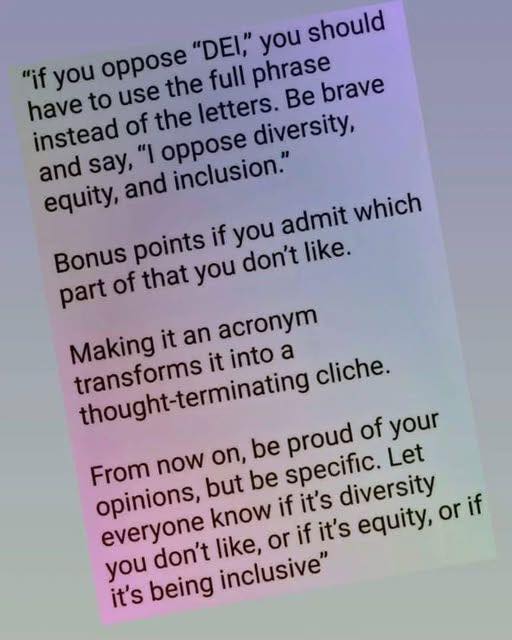
At the University of Michigan, A Controversy Reveals Dishonesty and Hypocrisy Underlying the DEI Fad

If Donald Trump accomplishes nothing more in his next four years than ending the nation’s tolerance to open borders while fawning over “good illegal immigrants” and driving a metaphorical stake through The Great Stupid’s DEI fad, electing him will have been worth all chaos that will come along with it.

DEI thrives as a hypocritical way to discriminate against white men and shift to a society based on rewarding achievement, diligence and ability to one based on group membership. That makes it un-American to the core. At the University of Michigan, the “director of the university’s office of academic multicultural initiatives”—you know, DEI—spoke out at a conference of such officers the university to opine that her university was “controlled by wealthy Jews and that because Jewish students are “wealthy and privileged” the don’t need diversity services. “Jewish people have no genetic DNA that would connect them to the land of Israel,” Rachel Dawson was quoted as saying.

Continue reading

Ethics Quote of the Week: Megyn Kelly

“Like maybe don’t say the laptop can’t be verified when it can,” she said, referring to Stahl’s response to the Hunter Biden laptop. How are you a journalist if you don’t want to follow up on that story? And then when your own organization verifies it, come out and do a mea culpa and admit you embarrassed yourself. Maybe don’t stealth edit the presidential candidate interview with ’60 Minutes,’ your flagship program that you’re an anchor of, without telling us, and then when it becomes a controversy, refuse to release the transcript because you’re more interested in running cover for the Dems than you are in honest reporting. Maybe don’t host a vice-presidential debate where you fact-check only one side. And then when your fact-check gets fact-checked by the vice-presidential candidate on the Republican side, you cut his mic…”

—Megyn Kelly, who has become considerably more quotable since abandoning news broadcasting for her podcast, responding to Leslie Stahl’s lamenting that “legacy media” media may be dying, that it’s all Donald Trump’s fault, and that she doesn’t know what to do about it. “I have some suggestions,” Kelly began.

Megyn was just riffing off the top of her head, of course. She could have gone on and on, as could I.

What do you call the insistence of Axis media defenders that while they may make “mistakes” (doesn’t everyone?) our journalists are noble, hard-working, objective truth-tellers who deserve our trust and respect? What is that? Denial? Delusion? Gaslighting? Outright lying? Insanity? Blindness? Stupidity? What?

What is the difference in effect between a state-run press, which is what the Founders devised the freedom of the press to prevent, and news media that voluntarily aligns itself with a single party and ideology and abuses its special status to manipulate the public, society, and elections?

Answer: There isn’t any.

Continue reading