Prelude.
Well, here I am again, starting off the Ethics Alarms day with a post related to politics and government. This is not a political blog, and I strive mightily to prevent it from being one. However, I cannot operate an ethics information and analysis site that fulfills (or, to be realistic, attempts to fulfill) the mission I have set for it and ignore massive, serious, indeed historic events and issues that have ethics principles not only at their core, but at risk because of them.
Those who have followed Ethics Alarms for the past decade know that I had made up my mind to vote for Hillary Clinton in the 2016 election because I had concluded that Donald Trump lacked literally every character trait, instinct and qualification that my study of leadership and the American Presidency had taught me that a U.S. President must have. I knew that Hillary Clinton and, of course, her husband were corrupt, dishonest and untrustworthy, but I also knew that she had the intellectual ability and at least some of the experience necessary to handle the job. I wrote dozens of posts about how unfit Donald Trump was, and that doesn’t take into account the Trump critiques I had written years before he had announced his candidacy in 2015.
Then, mere weeks from the election, I realized that the Democratic Party had rigged the nomination process to ensure Clinton’s victory, and that Clinton and the Democratic Party were ready, willing and eager to cheat in order to obtain power. How far that party (and the rotted news media that conspired with it) would go, as we now know, was fully revealed over the next eight years.
I decided, a couple of days before I had to vote, that it was a choice between an unfit candidate—Trump—and a dangerous, anti-democratic party ironically called the Democratic Party. I voted for neither as a matter of principle. I found myself surprised when my emotional reaction to Trump’s stunning upset was relief. The American system had, once again, gotten lucky. The public had recognized what I had, though almost too late, recognized myself.
An arrogant, elite, ruthless political party had the culture, society and government by the throat, and by a miraculous confluence of unlikely and indeed accidental events, had been at least temporarily foiled. It was a result that I analogized to the “futile and stupid” rebellion of the Deltas in the finale of “Animal House,” when the expelled Faber College students demonstrated their contempt for the system that had mistreated them by disrupting a parade and humiliating those in power.
And, memorably, the most chaotic of the rebels ended up a U.S. Senator.
The next four years proved my analysis of the Democratic Party correct, in fact too generous. It marshaled its allies in the news media, education, the law, the judiciary, academia, Big Tech, the federal bureaucracy and, of course the news media to launch what I have tagged as “the 2026 Post Election Ethics Train Wreck,” denying an elected U.S. President the mantle of legitimacy as well as the basic deference, respect, honor and cooperation a POTUS must have to carry out his agenda and policies. This divided the country to a dangerous extent. It set terrible precedents that I concluded, correctly, would damage the office and the future functioning of democratic institutions.
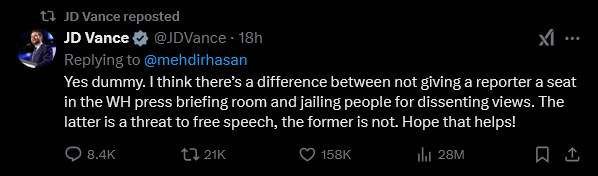
Worst of all, perhaps—it is a close competition—I saw an entire political party representing a large proportion of the public actively seeking to weaken and distort the First Amendment, the metaphorical beating heart of the unique structure our Founders created. This was (and is) a party that not only supports but relies upon a journalistic establishment that does not keep the public informed, but rather seeks to manipulate it by withholding information and employing partisan bias and advocacy in what are supposed to be objective news reports. This mutated Democratic Party also endorses censorship, using the usefully vague terms “hate speech” and “misinformation” to justify quashing dissenting views, opinions and analysis that the party deems a threat to its primacy.
Continue reading →


 Ethics Alarms