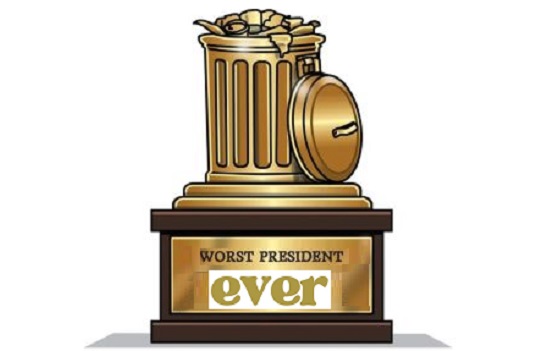
If you want to review how we got here, these were the previous posts in “The Worst President Ever?”: Part I, Part 2, Part 3, Part 4, Part 5, and a month ago, Part 6. Right now, the final field stands at eight, which is more than I wanted and a number that surprised me, especially since I disqualified one of the conventional wisdom favorites for Bad President infamy, Warren G. Harding. But poor Harding only was President for 2 and a half years, dying of a heart attack in August of 1923. He still had some good moments, and what he has always been marked down for is scandals in his cabinet that didn’t come to light until after he died. Like the other Presidents who didn’t serve a full term (W.H. Harrison, Taylor, Garfield, Chester A. Arthur, Andrew Johnson and Gerald Ford), Harding never had a fair chance to distinguish himself (although Chester A. Arthur managed to do well in fewer than four years), so I felt it wasn’t ethical to include Warren in the Presidential Hall of Shame.
With that calculation, I realize that the field of eight must in fairness be reduced to seven. As I just mentioned, Andrew Johnson is one of the Presidents who didn’t get the opportunity to serve a full term. Yes, he only missed 41 days, but as the ghost of any President will tell you, a lot can happen in 41 days, good and bad. I think I may have been biased by the fact that when I first began studying the U.S. Presidency, literally everyone was taught that of course Johnson was the worst President: after all, he was the only President who was impeached! John Fitzgerald Kennedy while Senator helped the public understand that the impeachment was not as damning as widely believed by making Edmund Ross, the Republican Senator from Kansas who saved Johnson from conviction, one of his “Profiles in Courage”; still the stain of impeachment by the House hung like a black cloud over the first President Johnson. That cloud began dispersing a bit when Richard Nixon had to resign, a bit more after Bill Clinton was impeached (on stronger grounds than Johnson) and beat the rap as well as managing to remain a rock star in his party until that sexual predator thingy belatedly caught up with him. Then Nancy Pelosi’s Democrats managed to eliminate impeachment as a brand of disgrace by abusing the process with two purely partisan impeachments during Donald Trump’s first term. Johnson’s impeachment doesn’t look so damning now, and he didn’t get a full term in office. I am revoking his selection as a candidate for The Worst President.

 Ethics Alarms
