This Is How My Late Wife Grace Handled the Euthanizing of a Dog…

Some of the comments on this post compel me to cross-post the following story from Facebook, as I continue to try to deal with the sudden loss of my wife on Leap Year. The contrast with Kristi Noem’s cruel and impulsive shooting of a young dog that displeased her didn’t occur to me for some reason until I read the recent posts of readers here.

Today I was driving home from the vet’s with Spuds and his newly drained ear, and “I Will,” Paul’s sweet little song from the White Album came on the radio. (“Who knows how long I’ve loved you…”)

Grace envied singers and always wanted to sing herself, but was convinced that she couldn’t…I tried to tell her that she didn’t have a bad voice and should take some coaching, but she wouldn’t do it. When she wanted to sing, only with me, she deliberately used a fake voice, either a high falsetto or sometimes a weird guttural voice that sounded eerily like Pazuzu in “The Exorcist.”

Grace shared her mother’s and oldest sister Edie’s deep connection to animals: all three loved them so much the animals could sense it. If one of our dogs or Kibber the cat had some wound or problem to be tended to, they would only let Grace do it: it was almost mystical.

When our beloved 160 lb. English Mastiff, Patience, had her cancer return in her seventh year (Grace paid $12,000 for her treatment when the cancer first appeared and didn’t tell me for years…I didn’t mind: Patience was worth it, and it bought her another year), the sweet, sensitive dog was so brave…she had no appetite and was fading away, but she always wagged her huge tail when Grace came near. One day, as we knew Patience was running out of time, I returned from an errand to find Grace lying on the floor with her head at Patience’s ear. She was singing softly in her real voice, “I Will” to Patience as the dog slowly wagged her tail. Grace had tears pouring down her face, and pretty soon, so did I.

Over the next few days, Grace sang that song to Patience every time she seemed uncomfortable or agitated, usually beginning with, “Don’t be afraid!” and then, softly, “Who knows how long I’ve loves you…” And Patience would look into her eyes, and wag.

Three days later, we called a vet who made house visits to come and end our dog’s suffering. We probably waited too long. Patience had to tell us it was time by wandering out of our back yard down the hill into the bamboo; I had to persuade her to come back. She had gone off to die. As the vet fed the fatal drug into the vein in Patience’s leg, Grace was lying right by Patience’s side with her arm around her. She sang “Who knows how long I’ve loved you” until that big tail stopped, and Patience was gone.

I’m so glad that Grace never heard the Kristi Noem story.

“Bias Makes Harvard Incredibly Stupid,” the Series! Today’s Episode: “The Law of Holes”

One of the downsides of denouncing my alma mater is that I only hear about its latest unethical conduct when the story imposes itself on my consciousness or when the alumni magazine arrives, usually containing news that it a month old or more. I was going to write about the last two, post-Claudine Gay presidency issues, which were fascinating as exercises in denial, spin, and self-delusion: the framing of Harvard’s most recent debacle was essentially that “something happened” to Old Ivy, you know, like an earthquake or a plague of frogs. These are supposed to be smart people. Instead, America is auditing a Harvard course on just how stupid bias can make us. Well, that’s a lot more useful than a lot of Harvard courses now.

But even I didn’t see this coming: I didn’t think Harvard could be this stupid. I really didn’t; when I saw this headline in the Washington Free Beacon, my first thought was that I had hit the Babylon Bee on an unfunny day. No, not only was it true, the story was two weeks old.

As the Harvard Crimson had announced on April 16, Vivian Hunt (seen here in a student production of “The Handmaiden’s Tale” or something—I don’t know what the hell she’s wearing or why, but it’s weird)…

… is the newly appointed head of the Harvard Board of Overseers. Hunt is a Harvard College alum, female, black, a likely affirmative action success, and a vocal DEI activist, even more of one, arguably, than disgraced ex-prez Claudine Gay.

Hunt is nearly “patient zero” for the DEI plague. In 2015 she co-authored the McKinsey consulting firm’s influential and dishonest paper, “Why diversity matters,”based on data that has recently been shown to be junk as many (like me) long suspected. She has vigorously argued that meritocracy “isn’t good enough” and urged the private sector to hire based on color and gender rather than that old-fashioned, busted, racist, “talent, ability, and demonstrated success” formula.

Continue reading

Time for Some Ethical Clarity Regarding the Hamas-Israel War…

1. Advocating for Gaza or Gazans is advocating for Palestinians and Hamas.

2. Advocating for Palestinians and Hamas is advocating anti-Semitism and genocide—of Jews.

3. Advocating for Palestinians and Hamas is also advocating for, rationalizing , enabling and encouraging terrorism.

4. Any public statements from President Biden or his administration critical of Israel’s handling of the war helps achieve Hamas’s objectives. Helping to achieve Hamas’s objectives as a consequence of its terrorist attack validates the use of terrorism as a means of achieving Palestinian ends.

Continue reading

Ethics Quote of the Week: David Marcus

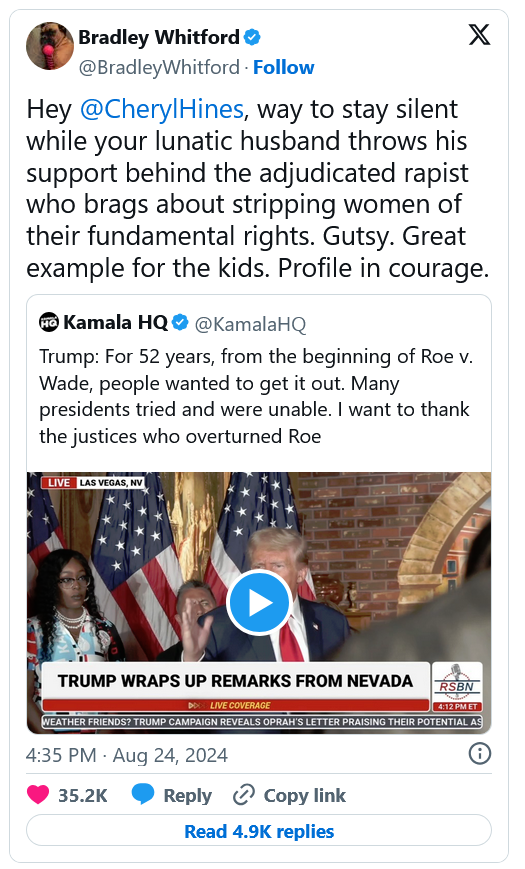
Marcus is an American entrepreneur. His depressing but revealing (though hardly surprising quote is in this tweet, which also relates nicely to the previous post:

Hey Douthat! How About Coming Right Out and Stating That U.S. College Students Are Indoctrinated into Radical, Progressive, Marxist Ideology?

Talk about burying the lede.

Sort-of conservative New York Times columnist Ross Douthat issued what might have been a useful column, What Students Read Before They Protest, about the reasons why students at Columbia and other “elite” educational institutions are demonstrating in favor of Hamas, terrorism, anti-Semitism, and wiping Israel off the face of the earth. But Douthat, who can write clearly and forcefully when he wants to (or, I suppose, when his woke and biased editors let him) instead buries his own objective in foggy rhetoric, Authentic Frontier Gibberish and equivocation to such an extent that 1) few will have the patience to read it and 2) the importance of his point is diluted and lost.

This is how Jonathan Turley used to write until he was red-pilled.

Continue reading

“Nah, There’s No Mainstream Media Bias!” For Some Strange Reason, Sayeth the NYT, Trump Doesn’t Trust Our Intelligence Agencies…

Wow, what could possibly account for that? The man is paranoid!

I missed “Campaign Puts Trump and the Spy Agencies on a Collision Course” in the Times two weeks ago. Fortunately a non-Ethics Alarms-reading friend sent me this column by the usually astute and trustworthy Holman Jenkins at the Wall Street Journal. (Aside: I continue to wonder why so few of my friends and long-time associates read this blog, and none of my family members. It must be me, or as one friend who does read Ethics Alarms once said in a moment of self-doubt, “All my best friends hate me.”) His assessment of the significance of the piece tracks exactly with mine, and he seems to be coming from a similar point of view: he doesn’t have any illusions about Donald Trump, but he still finds the Times’ dishonest and biased coverage of him since Trump’s election despicable. Except this one initial arch comment—Gee, imagine not trusting intelligence agencies!—I’ll leave the commentary to Jenkins with a few footnotes from me:

Continue reading

Encore: From “The Law vs Ethics Files: The July 24, 1983 Pine Tar Incident, When Baseball Chose Ethics Over Law, And Was 100% Wrong

Several things led me to re-posting this Ethics Alarms entry from 2017.

First of all, the MLB network showed a documentary on the career of George Brett today, and scene above, with Brett erupting in fury at the umpire’s call voiding his clutch, 9th inning home run, is one of the classic recorded moments in baseball history. There was also a recent baseball ethics event that had reminded me of Brett’s meltdown: Yankees manager Aaron Boone was thrown out of a game because a fan behind the Yankees dugout yelled an insult at the home plate umpire, and the umpire ejected Boone thinking the comments came from him.. When Boone vigorously protested that he hadn’t said anything and that it was the fan,Umpire Hunter Wendelstedt said, “I don’t care who said it. You’re gone!”

Wait, what? How can he not care if he’s punishing the wrong guy?

“What do you mean you don’t care?” Boone screamed rushing onto the field a la Brett. “I did not say a word. It was up above our dugout. Bullshit! Bullshit! I didn’t say anything. I did not say anything, Hunter. I did not say a fucking thing!” This erudite exchange was picked up by the field mics.

There was another baseball ethics development this week as well, one involving baseball lore and another controversial home run. On June 9, 1946, Ted Williams hit a ball that traveled a reported 502 feet, the longest he ever hit, and one of the longest anyone has hit. The seat was was painted red in 1984 (I’ve sat in it!), and many players have opined over the years that the story and the seat are hogwash, a lie. This report, assembling new data about the controversy, arrives at an amazing conclusion: the home run probably traveled farther than 502 feet.

But I digress. Here, lightly edited and updated, is the ethics analysis of the famous pine tar game and its aftermath:

***

 I have come to believe that the lesson learned from  the pine tar incident is increasingly the wrong one, and the consequences of this extend well beyond baseball.

On July 24, 1983, the Kansas City Royals were battling the New York Yankees at Yankee Stadium. With  two outs and a runner on first in the top of the ninth inning,  Royals third baseman George Brett hit a two-run home run off  Yankee closer  Goose Gossage to give his team a 5-4 lead.  Yankee manager Billy Martin, however, had been waiting like a spider for this moment.

Long ago, he had noticed that perennial batting champ Brett used a bat that had pine tar (used to allow a batter to grip the bat better) on the handle beyond what the rules allowed. MLB Rule 1.10(c) states: “The bat handle, for not more than 18 inches from the end, may be covered or treated with any material or substance to improve the grip. Any such material or substance, which extends past the 18-inch limitation, shall cause the bat to be removed from the game.” At the time, such a hit was defined in the rules as an illegally batted ball, and the penalty for hitting “an illegally batted ball” was that the batter was to be declared out, under the explicit terms of the then-existing provisions of Rule 6.06.

That made Brett’s bat illegal, and any hit made using the bat an out. But Billy Martin, being diabolical as well as a ruthless competitor, didn’t want the bat to cause just any out. He had waited for a hit that would make the difference between victory or defeat for his team, and finally, at long last, this was it. Martin came out of the dugout carrying a rule book, and arguing that the home run shouldn’t count.  After examining the rules and the bat, home-plate umpire Tim McLelland ruled that Brett used indeed used excessive pine tar and called him out, overturning the home run and ending the game.

Brett’s resulting charge from the dugout (above) is video for the ages. Continue reading

Addendum to “The Supreme Court, the ‘Suicide Pact,’ and Ethics Zugzwang”

Thinking about that last post and the issues it raises as I was walking Spuds in the rain just now took me to an epiphany, and an embarrassingly late one.

Gerald Ford’s pardon of Richard Nixon was more important and crucial than I realized then. It was only one gutsy and maybe prescient act in an otherwise short and undistinguished Presidency, but it delayed the current crisis for half a century.

The conventional wisdom is that Nixon would have been prosecuted for his Watergate involvement, and that the event would have been a divisive and traumatic spectacle that a nation just getting past the Vietnam debacle could ill afford. That wasn’t what was going to happen, though, I now realize. (And I have never read or heard anyone acknowledge this.)

Had he been charged with any crime, Nixon would have immediately claimed immunity just as Trump is now. For the rest of his life, Nixon routinely said that “if the President does it, it’s not illegal.” What would the Supreme Court have ruled in 1975? Here is the Court then:

Chief Justice Warren Burger
William J. Brennan
Potter Stewart
Byron White
Thurgood Marshall
Harry Blackmun
Lewis F. Powell
William H. Rehnquist

The only two reliable liberals on the Court were Marshall and Brennan, but the conservatives were more moderate and less doctrinaire than today’s SCOTUS majority. I have no idea what that group would have done with the immunity issue, and I’m glad we didn’t have to find out.

Thanks, Jerry.

The Supreme Court, the “Suicide Pact,” and Ethics Zugzwang [Corrected]

I confess, I didn’t expect the U.S. Supreme Court to give Donald Trump’s Presidential immunity claim as serious a hearing as it did in last week’s oral arguments. Now that I read the transcript, however, I understand “what’s going on here,” to quote my own starting point for ethics analysis. Its focus, or at least the focus of the conservative members of the Court, is appropriate considering the current assault on our system of government by the totalitarian Left as it tries to use the criminal laws, the courts, and partisan prosecutors to prevent the public from throwing them out of office.

Naturally the Left is furious, and is attacking the justices. The attack isn’t based on legal reasoning, but the same tactic progressives and Democrats used to claim that SCOTUS had “stolen” the 2000 election by finally ruling that enough was enough, and that it was time to settle the identity of the leader of the nation and not paralyze the government fighting over an election with a filament thin edge within the margin of statistical error. The Bush v. Gore ruling was an example of one of the core functions of the Supreme Court as it has evolved: stepping in to guide the Constitution and the nation through unanticipated situations the Founders never considered or prepared for. But Democrats attacked Justice Scalia and the other conservative justices for defying their own guiding principles—“textualism” and “originalism,” the idea that the Constitution should not be extrapolated into new areas never anticipated or discussed in the original document. That judicial philosophy is a conservative bulwark against the arrogant and excessive “legislation from the bench” that marked the Warren Court in the Sixties, and to a lesser extent its predecessor in the Seventies, the Burger Court, the latter most infamously in the purely political Roe decision, finding a right to abortion in a document that didn’t hint of such a thing.

After hearing the oral argument in Trump v. U.S. and detecting signs that some of the Justices on the rightish side of the ideological spectrum agreed that some kind of Presidential immunity might be prudent and even essential, the Axis howled. “Two years ago, conservatives relied on a strict interpretation of the Constitution’s text and original meaning to overturn the federal right to abortion. But on Thursday, as they debated whether Trump can be prosecuted for his bid to subvert the 2020 election, they seemed content to engage in a free-form balancing exercise where they weighed competing interests and practical consequences,” whined Politico. “Some critics said the conservative justices — all of whom purport to adhere to an original understanding of the Constitution — appeared to be on the verge of fashioning a legal protection for former presidents based on the justices’ subjective assessment of what’s best for the country and not derived from the nation’s founding document.”

Translation: “The judges we support do this all the time and we think it’s wonderful, but these bad judges can’t do it no matter how much sense it makes because they have made it clear that they generally disapprove of the practice.”

Continue reading

Well, So Much For the PETA Vote!

To many analysts, South Dakota governor Krtisti Noem checked all the right boxes to be Donald Trump’s running mate. She’s a hard-right conservative, a successful and popular governor, an effective speaker, attractive, and a woman. (I must interject here that I find it just a bit hypocritical that the GOP, as it derides and condemns the diversity fad as it makes tribal membership more important than merit, skill, competence and experience, that Trump is almost certainly going to choose a woman or a black man as his VP. The least he could do to defy the Left is pick a Jew…). Noem seemed to be leading the race to be Trump’s second-in-command, in the view of many experts.

And then, as Frank and Nancy would say, she went and spoiled it all by saying something stupid like ‘I shot my dog because I couldn’t be bothered to train it.’

“Ethics Dunce” doesn’t adequately describe what Noem’s new book “No Going Back: The Truth on What’s Wrong with Politics and How We Move America Forward,” which will be released in May, reveals about her. Yes, she’s notably missing some key ethics alarms and some pretty basic ones at that, like “Be kind to animals, because they are innocents,” one of my late wife’s mantras. Noem is also, however, lacking in basic understanding of public sensibilities and has the political instincts of a Kamikaze pilot.

“I guess if I were a better politician I wouldn’t tell the story here,” Noem wrote after detailing the horrible story of how she lured “Cricket,” a 14-month old wire-haired pointer, to a gravel pit and shot her because the dog had failed her first pheasant hunting attempt. This wasn’t “Old Yeller”: Cricket wasn’t sick, or dangerous, or old. Cricket, as Noem’s account makes clear, just hadn’t been trained….you know, like Joe Biden’s “bad” German Shepherd, Commander.

Continue reading